

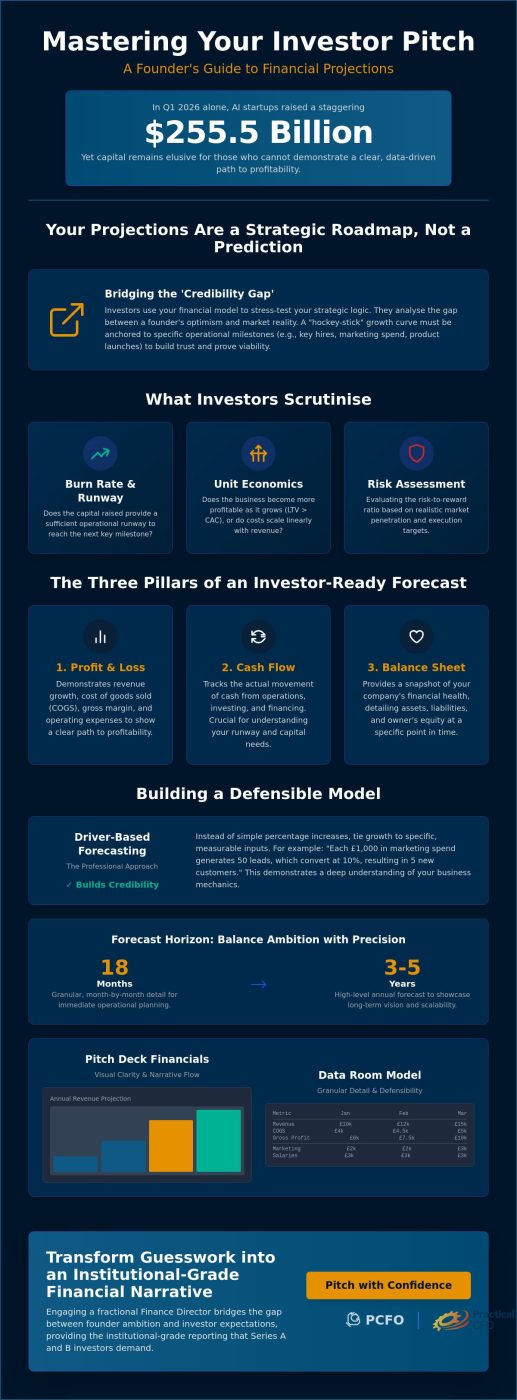
In the first quarter of 2026, AI startups raised a staggering $255.5 billion, yet capital remains elusive for those who cannot articulate their value through data. You may have a revolutionary product, but mastering how to present financial projections to investors is what separates a visionary idea from a viable, fundable business. Investors today are increasingly disciplined, demanding clear unit economics and a transparent path to profitability amidst a higher for longer interest rate environment.
It’s natural to feel a sense of trepidation when preparing to defend a three-year forecast against the scrutiny of a seasoned venture capitalist. You likely recognise that a pitch deck is only as strong as the strategic logic it rests upon, and the fear of appearing unprepared during a rigorous Q&A session is a challenge many founders face. Building a model that is both ambitious and defensible requires a level of fiscal maturity that can feel daunting to navigate alone.
This guide provides the strategic framework you need to pitch with confidence and secure the funding your business deserves. We will outline how to transform complex business models into a clear, professional narrative, ensuring you can justify every assumption with the composure of an experienced financial partner. By the end of this article, you will have the tools to build investor trust and demonstrate a sophisticated command of your company’s future trajectory.
Key Takeaways
- Recognise that your financial projections serve as a quantitative roadmap of your business strategy, allowing investors to stress-test your underlying logic.
- Master how to present financial projections to investors by focusing on driver-based forecasting rather than simple percentage increases to build immediate credibility.
- Learn how to balance visual clarity in your pitch deck with the granular detail required in your data room to maintain a steady narrative flow.
- Prepare for the rigours of the Q&A session by identifying common objections and understanding when a measured follow-up is better than an uncertain answer.
- Discover how engaging a fractional Finance Director can transform founder guesswork into the institutional-grade reporting that Series A and B investors expect.
The Strategic Purpose of Financial Projections in an Investor Pitch
Financial projections are often misunderstood as a simple exercise in predicting the future. In reality, they serve as a quantitative roadmap of your business strategy. When you learn how to present financial projections to investors, you aren’t just showing them where you expect to be; you’re demonstrating how you intend to get there. A robust financial forecast acts as the mathematical proof of your business narrative, translating abstract goals into tangible, measurable numbers.
Investors rarely expect your figures to be perfectly accurate three years from now. Instead, they use your model to test your strategic logic. They are looking to identify the ‘Credibility Gap’, which is the space between a founder’s natural optimism and the hard financial reality of the market. If your deck shows a “hockey-stick” growth curve without being backed by specific operational milestones, you risk losing trust. Every significant jump in revenue must be anchored to a corresponding event, such as a key hire, a specific marketing spend increase, or a product launch.
Why Investors Scrutinise Your Forecast
Investors look beneath the surface to assess your grasp of unit economics and scalability. They want to see that your business scales efficiently. This means your customer acquisition costs (CAC) must stay sustainable whilst your lifetime value (LTV) grows. Scrutiny also focuses on several critical areas:
- Burn Rate and Runway: Ensuring the capital you’re raising provides a sufficient operational runway to reach the next milestone.
- Unit Economics: Testing if the business becomes more profitable as it grows, or if costs scale linearly with revenue.
- Risk Assessment: Evaluating the risk-to-reward ratio based on realistic market penetration targets.
The Difference Between a Budget and a Pitch Forecast
It’s vital to distinguish between an internal budget and a pitch forecast. Whilst budgets are designed for operational control and cost management, a pitch forecast is built to showcase potential and scalability. You must balance conservative operational planning with the ambitious growth story that venture capitalists expect to see.
When considering how to present financial projections to investors, remember that your financial story must align perfectly with your marketing and sales narrative. If your pitch deck promises a rapid expansion into European markets, your projections must reflect the associated recruitment costs, local tax implications, and slower initial conversion rates. This alignment demonstrates that you’re a steady, experienced hand capable of navigating the complexities of a scaling business. It’s this level of detail that bridges the gap between founder guesswork and institutional-grade reporting.
The Three Pillars of an Investor-Ready Financial Forecast
A credible pitch rests on more than just high numbers. It requires an integrated financial model where your Profit and Loss, Cash Flow, and Balance Sheet speak the same language. If your projected revenue grows but your cash position doesn’t reflect the timing of payments, investors will immediately spot the inconsistency. When learning how to present financial projections to investors, you must move beyond simple percentage increases. Professional models use ‘driver-based’ forecasting, where growth is a direct result of specific inputs like marketing spend or sales headcount.
Whilst your total horizon should span three to five years, the first 18 months require granular, month-by-month detail. This level of precision shows you understand the immediate operational hurdles of scaling. Developing robust financial projections involves more than just a single ‘base case’ scenario. Investors expect to see sensitivity analysis that accounts for market volatility and shifting interest rates.
Pillar 1: The Revenue Model and Unit Economics
Your revenue model should clearly distinguish between recurring SaaS revenue and one-off transactional income. Investors prioritise predictable growth, so you must demonstrate a deep understanding of your Customer Acquisition Cost (CAC) against the Lifetime Value (LTV) of that customer. Even if the business is currently loss-making, your projections must illustrate a definitive path to profitability as you achieve economies of scale.
Pillar 2: Cash Flow and the ‘Funding Ask’
Cash is the lifeblood of any startup. You need to calculate your monthly burn rate accurately to identify your ‘Zero Cash Date’. This informs your ‘funding ask’, which should be justified by a clear deployment plan. For instance, you might allocate 40% of the funds to engineering and 60% to marketing. Presenting your runway clearly ensures investors know exactly when the next funding round will be necessary. If you need assistance refining these figures, our Chief Financial Officer Services can provide the strategic oversight required for institutional-grade reporting.
Pillar 3: Key Assumptions and Scenario Planning
Assumptions are the most important part of the entire model. You must document the ‘levers’ of your business, such as churn rates and hire dates, to show what actually moves the needle. A single ‘Base Case’ is rarely sufficient; you must include a ‘Downside Scenario’ to show you have a plan if growth slows or market conditions change. This proactive approach to risk management builds significant trust during the due diligence process.
Step-by-Step: How to Present Financial Projections in Your Slide Deck
Your pitch deck serves as the visual narrative of your financial model. Whilst your underlying spreadsheet contains thousands of cells, your slides must communicate the strategic essence of those numbers. When considering how to present financial projections to investors, clarity always trumps complexity. You must distinguish between the ‘Summary Slide’, designed to hook interest, and the ‘Data Room’, where the granular due diligence occurs. Overloading a slide with a full P&L table is a common mistake that distracts from your core message and invites unnecessary technical detours during a limited pitch window.
Adhering to the ‘Rule of Three’ ensures your audience remains focused on what matters most. Each slide should convey no more than three key takeaways. For instance, you might focus on your revenue trajectory, your operational efficiency, and your path to cash-flow breakeven. Charts are excellent for visualising long-term trends and growth curves, whilst small, precise tables should be reserved for highlighting specific annual totals. This balance allows investors to grasp the scale of the opportunity at a glance without feeling overwhelmed by raw data. Your ‘Ask’ slide shouldn’t be a surprise; it should feel like the logical conclusion of the financial data shown previously.
Designing the Financial Summary Slide
A well-designed financial summary slide prioritises three primary indicators: Revenue, EBITDA, and Headcount. These metrics provide a snapshot of your growth, profitability, and organisational scale. If your forecast includes significant jumps, use ‘Call-out Boxes’ to provide immediate context, such as the launch of a new product line or entry into a new territory. It’s vital to maintain a clean, professional colour palette that reflects corporate authority. This composed aesthetic helps the investor focus on the strategic narrative rather than being distracted by inconsistent formatting or cluttered visuals.
Mapping Financials to Milestones
Investors need to see the direct relationship between their capital and your company’s progress. Overlaying your financial charts with operational milestones, such as ‘UK Market Entry’ or ‘V2 Launch’, provides this essential context. This visual approach shows how the capital infusion directly accelerates your timeline and brings the business closer to its objectives. When you show how to present financial projections to investors through the lens of milestones, you help them visualise the return on investment. This clarity is what builds the confidence needed to move from a pitch to a successful funding round.
Defending Your Data: Mastering the Investor Q&A Session
Mastering the Q&A session is the final hurdle in understanding how to present financial projections to investors. This stage is where venture capitalists move beyond the polished narrative to perform a rigorous ‘stress test’ on your underlying logic. They want to see how your business model behaves under pressure. A common mistake is to treat these questions as a personal challenge. Instead, you should view them as a strategic opportunity to demonstrate your operational maturity and intellectual rigor.
When an investor asks a technical question that requires a specific data point you don’t have to hand, “I’ll get back to you with the exact figure” is a valid and professional response. It shows you value accuracy over guesswork. Conversely, a simple “I don’t know” suggests a lack of preparation and can be a significant red flag. To avoid this, always prepare a ‘Supplement Appendix’ containing detailed breakdowns of your cost of goods sold, marketing spend, and hiring plan. This allows you to provide deep-dive data without cluttering the main deck.
Common ‘Grilling’ Questions and How to Answer Them
Investors often use specific ‘trap’ questions to see if you’ve truly mastered your unit economics. You should prepare responses for scenarios such as:
- “Your CAC seems too low for this industry; how did you calculate it?” Be ready to break down your blended customer acquisition costs across different channels and explain your organic growth assumptions.
- “What happens to your cash flow if your sales cycle doubles in length?” This tests your understanding of working capital. Refer back to your sensitivity analysis to show you’ve planned for delayed revenue and identified potential cash pinches.
- “Why is your overhead growing faster than your revenue in Year 3?” Usually, this indicates a period of aggressive scaling or infrastructure investment. Explain the strategic intent behind this ‘investment year’ and how it sets the stage for future profitability.
The Psychology of Reassurance
Your composure during this session is just as important as the data itself. Using professional, measured language to admit risks whilst presenting clear mitigations builds immense trust. When learning how to present financial projections to investors, remember that transparency about historical performance versus future targets is a strength, not a weakness. It shows you are an embedded advisor who is invested in the long-term trajectory of the business.
Having a Finance Director present during the pitch provides a ‘second voice’ of authority. This presence signals to investors that your financials are under the stewardship of a seasoned professional. It transitions the conversation from founder optimism to institutional-grade reality. If you want to ensure your pitch stands up to this level of scrutiny, our Finance Director Services can help you prepare a defensible, high-growth model that commands respect in the boardroom.
Leveraging a Fractional FD to Bridge the Credibility Gap
A founder’s vision is the engine of a startup, but the financial model is its navigation system. For many entrepreneurs, the jump from Seed to Series A or B reveals a significant ‘Credibility Gap’ in their pitch. Investors at these stages aren’t just buying into a product; they’re investing in the fiscal governance of the organisation. Engaging a seasoned finance director acts as a powerful signal to the market. It demonstrates that you’ve transitioned from founder guesswork to institutional-grade financial reporting, providing the intellectual rigour that venture capitalists demand.
When you specialise in your product, you shouldn’t be expected to also specialise in complex financial architecture. An outsourced CFO manages the intense due diligence process, ensuring every cell in your model is defensible. This allows you to focus on the vision whilst we handle the technical scrutiny. We position your business as a professional, low-risk investment by ensuring your projections are both ambitious and achievable. Mastering how to present financial projections to investors becomes far simpler when you have a strategic partner who has sat on both sides of the boardroom table.
The ROI of Professional Financial Oversight
Professional oversight reduces the perceived risk for investors significantly. Having a seasoned FD in the room provides a steady hand during high-stakes negotiations, alleviating the anxieties of potential backers. We ensure the financial model is robust enough to survive the most rigorous due diligence phase, preventing deal-breaking inconsistencies from surfacing at the eleventh hour. This partnership provides immediate solutions to organisational gaps and frees up your time to focus on business growth advisory and forging the strategic partnerships that drive real-world traction.
How PCFO Supports Your Funding Journey
PCFO supports your journey by building a bespoke, driver-based model from the ground up that adapts to your specific business lifecycle. We don’t just hand over a spreadsheet; we coach you on how to present financial projections to investors with absolute confidence. Our role extends beyond the successful funding round. We provide ongoing, board-level financial advice to help you manage the capital once it’s raised, ensuring you meet the milestones promised in your deck. This proactive mindset ensures your business remains future-proofed and ready for its next stage of evolution, whether that is further scaling or an eventual exit.
Securing Your Strategic Future
Mastering the narrative behind your numbers is the final step in preparing for a successful funding round. By treating your forecast as a strategic roadmap rather than a set of predictions, you demonstrate the operational maturity that professional investors demand. You now understand that a driver-based model, supported by a clean slide deck and a well-prepared Q&A strategy, is essential for building long-term trust. Knowing how to present financial projections to investors with this level of rigour ensures your business is viewed as a sophisticated, institutional-grade opportunity.
At PCFO, we provide expert Finance Director services for growing UK SMEs, specialising in strategic business planning and exit support. Our team acts as your authoritative strategic partner, offering reassuring, board-level financial leadership throughout your growth lifecycle. We ensure your model is robust enough to survive the most intense due diligence. Secure your next funding round with professional CFO-backed financial projections from PCFO.
It’s your vision that drives the business, and the right financial architecture ensures that vision is heard. You’re now ready to approach the boardroom with absolute composure and secure the investment your company deserves.
Frequently Asked Questions
What is the most important financial metric investors look for?
Investors typically prioritise unit economics, specifically the ratio of Customer Lifetime Value (LTV) to Customer Acquisition Cost (CAC). This metric demonstrates whether your business model is fundamentally profitable at scale. Whilst top-line revenue growth is attractive, professional backers want to see that you aren’t simply buying growth at an unsustainable price. Clear unit economics provide the reassurance that your company becomes more efficient as it expands.
How many years of financial projections should I include in my pitch deck?
You should include three to five years of data when learning how to present financial projections to investors. The first 18 months must be granular and presented on a month-by-month basis to show immediate operational control. The subsequent years can be summarised quarterly or annually. This structure balances short-term tactical planning with the long-term strategic vision required to justify a venture-scale investment.
Should I present a ‘best-case’ or ‘conservative’ forecast to investors?
You must present a realistic ‘Base Case’ supported by a sensitivity analysis that includes a ‘Downside Scenario’. Presenting only an overly optimistic best-case forecast often undermines your credibility. Investors prefer to see that you have considered market volatility and have a plan for slower growth periods. This proactive approach to risk management shows you are a steady, experienced hand at the helm of the company.
How do I justify a high valuation if my business isn’t yet profitable?
Justifying a high valuation without current profit requires focusing on your revenue growth rate, market share potential, and the strength of your intellectual property. You should demonstrate how the capital infusion will accelerate you toward key milestones that trigger value inflection points. Investors often use revenue multiples based on your sector’s benchmarks, so your projections must show a clear, data-backed trajectory toward those future earnings.
What is the difference between a top-down and bottom-up revenue forecast?
A top-down forecast estimates revenue based on capturing a percentage of the total market, whilst a bottom-up forecast builds revenue from specific operational drivers like sales headcount and conversion rates. Bottom-up models are significantly more credible in a pitch setting. They show you understand the direct relationship between your activities and your results, rather than relying on vague market generalisations that rarely materialise.
Do I need a full-time CFO to present my financial projections?
You don’t need a full-time CFO to present your financials effectively, but a fractional Finance Director is often the ideal solution for growing SMEs. A fractional FD provides the institutional-grade reporting and board-level authority needed for Series A and B rounds without the cost of permanent executive recruitment. This partnership allows you to focus on the business vision whilst a seasoned expert defends the financial model.
How detailed should my ‘Use of Funds’ slide be?
Your ‘Use of Funds’ slide should be detailed enough to show strategic intent without becoming a line-item budget. Use broad categories such as Product Development, Sales and Marketing, and Operations to show how you’ll deploy the capital. For example, allocating 40% to engineering and 60% to market expansion provides a clear picture of your priorities. This clarity helps investors understand exactly how their money accelerates your growth.
What happens if we miss our projected targets after the funding round?
Missing projected targets is common in scaling businesses, but the key is how you communicate and manage the variance. Investors expect you to identify the reason behind the miss and present a proactive plan to course-correct. Transparent, board-level reporting builds trust even during difficult periods. Having a strategic partner to help you pivot ensures you maintain investor confidence whilst navigating the inevitable challenges of rapid expansion.