

Could your business scale faster if you weren’t the one making every financial decision? For many UK business owners, the transition from a startup to a growing SME often leads to a frustrating plateau where you feel like a bottleneck. You’re likely managing complex cash flow and seeking funding, yet you lack the clear visibility a seasoned finance director provides. It’s a common pressure point to feel that your current financial processes are reactive rather than strategic, leaving you ill-equipped for the next stage of growth.
This article shows you how to access board-level expertise to transform your business strategy and manage risk without the overhead of a full-time executive. You’ll discover how to move beyond basic bookkeeping to proactive leadership, preparing your company for future investment or a successful exit. We’ll explore the specific steps to professionalise your finance function, providing the intellectual rigour needed to navigate the 2026 economic landscape. By the end, you’ll understand how a strategic partner can turn your numbers into a roadmap for sustainable commercial success.
Key Takeaways
- Understand the fundamental difference between a compliance-focused accountant and a strategic finance director who drives future growth.
- Identify the critical indicators that your business has outgrown its current financial structure, such as making key decisions based on gut feel rather than data.
- Discover how the fractional model provides access to high-calibre leadership for just a few days a month, offering executive expertise without full-time overheads.
- Learn how strategic forecasting and proactive stakeholder management can stabilise cash flow and prepare your organisation for future investment or an exit.
What is a Finance Director? Defining the Modern Financial Leader
A finance director is a senior executive who safeguards a company’s financial health whilst steering its strategic path. This role is far more than an administrative necessity. It’s a leadership position that bridges the gap between raw financial data and actionable board-level decisions. In the UK, the FD acts as a critical partner to the CEO, providing the checks and balances required to scale without losing control. They ensure that every commercial move is backed by rigorous analysis, transforming gut feel into a calculated strategy.
To support these strategic discussions and help your leadership team align on key objectives, you can learn more about Echelon Facilitation and their professional business consultancy services.
The Core Difference: FD vs. Accountant
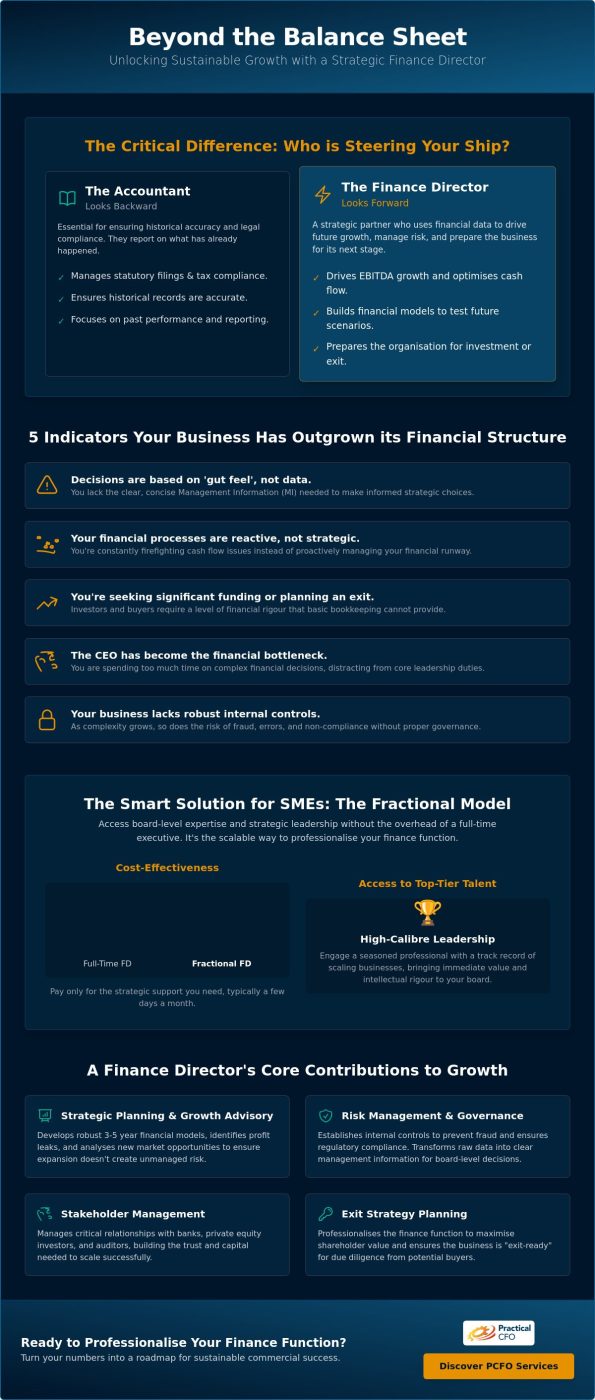
Many business owners conflate these roles, but the distinction is critical for growth. Accountants are essential for statutory filings, tax compliance, and ensuring historical records are accurate. They look backwards to report what has happened. A finance director looks forward. They prioritise EBITDA growth, manage the cash flow runway, and ensure the business is attractive to investors. While an accountant tells you where you’ve been, an FD tells you where you can go. For a detailed breakdown of how these two roles compare in practice, our guide on the fractional CFO vs accountant distinction explains which investment is right for your company’s growth stage.
They focus on:
- Optimising capital structure for maximum efficiency.
- Identifying cost-saving opportunities that don’t compromise quality.
- Developing robust financial models to test future scenarios.
Having an accountant is a legal necessity, but for a scaling business, it’s often insufficient. You need someone who can translate a balance sheet into a growth plan.
The Evolution of the “Financial Director” Title
The role has moved far beyond being a head bookkeeper. Modern financial leadership requires a deep understanding of technology, data analytics, and operational efficiency. In many UK organisations, the title of Chief Financial Officer (CFO) is used interchangeably with that of a finance director. Both roles now act as strategic business partners. They don’t just manage spreadsheets; they interpret market trends and implement systems that drive scalability.
This evolution means a contemporary finance director must be as comfortable discussing digital transformation as they are reviewing a profit and loss statement. They bring intellectual rigour to the boardroom, ensuring that financial systems evolve alongside the company’s ambitions. This proactive mindset is what distinguishes a modern leader from a traditional reporter.
Critical Finance Director Tasks: Beyond the Balance Sheet
The value of a finance director lies in their ability to translate financial health into commercial momentum. While a bookkeeper ensures the records are straight, the FD ensures the business is heading in the right direction. Their role involves managing critical relationships with external stakeholders, such as banks, private equity investors, and auditors. These relationships are often the lifeblood of a scaling firm, providing the capital and trust needed to move to the next level. By acting as the primary point of contact for these entities, the FD protects the CEO’s time, allowing them to focus on product and culture.
Beyond daily operations, an FD leads the charge on exit strategy planning. Whether you’re looking for a management buyout or a trade sale, the FD ensures the business is exit-ready by professionalising the finance function and maximising shareholder value. They provide the intellectual rigour required to ensure the data integrity of your organisation remains beyond reproach. This level of oversight ensures that when a potential buyer performs due diligence, the financial foundations are solid and transparent.
Strategic Planning and Business Growth Advisory
A primary responsibility is developing robust three-year and five-year financial models. These aren’t just static spreadsheets; they’re dynamic tools that align with the CEO’s vision. By identifying leaks in profitability, the FD can implement targeted overhead reduction programmes that free up capital for reinvestment. When new market opportunities arise, they analyse them through a strict financial lens. This ensures that expansion doesn’t lead to over-leverage or unmanaged risk. If you’re feeling the pressure of managing these complexities alone, exploring professional finance director services can provide the steady hand your board needs.
Risk Management and Board-Level Governance
Scaling brings complexity, and complexity brings risk. A finance director establishes the internal controls necessary to prevent fraud and ensure regulatory compliance. They transform raw data into clear, concise management information (MI). This MI allows the board to make decisions based on facts rather than intuition. It’s about creating a culture of accountability where every department understands its impact on the bottom line.
Managing working capital is perhaps the most vital task in this area. A business can be profitable but still fail if it runs out of cash during a period of rapid expansion. The FD monitors the cash cycle meticulously, ensuring the business remains solvent whilst pursuing aggressive growth targets. They anticipate funding gaps months before they occur, giving the business the lead time required to secure favourable terms.
Full-Time vs. Fractional Finance Director: A Comparison for SMEs
For most growing UK businesses, the traditional route of hiring a full-time executive is no longer the only path to success. The fractional model has emerged as a strategic alternative, allowing SMEs to access high-calibre leadership for two to four days per month. This approach ensures you aren’t paying for hours spent in the office; instead, you’re investing in the experience and intellectual rigour required to drive commercial results. It’s a shift that prioritises strategic impact over administrative presence.
Flexibility is the cornerstone of this model. As your business moves through different stages of its lifecycle, your need for financial leadership will fluctuate. A fractional finance director allows you to scale their involvement up during a period of rapid expansion or fundraising, and down once systems are stabilised. This adaptability ensures your overheads remain lean whilst your leadership remains robust. You also benefit from a diverse range of industry insights. A fractional FD often works with several non-competing businesses, bringing “cross-pollinated” ideas and proven strategies from other sectors directly into your boardroom.
The Real Cost of a Full-Time Executive
Hiring a permanent finance director in 2026 carries a substantial financial burden. Current data indicates that SME salaries for this role typically range from £70,000 to £120,000. Once you factor in Employer National Insurance, pension contributions, and executive bonuses, the total cost can be prohibitive for a scaling firm. There’s also the risk of the “boredom trap.” Many SMEs find that once the core finance function is professionalised, a full-time hire ends up performing lower-level tasks. You essentially pay an executive rate for bookkeeper-level output, which is a poor use of company resources. Before committing to a permanent hire, it’s worth understanding fractional CFO pricing in the UK to compare the true investment and ROI of each model.
When the Fractional Model Wins
The fractional model is particularly effective for businesses with a turnover between £1 million and £10 million. At this scale, you need sophisticated financial modelling and risk management, but the daily volume of work doesn’t justify a six-figure salary. It is also the perfect solution for project-based needs. Whether you are implementing a new ERP system, navigating a merger, or preparing for an exit, you can bring in a veteran FD to handle the heavy lifting. If you’re exploring how this model extends to the CFO level, our guide on what is a fractional CFO and how it works for growing UK businesses provides a detailed breakdown. This model provides the steady hand of a seasoned partner without the long-term liability of a permanent contract.
Is it Time to Hire? 5 Indicators Your Business Needs an FD
Identifying the exact moment to bring in executive financial leadership is a common challenge for founders. It isn’t just about turnover; it’s about the complexity of your operations. If you find yourself hitting a ceiling where your current accounting support can’t provide the strategic foresight you need, you’ve likely reached the tipping point. Recognising these five indicators early can prevent costly mistakes and professionalise your organisation before growth becomes unmanageable.
- The Profit-Cash Gap: You have “profitable” months on paper, but your bank balance is constantly low or unpredictable.
- Intuition-Led Decisions: You are making significant commercial choices based on “gut feel” rather than verified data and financial modelling.
- Reporting Pressure: Investors or lenders are requesting sophisticated reports, such as covenant compliance or unit economics, that you don’t know how to produce.
- Founder Burnout: You are spending more than 20% of your working week on financial admin and firefighting rather than business development.
- Strategic Horizons: You are planning a major acquisition or a business exit in the next 18 to 24 months and need to maximise valuation.
When these patterns emerge, a finance director provides the intellectual rigour needed to move from a defensive posture to a proactive strategy. They don’t just report on what happened; they provide the roadmap for what should happen next.
Solving the Cash Flow Conundrum
A finance director implements sophisticated forecasting models to predict “the crunch” months before it happens. They understand the vital difference between “paper profit” and “available cash,” ensuring you don’t over-commit during growth spurts. To put it simply, EBITDA stands for Earnings Before Interest, Taxes, Depreciation, and Amortisation, and it serves as a core proxy for your business’s operating profitability and overall valuation. By focusing on this metric, an FD helps you strip away non-operating expenses to reveal the true commercial strength of your company.
Preparing for Investment or Sale
Clean books are the absolute priority for any due diligence team. If your financial records are messy, it signals risk and can lead to a lower valuation or even a collapsed deal. An FD organises the “Data Room,” a secure repository of all financial and legal documents, to ensure the transaction process is seamless. They also take the lead in negotiating terms with venture capital or private equity firms, acting as a strategic buffer to protect your interests. If you recognise these signs in your own company, it may be time to explore our outsourced finance director services to bridge the gap.
How PCFO Delivers Board-Level Financial Leadership
PCFO provides fractional FD and CFO services designed specifically for the UK SME market. We don’t operate as distant consultants. Instead, we function as an embedded partner within your leadership team. This approach ensures that we bridge the gap between your day-to-day accounting and your long-term strategic growth goals. Our team brings decades of collective experience in business planning, exit strategy support, and complex financial turnarounds. We provide the steady hand needed to navigate the challenges of scaling a business in the 2026 economic climate.
Our goal is to alleviate the financial anxieties of business owners by providing intellectual rigour and strategic foresight. By joining your board on a fractional basis, we offer the same level of authority and insight as a full-time executive but at a fraction of the cost. This model allows you to professionalise your finance function whilst keeping your organisation lean and agile. We focus on future-proofing your business, ensuring that your financial strategy is always one step ahead of market shifts.
Our Fractional FD Framework
Every engagement begins with a comprehensive financial health check. This diagnostic phase identifies immediate risks and untapped opportunities within your current structure. We then establish a “rhythm of business” by implementing monthly management meetings and clear, actionable KPIs. This methodical approach ensures accountability across the organisation. As your business evolves, our support scales with you, transitioning from part-time finance director oversight to a full-service outsourced finance function if required. This flexibility ensures you always have the right level of expertise for your current lifecycle stage.
Why Choose PCFO Over a Recruitment Agency?
Choosing PCFO removes the financial and administrative burden associated with permanent hiring. You avoid expensive recruitment fees and the long-term liabilities of a full-time employment contract. Instead, you gain immediate access to a proven methodology and a broad network of specialist advisors. We provide the intellectual rigour of a veteran finance director without the overhead of a full-time hire. Our focus is on long-term partnership and the sustainable trajectory of your business, not just a transactional placement.
Discover how our Finance Director services can transform your business strategy.
Building a Foundation for Sustainable Growth
Transitioning from reactive reporting to proactive leadership is a defining moment for any UK SME. By integrating a seasoned finance director into your board, you move beyond basic compliance and start making decisions backed by intellectual rigour and strategic foresight. The fractional model ensures that high-calibre expertise remains accessible, providing the flexibility to scale your financial oversight as your business reaches new milestones.
PCFO brings decades of collective board-level experience to your organisation. We specialise in UK SME growth and exit planning, offering a flexible, no-contract fractional model that adapts to your specific needs. This approach alleviates financial anxieties and allows you to focus on your core commercial vision. Your business has the potential to scale securely; you simply need the right steady hand at the helm of your financial strategy.
Ready to transform your financial strategy? Book a Strategic Financial Review with a PCFO Director and secure the future of your business.
Frequently Asked Questions
What is the average salary for a Finance Director in the UK?
As of 2026, the average salary for a finance director in a UK SME with a turnover of up to £20 million typically ranges between £70,000 and £120,000. For mid-market companies with a turnover up to £200 million, this figure rises significantly to between £100,000 and £180,000. It’s important to remember that these figures represent base salary and don’t include executive bonuses, pension contributions, or Employer National Insurance liabilities.
Can a part-time Finance Director really understand my business?
Yes, a fractional leader often develops a deeper strategic understanding than a full-time employee by focusing exclusively on high-impact objectives. Because they aren’t bogged down in daily administrative tasks, they can maintain a bird’s-eye view of your commercial trajectory. They act as an embedded partner, bringing intellectual rigour and cross-industry insights that help identify growth opportunities you might otherwise miss.
What is the difference between a CFO and a Finance Director?
In the UK SME sector, these titles are often used interchangeably, but a CFO typically has a more outward-facing, capital-centric focus. A finance director usually manages the internal financial health, strategic planning, and operational efficiency of the organisation. Whilst both roles are strategic, a CFO might spend more time on fundraising and investor relations, whereas an FD ensures the financial infrastructure supports sustainable scaling. For a deeper exploration of the CFO model, our guide on what is a fractional CFO outlines how this senior role operates on a part-time basis for growing UK businesses.
Does my business need a Finance Director if I already have a good bookkeeper?
Your business likely needs both, as they perform entirely different functions. A bookkeeper focuses on historical accuracy and compliance, ensuring your records are up to date and your tax filings are correct. An FD uses that data to look forward, providing the strategic forecasting and risk management required to scale. If you’re making major commercial decisions based on intuition rather than financial modelling, a bookkeeper isn’t enough. Understanding the full spectrum of options available is essential, and our comparison of a fractional CFO vs accountant provides a clear framework to help you determine which level of financial leadership your business truly requires.
How many days a month does a fractional Finance Director usually work?
Most fractional FDs work between two and four days per month, depending on the complexity of your business and your current growth stage. This “rhythm of business” usually involves a monthly board meeting and dedicated time for strategic analysis or project work. The model is designed to be flexible, allowing you to scale their involvement up or down as your requirements change over the business lifecycle.
What qualifications should I look for when hiring a Finance Director?
You should look for a professional who is a member of a recognised UK accounting body, such as the ICAEW (ACA), ACCA, or CIMA. Beyond formal qualifications, the most important factor is a proven track record of board-level leadership within your specific industry or growth stage. They should demonstrate a deep understanding of strategic planning, risk management, and the commercial drivers that affect SMEs in the current economic climate.
Can a Finance Director help with business exit planning?
An FD is critical to a successful exit, as they are responsible for professionalising the finance function to maximise shareholder value. They organise the data room, ensure all financial records are beyond reproach for due diligence, and help negotiate terms with potential buyers. By preparing the business 18 to 24 months in advance, they ensure you don’t leave money on the table during a trade sale or management buyout.
What are the most important KPIs a Finance Director should track?
Every business is different, but an FD will typically prioritise EBITDA, cash flow runway, and the working capital cycle. They also track unit economics, such as customer acquisition cost (CAC) versus lifetime value (LTV), to ensure growth is profitable and sustainable. By monitoring these metrics, the FD provides the board with the management information needed to make informed, data-driven decisions that protect the company’s long-term health.