

The moment you feel your business can finally afford a full-time CFO is often exactly when you’ve already waited too long to address your financial complexity. Many UK leaders mistakenly view strategic financial leadership as a reward for reaching a certain scale, yet this delay frequently results in a dangerous lack of visibility during critical growth phases. Knowing exactly when to hire a fractional CFO is less about hitting a specific turnover figure and more about recognising when your organisational demands have outpaced your internal capacity for high-level analysis.
It’s common to feel like the primary bottleneck for every fiscal decision whilst simultaneously experiencing anxiety over upcoming funding rounds or cash flow projections. You require the calm confidence of a seasoned partner who’s navigated these waters before. This guide identifies the specific operational triggers and strategic milestones that signal your business is ready for fractional leadership. We’ll outline clear criteria for hiring and explain how an embedded advisor helps you secure the financial strategy needed to scale or exit with precision.
Key Takeaways
- Distinguish between compliance-led accounting and the forward-looking strategic oversight required to navigate complex growth phases.
- Recognise the specific operational milestones, such as SEIS/EIS funding rounds or international expansion, that signal exactly when to hire a fractional CFO.
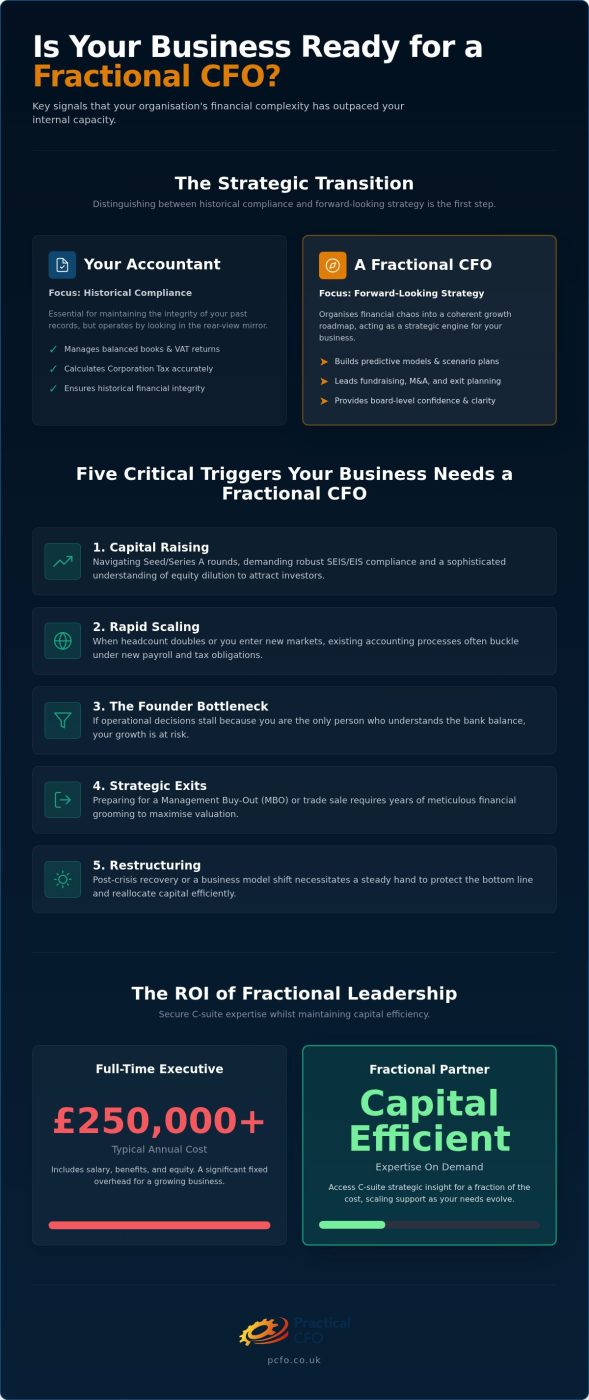
- Compare the total cost of ownership between a £250,000+ full-time executive and a fractional partner to secure C-suite expertise whilst maintaining capital efficiency.
- Identify your organisation’s specific financial “gap” to ensure you onboard a leader with the right expertise in fundraising, systems, or exit planning.
- Discover how a strategic financial partner alleviates executive decision-fatigue by providing clear visibility on future cash flow and long-term scalability.
The Strategic Transition: Why Your Accountant Isn’t a CFO
Many UK business leaders assume that because they have a capable accountant, their financial strategy is covered. This misconception often leads to a “strategic ceiling” where growth plateaus because the leadership team lacks forward-looking data. An accountant’s primary focus is compliance; they ensure your books are balanced, your VAT returns are submitted before the £90,000 threshold triggers a penalty, and your Corporation Tax is accurately calculated. They are essential for maintaining the integrity of your historical records, yet they rarely provide the predictive insights required to navigate a complex scale-up.
Deciding when to hire a fractional CFO often starts with an emotional shift. You move from a state of constant financial anxiety, where you feel like the bottleneck for every fiscal decision, to a position of proactive board-level confidence. A CFO doesn’t just report on the past; they organise existing financial chaos into a coherent growth roadmap. They transform your finance function from a back-office necessity into a strategic engine that informs every commercial move you make.
Historical Reporting vs. Strategic Foresight
Your year-end accounts are a vital record, but they are a poor tool for making tomorrow’s decisions. Relying on them is like trying to drive a car whilst only looking in the rear-view mirror. A CFO brings a different toolkit to the table, focusing on predictive modelling and scenario planning. They look amongst various data points to find actionable business intelligence, such as identifying which product lines offer the best margins for reinvestment or how a change in the 26.5% marginal tax rate might impact your dividend strategy. This agile approach, often referred to as the Fractional Executive Model, allows SMEs to access this high-level wisdom without the prohibitive cost of a full-time hire.
The “Strategic FD” Nuance in the UK Market
In the UK SME market, terminology can often be fluid. You will frequently hear the terms “Finance Director” (FD) and “Chief Financial Officer” (CFO) used interchangeably, but there’s a subtle nuance in their application. Typically, an FD is more operationally focused, acting as a “controller” who manages the day-to-day finance team and internal processes. A CFO is a “strategist” who looks externally at funding, investor relations, and long-term exit planning. PCFO bridges this gap by providing a service that adapts to your specific lifecycle. We ensure your internal systems are robust enough to support rapid growth whilst simultaneously acting as your authoritative strategic partner in the boardroom.
Five Critical Triggers: When Your Business Needs a Fractional CFO
Determining exactly when to hire a fractional CFO is often a matter of identifying specific inflection points rather than waiting for a specific turnover milestone. Growth creates complexity, and complexity, if left unmanaged, erodes profitability. For many UK founders, the need for high-level financial oversight becomes apparent when five critical triggers emerge:
- Capital Raising: Navigating Seed or Series A rounds requires more than just a pitch deck. It demands robust SEIS/EIS compliance and a sophisticated understanding of equity dilution.
- Rapid Scaling: When headcount doubles or you begin entering new national markets, your existing accounting processes often buckle under the weight of new payroll and tax obligations.
- The Founder Bottleneck: If operational decisions are stalling because you are the only person who understands the bank balance, your growth is at risk.
- Strategic Exits: Preparing for a Management Buy-Out (MBO) or a trade sale requires years of meticulous financial grooming to maximise valuation.
- Restructuring: Post-crisis recovery or a shift in business model necessitates a steady hand to protect the bottom line and reallocate capital efficiently.
If your leadership team is currently facing any of these challenges, engaging professional Finance Director Services can provide the strategic clarity required to move forward with confidence.
Funding and Capital Raising Milestones
Securing investment is a gruelling process that requires a “due diligence ready” data room. Investors, particularly in venture capital or private equity, expect to see predictive models that stand up to rigorous scrutiny. A fractional CFO validates your business valuation by ensuring every data point is defensible. They act as a bridge between your vision and the investor’s requirement for intellectual rigor, ensuring that SEIS/EIS thresholds are respected whilst protecting your long-term interests during negotiations.
Operational Complexity and Scaling Pains
As a business matures, “gut feel” decision-making starts leading to expensive cash flow surprises. Scaling requires a shift towards data-driven leadership. When to hire a fractional CFO is often the moment you need to integrate complex tech stacks or manage working capital whilst expanding your product lines. A strategic partner ensures your outsourced accountancy solutions are providing the right business intelligence, allowing you to focus on growth whilst they maintain a proactive watch over your financial health.
The ROI of Fractional Leadership: Full-Time vs. Part-Time Models
Analysing the financial impact of a C-suite hire requires looking beyond the base salary to the total cost of ownership (TCO). For many UK businesses, the decision regarding when to hire a fractional CFO is driven by the realisation that a full-time executive is a massive capital commitment that may not yet be necessary. A permanent CFO in the UK typically commands a total package between £250,000 and £420,000 once you account for employer National Insurance, pension contributions, and executive bonuses which often range from 20% to 50% of the base salary. When you add recruitment fees of 20% to 30%, the upfront barrier to entry becomes prohibitive for many scaling SMEs.
The “Fractional Advantage” allows you to access 100% of that same strategic expertise for approximately 20% of the cost. By engaging a partner on a part-time basis, you secure the intellectual rigor of a seasoned leader whilst maintaining the flexibility to scale the finance function up or down as your business dictates. A fractional CFO often pays for themselves by identifying overhead redundancies and ensuring tax efficiency, particularly for companies navigating the 26.5% marginal tax rate on profits between £50,000 and £250,000. They transform the finance department from a cost centre into a value-driver.
Comparing the Financial Commitment
The financial commitment of a fractional model is significantly lower risk than a permanent hire. Hiring the wrong full-time executive can cost a business upwards of six figures in lost time, recruitment fees, and severance. In contrast, a fractional partner offers a plug-and-play solution with no long-term statutory benefits or redundancy obligations. Hiring a fractional CFO typically results in a saving of 50% to 70% compared to the total annual cost of a full-time equivalent. In a high-growth phase, a fractional CFO often delivers a return on investment of three to five times their fee by optimising working capital and securing more favourable lending terms.
Beyond the Spreadsheet: The Value of Board-Level Advice
Strategic financial leadership provides value that a balance sheet cannot fully capture. A CFO acts as a vital sounding board for the CEO, offering a composed, objective perspective that balances the founder’s ambition with fiscal reality. Their presence in the boardroom signals professional maturity to banks, creditors, and potential investors, which is essential for building long-term trust. By leveraging a CFO’s professional network, your business gains access to strategic partnerships and specialist growth advisory that would otherwise be out of reach. They don’t just report on your current position; they actively shape your future trajectory.
Preparing for the Hire: How to Scrutinise and Onboard
Once you have identified exactly when to hire a fractional CFO, the focus shifts to ensuring the right cultural and strategic fit. Not all financial leaders are created equal; some excel at navigating complex venture capital rounds, whilst others specialise in building robust internal systems or grooming a business for a trade sale. You must first diagnose your organisation’s primary “gap” to avoid hiring a generalist for a specialist problem. Identifying whether you need a fundraiser, a system-builder, or an exit-planner is the first step toward a successful partnership.
The interview process is your primary tool for separating a traditional accountant from a strategic leader. Focus your questioning on future-facing scenarios rather than historical reconciliations. Ask how they would model a 20% increase in customer churn or what specific levers they would pull to improve working capital during a period of rapid expansion. A true strategic partner will discuss business outcomes and risk mitigation, whereas a compliance-led professional will focus on the mechanics of the ledger.
To ensure immediate impact, define clear KPIs and 90-day goals before the engagement begins. These might include:
- Establishing a “due diligence ready” data room for upcoming investment.
- Reducing the monthly reporting cycle from 15 days to 5.
- Optimising the tech stack to integrate Outsourced Accountancy Solutions with real-time business intelligence.
- Reviewing the impact of the 25% Corporation Tax rate on current reinvestment plans.
Defining the Scope of the Role
A bespoke finance director job description should clearly delineate where tactical oversight ends and high-level strategic planning begins. It’s essential to ensure alignment between your new fractional CFO and your existing accounting function. If you use a sister brand like Practical Accounting for tactical tasks, your CFO can remain focused on board-level advisory. This structure prevents the fractional leader from becoming bogged down in transactional work, ensuring you get the maximum strategic value for your investment.
Onboarding for Immediate Impact
Successful onboarding requires providing the CFO with unfettered access to historical data, your company culture, and your long-term vision. “Day 1” clarity on reporting lines and decision-making authority is non-negotiable. Integrate the fractional leader into your existing management team as a peer rather than an external contractor. This embedded approach fosters the trust necessary for them to challenge existing assumptions and provide the intellectual rigor required to future-proof your business.
If you are ready to bridge the gap between compliance and strategy, explore our Chief Financial Officer Services to find a partner who aligns with your growth trajectory.
Scaling with Confidence: Why PCFO is the Strategic Choice
PCFO positions itself as the authoritative strategic partner for UK founders who require more than just a reporting function. We don’t act as distant external contractors. Instead, we become an embedded advisor invested in the long-term trajectory of your business. Our approach focuses on alleviating the financial anxieties and decision-fatigue that often accompany rapid growth. We provide a steady hand at the helm, ensuring that your financial strategy remains proactive and aligned with your commercial ambitions.
Identifying exactly when to hire a fractional CFO is the first step toward professionalising your boardroom. PCFO ensures that this transition is seamless by integrating deep institutional knowledge with your specific organisational goals. We bridge the gap between tactical accounting and high-level strategy, offering a level of intellectual rigor that future-proofs your business against market volatility. Our services are designed to adapt to your specific lifecycle, providing the intellectual capital you need without the overhead of a full-time executive hire.
Tailored Financial Leadership for UK SMEs
Our boutique model offers a distinct advantage over generic executive recruitment agencies. We don’t just fill a vacancy; we provide a comprehensive framework for scalability. PCFO specialises in the unique hurdles faced by UK SMEs, such as managing the transition between the 19% small profits rate and the 25% main rate of Corporation Tax. Whether you are targeting national expansion or preparing for an eventual trade sale, our exit strategy support and business growth advisory ensure your firm remains attractive to buyers and investors alike. We work alongside your management team to ensure that every financial decision supports long-term scalability.
Next Steps: Your Roadmap to Financial Clarity
The journey towards financial clarity begins with a transparent assessment of your current financial maturity. We invite you to book a discovery call to discuss your specific organisational gaps and growth milestones. During your first 30 days with a PCFO partner, we focus on establishing “Day 1” clarity, auditing existing reporting lines, and identifying immediate levers for cash flow optimisation. This methodical progression builds a foundation of trust, allowing you to lead your company with renewed confidence and strategic foresight.
Schedule a consultation with a PCFO strategic advisor today to secure the financial leadership your business deserves.
Securing Your Strategic Financial Future
Transitioning from historical reporting to strategic foresight is a fundamental shift in business leadership. By identifying the specific operational triggers that necessitate high-level oversight, you ensure your organisation isn’t held back by financial complexity. The fractional model offers the flexibility to access this expertise whilst protecting your bottom line from the high costs of permanent executive recruitment.
Recognising exactly when to hire a fractional CFO is the pivotal moment when you stop simply managing your accounts and start actively driving your business value. PCFO provides the composed, board-level advice and specialised UK SME growth expertise required to navigate your most critical milestones. Our services integrate seamlessly with your existing outsourced accountancy to provide a unified, growth-oriented finance function.
Secure your strategic financial future with a PCFO fractional advisor today. You’ve built a remarkable business; let us provide the steady hand at the helm to help you lead it with confidence.
Frequently Asked Questions
How much does a fractional CFO cost in the UK?
Cost is determined by the specific complexity and scope of your engagement. Whilst a full-time executive can cost between £250,000 and £420,000 annually, a fractional partner offers a significantly lower entry point. You only pay for the high-level strategic time you actually use. This allows you to protect your cash flow whilst still accessing board-level expertise that is usually reserved for much larger corporations.
Is my business too small for a fractional CFO?
No business is necessarily too small if it’s facing strategic complexity. If you are navigating the £90,000 VAT threshold or managing profits between £50,000 and £250,000, the tax implications alone often justify the hire. Deciding exactly when to hire a fractional CFO is usually triggered by a need for better visibility on future cash flow rather than reaching a specific revenue figure.
What is the difference between an accountant and a fractional CFO?
An accountant focuses on historical accuracy and compliance, ensuring your tax returns and statutory accounts are correct. A fractional CFO looks forward, using that data to build predictive models and growth strategies. They act as a commercial partner who helps you make informed decisions about investment, scaling, and risk mitigation, whereas an accountant primarily records what has already happened in the past.
How many hours a month does a fractional CFO typically work?
The commitment is entirely flexible and scales with your requirements. Many UK SMEs start with one or two days per month to establish strategic oversight and board-level reporting. During periods of intense activity, such as a funding round or an exit process, this may increase. The fractional model ensures you aren’t paying for executive downtime when your business doesn’t require constant oversight.
Can a fractional CFO help with my business exit strategy?
Absolutely, they’re often the primary architect of a successful sale. A fractional CFO ensures your business is exit-ready by professionalising your financial records and validating your valuation. They manage the due diligence process and represent your interests amongst potential buyers or investors. This ensures you maximise the final transaction value whilst significantly reducing the stress of the process for the leadership team.
Will a fractional CFO manage my existing finance team?
Yes, they provide the leadership and mentorship your internal team needs to professionalise. A fractional CFO doesn’t replace your bookkeeper or accountant; they provide a layer of strategic oversight that guides their tactical output. This ensures your existing team is focused on the right KPIs and that their reporting meets the standards expected by board members, banks, and potential investors.
How do I know if I need a CFO or a Finance Director?
The distinction lies in the focus of the role. A Finance Director is typically more operationally focused, managing internal controls and day-to-day financial health. A CFO takes a broader view, handling external relations, funding, and long-term strategy. If you are primarily concerned with internal efficiency, an FD may suffice. However, if you are looking to scale, raise capital, or exit, a CFO’s strategic foresight is essential.
What happens if we need to transition to a full-time CFO later?
A fractional partner makes this transition much smoother and less risky. They can help you define the exact requirements for the full-time role and even lead the recruitment process. Once a candidate is found, they provide a structured handover to ensure the new hire has immediate clarity on your strategy and systems. This prevents the strategic dip that often occurs during executive leadership changes.