

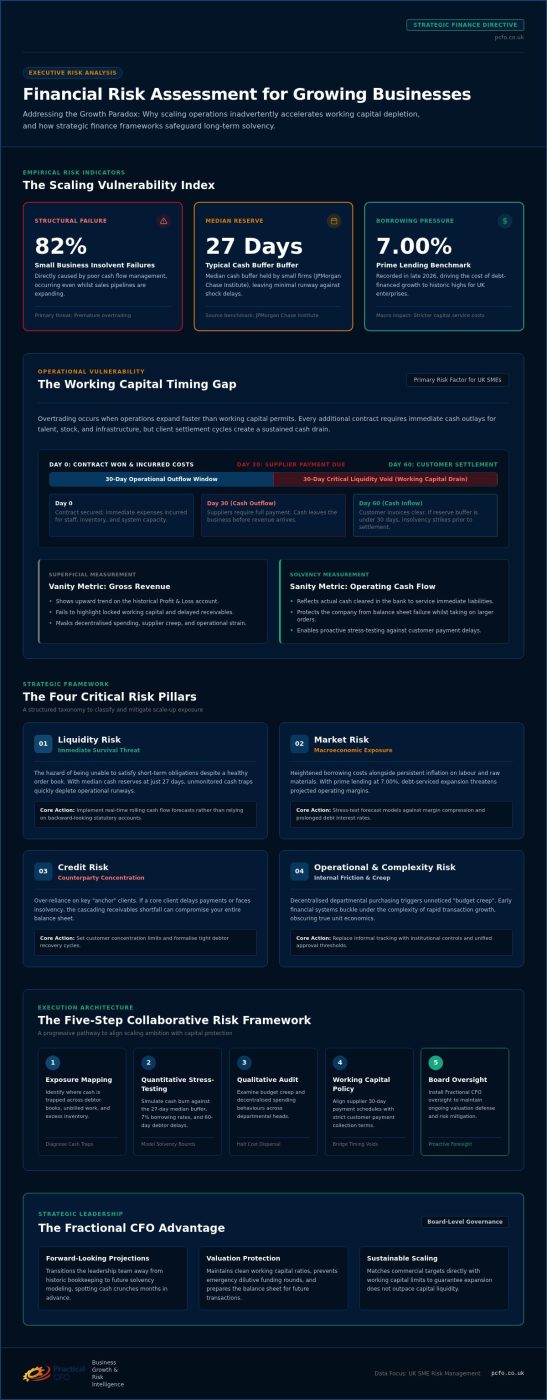
Did you know that 82% of small business failures are caused by poor cash flow management, even when sales are climbing? It’s a common paradox that many UK founders face. You’re winning more contracts and hiring talent, yet visibility over departmental spending is fading. You likely feel the constant pressure of overtrading, wondering if your working capital can actually keep pace with your ambitions. Conducting a robust financial risk assessment for growing business is no longer just an optional task once you hit the scaling phase; it’s your primary safeguard against insolvency.
This guide will help you master the specific frameworks and leadership strategies required to identify, measure, and mitigate the unique financial risks that emerge whilst scaling. We’ll provide a clear structure to categorise your growth risks, offer actionable steps for your assessment, and explain how strategic finance leadership can protect your long-term trajectory. By the end of this article, you’ll have the tools to move from reactive management to proactive foresight, ensuring your expansion remains both ambitious and secure.
Key Takeaways
- Recognise the “Growth Paradox” where rising sales can inadvertently lead to overtrading and a critical loss of liquidity.
- Utilise a comprehensive four-pillar framework to map out your exposure across liquidity, market, credit, and operational risk categories.
- Implement a structured financial risk assessment for growing business that balances quantitative data with qualitative strategic foresight.
- Leverage the expertise of a Fractional CFO or Finance Director to provide board-level oversight and protect your company’s long-term valuation.
- Follow a five-step collaborative methodology designed to align your scaling ambitions with sustainable working capital management.
Understanding the Growth Paradox: Why Scaling Increases Financial Risk
Growth is often viewed as the ultimate indicator of success, yet for many founders, it is a period of extreme vulnerability. This is known as the “Growth Paradox”. Whilst your revenue may be climbing, your liquidity often moves in the opposite direction. As you secure larger contracts, you must invest in staff, inventory, and infrastructure long before the customer’s payment hits your bank account. This creates a dangerous gap that can swallow even the most promising company. Relying on traditional accounting isn’t enough; standard reports often focus on historical profit rather than future solvency. To survive this phase, you must adopt professional financial risk management practices that look forward rather than backward.
A proactive financial risk assessment for growing business owners is the only way to spot these structural weaknesses before they become terminal. Without it, you are essentially flying blind during the most turbulent part of your journey. You need a framework that identifies where your cash is trapped and how much pressure your balance sheet can truly withstand.
The Mechanics of Overtrading and Cash Burn
Overtrading occurs when a business expands its operations faster than its working capital allows. As sales volume increases, so does the demand for upfront cash. If your suppliers require payment in 30 days but your customers take 60 days to pay, every new sale actually drains your bank account in the short term. This timing gap is the silent killer of scaling firms. You might see a healthy profit on your P&L, but your bank balance tells a different story. You must distinguish between “vanity metrics” like gross revenue and the “sanity metrics” of operating cash flow. Overtrading represents the primary risk for UK SMEs in 2026, as businesses frequently exhaust their working capital before the rewards of expansion are realised.
Complexity Risk: The Hidden Cost of Organisational Growth
As your company grows, financial control often becomes decentralised. Department heads may begin making independent purchasing decisions, leading to “budget creep” that erodes your margins. Systems that worked perfectly for a five-person team often buckle under the weight of hundreds of transactions. This lack of visibility makes a financial risk assessment for growing business essential for maintaining grip. Strategic oversight must replace simple bookkeeping to ensure that every pound spent aligns with your long-term goals. Managing this complexity requires a shift in leadership; you need a partner who can navigate these organisational shifts whilst keeping your capital secure.
The Four Critical Pillars of Risk Assessment for Growing SMEs
A successful scale-up requires more than just sales momentum; it demands a balanced risk ecosystem. These four pillars—Liquidity, Market, Credit, and Operational—form the foundation of any comprehensive financial risk assessment for growing business. These elements don’t exist in isolation. A failure in operations often triggers a liquidity crisis, which in turn damages your credit standing. Prioritising these risks based on their potential impact on your business continuity and eventual valuation is a core component of our Business Growth Advisory UK services. By categorising threats, you can allocate resources to the areas that pose the greatest danger to your stability.
Liquidity and Market Risks: Protecting Your Runway
Liquidity risk is your most immediate threat during expansion. It’s the risk of being unable to meet short-term financial obligations despite having a profitable order book. Research by the JPMorgan Chase Institute shows the median small firm holds only 27 days of cash buffer. This means your runway is likely shorter than you think. Market risks add another layer of complexity to your planning. With the Prime Lending Rate reaching 7.00% in late 2026, debt-financed growth is significantly more expensive than in previous years. Inflationary pressures on labour and materials can quickly erode margins that seemed secure six months ago. Implementing strategic budgeting and forecasting allows you to stress-test your business against these external shifts before they impact your solvency. If your growth involves the movement of physical goods, you might also learn more about Cargo Insure Online to ensure your logistics operations are fully protected against operational risks.
Credit risk often hides within the success of a growing business. Relying on a few “anchor” clients creates a dangerous dependency. If one major customer delays payment or faces their own financial distress, your cash flow can collapse. You must monitor debtor days with rigour; growth should never come at the expense of your balance sheet health. Operational risks are equally critical during a scale-up. Rapid growth accelerates the impact of small inefficiencies. A single point of failure in your supply chain or a lack of redundancy in your finance team can halt operations entirely. Adopting the SBA’s core risk management strategies helps SMEs build the resilience needed to withstand these internal pressures. If you feel your current systems are struggling to keep pace, our Finance Director services can help you build a robust framework for sustainable expansion.
Qualitative vs Quantitative Assessment: How to Measure Growth Risks
Measuring risk during a scale-up requires a dual-lens approach. Whilst quantitative data provides a snapshot of your current stability, qualitative analysis offers the foresight needed to navigate future obstacles. A comprehensive financial risk assessment for growing business must integrate both to be effective. Relying solely on software-generated spreadsheets often misses the human and market factors that precede a financial downturn. By balancing hard metrics with strategic intuition, you can build a more resilient organisation that’s prepared for both expected and unexpected volatility.
Quantitative Analysis: The Power of Financial Ratios
Hard data acts as your early warning system. By monitoring liquidity ratios like the Current Ratio and Quick Ratio, you can assess your ability to cover short-term liabilities as they fall due. The Cash Conversion Cycle is particularly vital for scaling firms; it tracks exactly how long capital is tied up in inventory and receivables before returning as cash. You should also keep a close eye on your leverage to ensure your expansion isn’t becoming top-heavy. A Debt-to-Equity ratio of over 2.0 might signal over-leveraging for an SME, suggesting that your growth is built on a precarious foundation of debt rather than sustainable equity.
Qualitative Assessment: Identifying Strategic Vulnerabilities
Numbers don’t always tell the whole story. Qualitative assessment looks at the “soft” risks that data can’t easily capture, such as management depth or the looming threat of founder burnout. This is where Harvard Business Review’s risk management framework becomes invaluable. It helps leaders categorise risks into preventable, strategy-driven, and external factors, ensuring no blind spots remain. You should conduct a SWOT analysis that focuses specifically on financial resilience, evaluating how shifting market sentiment or a sudden competitive entry might impact your future revenue streams. This process turns gut feelings into documented strategic insights.
Prediction isn’t about having a crystal ball; it’s about preparation. Scenario planning, or “what-if” analysis, allows you to model various outcomes, such as a 20% drop in a key customer’s orders or a 15% increase in supply costs. By using historical data to predict future volatility, you can create a range of potential financial futures. This proactive stance ensures that when volatility strikes, you already have a documented plan of action to protect your company’s value and maintain your momentum.
A Step-by-Step Guide to Conducting Your Financial Risk Assessment
A robust financial risk assessment for growing business is not a static exercise. It’s a dynamic process that requires close collaboration between the CEO and the finance function. To build a truly resilient company, you must move beyond simple compliance and treat risk management as a core strategic pillar. High-quality data is the fuel for this process. Leveraging outsourced accountancy solutions provides the granular visibility needed to feed your assessment with accurate, real-time figures that reflect the current state of your operations.
Step 1 & 2: Identification and Categorisation
Effective risk management starts with a dedicated identification workshop. Bring your leadership team together to brainstorm potential threats without initial judgement. Categorise these findings into the four pillars established earlier: liquidity, market, credit, and operational. It’s vital to differentiate between external threats, such as the 7.00% Prime Lending Rate, and internal risks like hiring ahead of demand or over-investing in new product lines. This categorisation ensures that your team understands which risks are within their control and which require external hedging or contingency planning.
Step 3 & 4: Probability Mapping and Mitigation Planning
Once identified, you must prioritise. Use a Risk Heat Map to plot each item based on its likelihood of occurrence and its potential impact on your operations. Focus your immediate energy on “High Impact / High Probability” risks. For these critical items, develop specific mitigation strategies with clear timelines and measurable outcomes. Accountability is key here. Assign a “Risk Owner” for every major threat to ensure that mitigation plans don’t just stay on paper but are actively managed and monitored within the organisation.
Step 5: Continuous Monitoring and Board Reporting
Scaling moves fast, so your assessment must keep pace. Establish Key Risk Indicators (KRIs) that serve as early warning signals for the board. For example, if debtor days exceed a certain threshold, it should trigger an immediate review of your credit control processes. Regular reviews are essential to ensure your strategy remains relevant as you expand. This ongoing discipline doesn’t just protect you today; it significantly enhances your company’s value during exit strategy planning. Investors pay a premium for businesses that can demonstrate a mature, documented approach to risk.
If you’re ready to secure your company’s future, our Finance Director Services provide the expert leadership needed to conduct a professional assessment and protect your growth trajectory.
Strategic Risk Mitigation: The Role of Fractional Finance Leadership
Many business owners rely on their year-end accountant for advice, but scaling requires a different level of foresight. A standard accountant typically focuses on compliance, tax efficiency, and historical reporting. Whilst these functions are necessary, they don’t have the strategic bandwidth required to lead a continuous financial risk assessment for growing business. Strategic risk mitigation requires a leader who is embedded in your future plans, rather than one who only reviews your past performance. Fractional finance leadership provides this high-level expertise. It offers the same calibre of strategic navigation as a full-time executive but at a fraction of the cost.
From Reporting to Navigating: The CFO Difference
The difference between an accountant and a CFO is often described through a simple analogy. An accountant looks in the rear-view mirror to see where you’ve been, whilst a CFO looks through the windscreen to navigate the road ahead. This objective, external perspective is vital for identifying internal growth risks that founders might overlook due to optimism bias. A seasoned Finance Director acts as a steady hand at the helm. They ensure that your financial strategy adapts to your specific lifecycle. For example, a part-time FD recently identified a critical liquidity gap for a scaling client six months before it would have hit their bank balance. By spotting a structural mismatch between supplier payment terms and customer credit cycles during a period of rapid expansion, they implemented a new credit control policy that averted a potential cash crunch.
Future-Proofing Your Business for Sale or Investment
A robust risk assessment framework does more than just prevent failure; it actively builds enterprise value. When you eventually prepare for a sale or an investment round, the due diligence process will scrutinise your risk management with rigour. Showing investors that you have identified, measured, and mitigated potential threats increases their confidence and your business valuation. It demonstrates that your growth is sustainable and not merely a result of temporary market conditions. For companies with a turnover between £1m and £50m, fractional leadership is the most scalable solution. It allows you to access board-level oversight without the overhead of a full-time corporate salary. You can review the details of this strategic investment in our Fractional CFO Pricing UK guide. This approach ensures your foundation is secure, allowing you to focus on your primary objective of scaling the business safely.
Securing Your Company’s Future Through Strategic Foresight
Scaling a business is a journey that requires more than just sales momentum; it demands a disciplined approach to capital management. By identifying the Growth Paradox early and implementing a structured financial risk assessment for growing business, you protect your company from the common pitfalls of overtrading. Balancing hard financial ratios with strategic qualitative insights ensures your foundation remains solid whilst you reach for new heights.
PCFO provides the high-level financial leadership required to navigate these complexities. We offer bespoke risk frameworks for UK SMEs and strategic growth advisory focused on long-term value. Our Fractional FD and CFO expertise ensures you have a steady hand at the helm during your most critical expansion phases. Book a strategic consultation with a PCFO expert to assess your growth risks and ensure your expansion remains both ambitious and secure.
Expansion should be an era of opportunity rather than anxiety. With the right strategic partner, you can scale with confidence and build a business that is truly future-proof.
Frequently Asked Questions
What is the most common financial risk for a growing business?
The most common risk is a lack of liquidity, often referred to as the “Growth Paradox.” As you win larger contracts, you must fund operations, inventory, and payroll long before customer payments arrive. This creates a dangerous working capital gap that can lead to insolvency despite high sales. Managing this requires a proactive financial risk assessment for growing business to ensure your cash buffer remains sufficient to cover these rising upfront costs.
How often should a scaling SME conduct a financial risk assessment?
You should conduct a formal assessment at least once a quarter during periods of rapid expansion. Fast-moving firms often outgrow their financial assumptions within months. A quarterly review allows you to adjust your forecasts and stress-test your balance sheet against current market conditions. If you experience a significant event, such as a major contract win or a shift in interest rates, you should perform an ad-hoc assessment immediately.
What is the difference between a risk assessment and a standard audit?
A standard audit is a backward-looking exercise focused on historical accuracy and compliance. In contrast, a risk assessment is a forward-looking, strategic process designed to identify future threats to your solvency and growth. Whilst an audit confirms what has already happened, an assessment helps you navigate what might happen next. It focuses on scenario planning and mitigation strategies rather than just historical reporting or checking regulatory boxes.
Can a small business perform a risk assessment without a full-time CFO?
Yes, you can effectively manage this process using Fractional CFO or Finance Director services. Most SMEs with turnovers between £1m and £50m don’t require a full-time executive but do need board-level strategic oversight. A fractional partner provides the necessary expertise to lead a financial risk assessment for growing business at a fraction of the cost. This model offers the intellectual rigour of a corporate CFO whilst remaining flexible to your specific lifecycle.
What are the early warning signs of overtrading in a UK business?
Early warning signs of overtrading include a persistent decline in cash reserves despite rising revenue. You might also notice your debtor days stretching out or find yourself frequently hitting credit limits with suppliers. If you’re constantly relying on short-term debt to fund daily operations, your business is likely overtrading. These signals suggest that your growth is consuming working capital faster than your current financial structure can support.
How does a financial risk assessment impact business valuation?
A robust assessment framework significantly increases business valuation by reducing the perceived risk for potential investors or buyers. It demonstrates that your growth is sustainable and that you have professional controls in place to manage volatility. During due diligence, having a documented history of risk mitigation proves that your profits are resilient. This transparency often leads to a higher valuation multiple, as buyers pay a premium for stability and strategic foresight.
What is a Risk Heat Map and how do I use it?
A Risk Heat Map is a visual tool used to prioritise threats by plotting their potential impact against their probability of occurring. You use it to categorise risks into low, medium, and high-priority zones. High-impact, high-probability items require immediate mitigation plans and dedicated “Risk Owners.” This methodical approach ensures that your leadership team focuses its limited resources on the most critical vulnerabilities rather than becoming overwhelmed by minor issues.
Does business insurance cover all the risks identified in an assessment?
Business insurance typically covers specific external events, such as fire, theft, or professional indemnity claims. However, it doesn’t protect against structural strategic risks like poor cash flow management, overtrading, or market shifts. An assessment identifies these internal and strategic vulnerabilities that insurance cannot mitigate. Whilst insurance, such as policies arranged through Commercial Property Insurance UK, is a valuable part of your risk toolkit, it’s no substitute for the proactive financial leadership and strategic navigation provided by a Finance Director.