

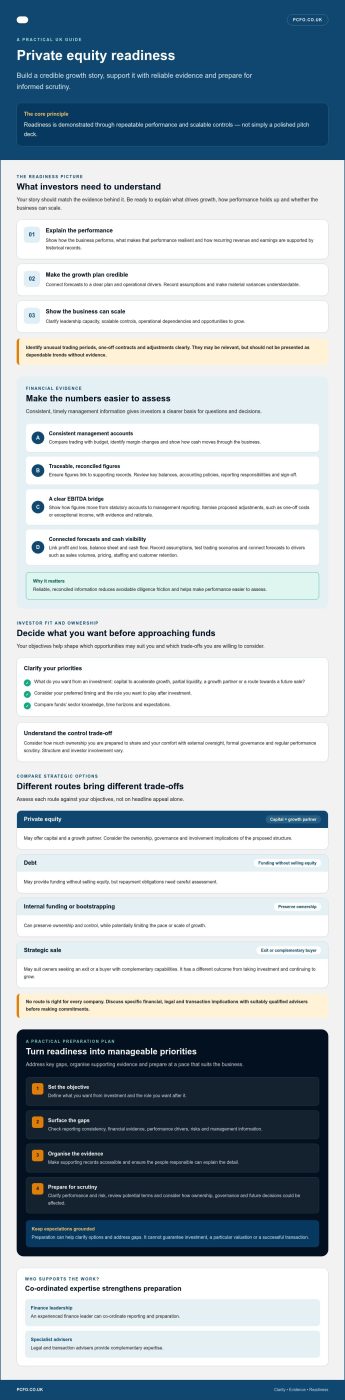
Private equity readiness is demonstrated through repeatable performance and scalable controls, not simply a polished pitch deck. Preparing a business for private equity investment means explaining what drives growth, supporting the numbers with reliable evidence and showing how the business can scale.
If you’re unsure what investors will scrutinise, or whether your financial information tells a clear, consistent story, you’re not alone. Discussions can also raise important questions about control, governance and the demands of a transaction. Preparation helps you address these issues before they become obstacles and gives you space to decide whether private equity fits your ambitions.
This practical UK guide explains how to assess investor fit, strengthen your financial evidence and prepare for initial discussions. You’ll also learn how to identify gaps in management information, clarify performance and risk, and compare private equity with other strategic options. The aim is a clear readiness plan, with priorities you can act on at a pace that suits your business.
Key Takeaways
- Define what you want from an investment before approaching funds, then compare potential investors’ sector knowledge, time horizons and expectations.
- Use consistent management accounts and a clear explanation of EBITDA adjustments to make performance easier to assess.
- Understand how investment terms could affect ownership, governance and future decisions before entering discussions.
- Make preparing a business for private equity investment manageable by setting priorities, addressing key gaps and organising supporting evidence.
- An experienced finance leader can coordinate reporting and preparation, while specialist legal and transaction advisers provide complementary expertise.
Preparing a Business for Private Equity Investment: What Readiness Really Means
Investment readiness means being able to support your business’s performance, explain a credible growth plan and withstand informed scrutiny from potential investors. It’s more than preparing a pitch deck: the story you tell should match the evidence behind it. Preparing a business for private equity investment can help you identify gaps and enter discussions with a clearer view of your options, but it can’t guarantee investment, a particular valuation or a successful transaction.
Before speaking with funds, be clear about your objectives. Are you seeking capital to accelerate growth, partial liquidity, a partner to support expansion, or a route towards a future sale? Consider your preferred timing and the role you want to play after investment. These decisions help you assess which opportunities may suit you and what trade-offs you’re willing to consider.
What private equity investors may want to understand
Investors will want to understand how the business performs, what makes that performance resilient and whether the leadership team can deliver its plans. They may explore customer concentration, margins, cash generation, operational dependencies and opportunities to grow. The What is Private Equity overview provides useful background on investment approaches, but each fund’s priorities depend on its mandate, the proposed deal structure and your business’s circumstances.
Evidence matters more than confident assertions. Recurring revenue and earnings supported by historical records can help explain the company’s underlying performance. A one-off contract or unusually strong trading period may still be relevant, but identify it clearly rather than presenting it as a dependable trend. Forecasts are useful when their assumptions are transparent and linked to a credible plan.
Is private equity the right route for your business?
Consider how much ownership you’re prepared to share and how comfortable you are with external oversight, formal governance and regular performance scrutiny. Private equity may offer capital and a growth partner, but the structure and level of involvement vary. Compare it with other routes against your objectives, not on headline appeal alone:
- Debt: may provide funding without selling equity, but repayment obligations need careful assessment.
- Internal funding or bootstrapping: can preserve ownership and control, while potentially limiting the pace or scale of growth.
- Strategic sale: may suit owners seeking an exit or a buyer with complementary capabilities, but has a different outcome from taking investment and continuing to grow.
No route is right for every company. Discuss specific financial, legal and transaction implications with suitably qualified advisers before making commitments.
Build Investor-Ready Financial Evidence Before You Approach Funds
Reliable financial information helps investors understand how the business performs, not just what its headline figures say. Consistent, timely management accounts make it easier to compare trading with budget, identify changes in margins and show how cash moves through the business. Preparing a business for private equity investment means ensuring figures can be traced to supporting records and explained by people who understand the detail.
Reliable, reconciled financial information reduces avoidable diligence friction by giving investors a consistent basis for questions and decisions.
EBITDA is commonly used to assess operating performance, but the label alone isn’t enough. Definitions can vary, and proposed adjustments, such as one-off costs or exceptional income, need clear evidence and rationale. Prepare a bridge from statutory accounts to management reporting, showing how each figure was derived and itemising adjustments rather than relying on unsupported claims. Where accounting treatments or reporting policies differ, explain the impact and seek appropriate professional advice.
Strengthen reporting, forecasts and cash visibility
Review how quickly monthly accounts are produced, which accounting policies are applied and whether key balances are reconciled. Make responsibilities clear, including who reviews and signs off the reporting. An integrated forecast should connect profit and loss, balance sheet and cash flow, with assumptions recorded and scenarios showing how changes in trading could affect funding needs. Link forecasts to operational drivers such as sales volumes, pricing, staffing or customer retention, and explain material variances against previous results.
Prepare for financial due diligence
Organise records so that responses can be supported without a last-minute search. The British Business Bank’s Private Equity preparation checklist offers a useful companion to your internal preparation. Depending on the proposed process, relevant material may include accounts, tax records, debt agreements, customer information and supporting schedules. Keep versions clear and share sensitive information only through agreed channels.
Before discussions progress, review unusual items, customer concentration, working-capital movements and potential contingent liabilities. Prepare concise explanations with supporting evidence, rather than waiting for questions to expose gaps. If a secure data room is appropriate, agree access, document handling and responsibilities with your advisers before uploading confidential records.
An experienced finance leader can help coordinate reporting, forecasts and supporting schedules, working alongside specialist legal, tax and transaction advisers where required. If you’re assessing gaps in your management information, finance leadership support may help bring greater structure to your preparation.
Assess Investor Fit, Deal Terms and the Control Trade-Off
Private equity can bring capital and support for growth, but investment may also change ownership, governance and how future decisions are made. The balance depends on the deal. Before progressing discussions, consider how much influence you’re willing to share, what you want the investment to achieve and how involved you expect to remain. The House of Lords Library’s overview of private equity’s role in the UK economy offers wider UK context, but the right choice depends on your company’s circumstances and objectives.
Compare funding routes against the outcome you want, rather than assuming one is inherently better. These are broad distinctions, not predictions of particular terms:
| Route | Potential fit | Key trade-off to consider |
|---|---|---|
| Private equity | Seeking investment and an active partner to support growth | Ownership, governance and investor involvement may change |
| Debt | Funding growth whilst retaining equity ownership | Repayment obligations and any associated terms need careful assessment |
| Strategic investment | Seeking capital alongside a commercial relationship or strategic contribution | Consider the investor’s influence and how its commercial interests align with yours |
| Business sale | Seeking an exit or a change of ownership | Your future role and level of control depend on the agreed transaction |
Questions to ask a prospective private equity investor
Ask why the investor is interested in your business, what relevant portfolio experience it can point to and what it expects to contribute beyond capital. Discuss its investment time horizon, growth expectations, reporting requirements, governance approach and likely involvement in decisions. Ask how board composition and decision rights might work in practice. Reference checks and a review led by your advisers can help test whether the investor’s stated approach matches its track record, without assuming every fund operates in the same way.
Understand the commercial and personal implications
Ownership dilution, control rights, board roles and expectations around a future exit are deal-specific. Consider the role you want after investment, your financial objectives and the level of oversight you can accept. Preparing a business for private equity investment should include these personal and commercial questions, not just financial analysis.
An early conversation or indicative proposal isn’t automatically a final contractual commitment. However, documents can have different implications, so don’t rely on informal assumptions. Have qualified legal and financial advisers review proposed terms and explain their effect before you agree or sign. Their advice can help you compare the offer with your priorities and understand the choices available.
Create a Practical Private Equity Preparation Plan
A structured plan turns preparation into manageable work rather than a last-minute exercise. Start by agreeing what you want from investment, your preferred timing and who will lead the process. Then assess gaps, rank the work by importance, organise the supporting evidence and rehearse likely investor questions. Assign an owner and review date to each workstream so progress is visible and responsibilities don’t sit solely with the business owner.
Keep the plan proportionate to your capacity. Some items may need attention before approaching investors, such as resolving material inconsistencies in reporting or clarifying who can approve key decisions. Other improvements, including refining longer-term processes, may continue during discussions if you can explain the current position and manage the risk. Review priorities regularly as the business and potential transaction develop.
- Set objectives: record what you want the investment to achieve and your preferred role afterwards.
- Assess gaps: compare current reporting, operations and governance with what investors may need to understand.
- Prioritise and assign: name a responsible person, a target date and the business impact for each action.
- Organise and rehearse: bring relevant documents together and practise clear, evidence-based responses.
Close operational and governance gaps
Review leadership accountability, management depth and reliance on key individuals. If a critical customer relationship or operating process depends on one person, identify how the business would manage their absence. Clarify how decisions are made and recorded. Document material contracts, intellectual property, compliance responsibilities and known risks, working with suitable specialists where required. Prioritise fixes according to investor relevance, potential business impact and the management time available. Not every issue needs the same response, but significant gaps should have a clear owner and plan.
Prepare the investment narrative and supporting materials
Build a concise explanation of the market opportunity, the company’s historical performance, its growth drivers and the assumptions behind its plans. Keep presentation materials aligned with the underlying management information. If a forecast assumes increased sales, for example, be ready to explain the operational capacity and commercial drivers supporting that assumption. Practise answering questions about performance, risks and growth capacity without overstating certainty. Clear, consistent answers are more useful than a polished story the evidence cannot support.
Private equity preparation can also prompt broader consideration of your future plans. For additional context, explore exit strategy planning services. If you need support shaping objectives and coordinating financial preparation, consider PCFO’s business planning and finance leadership support.
Finance Leadership: Moving to Investor Discussions
As preparation moves towards investor discussions, an experienced finance leader can help turn financial records and plans into a coherent, decision-useful picture of the business. They may coordinate reporting, forecasting and responses to information requests, while helping you assess the financial implications of different options. This can be particularly useful if existing reports are inconsistent, forecasting capacity is limited or senior leaders are already stretched.
Part-time or outsourced Finance Director and CFO support can provide senior oversight without a permanent executive appointment. The right scope depends on your needs. Agree responsibilities, deliverables and decision-making boundaries at the outset, including who owns reporting, who approves information shared externally and how progress will be reviewed.
When to bring in external finance leadership
Consider additional finance leadership if management information arrives late, forecasts aren’t regularly updated, or the business lacks capacity to coordinate preparation alongside day-to-day operations. A finance leader can help organise the work and strengthen financial decision support, but won’t replace specialist legal, tax or transaction advisers. For more on how the role can support a growing company, read about the strategic role of a Finance Director. If you’re weighing up the scope of a fractional appointment, fractional CFO pricing in the UK offers related context.
Choose the next step that fits your readiness
A focused readiness review can help you identify evidence gaps, rank priorities and decide where specialist advice is needed. It can also clarify whether your objectives, materials and internal capacity are sufficiently clear to begin investor conversations, or whether some preparation should come first. Preparing a business for private equity investment is a process of informed decisions, not a commitment to pursue a deal.
PCFO provides fractional and outsourced finance leadership, business planning and growth advisory to growing UK businesses. This support can help owners assess readiness and coordinate preparation; it doesn’t make PCFO an investor or guarantee a transaction. To discuss whether finance leadership support fits your priorities, Discuss your business preparation with PCFO.
Turn Preparation into a Clear Next Step
Preparing a business for private equity investment is about building a reliable picture of performance, making growth plans credible and understanding the implications for ownership and decision-making. A focused readiness plan helps you address the most important gaps without losing sight of your wider objectives. It also gives you a sound basis for comparing private equity with other options, rather than treating an investor conversation as a commitment.
Finance leadership can help bring reporting, forecasting and preparation into a clearer structure. PCFO provides fractional and outsourced Finance Director and CFO services, alongside business planning and exit strategy support, and outsourced accountancy solutions for growing UK businesses. This support can complement specialist legal, tax and transaction advisers as you assess your position.
If you’d like to explore what preparation could look like for your business, discuss your business preparation with PCFO. You can take a measured approach, set priorities that fit your goals and move forward with greater confidence.
Frequently Asked Questions
How do I prepare my business for private equity investment?
Start by clarifying what you want investment to achieve and whether private equity suits your ownership and growth objectives. Then review reporting quality, forecasts, cash visibility, leadership capacity and key risks. Agree actions, owners and review dates, and prioritise gaps that could undermine confidence or delay discussions. Organise supporting records and practise explaining performance and assumptions. Preparing a business for private equity investment is about evidence and decision readiness, not just a pitch deck.
What do private equity investors look for in a business?
Investors typically assess the company’s performance, resilience, leadership and potential for growth, though priorities differ between funds and transactions. They may examine the reliability of earnings, recurring revenue, customer concentration, cash generation and the assumptions behind growth plans. They’ll also want to understand key risks and whether the team can deliver its strategy. Support claims with historical evidence, and distinguish ongoing performance from one-off income or unusually strong trading periods.
How long does it take to prepare a business for private equity?
There’s no standard preparation period. The time required depends on the quality of your reporting, the complexity of the business, the gaps identified and the capacity available to address them. A focused readiness review can help you separate urgent issues from improvements that can continue during discussions. Set realistic responsibilities and review dates, then reassess progress regularly. Avoid starting investor conversations on a fixed timetable if important evidence or decisions remain unclear.
Do I need a Finance Director before approaching private equity investors?
No. A permanent Finance Director isn’t a requirement for every business, but someone needs the capacity and expertise to oversee financial information and respond to questions. If reporting is inconsistent, forecasting is limited or leaders are stretched, part-time or outsourced Finance Director or CFO support may help coordinate preparation and improve decision-making. Agree the scope and responsibilities in advance. Finance leadership complements specialist legal, tax and transaction advisers; it doesn’t replace them.
Will private equity investors take control of my business?
Not necessarily, but investment can change ownership, governance and decision-making. The balance depends on the negotiated deal, including ownership interests, board arrangements and decision rights. Ask how the investor expects to be involved, what decisions require approval and how your role may change. Don’t assume a discussion or indicative proposal settles these points. Have independent legal and financial advisers review the proposed terms so you understand their commercial and personal implications before committing.
What financial documents should I prepare for private equity due diligence?
Prepare available statutory accounts, timely management accounts, budgets and forecasts, tax records, debt details and supporting schedules. Investors may also request customer and revenue information, working-capital analysis and explanations of unusual items or adjustments. Make sure figures reconcile across reports and that forecast assumptions are documented. Organise records clearly, control access to sensitive information and agree document handling with your advisers. The exact information required will depend on the business and the proposed transaction.