

Your five-year financial plan should be built to change. A forecast based on assumptions that are treated as facts can quickly lose its value, especially when growth plans, costs or cash needs shift. If you’re asking how to create a 5 year financial plan, you may be wondering what information to gather and how to make projections useful beyond the first year.
The answer is to treat the plan as a set of scenarios and decisions, not a fixed prediction. This guide explains how to build a realistic baseline from your business performance, connect growth goals to revenue, costs and cash flow, and set measurable milestones. You’ll also learn how to compare possible outcomes and establish a review rhythm, so the plan stays relevant as your business and conditions change. The result should be a practical framework for making decisions, rather than a spreadsheet that sits untouched.
Key Takeaways
- Learn how to create a 5 year financial plan that links business objectives to clear assumptions and financial forecasts.
- Identify the records and current cash information that can help establish a credible starting point for projections.
- Compare base, upside and downside scenarios to see how changing assumptions could affect available cash.
- Turn longer-term ambitions into nearer-term milestones and review points that support timely decisions.
- Recognise when accounting records or forecasting tools may need to be complemented by strategic finance leadership.
What is a five-year financial plan for a business, and what should it answer?
A five-year business financial plan is a forward-looking model that connects a company’s objectives and assumptions to projected performance and the decisions needed to achieve them. It is a strategic guide built around scenarios, not a fixed prediction of what will happen.
A five-year horizon helps leaders consider the direction and financial implications of longer-term ambitions. It doesn’t mean every year needs the same level of detail. Near-term projections should be more precise and grounded in current information. Later years can use broader assumptions, which can be refined as the business develops.
A financial plan overlaps with a Business plan, but the two aren’t interchangeable. A business plan sets out the wider case for the company, including its objectives, market and operating approach. The financial plan tests how those ambitions could work financially. It translates choices, such as entering a new market or expanding a team, into projected income, spending, cash requirements and funding needs.
What should a five-year business financial plan include?
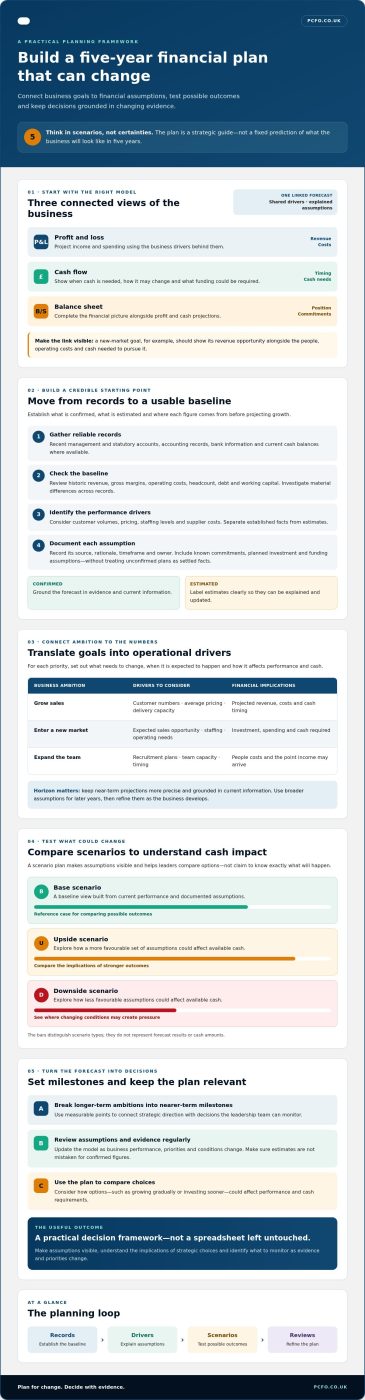
A useful model brings together linked profit and loss, cash flow and balance sheet projections. It should explain the assumptions behind the figures rather than present them as standalone targets. For example, a revenue forecast might depend on customer numbers, sales volumes, pricing or contract renewals. Costs might reflect supplier spending, premises, recruitment and planned investment.
Connect these drivers to strategic objectives. If the goal is to expand into a new market, show the expected revenue opportunity alongside the people, operating costs and cash needed to pursue it. This helps you assess whether the ambition appears financially achievable, and identify the decisions and resources it depends on.
Who needs a five-year financial plan, and when?
A five-year view can help growing SMEs preparing for expansion, investment, funding or a major operational change. Founders and leadership teams can use it to compare options, such as growing gradually or investing sooner, and consider how each could affect performance and cash requirements.
The value isn’t in claiming to know exactly what the business will look like in five years. It’s in making assumptions visible, understanding the implications of strategic choices and identifying what to monitor. That’s the practical starting point for how to create a 5 year financial plan: build a model that informs decisions and can be updated as evidence and priorities change.
How to build the financial baseline and assumptions behind your plan
A reliable forecast starts with a clear view of how the business performs now. Before projecting growth, establish which figures are confirmed, which are estimates and where the information comes from. Recent management accounts, statutory accounts and current cash information can provide a useful starting point. The UK government’s guide to business planning also outlines the role of financial forecasts, including cash flow, sales and profit and loss.
Which business information should you gather first?
Use a structured sequence to turn your records into a forecast:
- Gather reliable records: collect recent management and statutory accounts, accounting records, bank information and current cash balances where available.
- Establish the baseline: review historic revenue, gross margins, operating costs, headcount, debt and working capital. Compare management accounts with bank and accounting records, and investigate material differences before using the figures.
- Set the drivers: identify what affects performance, such as customer volumes, pricing, staffing levels or supplier costs. Separate established facts from estimates.
- Model the statements: use the drivers to build connected profit and loss, cash flow and balance sheet projections.
- Document assumptions: note each important assumption’s source, rationale, timeframe and owner. Include known commitments, planned investment and funding assumptions, without treating unconfirmed plans as settled facts.
A clear record of assumptions makes the forecast easier to explain and update. Label estimates so they aren’t mistaken for confirmed figures, and identify who can confirm or revise them.
How do you turn business goals into financial assumptions?
Translate each priority into operational drivers you can monitor. A goal to grow sales, for example, might depend on customer numbers, average pricing and the team’s capacity to deliver. A planned expansion may also require additional staffing or investment before new income arrives. Set out the expected timing as well as the effect, then assign an owner to check whether the assumption remains realistic. This is how strategic business planning guidance can help turn priorities into measurable plans.
Keep the five-year outlook appropriately broad, and use a rolling monthly or quarterly view for nearer-term decisions. Refresh that detailed view as actual results come in, then carry relevant changes into the longer-range assumptions. If you need support building or challenging the model, a business planning consultant may help connect your operational priorities with the financial forecast.
How to model cash flow and test five-year business scenarios
Profit and cash aren’t the same. A sale can contribute to reported profit before the customer pays, while wages, suppliers and other bills may need settling sooner. A profitable business can still face cash pressure if money arrives after payments are due or too much cash is tied up in working capital. A forecast should therefore show not only whether the business expects to make a profit, but when cash is likely to come in and go out.
Which financial statements and measures should the model connect?
Build the projected profit and loss account, balance sheet and cash flow view as linked parts of one model. Sales and costs flow through the profit and loss account; unpaid invoices and stock affect working capital on the balance sheet; payment timing determines the cash position. A sales increase might improve projected profit, for example, but if customers pay later or stock must be purchased upfront, the business may need more cash to support it.
Choose measures that fit your business model. Gross margin and operating costs can show how efficiently revenue turns into operating profit. Cash headroom and working capital can indicate whether the business can meet commitments and fund planned activity. A useful Creating a Financial Forecast guide also considers sales, expenses and cash flow together. Focus on measures that inform your decisions, rather than forcing every business into the same KPI set.
How should you build and compare scenarios?
Set out base, upside and downside cases using the same core drivers, then vary the assumptions most likely to change. For instance, test the effects of slower sales, delayed customer receipts, higher operating costs or a different hiring timetable. Keep other assumptions consistent where appropriate, so you can see what each change does to cash needs, capacity and investment plans.
| Scenario | Assumptions to test | Decision to consider |
|---|---|---|
| Base | Expected sales, costs and payment timing | Can planned investment proceed as intended? |
| Upside | Stronger demand or faster receipts | What extra capacity or staffing may be needed? |
| Downside | Slower sales, later receipts or higher costs | Which spending or hiring decisions may need to change? |
Use the comparison to identify when cash headroom could tighten and what action might help, such as phasing investment or reviewing recruitment timing. This makes scenario planning a practical decision tool, not simply three alternative sets of figures. For further detail on maintaining cash visibility, see this cash flow forecasting guidance. If you need help connecting cash projections with business decisions, PCFO’s Finance Director services may be relevant.
How to turn the five-year forecast into milestones and regular reviews
A five-year ambition becomes useful when leaders can see what needs to happen next. Break the forecast into annual outcomes, nearer-term milestones and decision points. For example, a plan to expand into a new market might set an annual goal to establish a presence, with nearer-term milestones for validating demand, preparing operational capacity and deciding whether to commit further investment.
Make each milestone measurable and assign an owner. Set out what evidence will inform the next decision, such as sales progress, delivery capacity or cash headroom. This helps the leadership team distinguish activity from progress and makes the plan easier to act on.
How often should a business review its financial plan?
Routine management reporting tracks actual performance against budget and forecast. A deeper strategic review asks whether the plan’s objectives and assumptions still make sense. The right rhythm depends on your reporting cycle and how quickly key assumptions can change. A business with volatile demand may need to revisit its forecast more often than one with stable contracts. Update it when material circumstances change, rather than waiting for a scheduled review.
What should leaders do when actual results differ from plan?
Start by understanding the variance. Is it a timing difference, a change in performance, an outdated assumption or a structural issue? A delayed customer order may shift expected receipts without changing the underlying sales outlook. A sustained change in demand could affect future targets, cash and resource decisions more fundamentally.
Before changing the plan, assess the implications for cash, milestones, investment and staffing. Then record the agreed response, who owns it and when it will be reviewed. This keeps the forecast connected to decisions rather than allowing it to drift from business activity.
Use a consistent review checklist:
- Update actuals and compare them with the forecast.
- Revisit assumptions where results or circumstances have changed.
- Assess cash and the effect on planned commitments.
- Agree actions and record the decision behind each one.
- Assign owners and set the next review point.
This review discipline is central to how to create a 5 year financial plan that remains useful as the business changes. If you’d like support turning forecasts into measurable priorities and review decisions, explore PCFO’s business planning support.
When to get finance leadership support for your five-year plan
External finance leadership may be useful when the plan’s assumptions are hard to test or its implications aren’t clear. Signs include complex growth choices, uncertainty about how much cash expansion will require, and difficulty turning management information into decisions. If the leadership team spends more time assembling figures than assessing what they mean, additional expertise may help.
Accounting records show what has happened. Forecasting tools organise assumptions and project possible outcomes. Strategic finance leadership connects both to business priorities, challenges whether the assumptions are credible and helps leaders decide what to do next. These roles complement one another. A spreadsheet or software platform can calculate a forecast, but it can’t determine whether the underlying plan makes sense.
What can a CFO or Finance Director contribute?
A CFO or Finance Director can help connect operational plans, such as hiring or entering a new market, to their financial consequences. This may include testing assumptions, modelling scenarios, improving cash visibility and shaping management reporting around the questions leaders need to answer. The aim isn’t simply to produce more figures. It’s to help leaders make decisions with a clearer view of their likely effect on performance and cash.
For more on how financial leadership can support a growing company, read about the strategic role of a Finance Director. Part-time or outsourced Finance Director and CFO support can also provide financial challenge when a business needs it, without assuming that every company requires a permanent finance leader.
How to choose between a spreadsheet, software and expert support
Choose an approach that fits your data quality, model complexity, reporting needs, internal capability and governance. A spreadsheet may be practical for a straightforward plan that a capable team can maintain. Software can help organise data and analysis, particularly as reporting needs grow, but it won’t fix unreliable inputs or replace sound assumptions and business judgement.
Consider expert support if the model has become difficult to maintain, leaders need more confidence in the assumptions, or forecasts aren’t informing decisions. The right balance may combine internal knowledge, suitable tools and finance leadership. This is a practical consideration in how to create a 5 year financial plan that your team can use, not just build. For a closer comparison, see the FP&A consultant versus software comparison.
If you’d like to discuss how business planning support could help your team test its assumptions and connect forecasts to decisions, talk to PCFO about business planning support.
Make your five-year plan a tool for confident decisions
A useful five-year plan connects your business goals to credible financial assumptions, cash flow and practical milestones. It isn’t a promise that every forecast will prove accurate. It’s a framework to revisit as performance, priorities and conditions change.
Start with a clear baseline, then test how different growth scenarios affect cash, costs and capacity. Review actual results against the plan, investigate material variances and agree who will take action. That discipline helps keep the forecast relevant and turns long-term ambition into decisions your team can make now.
If you’re considering how to create a 5 year financial plan and want support testing assumptions or linking forecasts to strategy, PCFO provides business planning and growth advisory, alongside part-time and outsourced Finance Director and CFO services. Discuss your business planning needs with PCFO.
With a clear structure and regular review, you can plan for growth with greater confidence and adapt as your business evolves.
Frequently Asked Questions
What should a five-year financial plan for a business include?
It should include connected profit and loss, cash flow and balance sheet projections, alongside the assumptions that drive them. These might cover sales, pricing, operating costs, staffing, investment and funding. Link the figures to strategic objectives, then use scenarios and measurable milestones to explore what could change. Near-term forecasts should be more detailed than later years, which rely on assumptions that need revisiting as the business develops.
How do you create a five-year financial plan for a small business?
Start with reliable records and current cash information to establish how the business performs now. Then define goals and translate them into drivers such as customer numbers, pricing, capacity and staffing. Build linked financial projections, label estimates clearly and document their source and owner. To understand how to create a 5 year financial plan, test different scenarios, then use nearer-term forecasts and regular reviews to keep decisions grounded in current information.
Is a five-year financial plan the same as a business plan?
No. A business plan sets out the wider direction of the company, including its objectives and how it intends to operate. A five-year financial plan focuses on the financial implications of those ambitions, using projections and assumptions to explore revenue, costs, cash and funding needs. The two should align, but they serve different purposes. The financial plan helps leaders assess whether proposed strategies appear financially achievable and what decisions they may require.
How accurate can a five-year financial forecast be?
A five-year forecast can’t reliably predict every future result. Its accuracy depends on the quality of the information and assumptions behind it, and uncertainty generally increases further into the forecast. Use recent business performance to ground the starting years, then make later projections more directional. Comparing base, upside and downside cases can show how sensitive outcomes are to changes in sales, costs or payment timing, without presenting any scenario as certain.
How often should a business update its five-year financial plan?
There isn’t one review frequency that suits every business. Compare actual results with the forecast through routine management reporting, then schedule deeper reviews of strategic objectives and assumptions in line with your planning cycle. Update the forecast sooner if circumstances or a material assumption changes, such as expected demand, costs or investment timing. At each review, check cash, explain important variances and record agreed actions, owners and the next review point.
What is the difference between a cash flow forecast and a five-year financial plan?
A cash flow forecast focuses on when money is expected to enter and leave the business, helping leaders assess whether funds will be available to meet payments. A five-year financial plan is broader. It connects strategic objectives and assumptions to projected profit and loss, cash flow and balance sheet outcomes over a longer horizon. The cash forecast is an important part of that plan, but it doesn’t cover every measure or strategic choice on its own.
Can I create a five-year financial plan in a spreadsheet?
Yes, a spreadsheet can work if the model is manageable, the data is dependable and someone can maintain and check it. Keep assumptions visible, link calculations clearly and control versions so users know which forecast is current. As complexity or reporting needs grow, software may help organise the process. Neither a spreadsheet nor software replaces sound assumptions, financial understanding or leadership judgement about what the projections mean for the business.
When should a business ask a CFO or Finance Director for help with its financial plan?
Consider finance leadership support if growth decisions are complex, cash requirements are unclear or forecasts aren’t guiding action. A CFO or Finance Director can challenge assumptions, connect operational plans to financial outcomes and support scenario modelling, cash visibility and decision preparation. PCFO provides part-time and outsourced Finance Director and CFO services, as well as business planning and growth advisory. This can be an option for businesses that need strategic input without assuming a permanent executive role.
To discuss how PCFO’s business planning and fractional finance leadership services could support your five-year plan, contact PCFO.