

International expansion is not a single forecast followed by a launch. It is a series of funded decisions, each shaped by what the numbers and market evidence reveal. Developing a financial strategy for international expansion means looking beyond headline revenue potential to understand how much cash is required, when it will be needed and what could put returns under pressure.
If you are weighing markets with different costs, customer assumptions and operating models, it can be difficult to compare them like for like. Growth may look healthy on paper while margins narrow or cash is tied up for longer than expected. These risks are easier to assess before you commit significant resources.
This 2026 guide sets out a staged approach to assessing markets, testing financial assumptions and planning funding needs. You will learn how to model revenue, margins and cash exposure, account for key risks, and set measurable review points so investment can adapt as evidence emerges. Senior finance leadership can connect those decisions to practical forecasts and management reporting, giving you a clearer basis for deciding what to do next.
Key Takeaways
- Start with clear expansion objectives and evidence of profitable customer demand, rather than choosing a market on potential alone.
- When developing a financial strategy for international expansion, model revenue, margins and cash needs using consistent assumptions for each market.
- Compare entry routes by upfront commitment, control, ongoing costs, cash exposure and flexibility.
- Stage investment through validation and pilot decisions, with agreed review points to guide whether to pause, adapt or scale.
- Connect forecasts to commercial decisions and management reporting, with senior finance oversight as the plan develops.
Why developing a financial strategy for international expansion starts before choosing a market
A promising market is a reason to investigate, not yet a reason to commit. Developing a financial strategy for international expansion means linking the business objective to the investment required, the cash available and the measures that will show whether the plan is working. This gives leaders a consistent basis for comparing opportunities before a preferred market starts to feel like the only option.
Interest in a market and readiness to serve it profitably are different questions. There may be potential customers, but can the business reach them at a viable price, deliver reliably and cover the costs of selling and operating there? The answer depends on assumptions about demand, pricing, contribution, capacity and the time between making a sale and collecting payment. Test these assumptions against evidence, rather than relying on a headline revenue forecast.
Revenue alone can hide pressure. Sales may grow while discounts, delivery costs, local support or slow customer payments weaken contribution and increase the cash needed to sustain operations. A useful financial strategy shows these effects together, so decision-makers can see not only what the opportunity might earn, but when it may consume cash and how much funding exposure the business can manage.
What should the financial strategy answer before expansion begins?
Start by defining the purpose. Is expansion intended to reach new customers, reduce reliance on existing markets or create another route to growth? Next, identify which assumptions must hold for that objective to make commercial sense. For example, test whether expected demand can support target pricing, whether the business has capacity to fulfil orders, and how long it can fund the gap between initial spending and customer receipts.
Keep market attractiveness separate from operational readiness. A market may look compelling while the business still needs to work out how it will sell, deliver and support its offer. Exploring market entry models can help frame the choices around control and resource commitment. The financial case, however, needs to reflect the company’s own capabilities and constraints.
How does financial planning reduce expansion uncertainty?
Planning cannot remove uncertainty, but it can make it explicit. Record the assumptions behind demand, pricing, costs and cash timing, then challenge them with evidence as it becomes available. If a key assumption changes, update the forecast and assess the effect on contribution and funding needs instead of relying on an outdated sales target.
“An expansion financial strategy is a practical plan for funding growth, testing its commercial case and deciding what to do next.”
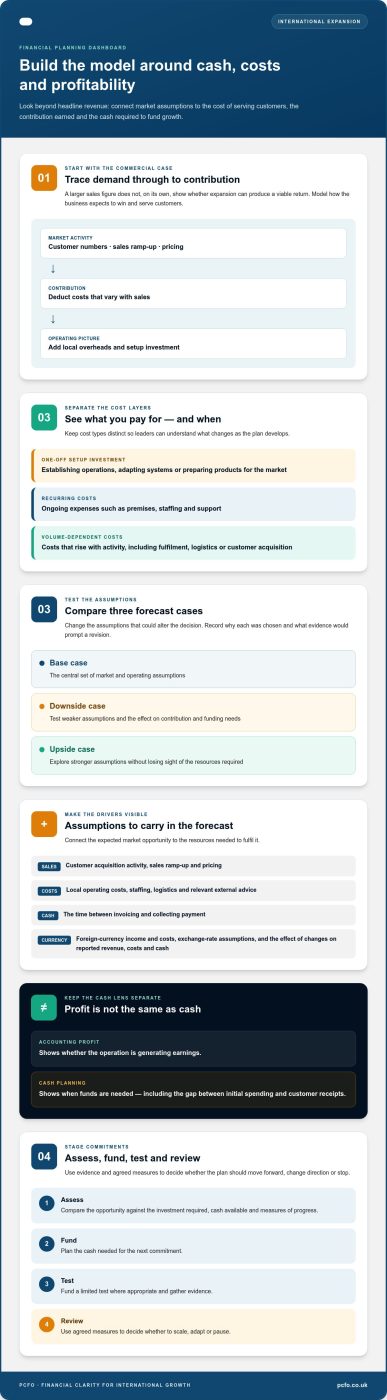
Use the plan to stage commitments. Assess the opportunity, fund a limited test where appropriate, review the results against agreed measures, then decide whether to scale, adapt or pause. The principle is simple: assess, fund, test and review. This keeps options open as evidence develops without dismissing a genuine growth opportunity.
Build the financial model around market assumptions, cash and profitability
A useful expansion model traces the commercial case from expected demand to the cash needed to deliver it. Start with customer numbers, sales ramp-up and pricing. Deduct costs that vary with sales to estimate contribution, then account for local overheads and setup investment. This makes it easier to see whether growth could produce a viable return, rather than simply a larger sales figure.
Separate costs so leaders can see what changes as the plan develops:
- One-off setup investment: initial costs such as establishing operations, adapting systems or preparing products for the market.
- Recurring costs: ongoing expenses such as premises, staffing and support.
- Volume-dependent costs: costs that rise with activity, including fulfilment, logistics or customer acquisition.
Build a base case, a downside case and an upside case. Change the assumptions that could alter the decision, such as sales pace, achievable pricing, cost levels or customer payment timing. Record why each assumption was chosen and what evidence would lead you to revise it. Citi’s discussion of global growth strategies also highlights the wider financial and geopolitical considerations that can affect international plans.
Which financial assumptions belong in an international expansion forecast?
Build the forecast around how the business expects to win and serve customers. Include the likely sales ramp-up, customer acquisition activity, pricing and the time between invoicing and collecting payment. Add local operating costs, staffing assumptions, logistics and relevant external advice. Together, these inputs connect the market opportunity to the resources needed to fulfil it.
Make currency assumptions visible too. Identify which income and costs will arise in foreign currencies, state the exchange-rate assumptions used, and show how changes could affect reported revenue, costs and cash. This makes currency exposure easier to assess instead of hiding it inside a single forecast total.
How should leaders assess cash requirements and break-even?
Profit and cash are not the same. Accounting profit shows whether the operation is generating earnings; cash planning shows whether the business can fund the journey to get there. Alongside setup costs, forecast working capital and any expected operating losses. Model when customers may pay, when suppliers must be paid and whether the parent business can support the timing gap.
Estimate when the operation could contribute positively, and make the assumptions behind that point explicit. Test how a slower sales ramp or later collections could shift it. Flag transfer pricing, VAT and reporting implications for appropriate specialist review, and verify current requirements for the relevant jurisdictions before relying on the model. Growing businesses can also use finance leadership and planning support to connect forecasts with funding decisions and ongoing management reporting.
Compare international entry models by investment, control and financial flexibility
The route into a market shapes more than the launch plan. It affects how much capital is committed, which operating responsibilities sit with your business and how readily you can change course. Compare each option against the same financial criteria, then reflect the differences in your forecast. There is no universally best model. The right choice depends on the company, market, customer proposition and operating requirements.
How do different entry models change the financial commitment?
Direct establishment can give the business greater control over customer relationships and operations, while placing more setup, staffing and ongoing responsibility directly on the company. A distributor or partner may reduce the need to build a full local operation, but can limit control over sales activity and introduce commissions, revenue sharing or reliance on another organisation. A lower-commitment test can help assess demand before a larger investment, provided it gives evidence relevant to the eventual operating model.
An Employer of Record (EOR) arrangement is another employment approach to evaluate, not a substitute for comparing the broader market-entry route. Assess its costs, responsibilities and suitability alongside the planned activity. Legal, tax and employment consequences vary by arrangement and jurisdiction, so seek appropriate specialist advice.
| Route | Control | Upfront commitment | Ongoing cost | Cash exposure | Flexibility |
|---|---|---|---|---|---|
| Direct establishment | Higher operational control | Typically higher, with local setup to plan for | Direct operating and staffing costs | More costs and working capital held by the business | Changes may involve adjusting an established operation |
| Distributor or partner | Shared or more limited control | Potentially lower than building a full operation | May include commissions or agreed revenue sharing | Depends on payment terms, stock and partner commitments | Depends on contractual arrangements and partner reliance |
| Limited test | Varies with the test design | Can be scoped to a defined activity | Costs depend on duration and delivery method | Can limit initial exposure if scope is controlled | Offers a review point before a larger commitment |
How can a business compare markets consistently?
Use the same demand, pricing, margin, cash timing and risk assumptions for every shortlisted market. Show which inputs are supported by evidence and which remain estimates. Then identify what further research would most improve confidence, such as validating customer demand or clarifying likely operating costs.
This is where developing a financial strategy for international expansion supports a more disciplined choice: compare both the market and the route, rather than assuming one entry model will work everywhere. For wider context on how expansion fits the company’s growth plans, see business growth advisory in the UK.
Turn the financial strategy into staged investment, risk controls and review points
A forecast becomes useful when it guides what the business does next. Set decision gates before committing funds, assign an owner to each decision and agree what evidence is needed to proceed. This turns developing a financial strategy for international expansion into ongoing financial oversight, rather than a plan that is revisited only when results disappoint.
Build a sequence of investment decisions
- Establish a baseline: record the current cash position, forecast, available funding and performance measures before expansion spending begins.
- Validate assumptions: assign owners to test demand, pricing, costs, payment timing and operational readiness. Note what evidence would change each assumption.
- Approve a pilot: define its scope, budget and intended outcomes, alongside a limit on further commitments.
- Review evidence: compare actual sales conversion, contribution, working capital and cash use with the forecast. Track variances and investigate their causes.
- Scale or adapt: release further investment only when agreed evidence supports it. Otherwise, change the approach, extend testing or pause.
Set review frequency to match the pace and financial exposure of the expansion. A launch with fast-changing costs or cash commitments may need closer monitoring than a slower, lower-exposure test. The finance lead should bring financial measures together with operational updates, so leaders can respond before a cash shortfall becomes urgent.
Which risks should the financial plan monitor?
Maintain a risk register alongside the forecast. Track currency movements, slower customer payments, rising costs and demand below plan. For each material risk, record its potential financial effect, mitigation, accountable owner and next review date. Tax, VAT, transfer pricing and reporting questions should be reviewed with qualified specialists using current rules for the relevant jurisdictions.
How should leaders set expansion decision gates?
Use clear thresholds, not the passage of time alone. For example, agree the minimum cash headroom to retain, the customer traction needed before extending a pilot, and the contribution level required to justify additional spending. Set measures that reflect the business’s funding position and expansion objectives.
| Scenario | What to test | Potential decision response |
|---|---|---|
| Downside | Slower sales, delayed collections or higher operating costs | Reassess cash runway, defer planned commitments or reduce the pilot scope |
| Base case | Expected demand, costs and payment timing | Proceed within the approved budget, subject to review gates |
| Upside | Stronger demand or faster customer conversion | Test whether capacity and working capital can support measured growth |
Regular cash flow forecasting helps leaders monitor liquidity against these scenarios. For support connecting expansion forecasts with funding decisions and management reporting, explore finance leadership support.
Put international expansion financial strategy into practice with senior finance oversight
A sound plan needs someone to connect its assumptions with the decisions leaders make as expansion progresses. The sequence is straightforward: define the objective, model the case, compare routes, stage investment and review results. Senior finance oversight keeps those steps connected, so commercial ambition, funding needs and performance reporting inform the same decisions.
For a growing business without a full-time senior finance leader, part-time or outsourced Finance Director or CFO support offers a flexible way to strengthen planning and oversight. The focus is on turning financial information into useful questions: are results tracking against the case, what has changed, and does the next commitment still make sense? This helps keep developing a financial strategy for international expansion grounded in evidence as the business learns.
What does a finance leader contribute to expansion planning?
A finance leader brings the commercial case, forecast and funding requirements into one view. They can help leadership teams understand the trade-offs behind a decision, such as whether to prioritise customer acquisition, protect cash headroom or delay a commitment until a key assumption is better supported. Management reporting then gives the team a consistent way to assess progress and respond to changes.
This contribution is most valuable when forecasts guide action, rather than simply record expected results. For more context, read about the strategic role of a Finance Director.
How can the business start developing its plan?
Begin with a short working document. Record the expansion objective, the markets under consideration and the evidence already available. Then identify which unknowns could most affect the decision. For instance, if the case depends on a particular sales pace or customer payment pattern, make that assumption visible and prioritise research that can test it.
- Objective: What should expansion achieve for the business?
- Evidence: What do you know about demand, costs and the ability to serve customers?
- Decision-sensitive assumptions: Which estimates could change the route, funding requirement or timing?
- Next review: What evidence will leadership need before approving the next step?
This creates a practical starting point, even if some inputs remain uncertain. Part-time and outsourced finance leadership can be tailored to a business’s growth stage and planning needs, helping connect forecasts to commercial decisions and management reporting. To discuss financial planning and growth support, speak with PCFO.
Move forward with a clearer expansion decision
International growth is easier to manage when it is treated as a sequence of evidence-led decisions, not a single commitment. Developing a financial strategy for international expansion means comparing markets on consistent assumptions, understanding how investment affects cash and profitability, and setting review points before moving to the next stage.
Start with a clear objective, test the financial case and compare entry routes against your business’s needs. Then stage funding against measurable evidence, keeping cash, margins and changing assumptions under review. This gives leaders room to adapt while keeping expansion ambitions connected to the company’s financial capacity.
PCFO’s part-time and outsourced Finance Director and CFO leadership can help connect forecasts with funding decisions and management reporting. Business growth advisory, business planning support and outsourced accountancy solutions can also support growing businesses as their needs develop.
Discuss your financial strategy for international expansion with PCFO and take a considered next step towards growth. With a clear plan and regular financial oversight, you can pursue international opportunities with greater confidence.
Frequently Asked Questions
How do you develop a financial strategy for international expansion?
Develop it by linking the expansion objective to a tested commercial case, funding plan and measurable review points. Define what growth should achieve, compare markets using consistent assumptions, and model demand, pricing, margins, operating costs and cash timing. Then assess entry options, test key uncertainties and stage investment against evidence. Assign decision owners and agree what results would prompt the business to proceed, adapt or pause.
What should an international expansion financial plan include?
An international expansion financial plan should include sales and pricing assumptions, contribution margins, setup investment, recurring and volume-linked costs, and working capital requirements. It should also show forecast cash flow, funding exposure and scenarios for weaker or stronger performance. Record foreign exchange assumptions and identify relevant tax, VAT, transfer pricing and reporting questions for qualified specialist review. Include measures and review dates so leaders can compare actual performance with the plan.
How do you compare markets for international expansion financially?
Compare each shortlisted market using the same model structure and decision criteria. Apply consistent assumptions for demand, pricing, sales conversion, margins, operating costs, payment timing, cash exposure and key risks. Clearly distinguish evidence-backed inputs from estimates, then note what research could improve confidence. A market with higher projected revenue may still be less attractive if costs, collection delays or investment needs weaken its contribution or increase funding pressure.
How much funding does a business need for international expansion?
There is no universal funding figure. Estimate the cash needed to cover setup investment, operating costs, expected early losses where applicable and working capital until customer receipts arrive. Model the timing of payments as well as total costs, then test how slower sales, delayed collections or higher costs could affect the cash low point. The funding plan should preserve appropriate headroom and be updated as assumptions are validated.
How can a business manage foreign exchange risk when expanding?
Start by identifying expected foreign-currency income and expenses, including when each is likely to be received or paid. Record the exchange-rate assumptions in the forecast and model how movements could affect margins and cash. Businesses can assess approaches such as matching currency inflows with outflows, agreeing transaction currencies or considering financial instruments. The appropriate approach depends on the company’s exposure and should be assessed with suitably qualified financial specialists.
Should a business establish a foreign entity before entering a new market?
Not necessarily. The appropriate structure depends on the planned activities, customer proposition, operating responsibilities and local requirements. Compare the financial and practical implications of direct establishment with partner-led arrangements or a limited test, where suitable. Before committing, obtain qualified legal, tax and employment advice on the proposed route and verify current requirements for the jurisdiction. Reflect the expected setup and ongoing obligations in the financial model before approving investment.