

What if your highest-revenue customers aren’t your most profitable? If you’re working out how to calculate customer lifetime value (clv), that distinction matters. A useful estimate depends on consistent customer data, realistic margins and clear assumptions, not revenue alone.
Where to start depends on how customers buy from you. Subscription businesses, retailers and service firms have different purchasing patterns, so there isn’t one formula for every model. Incomplete retention or cost data can also make a precise-looking figure less reliable than it seems.
This guide explains how to choose a CLV method that fits your business and calculate a transparent estimate with the information you have. You’ll see how to distinguish customer revenue from customer profit, identify the assumptions behind your result and account for data gaps.
It also shows how to use CLV alongside customer acquisition and retention measures, so it can inform growth planning and forecasting rather than sit as a standalone number. Reliable CLV starts with consistent cohorts, margins and explicit assumptions.
Key Takeaways
- Learn how to calculate customer lifetime value (clv) with a formula suited to your business model and the data you have.
- Compare historical, lifespan-based and forward-looking approaches to understand what each can reveal.
- Follow a worked example to see how average order value, purchase frequency, customer lifespan and gross margin shape an estimate.
- Use customer segments to identify where retention efforts may support growth, while considering whether those results can scale.
- Apply CLV alongside acquisition costs, cash flow and retention measures to inform planning.
What customer lifetime value means and why it matters
Customer lifetime value (CLV) estimates the value a customer generates over their relationship with a business. It can measure revenue or profit, and cover either a past period or an expected future lifespan. It is not simply the value of one purchase. A foundational overview of the concept and common models is available in Customer Lifetime Value.
Leaders use CLV to consider customer acquisition, retention and profitability together. It can help assess how much marketing investment or retention effort may be justified, and which products, services or customer groups contribute most to performance. The measure needs a clear label: revenue-based CLV describes sales, while a gross-margin-adjusted or profit-based figure estimates the value remaining after specified costs are accounted for. These are different measures and should not be compared as if they mean the same thing.
CLV is an estimate whose usefulness depends on consistent inputs, clear definitions and explicit assumptions. Before calculating it, decide what question you need the measure to answer. That choice determines the data, time period and method to use.
What does customer lifetime value measure?
CLV measures an observed or expected customer relationship over time, rather than a single transaction. A retrospective calculation summarises activity within a defined historical period. A forward-looking estimate uses past behaviour and other assumptions to project the value a customer may generate in future. Neither approach is automatically more reliable: the right one depends on the decision and the quality of your data.
Revenue-based CLV helps assess sales associated with customers or segments. Margin-adjusted CLV is more relevant when you want to understand contribution to profit, because two customers with similar spending may have different costs to serve. State which version you’re using and which costs it includes.
When is CLV useful to a growing business?
CLV can inform decisions about retention activity, marketing allocation and product or service development. For example, if a segment generates strong margin but customers tend to leave early, you could assess whether targeted retention efforts make commercial sense. If you use CLV in forecasts, review its assumptions alongside your other financial plans.
A company-wide average can hide meaningful differences. Comparing segments by acquisition channel, product or customer behaviour may show where value is concentrated and where performance varies. Treat those findings as decision support, not a verdict. A high-CLV segment may be costly to serve or difficult to grow, while a lower current value could reflect newer customers with limited history. Consider CLV alongside other business measures before changing priorities.
How to calculate customer lifetime value: formulas and inputs
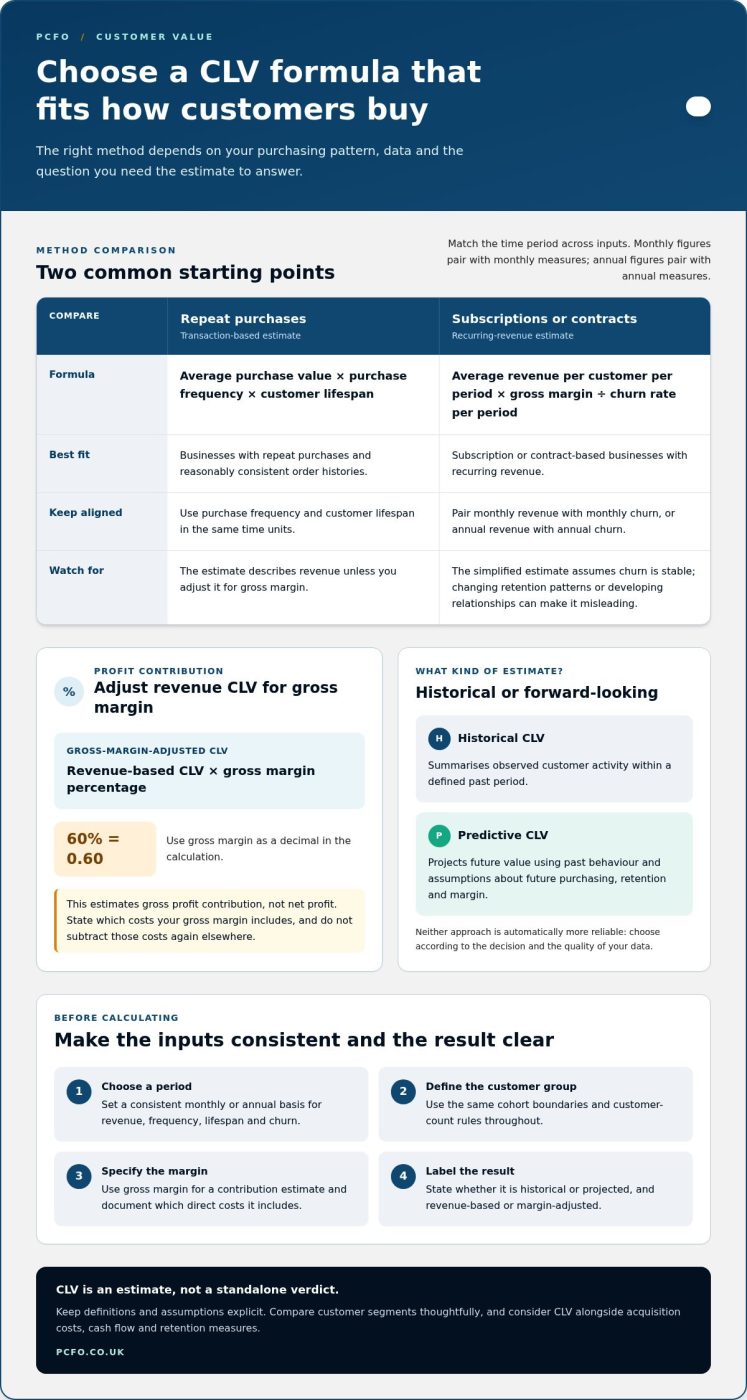
The right CLV formula depends on how customers buy from you and what you want the result to show. For repeat purchases, start with a transaction-based revenue estimate:
Revenue-based CLV = average purchase value × purchase frequency × customer lifespan
Keep the time units consistent. If purchase frequency is measured in orders per year, customer lifespan must be in years. To estimate gross-margin-adjusted CLV, multiply the revenue-based result by gross margin percentage:
Gross-margin-adjusted CLV = revenue-based CLV × gross margin percentage
Use gross margin as a decimal in the calculation, such as 0.60 for 60%. This estimates gross profit contribution, not net profit. State which costs are included in your gross margin, and avoid subtracting those costs again elsewhere in the formula.
Which CLV formula suits your business model?
Transaction frequency is a practical choice for businesses with repeat purchases and reasonably consistent order histories. Subscription or contract-based businesses can use a simplified recurring-revenue estimate:
Recurring CLV = average revenue per customer per period × gross margin ÷ churn rate per period
Pair monthly revenue with monthly churn, or annual revenue with annual churn. This simplified estimate assumes churn is stable, so it can mislead if retention patterns change or customer relationships are still developing.
Historical CLV summarises observed customer activity. A predictive estimate projects future value, relying on assumptions about future purchasing, retention and margin. IBM’s overview of historic and predictive CLV distinguishes these approaches. A practical answer to how to calculate customer lifetime value (clv) starts by matching the method to the decision and the evidence available.
What data do you need to calculate CLV?
Define each input before calculating. Average purchase value is revenue per order; purchase frequency is the number of orders per customer over a stated period. For recurring revenue, use average revenue per customer over a clearly defined period. Customer counts, repeat purchasing, retention and churn should refer to the same cohort and timeframe.
- Choose a period: Set a consistent monthly or annual basis for revenue, frequency, lifespan and churn.
- Define the customer group: Apply the same cohort boundaries and customer-count rules throughout.
- Specify margin: Use gross margin when estimating contribution, and document which direct costs it includes.
- Label the result: Make clear whether the figure is historical or projected, and revenue-based or margin-adjusted.
If you’re embedding CLV assumptions in forecasts and growth plans, finance leadership for business planning can help connect the metric with wider financial decisions.
How to choose a reliable CLV method for your data
Choose a method that reflects both customer behaviour and the decision you need to make. A simple calculation based on observed purchases may be more useful than a complex forecast if your history is limited or inconsistent. Before comparing results, define the customer group, observation period and margin basis.
A CLV result is only comparable when its period, cohort and margin basis match. Without shared definitions, a change in the figure may reflect a different calculation rather than a real change in customer value.
Historical CLV or predictive CLV: which should you use?
Historical CLV describes what customers actually generated during a defined period. It’s useful for reviewing past performance when records are complete and the period is long enough to capture relevant behaviour. A simple lifespan estimate extends observed patterns, while a predictive model forecasts future spending, retention or margin. That forecast needs stronger assumptions and enough consistent history to support them.
Changes in prices, product mix or retention can weaken the link between past behaviour and future results. Treat projections cautiously when those conditions are shifting, and explain where missing history limits confidence.
How can customer cohorts improve the estimate?
Calculate CLV for groups with a meaningful shared characteristic, such as acquisition period, channel or product. Customers acquired through different routes may have different purchase patterns, so one blended average can conceal useful differences. Use the same cohort rules and observation window each time you compare results.
Small or incomplete cohorts can produce unstable estimates. Label them clearly and avoid presenting a precise-looking figure as conclusive.
For subscription or contract businesses, a common simple lifespan approximation is the reciprocal of the churn rate. For example, use a monthly churn rate to estimate lifespan in months, not years. This shortcut assumes churn is reasonably stable and consistently defined, including which customers count as having left and over what period. If churn changes materially, the resulting lifespan may misrepresent the relationship.
Use these checks to select and document a method:
- History: Is customer activity complete for the period you’re measuring?
- Consistency: Are purchase, retention or churn inputs defined in the same way across groups?
- Purpose: Are you describing past performance or estimating future value?
- Confidence: Are there gaps, small cohorts or changing conditions that should qualify the result?
A transparent estimate is more useful than an apparently precise one. Record the formula, period, cohort definitions and assumptions, then revisit them as customer behaviour and business conditions change.
How to calculate CLV step by step, with a worked example
Use one clearly defined customer group and a consistent time basis, then show each input and calculation. The figures below are hypothetical and illustrate a transaction-based estimate. They don’t represent a typical business result.
How to work through the calculation
- 1. Choose a cohort: Select customers with a shared characteristic, such as when they first purchased or the channel through which they were acquired.
- 2. Define the period: Use years for both purchase frequency and customer lifespan in this example. Keep the customer definition, currency and observation period consistent.
- 3. Assemble the inputs: Assume an average order value of £80, four orders per customer each year, a three-year lifespan and a gross margin of 60%.
- 4. Select the formula: For repeat purchases, multiply average order value by annual purchase frequency and lifespan. Then multiply the revenue estimate by gross margin to estimate gross profit contribution.
- 5. Calculate and label the results: Keep revenue CLV separate from margin-adjusted CLV.
Revenue CLV: £80 × 4 orders per year × 3 years = £960.
Margin-adjusted CLV: £960 × 60% = £576.
The first figure estimates revenue over the assumed relationship. The second estimates gross profit contribution using the stated margin. It isn’t net profit and won’t include costs excluded from the gross-margin calculation.
How to check your CLV estimate
Test whether the assumed lifespan fits observed customer history and retention patterns. Compare the result across cohorts before treating it as representative of your whole customer base. If one group has a shorter purchasing history, flag that limitation rather than implying equal confidence in every estimate.
Then test alternative assumptions. If the lifespan were two years instead of three, revenue CLV would be £80 × 4 × 2 = £640, and margin-adjusted CLV would be £640 × 60% = £384. If lifespan stayed at three years but gross margin were 50%, the adjusted estimate would be £960 × 50% = £480. These are illustrative scenarios, not predictions.
Document the cohort, period, formula, margin basis and assumptions. This makes the calculation easier to reproduce and helps you assess how changes in customer behaviour could affect planning. If you’re incorporating CLV into forecasts, strengthen your financial planning with finance leadership that connects customer economics to wider business decisions.
How to use CLV in growth planning and financial decisions
CLV is most useful as part of a wider financial view, not as a decision in isolation. Compare it with customer acquisition cost (CAC), retention measures and cash flow to understand both the potential value of a customer and the investment needed to acquire and serve them. A high estimated CLV doesn’t guarantee future profitability, particularly if customer behaviour, costs or margins change.
How should you interpret CLV alongside CAC?
Calculate CAC on a comparable basis. For example, divide acquisition costs by the number of new customers in the same cohort and period used for CLV. A CLV-to-CAC comparison can help assess whether acquisition investment appears proportionate to expected customer value, but it isn’t a promise of future returns. Check payback timing too. A customer may generate value over several years, whilst acquisition spending and operating costs affect cash flow sooner.
Retention measures add another perspective. If customers leave earlier than the lifespan assumed in your CLV estimate, the expected value may not be realised. Review acquisition, retention and margin assumptions together before adjusting budgets or growth targets.
How can finance planning make CLV more useful?
Use segment-level CLV to decide where retention activity or marketing investment may merit closer attention. A high-value segment isn’t automatically scalable: consider whether there are enough suitable customers to reach, whether acquisition costs would rise and whether the business can maintain service levels and margins as it grows. For a wider view of these choices, explore business growth advisory and scaling strategy.
Bring CLV assumptions into revenue, margin and retention forecasts. Record where each input comes from and when it was reviewed, then use sensitivity analysis to see how changes in purchase frequency, lifespan or margin could affect decisions. This helps leaders understand which assumptions matter most instead of treating one headline estimate as certain. FP&A consulting versus software for UK SMEs explores how analysis can fit into planning processes.
For growing businesses, finance leadership can connect customer economics with forecasts and strategic priorities. PCFO’s Finance Director and CFO services support this wider planning. Consider how how to calculate customer lifetime value (clv) fits your plans, then review the inputs regularly and update the estimate as customer behaviour and business conditions evolve.
Turn your CLV estimate into a planning tool
A useful CLV estimate starts with a formula that fits your business model, consistent customer data and clearly stated assumptions. Distinguish revenue from margin-adjusted value, then compare customer segments on the same basis. This makes the answer to how to calculate customer lifetime value (clv) more than a headline figure: it becomes a decision-support measure.
Use the result alongside customer acquisition cost, cash flow and retention measures. Review assumptions as customer behaviour changes, and connect your findings to forecasts and growth priorities. CLV can guide decisions, but it should inform wider commercial judgement rather than replace it.
PCFO provides fractional and outsourced Finance Director and Chief Financial Officer services, alongside support for business planning, growth advisory and outsourced accountancy. If you’re ready to connect customer profitability analysis with your wider plans, explore how PCFO supports financial planning and business growth.
With clear inputs and regular review, you can use CLV to make more considered decisions about where your business grows next.
Frequently Asked Questions
How do you calculate customer lifetime value?
To calculate customer lifetime value, choose a customer group and a consistent measurement period, then select a formula that fits your business model. For repeat purchases, multiply average purchase value by purchase frequency and customer lifespan. To estimate gross-profit contribution, multiply revenue CLV by gross margin. State your assumptions, keep inputs consistent and label the result clearly. The calculation is an estimate, not a guaranteed forecast of future customer behaviour.
What is the simplest CLV formula?
A simple transaction-based formula is average purchase value multiplied by purchase frequency and customer lifespan. This gives a revenue estimate, not profit. For a gross-margin-adjusted estimate, multiply the revenue result by the gross margin percentage once. Make sure purchase frequency and lifespan use the same time basis, such as orders per year and years. Treat the result as an estimate and document the assumptions behind it.
Should CLV be calculated using revenue or profit?
Either measure can be useful, but each answers a different question. Revenue CLV estimates the sales generated across a customer relationship. Margin-adjusted CLV estimates gross-profit contribution before other costs, depending on which costs are included in gross margin. Label the measure so it’s clear what the figure represents. For meaningful comparisons, don’t set revenue CLV against a profit-based acquisition cost or compare results calculated on different bases.
How do you calculate customer lifetime value for a subscription business?
A simplified subscription estimate is average revenue per customer per period multiplied by gross margin, then divided by churn rate for that same period. For example, monthly revenue requires a monthly churn rate. The approach assumes churn is defined consistently and remains sufficiently stable. Use a suitable customer cohort, explain the assumptions and treat the result cautiously if retention is changing. In those circumstances, the estimate may be less reliable as a guide to future value.
What is the difference between CLV and customer acquisition cost?
CLV estimates the value generated over a customer relationship; customer acquisition cost (CAC) estimates the cost of acquiring a customer. Comparing them can help assess acquisition economics, provided customer definitions and time bases are consistent. The comparison alone doesn’t show when revenue or costs occur. Consider payback timing and cash flow too, since acquisition spending may happen before the customer generates the value projected by CLV.
How often should a business recalculate CLV?
Review CLV when customer behaviour, pricing, gross margin, retention or your business model changes materially. Regular reviews can also keep assumptions current, but the right frequency depends on how quickly your data and trading conditions change. Record the calculation date, method and key inputs each time. That makes it easier to distinguish a genuine change in customer performance from one caused by updated definitions or calculation assumptions.
Can CLV be calculated with limited customer data?
Yes, but limited data makes the result more uncertain. Start with the most reliable figures available, define the customer group and measurement period, and disclose assumptions about repeat purchases, lifespan or churn. Don’t present a small or incomplete sample as representative of every customer. As transaction, margin and retention records become more consistent, update the calculation and assess whether the estimate provides a stronger basis for business decisions.