

The simplest recurring price isn’t always the safest choice. A flat subscription can make revenue easier to forecast, but it may not reflect how customers use or value your offer. Usage-based pricing can align charges more closely with demand, yet make costs harder for customers to predict. Choosing between these options is a central challenge when assessing pricing strategies for recurring revenue businesses.
It’s reasonable to be cautious. A price change or poorly matched model can affect customer trust and retention, while a price that doesn’t cover delivery costs can constrain cash flow and growth. The aim isn’t to chase the highest headline price, but to align what customers pay with the value they receive and the cost of serving them.
This guide compares common recurring pricing models and sets out a practical framework for assessing fit, testing changes and reviewing results. You’ll consider customer behaviour alongside margins, forecasting and unit economics, so pricing decisions can support sustainable growth and withstand financial scrutiny. It also explains how structured financial planning can help you refine your approach as your business evolves.
Key Takeaways
- Use a clear framework to compare pricing strategies for recurring revenue businesses, weighing customer behaviour against revenue predictability and operational demands.
- Build prices around outcomes customers value, while checking delivery costs, acquisition costs and retention evidence.
- Test pricing changes in a measured way, with a baseline and clear criteria for deciding whether to proceed.
- Review conversion, churn, expansion, payment failures and gross margin together to understand the quality of recurring revenue.
- Include pricing in regular financial planning to assess its effect on forecasts, cash flow and growth priorities.
Why pricing strategy matters for recurring revenue businesses
Recurring pricing sets what customers pay, when they pay and what continuing value they receive in return. Price, packaging, billing frequency and customer experience need to work together. A plan may look attractive at sign-up but still cause confusion if charges are hard to understand or the service no longer feels worth renewing.
A pricing strategy is the business decision about how to charge for ongoing value. A billing process is the operational method used to issue invoices, collect payments and manage renewals. Keeping the two distinct helps you assess whether your commercial approach is sound, rather than focusing only on whether your systems can process it.
Unlike a one-off sale, recurring revenue depends on customers continuing to pay over time. Some businesses combine both, for example, by charging an ongoing subscription alongside a one-off set-up fee. The Subscription business model includes different ways to structure continuing access or services. The right approach depends on what customers receive and how they use it.
What makes recurring revenue pricing different?
Each renewal gives customers another opportunity to weigh the value they receive against the price they pay. Retention therefore affects customer lifetime value: keeping a suitable customer for longer can support more revenue over the relationship, provided the cost of serving them remains sustainable. A recurring commitment may make income easier to forecast, but it doesn’t guarantee future revenue. Customers can cancel, contracts can end and payments can fail.
Recurring arrangements vary. A contractual subscription usually sets out continuing access or service for an agreed period, while a membership may centre on participation or benefits. A retainer or ongoing service arrangement can provide continuing support under agreed terms. These differences shape customer expectations, how they perceive value and how clearly the offer needs to be packaged.
What should pricing help the business achieve?
Effective pricing connects customer-perceived value with sustainable contribution margins and a clear market position. Set prices too low and delivery costs may erode returns. Set them without a clear value case and customers may question renewal. Pricing strategies for recurring revenue businesses must balance acquisition, expansion, retention and predictable income. A discount may support sign-ups, for example, but its effect on later renewals and margins matters too.
Two measures can help frame performance:
- Monthly recurring revenue (MRR) is the recurring revenue value from active subscriptions, expressed monthly.
- Annual recurring revenue (ARR) expresses recurring revenue on an annualised basis.
Use these as operating measures, not as substitutes for cash-flow forecasts or recognised revenue. Reviewing them alongside margins, customer behaviour and plan mix gives leaders a clearer basis for pricing decisions and growth planning.
How to compare recurring revenue pricing models
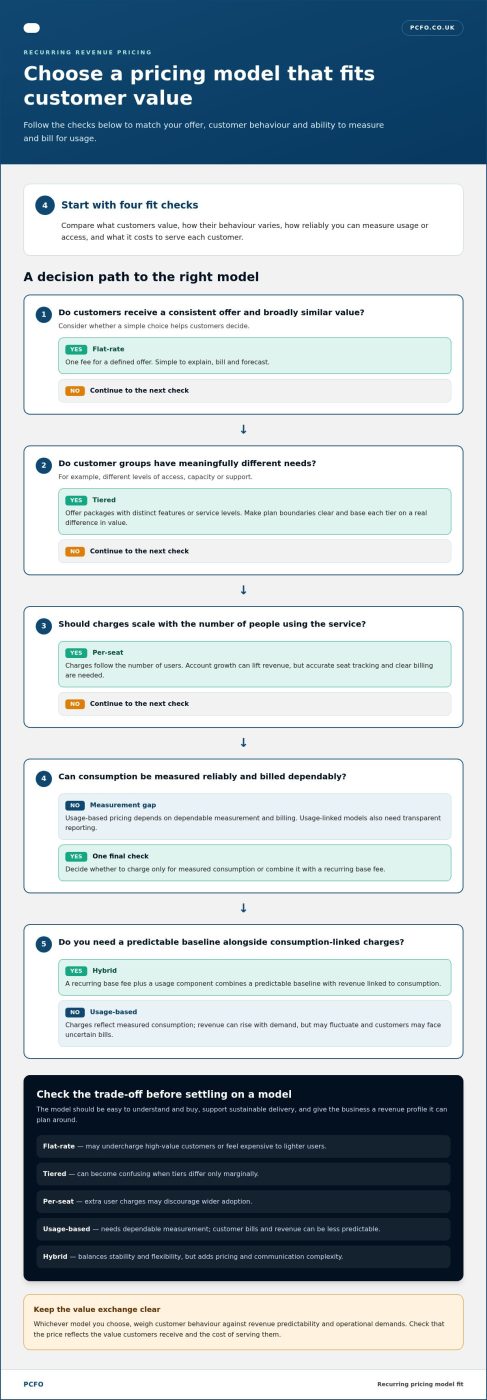
The right model makes the offer easy to understand and buy, supports sustainable delivery and gives the business a revenue profile it can plan around. Compare pricing strategies for recurring revenue businesses against four questions: what customers value, how their behaviour varies, how reliably you can measure usage or access, and what it costs to serve each customer.
Model | Customer logic | Revenue and operational implications | Main trade-off
Flat-rate | One fee for a defined offer. | Simple to explain, bill and forecast. | Easy to buy, but may undercharge high-value customers or feel expensive to lighter users.
Tiered | A choice of packages with distinct features or service levels. | Supports segmentation and upgrades; needs clear plan boundaries and regular review. | Useful choice can become confusing if tiers differ only marginally.
Per-seat | Charges scale with the number of users. | Account growth can lift revenue, but requires accurate seat tracking and clear billing. | Customers may limit adoption if each additional user increases the bill.
Usage-based | Charges reflect measured consumption. | Revenue can rise with demand, but depends on dependable measurement and billing. | Customers may face uncertain bills, while revenue can fluctuate.
Hybrid | A recurring base fee plus a usage component. | Combines a predictable baseline with revenue linked to consumption; requires transparent usage reporting. | Balances stability and flexibility, but adds pricing and communication complexity.
When do flat-rate, tiered and per-seat models fit?
A flat fee can suit a consistent offer where customers receive similar value and simplicity helps them decide. Tiers are more appropriate when customer groups have meaningfully different needs, such as distinct levels of access, capacity or support. Build each tier around a real difference in value, not just extra features for their own sake.
Per-seat pricing can align charges with the number of people benefiting from a service and create a route to account expansion. Consider, though, whether seat charges could discourage wider adoption. If broader use improves customer outcomes, that barrier may work against retention and long-term growth.
When should a business consider usage-based or hybrid pricing?
Usage-based pricing is most appropriate when measured consumption closely tracks customer value, can be recorded accurately and is easy for customers to understand. Explain how usage is counted and make limits or alerts clear, so customers can manage their spend. A hybrid model can reduce bill uncertainty by combining a base subscription with charges for usage beyond an included level.
There is no universally best model. Test the options against customer behaviour, delivery economics and forecast impact. Financial leadership can help connect that assessment to margins and growth plans. Business planning support provides a structured basis for evaluating the commercial implications.
How to set recurring prices around value, costs and customer segments
Value-based pricing starts with understanding the outcomes customers want, then assessing how your offer helps deliver them. It isn’t a reason to raise prices simply because a customer appears willing to pay more. Strong pricing strategies for recurring revenue businesses connect a clear customer benefit with the resources needed to deliver it consistently.
Recurring prices need to reflect both the value customers perceive and the cost to serve them. A price grounded only in perceived value may leave delivery costs uncovered; one based only on costs can overlook what makes the offer distinctive. Assess both alongside gross margin targets, customer acquisition costs and retention evidence.
How can customer value inform recurring prices?
Build your view from evidence. Customer conversations, usage patterns, renewal feedback and analysis of alternatives can reveal which outcomes matter, what customers use and where they see a difference. Look for a value metric that is observable, understandable and connected to the offer. For instance, if customers value capacity, a measure linked to capacity may make more sense than one based on a feature they rarely use.
Customer lifetime value (CLV) and customer acquisition cost (CAC) can help assess commercial sustainability. CLV estimates the value of a customer relationship over time; CAC estimates the cost of acquiring a customer. Neither determines the right price on its own. Treat them as inputs, and check assumptions against actual retention, acquisition and service costs. A high estimated CLV, for example, doesn’t justify a price customers consider unfair or an offer that is expensive to support.
How should tiers and packaging reflect different needs?
Segments may differ in objectives, usage, willingness to pay and the level of support they require. Don’t assume those differences from company size or job title alone. Use customer and operational evidence to identify meaningful groups, then shape packages around outcomes, service levels or usage limits that matter to each group.
Make the distinctions easy to compare. Customers should be able to see what changes between plans and why an upgrade might be useful. A smaller plan could suit customers with simpler needs, while a higher tier could include greater capacity or more support. The upgrade path should reflect increased value, not rely on withholding an essential part of the core outcome.
Finally, model the financial effect of each package. Compare expected revenue with delivery effort, acquisition costs and retention patterns by segment. This provides a more reliable basis for setting prices, protecting margins and refining the offer as customer needs evolve.
How to test pricing changes while managing churn and cash-flow risk
A pricing test should limit uncertainty, not simply measure whether a higher price increases short-term revenue. Before making a change, decide what evidence would support a wider rollout and what results would prompt you to pause or revise it. The right test design depends on customer volume, contract terms and the nature of the change. A small customer base, for example, may call for a phased review rather than a simple split test.
- Establish a baseline. Record current conversion, churn, expansion, gross margin, payment failures and recurring revenue. Note existing discounts and cost-to-serve, so you can distinguish a pricing effect from other changes.
- Form a hypothesis. State what you expect to change and why. For example, a revised package might improve conversion amongst a defined customer group without reducing retention or contribution margin.
- Choose a proportionate test. Identify the customers, plans or new sign-ups affected, and set the test period according to renewal cycles and contract terms. Avoid changing several things at once if you need to understand what drove the result.
- Monitor the full picture. Track the primary outcome alongside supporting measures, including churn, expansion, gross margin, failed payments and recurring revenue. Review customer feedback and cancellations too.
- Decide before scaling. Compare results with the baseline and your pre-agreed criteria. Proceed only when customer outcomes and financial effects are acceptable; otherwise, refine the offer or stop the change.
What should a recurring pricing test measure?
Choose one primary measure, such as conversion or expansion, and supporting indicators before the test begins. Compare like with like: customer cohorts or equivalent periods can help, but account for seasonality, renewal timing and concurrent changes to marketing, service or packaging. A rise in recurring revenue alone may hide higher discounting, weaker retention or increased cost-to-serve. Assess revenue quality as well as its headline movement.
How can a business communicate pricing changes clearly?
Explain what is changing, when it takes effect and how it affects each customer group. Keep the message direct and consistent across relevant customer communications. Plan the treatment of existing customers with their agreements and applicable requirements in mind, and give customers time to understand the change before it affects them.
After communicating, monitor questions, feedback, cancellations and payment behaviour. A clear explanation can help protect trust, while early signals give you time to respond before rolling the change out more widely.
Structured financial planning can help assess forecast, margin and cash-flow implications before a test is expanded. Pricing and growth planning can be considered alongside financial leadership.
How financial leadership turns pricing strategy into a recurring review
Pricing should be reviewed as part of financial planning, not treated as a one-off decision. A change to price, packaging or discounts can affect customer retention, margins, cash flow and the resources needed to deliver the service. Consider these effects alongside strategic priorities, such as entering a new segment or investing in growth. This helps ensure pricing strategies for recurring revenue businesses support the company’s direction as well as its immediate revenue needs.
What belongs in a recurring pricing review?
Set a regular review point that suits your sales and renewal cycles. Bring the main indicators together rather than judging performance through revenue alone:
- Revenue quality: recurring revenue, churn and expansion, viewed by plan or customer segment.
- Commercial performance: gross margin, acquisition trends, discounting and plan mix.
- Customer evidence: feedback, usage patterns and reasons for cancellation or upgrades.
Compare actual results with the assumptions in your forecast. If a plan attracts more customers than expected but requires substantially more support, investigate the effect on margins and delivery capacity. Record the decision, its rationale, an owner and the measures to revisit. That creates accountability and makes it easier to see whether a pricing change delivered the intended result.
When can external finance leadership help?
As a business grows, pricing decisions can involve more segments, plans and cost considerations. A fractional CFO or Finance Director can help model scenarios, compare their effects on revenue, cash flow and margins, and connect the findings to the wider business plan. This provides a structured basis for weighing options rather than relying on a single forecast or headline revenue measure.
PCFO’s fractional CFO, Finance Director and business-planning support can bring financial leadership into pricing decisions and ongoing review. This strategic support can help management understand the assumptions behind a proposed change, assess the trade-offs and revisit performance as the business evolves.
Explore PCFO’s finance leadership support to bring pricing decisions into a broader financial plan.
Make pricing a stronger foundation for growth
Sound pricing isn’t a one-off decision. It comes from matching the model to customer value, understanding what it costs to deliver, and reviewing the effect on retention and margins. Test changes against clear measures before rolling them out, then revisit the evidence as customer needs and business priorities evolve.
The most effective pricing strategies for recurring revenue businesses connect commercial choices to forecasts, cash flow and sustainable growth. Regular financial review helps you see whether recurring revenue is translating into healthy margins and whether your plans remain grounded in what the business can deliver.
PCFO provides fractional and outsourced CFO and Finance Director services, alongside business planning, growth advisory and outsourced accountancy support. This financial leadership can help bring structure to pricing decisions and their wider business implications. Discuss how financial leadership can support your pricing decisions.
With a clear framework and regular review, you can refine your approach with greater confidence and build a stronger platform for growth.
Frequently Asked Questions
What is the best pricing strategy for a recurring revenue business?
There’s no single best model; choose the one that fits your offer, customer behaviour and delivery economics. A flat fee may suit a consistent service that customers value similarly, while tiers can serve distinct needs. Usage-based pricing may fit when measurable consumption closely reflects value. Compare customer clarity, revenue predictability, cost-to-serve and margin before deciding. The strongest pricing strategies for recurring revenue businesses balance customer value with sustainable financial performance.
How should a business choose between tiered and usage-based pricing?
Choose tiers when customer groups have meaningfully different needs that can be met through clear package differences, such as access, support or capacity. Consider usage-based pricing when consumption can be measured transparently and closely tracks the value customers receive. Tiers make costs easier to anticipate, while usage pricing can make bills less predictable. Compare how each model affects customer understanding, adoption, revenue forecasting and the effort required to administer it.
Can changing prices increase churn?
Yes, a price change can prompt cancellations if customers don’t understand the reason, see enough value or can absorb the additional cost. The effect depends on the size and structure of the change, customer expectations and the alternatives available. Explain what is changing, when it takes effect and how customers are affected. Monitor cancellations, feedback, renewals and payment behaviour, and assess these alongside revenue and margin before extending the change.
How often should a recurring revenue business review its pricing?
Review pricing on a regular schedule that reflects your renewal cycles and the pace of change in your offer, costs and customer needs. A quarterly review can provide a useful planning rhythm, though not every review needs to result in a price change. Reassess sooner if margins shift, customer feedback changes, discounting grows or plan mix moves unexpectedly. Keep a record of assumptions and decisions so each review builds on evidence rather than instinct alone.
Should recurring revenue businesses use value-based pricing?
Value-based pricing can be useful when you understand which outcomes customers value and how your offer contributes to them. It should inform, not replace, financial analysis: check the price against delivery costs, gross margin objectives, acquisition costs and retention evidence. Customer conversations and usage patterns can help identify relevant value measures. Make the measure understandable and connected to the offer, rather than assuming perceived value alone determines a sustainable price.
How can a business test a new subscription pricing model?
Start by recording a baseline and choosing a primary outcome, such as conversion or expansion, with supporting measures including churn, gross margin and payment failures. Form a clear hypothesis, then test with a defined customer group or period where contract terms allow. Compare similar cohorts or periods and account for other changes that could affect results. Decide in advance what evidence would justify wider rollout. Assess customer outcomes and financial effects before proceeding.
Which metrics matter most when reviewing recurring pricing?
Review recurring revenue alongside conversion, churn, customer expansion and gross margin to understand both growth and revenue quality. Add payment failures, discounting and cost-to-serve, since these can affect cash collection and the return from each plan. Compare actual performance with forecast assumptions, and examine results by customer segment or plan where the data allows. No single measure gives the full picture; interpret the metrics together before changing prices or packaging.