

R&D tax relief can reduce the cost of qualifying work, but a project must seek an advance in science or technology by resolving scientific or technological uncertainty. That makes R&D tax credits and financial planning closely connected: potential relief can affect how a UK business assesses project spending, tax liabilities and future investment.
It’s understandable to focus first on whether a project or expense qualifies. Eligibility depends on the work involved and the evidence linking costs to that work, so a claim needs more than an innovative idea or a successful outcome. Projects that don’t succeed may still qualify if they involved resolving technical uncertainty.
This article explains what UK R&D tax credits are, which businesses and activities may qualify, and how to factor eligible spending into cash-flow forecasts. It also explains why reviewing project costs as work develops connects a potential claim with wider business decisions, rather than treating it as a separate year-end exercise.
Key Takeaways
- Assess whether project work seeks an advance in science or technology by addressing uncertainty, rather than relying on whether the project succeeds.
- Review your company’s tax position and business structure when considering eligibility for UK R&D tax relief.
- Connect project costs to the activities they support, and keep clear records to explain how expenditure relates to the work.
- Bring potential relief into cash-flow forecasts and investment decisions, while treating it as part of your wider tax planning.
Are research and development expenses tax deductible?
UK R&D tax relief can reduce the cost of qualifying development projects, but ordinary business spending does not qualify automatically. Cash-flow planning should link potential relief to eligible activities, costs and supporting records.
Including R&D relief in cash-flow projections
When modelling potential relief, include it alongside project expenses and tax liabilities, but don’t treat a potential claim as cash already available. Track project spending as it occurs, then update forecasts when activities, costs or evidence change. For example, separate development costs from routine operational spending so the forecast reflects the work being assessed.
Scientific and technological project criteria
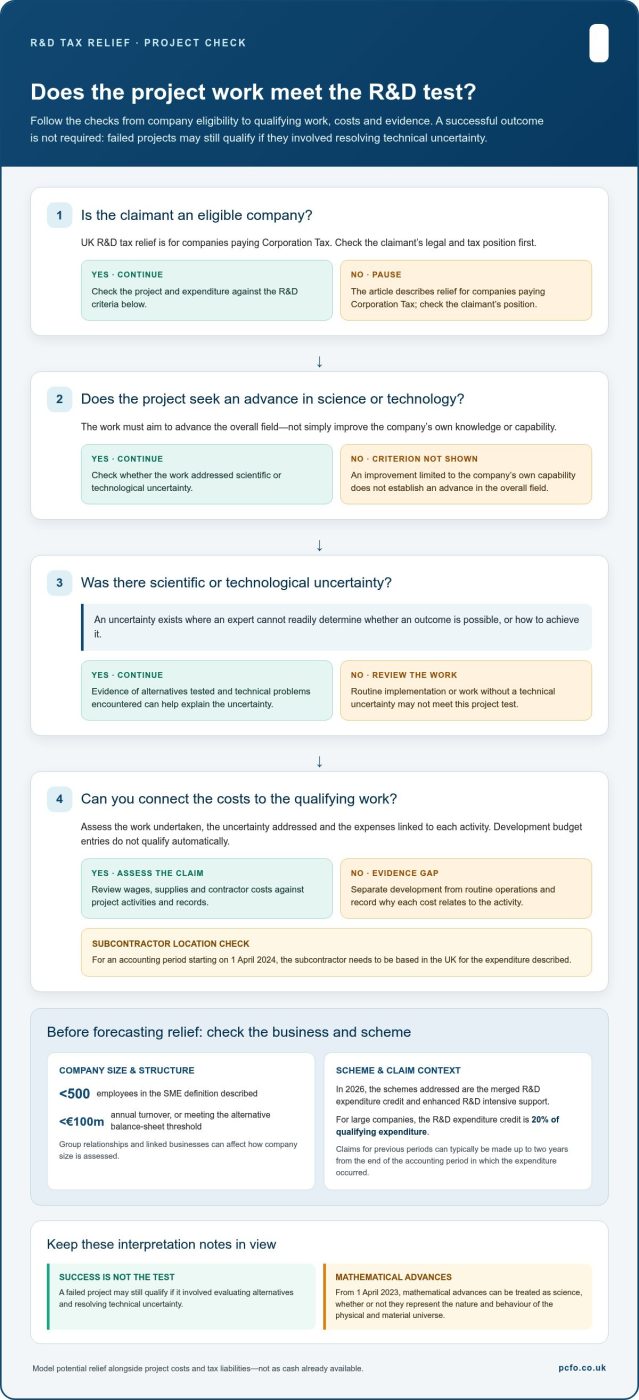
A qualifying project must seek an advance in science or technology by resolving scientific or technological uncertainty. The advance must benefit the overall field, not simply improve your company’s knowledge or capability. An uncertainty exists where an expert cannot readily determine whether a technological outcome is possible, or how to achieve it. According to HM Revenue & Customs, mathematical advances can be treated as science from 1 April 2023, whether or not they represent the nature and behaviour of the physical and material universe.
Checking whether project activities qualify
Assess the work undertaken, the uncertainty addressed and the expenses linked to each activity. Interviews with project staff can establish what alternatives were tested, what technical problems arose and how the team attempted to resolve them. Failed projects may qualify if they involved evaluating alternatives and resolving technical uncertainty. Review wages, supplies and contractor costs against project records. For an accounting period starting 1 April 2024, subcontractor location matters: the subcontractor needs to be based in the UK for the expenditure described.
Comparing available R&D relief schemes
In 2026, the schemes addressed here are the merged R&D expenditure credit and enhanced R&D intensive support. The merged scheme followed the UK Government’s announced merger from April 2024; the supplied facts do not give a separate enhanced-support rate. For large companies, the R&D expenditure credit is 20% of qualifying expenditure. Calculate a claim from eligible expenditure and the applicable scheme, rather than total project spend.
To submit a claim, identify qualifying projects, analyse costs and assemble supporting evidence for HMRC. Claims for previous periods can typically be made up to two years from the end of the accounting period in which the expenditure occurred. Inaccurate claims risk scrutiny and may expose a business to penalties. The consequences depend on the circumstances, so keep clear records to support the claim.
Taxpayer eligibility and trade-or-business requirements
UK R&D tax relief is for companies paying Corporation Tax, so start by checking the claimant’s legal and tax position. The SME definition described for the relief includes fewer than 500 employees and annual turnover under €100m, or meeting the alternative balance-sheet threshold. Group relationships and linked businesses can affect how a company’s size is assessed, so review the wider structure before forecasting relief.
Eligibility is only part of the decision. Map the company’s trade, projects and expenditure together: identify which activities involved scientific or technological uncertainty, who undertook them, and how the costs relate. For example, a company developing production software should distinguish technical development from routine implementation. This helps financial planning reflect eligible activity instead of treating all innovation spending as qualifying.
For liquidity planning, model potential relief separately from cash already available. Record when project costs arise, then assess how a potential claim could affect forecast tax liabilities and funding needs. This gives directors a clearer view of liquidity when deciding whether to stage an investment, retain working capital or fund further development. It also avoids commitments based on a claim before its supporting costs have been analysed.
Recent scheme changes matter to strategic plans: the UK Government announced that the SME and RDEC schemes would merge from April 2024. Businesses should therefore review the applicable scheme against their accounting period and current project portfolio, rather than relying on an old claim approach. A fresh assessment can help connect innovation priorities with corporate budgets and investment decisions.
R&D tax advisers’ fees depend on the case and are provided after a quote request. Relevant cost factors include project complexity, claim scope and the quality of existing records. When assessing advice, consider how clearly eligibility, expense calculations and evidence requirements are explained, rather than assuming a particular claim outcome.
To connect relief with growth plans, business planning support can help align project investment, cash requirements and wider strategic priorities.
Qualified research expenses
Identifying potential research and development expenses means linking each cost to the work carried out on a qualifying project. An expense appearing in a development budget is not automatically eligible. Separate project costs from routine operations, then record why each cost relates to the activity being assessed. This gives claims a clearer financial basis and helps business leaders understand which spending may support innovation.
An R&D assessment typically examines categories such as employee wages, supplies and contractor costs. For each project, link these costs to specific activities and keep records showing how they were incurred. For example, distinguish staff time spent addressing a technical problem from time spent on routine administration. Categorise supplies by their use in the project, rather than including general purchases without a clear connection. This analysis shows how the claimed amount was calculated.
Contractor expenditure also needs careful review. For an accounting period starting 1 April 2024, the subcontractor needs to be based in the UK for the expenditure described. Record the contractor’s role, the work undertaken and its relationship to the project. A clear link between the contractor activity and the research supports a more transparent assessment than a broad contractor-cost total.
Use project records to show what the team was trying to resolve and how its work progressed. Useful evidence can include:
- Project descriptions that identify the development objective and technical work.
- Staff or contractor information connecting tasks with project activities.
- Expense calculations showing how wages, supplies and contractor costs were allocated.
Review project records alongside the expense schedule, rather than treating the cost calculation as a standalone exercise. If a project changes direction, update its activity notes and cost allocation so the claim reflects the work actually undertaken. This helps distinguish qualifying research from routine improvements and gives decision-makers a clearer view of the project’s after-tax cost when considering investment.
Tax planning and cash-flow forecasting
Treat R&D relief in a forecast as a potential adjustment to tax liabilities, not as cash already received. Financial planning for R&D tax credits means comparing expected project costs with eligible expenditure, then updating assumptions as work develops. This gives directors a clearer view of a project’s after-tax cost and the funds available for other commitments.
Review project spending regularly. A development team may change its approach after testing an innovative design or working to overcome a technical obstacle. Update the expense analysis and forecast when that happens, rather than relying on an unchanged budget. This connects the claim application to actual project activity and gives decision-makers a more useful basis for investment choices.
Use scenarios to assess how potential relief could affect business liquidity. A base forecast can reflect expected eligible costs; a cautious version can exclude items still under assessment. Compare both with planned spending, tax liabilities and working-capital needs. This helps prevent the forecast from depending on expenditure that may not qualify, while showing how relief could support future investment.
Previous accounting periods can also inform planning. UK businesses can typically claim R&D tax credits for previous periods up to two years from the end of the accounting period in which the expenditure occurred. Review earlier project records and costs alongside current forecasts so a relevant past period isn’t overlooked. Keep the period, project evidence and expense calculation connected in your working papers.
A sound approach to financial planning for R&D tax credits treats relief as one input to strategic decisions, not a substitute for cash reserves or broader financial planning. Record project costs, revisit assumptions as activities evolve, and compare the expected tax position with planned cash requirements. To align project assumptions with wider budgets, review your business plan alongside the forecast.
PCFO: Finance Director Services
PCFO helps growing businesses connect potential R&D relief with wider financial planning through its Finance Director Services. This can help when project spending, cash-flow forecasts and investment priorities need to be considered together, rather than managed as separate decisions.
A Finance Director can help assess how planned development affects budgets and liquidity, while Business Growth Advisory and business planning consultancy support decisions about future investment. For businesses preparing for a major transition, exit strategy support can also place innovation spending within longer-term objectives.
Turn to PCFO when you need a clearer financial view of how R&D activity fits your business plan. Contact PCFO to discuss your planning needs.
Make your next investment decision with clarity
Use your R&D outlook as one input to upcoming decisions, not as a substitute for a robust business plan. Consider how planned development fits your priorities, available cash and wider growth objectives. This gives leadership a practical basis for deciding which opportunities to pursue and preparing for different funding needs.
A considered approach to R&D tax credits in financial planning connects project choices with the company’s longer-term direction. PCFO’s Finance Director Services, Chief Financial Officer Services and Business Growth Advisory support businesses with financial oversight and growth planning. This support can help turn project information into clearer investment and cash-flow decisions.
To discuss how R&D planning fits your business priorities, contact PCFO about your R&D tax planning. A clear plan can help you move forward with confidence.
Frequently Asked Questions
What are R&D tax credits?
R&D tax credits are UK tax relief that can reduce a company’s costs for qualifying research and development. They recognise work aimed at advancing science or technology, not every project described as innovative. For example, a company investigating whether a new manufacturing process can work may have qualifying activity to assess. Relief can inform investment forecasts, but should be based on eligible project spending.
What are eligible R&D expenses?
Potentially eligible expenses are costs connected to qualifying project activity, rather than general overheads considered in isolation. An assessment may examine employee wages, supplies and contractor costs. For instance, staff time spent testing technical approaches may be relevant, while unrelated administration needs separate treatment. Keep project budgets and accounting entries traceable to the work so the cost calculation can be explained and reviewed alongside project evidence.
What does not qualify as R&D?
Work in the arts, humanities or social sciences, including economics, does not qualify for UK R&D tax relief. Routine or minor upgrades also fall short if they don’t represent a genuine, non-trivial advance. A company redesigning a familiar interface without addressing technological uncertainty, for example, cannot treat that work as qualifying simply because it improves its product. The key distinction is the nature of the work, not its commercial value.
What is R&D for tax purposes?
For tax purposes, R&D involves a project seeking an advance in science or technology by resolving scientific or technological uncertainty. The advance must contribute to the wider field, not only build the company’s internal knowledge. A project may still be relevant if it fails: evaluating alternatives and working to resolve technical uncertainty can matter even without a successful result. Keep a clear record of the objective and technical challenges.
Why might you need an R&D study?
An R&D study organises evidence about project activities and related expenses to support an eligibility assessment and claim calculation. Interviews with people involved in the work can clarify technical challenges, while project information and expense analysis connect activities to costs. A fresh study may be useful if your operations or record-keeping process has changed since an earlier claim.
Which UK businesses and projects qualify for R&D tax relief?
A UK company paying Corporation Tax may be eligible to claim, provided its project meets the R&D criteria. The company’s size and project circumstances can affect which relief scheme applies. For example, a technology company developing software may have qualifying work if it seeks a technological advance and addresses genuine uncertainty. Commercial success alone doesn’t establish eligibility; assess the technical work and related expenditure.