

Seed capital is early-stage funding used to develop a start-up’s idea, product or service and build towards further financing. In the UK, first pre-seed rounds average £50,000 to £250,000, while seed rounds average £500,000 to £1.5 million. A seed funding financial plan example helps connect the amount you seek to expected costs, revenue and the milestones the funding should support.
It’s understandable to focus on the fundraising figure, but investors also need to see how you arrived at it. A clear plan shows what the money will fund, how long it is expected to last and what progress it can support.
This article explains what seed capital can pay for, how to estimate a funding target and when a raise may make sense. It also outlines the financial projections investors expect, helping you present a grounded case for your start-up’s next stage.
Key Takeaways
- Build projections that connect expected costs, revenue and cash flow to clear business milestones.
- Separate product development, people and operating expenses so investors can see how the funds will be used.
- Set a fundraising target around the runway and progress needed to reach your next stage, rather than choosing a figure in isolation.
- Align the timing of your raise with your product’s development and the evidence of demand you can present; financial planning support can help strengthen that case.
Financial projections for an investor pitch
Investor projections connect your funding request to expected costs, revenue and measurable progress. A clear model also helps show how the money will support the business’s next stage.
Forecast assumptions and accounting rules
Forecast assumptions are the drivers behind expected sales, costs and cash flow. Consistent accounting treatment makes them easier to assess. For a UK start-up, set out customer numbers, pricing, payment timing, staffing and supplier costs, then show their effect on cash. If trading extends into European markets or involves establishing an overseas entity, resources from specialists like Intercompany Solutions can help clarify local VAT rules and setup costs so they are factored into the model. Use the same categories across forecast periods and distinguish estimates from actual results. This helps investors assess whether the expected progress supports the plan.
Financial plan contents
A seed funding financial plan should include projected revenue, operating costs, cash flow, funding needs and the assumptions behind each forecast. Show how the capital will support milestones, such as product development or customer acquisition. Present a base case alongside a more cautious scenario, and explain which assumptions change. This gives investors a practical view of how the business could respond if sales arrive later or costs rise.
Pre-money and post-money valuation
Pre-money valuation is the company’s value before investment; post-money valuation includes the new capital. UK seed rounds average £500,000 to £1.5 million, and the calculation shows how the agreed investment and equity share affect ownership. Forecasts support valuation discussions, but don’t determine value alone.
Pitch preparation and investor documents
Prepare a concise pitch deck, a targeted investor list and supporting financial documents, including forecasts, cash-flow projections and current accounts. Explain the market, customer demand, progress to date, funding request and intended use of funds. UK funding conversations may involve angel investors, venture capital funds, friends, and consideration of SEIS or EIS. Angels may offer mentorship and introductions alongside capital, while equity reduces founders’ ownership. Borrowing from friends can strain relationships if repayment becomes difficult. Practise a short pitch, then tailor follow-up discussions to each investor’s interests.
Start-up expenses covered by seed capital
Seed capital can fund the work needed to turn a business idea into an operating product or service. A start-up might allocate funds to product development, market research, prototype production, testing and customer feedback. These costs help founders refine their offer before committing to wider production or sales.
Seed funding can also cover initial operating expenses, including rent, equipment, payroll, insurance, research and development, and the business plan itself. A software start-up, for example, may need development and testing capacity, while a physical product business may need prototype materials and production equipment. Group each expense by purpose and link it to a planned outcome, such as a tested prototype or an initial sales process.
Include legal and regulatory planning in the forecast. Set out expected spending on professional advice, contracts and permissions relevant to the business model, rather than treating compliance as an afterthought. Requirements vary by activity, so a food business and a software company may face different considerations. For start-ups navigating international investment or dual-market operations, practices such as Israel Cross Border Law Firm highlight the value of budgeting for specialist cross-border legal support. Keep assumptions visible and leave out obligations that don’t apply to your operation.
A common financial planning risk is underestimating costs or assuming revenue will arrive sooner than it does. Model how delayed sales or higher development spending would affect cash flow, then prioritise essential expenditure over optional expansion. This makes the impact of changing assumptions easier to understand.
Funding is often described in four stages: seed capital, venture capital, mezzanine funding and an initial public offering. These stages describe different points in a company’s financing journey, not a fixed route every start-up must follow. Seed funding can help establish a product or service; later venture capital may support growth. Grants, loans and equity each affect cash flow, repayment or ownership differently, so assess the funding type alongside the expense it will support. A business planning consultant can help connect projected spending with business milestones.
Estimating a pre-seed fundraising target
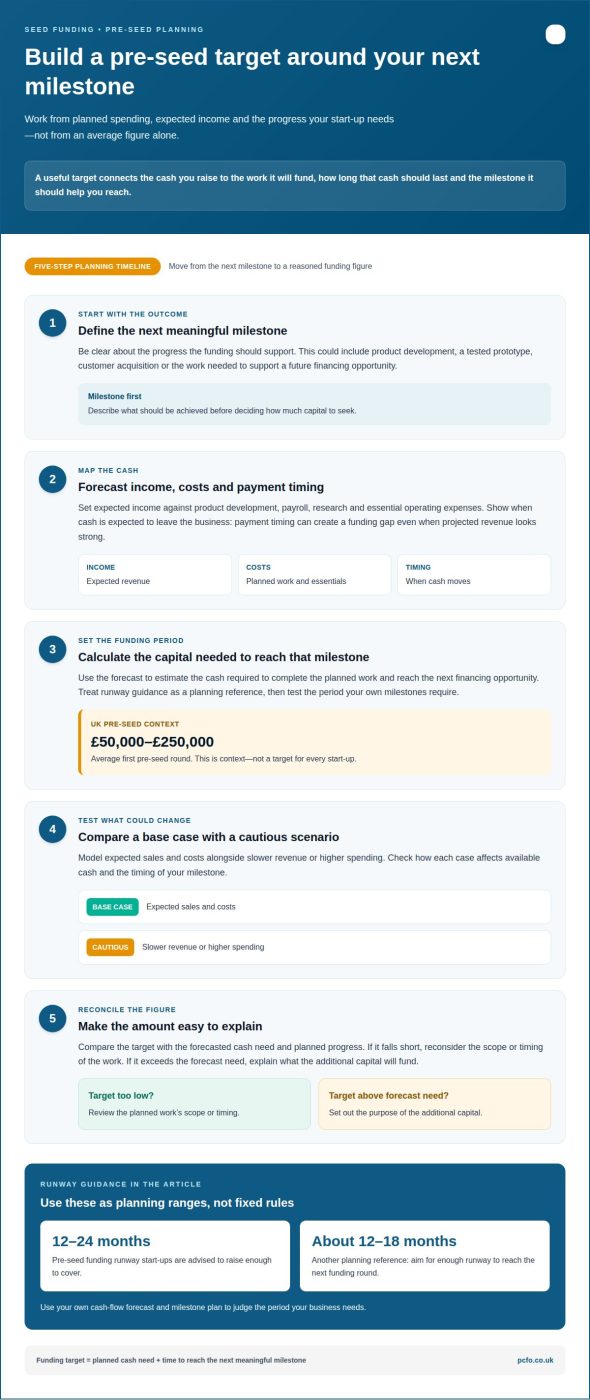
Set a pre-seed target by forecasting the cash required to reach the next meaningful business milestone. UK start-ups raise between £50,000 and £250,000 in their first pre-seed round, on average, but this range is context rather than a target for every company. Your initial figure should follow your planned spending, expected income and the progress needed to attract further investment.
Start with a cash-flow forecast. Map expected income against costs such as product development, payroll, research and essential operating expenses. Identify when cash is likely to leave the business, because payment timing can create a funding gap even when projected revenue looks strong. Then calculate the capital needed to complete the work that supports your next financing opportunity, rather than choosing a figure simply because it falls within an average range.
Runway helps test whether the target is practical. Start-ups are advised to raise enough pre-seed funding for 12-24 months of runway. Founders should also aim for enough funding to provide about 12 to 18 months of runway and reach the next funding round. Treat these planning ranges as guidance, then use your forecast to model the period your own milestones require. If the target falls short, reconsider the scope or timing of planned work; if it exceeds the forecast need, explain the additional capital’s purpose.
Use scenarios to make the calculation more resilient. A base forecast can reflect expected sales and costs, while a cautious version tests slower revenue or higher spending. Compare how each case affects available cash and milestone timing. If customer uptake takes longer, for example, the model should show whether the business can continue developing its product or service. This makes a venture round easier to frame: investors can see the assumptions, planned use of funds and evidence that would support the next step.
Review the target whenever a key assumption changes, such as supplier terms or sales timing. A forecast turns fundraising from a rounded guess into a reasoned request linked to initial priorities and future opportunities.
Seed funding definition and timing
Seed funding is early-stage capital that helps a start-up develop its business and prepare for further financing. It often follows pre-seed funding, which can support an entrepreneur with an idea but limited resources to execute it. Seed investment can help refine a minimum viable product (MVP), prototype or service, then demonstrate its potential to customers and future investors.
The right time to raise depends on what the business has built and what the next phase requires. A start-up may be ready after developing a promising MVP, or when a prototype needs funding for testing, initial manufacturing or sales. Customer feedback on a working product, for example, can help explain why further development is needed and what progress the investment should support.
Seed capital is commonly raised from family, friends or angel investors. Angels may offer mentorship and introductions to industry professionals alongside financial backing, usually in exchange for equity. Founders should weigh the ownership they give up against the money and expertise received. Clear terms help everyone understand the arrangement.
Other funding routes have different implications. A loan avoids giving an investor equity, but repayments can pressure cash flow when revenue is scarce, and interest may apply. Grants do not need repayment or incur interest, although applications can take time and competition is high. The right route depends on the company’s needs, cash position and willingness to share ownership or take on repayments.
Before raising, connect the funding request to a defined milestone, such as completing MVP testing or preparing a service for initial sales. This gives potential investors a clear view of what their capital enables. If you’re aligning a raise with product development and business milestones, develop a funding plan that connects the investment to the next stage.
PCFO: Chief Financial Officer Services
PCFO provides Chief Financial Officer Services to help growing businesses connect fundraising decisions with financial planning. If your forecast, cash-flow view and funding milestones need to work together, this support can bring the numbers into a coherent plan.
Turn to PCFO when you need a clearer financial case for a raise or when growth plans make financial oversight more complex. Finance Director Services and business planning consultancy can support your planning as the business develops. The focus is on understanding your assumptions, funding needs and priorities, helping you make informed decisions about the next stage.
Contact PCFO to discuss the financial planning support your business needs.
Turn your funding plan into a confident next move
Your next step is to treat the forecast as a decision-making tool, not a document prepared only for investors. As trading begins, compare actual performance with your assumptions and use the differences to guide hiring, product priorities and further fundraising. A seed funding financial plan example can provide a starting structure, but your plan should evolve with your business and the evidence it gathers.
PCFO offers Finance Director Services, Chief Financial Officer Services and Business Growth Advisory to support businesses as financial decisions become more complex. This can help bring planning, financial oversight and growth priorities into closer alignment.
If you’re preparing for a raise or reviewing your next stage, discuss your funding plan with PCFO. A clear view of your choices can help you move forward with purpose.
Frequently Asked Questions
What is seed finance?
Seed finance is investment or other funding used to move an early-stage business towards commercial activity. A founder might use funds from an angel investor, for example, to test a prototype and learn whether customers will pay for it. Funding may be exchanged for equity or provided through another arrangement. The structure matters because it affects ownership, repayment obligations and the company’s future financial flexibility.
What should a seed funding financial plan example with three-year forecasts show?
A useful three-year forecast should show how revenue, operating costs and cash position could change as the business develops. Set out the assumptions behind customer numbers, pricing and payment timing, then connect planned spending to milestones. Keep actual results separate from projections and include a cautious case where sales take longer to build. This lets investors see what drives the forecast and where the business may need to adapt.
How do you build revenue and cost projections for a seed-stage start-up?
Build revenue projections around how customers will buy: estimate sales volume, price and payment timing for each product or service. Separate recurring costs, such as salaries or software, from one-off development and launch spending. A subscription business, for instance, should account for gradual customer growth and possible cancellations. Review assumptions against early customer evidence, then update the forecast as actual sales and costs emerge.
How much seed funding should a UK start-up raise?
UK start-ups raise £50,000 to £250,000 in their first pre-seed round, on average, and £500,000 to £1.5 million in a seed round. These averages provide context, not a target for every business. Base your request on forecast cash needs, the work required to reach the next milestone and the funding needed to continue afterwards. Explain how the amount connects to those priorities.
How do you calculate start-up runway and monthly burn rate?
Monthly net burn is the cash leaving the business after cash received during the same month is deducted. To estimate runway, divide available cash by average monthly net burn. If spending exceeds receipts, for example, the result indicates how long current funds may last at that rate. Use cash movements, not just accounting profit, and revisit the calculation when income, payment dates or planned expenditure change.