

Can your business afford to wait for year-end accounts to tell you that you missed a growth opportunity six months ago? Many UK business owners feel blind regarding their future cash flow, trapped in a cycle of looking at historical data whilst the Bank of England base rate remains at 3.75% and significant FRS 102 accounting changes loom for 2026. It’s a common frustration to feel that your current accounting support lacks the strategic weight required for decisive board meetings.
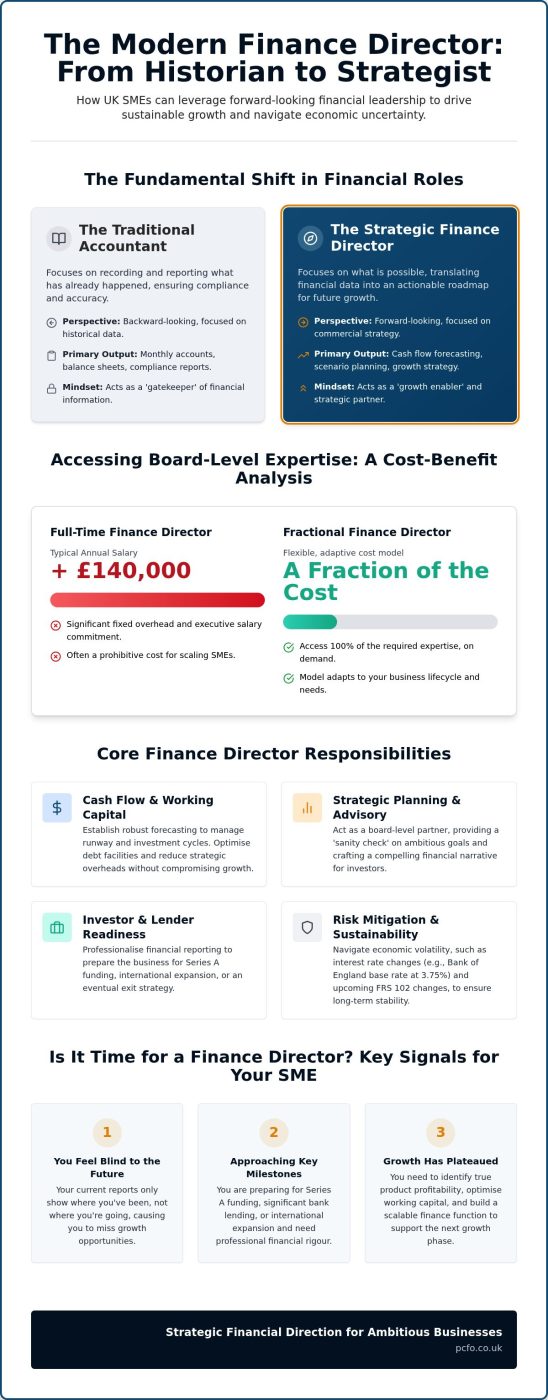
We recognise that the anxiety over a full-time executive salary, which can exceed £140,000 for an experienced professional, often prevents SMEs from securing the leadership they need. This guide promises to show you how a finance director acts as a strategic partner to scale your operations. You’ll discover how to access board-level expertise through a flexible, fractional model that adapts to your business lifecycle. We will outline a clear roadmap for financial growth, from professionalising your reporting for lenders to building a truly scalable finance function that supports your long-term success.
Key Takeaways
- Understand the fundamental shift from historical reporting to forward-looking leadership that drives strategic growth.
- Learn how to manage runway and investment cycles using robust cash flow forecasting and sophisticated scenario planning.
- Discover how a fractional finance director provides 100% of the required expertise at a fraction of the cost of a full-time executive.
- Identify the specific ‘plateau’ signals and business milestones that indicate your SME is ready for senior financial guidance.
- Gain the tools to professionalise your financial reporting, ensuring your business is ready for Series A funding or international expansion.
What is a Finance Director? Defining the Strategic Role in 2026
A finance director is a senior executive responsible for the financial health and strategic direction of your company. Whilst an accountant typically looks backward at what happened, a finance director looks forward at what is possible. They translate complex financial data into an actionable commercial strategy for the CEO, moving far beyond the simple preparation of monthly accounts. We define the finance director as the navigator of the business, ensuring the engine of operations has the necessary fuel of capital to reach your ultimate destination.
Strategic Leadership vs Financial Reporting
An FD moves far beyond the static nature of balance sheets to influence business model innovation. By applying sophisticated financial management principles, they help you identify which products are truly profitable and where capital is being wasted. This role is vital for risk mitigation and ensuring long-term sustainability in a volatile market. For founder-led businesses, having board-level financial advice is often a game-changer. It provides the intellectual rigour needed to challenge assumptions and validate growth plans before they are executed. You gain a partner who focuses on future-proofing the organisation rather than just reporting on its history.
The Evolving Role of the FD in Growing UK SMEs
The modern UK economy requires a shift from the traditional ‘gatekeeper’ mindset to that of a ‘growth enabler’. In 2026, the finance director must adapt to a digital-first environment where real-time data is the standard. SMEs now require these high-level insights much earlier in their lifecycle than they did a decade ago. This is because the margin for error has narrowed significantly.
Whether you’re managing the impact of new lease accounting standards or navigating a base rate of 3.75%, you need proactive leadership. Modern FDs use predictive analytics to provide foresight, allowing you to pivot before a cash flow crisis occurs. You aren’t just looking for someone to record your history. You’re looking for an embedded partner who can help you write your future. This proactive mindset ensures that your financial function isn’t a bottleneck, but a scalable department that supports every commercial ambition. It allows you to build a professionalised finance department that commands respect from investors and lenders alike.
Core Finance Director Tasks: Driving Business Performance
The primary objective of a finance director is to transform raw financial data into a lever for business performance. They don’t just record what has happened; they influence what happens next. By leading the outsourced accountancy solutions function, they ensure that the foundation of your data is beyond reproach. This integrity allows them to manage critical relationships with external stakeholders, including banks, investors, and auditors, with absolute confidence.
Cash Flow Management and Working Capital Optimisation
Cash flow is the lifeblood of any scaling SME, yet it remains a primary source of anxiety for many founders. An FD establishes robust forecasting that allows you to manage runway and investment cycles effectively. They look deep into the business cycle to identify ‘trapped’ cash, such as inefficient inventory levels or slow-paying debtors, which can be used to fund growth internally.
With the Bank of England base rate currently at 3.75%, the cost of borrowing is a significant consideration. A finance director manages your debt facilities and negotiates with lenders to ensure your capital structure is as efficient as possible. They also implement strategic overhead reductions. This isn’t about arbitrary cost-cutting; it’s about removing waste without compromising your operational capability or future growth potential.
Strategic Planning and Board-Level Advisory
In the boardroom, the FD acts as a strategic partner who provides the ‘sanity check’ on ambitious sales targets. They ensure that growth is profitable and sustainable, aligning departmental budgets with your overall business growth advisory uk goals. This involves crafting a compelling financial narrative for board meetings and investor updates that goes far beyond a simple P&L statement.
A critical, often overlooked task is preparing the business for an eventual exit. Whether you plan to sell in two years or ten, an FD begins building shareholder value today. They ensure that every strategic decision increases the company’s attractiveness to future acquirers by professionalising reporting and de-risking the financial function. If you’re looking to bridge the gap between basic bookkeeping and high-level strategy, exploring our fractional finance director services can provide the board-level clarity your business deserves.
By developing sophisticated ‘what-if’ scenario planning, they help you prepare for market volatility. You’ll know exactly how a 10% drop in sales or a 5% increase in supplier costs will affect your bottom line before it happens. This foresight allows for proactive adjustments rather than reactive crisis management.
Full-Time vs Fractional Finance Director: A Cost-Benefit Analysis
Many UK SMEs reach a point where growth stalls because they lack senior financial leadership. However, the perceived cost of a full-time finance director often acts as a barrier to entry. We believe that accessing board-level expertise shouldn’t be a binary choice between a six-figure salary and nothing. The fractional model offers a strategic middle ground, providing the intellectual rigour of a seasoned executive without the permanent overhead.
Decoding the True Cost of a Full-Time Executive Hire
Analysing the Total Cost of Employment (TCOE) for a full-time hire reveals a significant financial commitment. Median base salaries for a finance director in the UK typically range from £105,000 for smaller SMEs to over £160,000 for those with higher turnover. When you add recruitment fees, employer National Insurance, and pension contributions, the actual cost to the business can easily exceed £200,000.
There is also a ‘hidden’ cost to consider. In many SMEs, a full-time executive often spends a portion of their week on administrative or transactional tasks that could be handled by a more junior team member. You are essentially paying executive rates for bookkeeping oversight. A full-time hire becomes a necessity once the complexity of daily operations requires constant, on-site financial leadership, but for many scaling firms, it remains an expensive luxury.
The Flexibility of Fractional FD Services
Fractional services allow you to access 100% of the strategic brainpower for a fraction of the price tag. By focusing purely on high-value tasks such as business model innovation or risk mitigation, a part-time FD often delivers a higher ROI than a full-time equivalent. This model is particularly effective when you need ‘on-demand’ expertise for specific projects like M&A activity or managing the transition to new accounting standards. For a detailed breakdown of how this investment scales, you can review fractional cfo pricing uk.
An outsourced FD brings a ‘fresh pair of eyes’ to your organisation. Because they work across multiple business models and industries, they possess a breadth of perspective that an internal hire might lack. They can identify inefficiencies and opportunities for working capital optimisation that aren’t always obvious from the inside. This model is inherently scalable; as your turnover grows, the level of support can increase in lockstep. It provides a professionalised finance function that adapts to your business lifecycle, ensuring you always have the right level of guidance at the right time.
Identifying the Right Time to Hire a Financial Director
Recognising the ‘plateau’ effect is often the first step in identifying the need for strategic intervention. You might see sales figures climbing whilst net profits remain stubbornly static. This divergence usually indicates that your operational costs or pricing structures are no longer aligned with your scale. A finance director steps in to diagnose these inefficiencies before they become structural failures. Hiring an FD before you feel the absolute necessity is often the smartest move. It allows you to build the infrastructure for growth rather than retrofitting it under pressure.
Significant milestones also serve as clear indicators. If you are preparing for Series A funding, international expansion, or a potential merger, your financial reporting must be impeccable. Investors and lenders expect a level of sophistication that goes beyond standard bookkeeping. This preparation is a core component of our exit strategy planning services, which focus on maximising business value long before a sale is actually on the table. If you are currently facing these trigger points, you can speak with our team to explore how a fractional FD can support your next milestone.
Trigger Points for Strategic Financial Intervention
Complexity is the primary driver for senior financial oversight. As your business grows, you may find yourself managing multi-currency operations or navigating intricate supply chains that require expert risk management. Losing track of project-specific profitability or service-line margins is a common symptom of a business that has outgrown its current accounting function. Additionally, if your board or investors are demanding more sophisticated ‘what-if’ scenarios and predictive reporting, the transition to an FD role is overdue.
Evaluating Technical Skill vs Cultural Fit
An FD must be a true business partner to the CEO. Whilst technical accounting qualifications are the baseline, the ability to translate those numbers into commercial strategy is what defines a successful hire. You should look for someone with sector-specific experience who understands industry-standard KPIs and the unique challenges of your market.
When interviewing, focus on the strategic mindset. Ask how they have previously influenced a business model or mitigated a specific financial risk. The right person will not just provide reports; they will provide the confidence needed to make bold, informed decisions. This cultural alignment ensures that your finance function becomes a proactive growth enabler rather than a reactive department focused solely on compliance.
Partnering with PCFO for Expert Finance Director Services
PCFO offers a partnership that transcends the typical consultancy model. We provide an embedded finance director who acts as a steady, experienced hand at the helm of your company’s strategy. Our approach is built on a commitment to proactive, growth-oriented leadership that anticipates challenges before they impact your bottom line. We don’t just observe your business from the outside; we integrate with your team to understand your unique operational hurdles and commercial ambitions.
Taking the first step involves a diagnostic approach where we identify the specific financial gaps within your organisation. Whether you’re struggling with project profitability or preparing for a significant capital event, we provide a clear roadmap for improvement. This diagnostic phase ensures that our intervention is targeted and effective, providing the intellectual rigour needed to professionalise your finance function for the long term.
Our Methodology: Embedded Strategic Financial Leadership
Our methodology focuses on immediate value creation. By integrating directly with your existing team, we ensure that data integrity is established from day one. We utilise the PCFO ‘Growth Framework’, a structured approach designed to help UK SMEs scale safely in a volatile economic environment. This framework has successfully transformed businesses from a state of financial uncertainty into organisations with clear, actionable roadmaps. We’ve seen founders regain their confidence once they have a professionalised reporting suite that satisfies both internal needs and external investor requirements.
Beyond the Balance Sheet: Growth Advisory and Exit Planning
Strategic financial leadership is about more than just managing the current quarter. We look years into the future to ensure your business is prepared for a high-value sale or a strategic merger. Our expertise in exit strategy planning allows us to begin building shareholder value today, ensuring that your financial narrative is compelling to future acquirers. This long-term foresight provides the peace of mind that comes from knowing your business is being steered by an expert who is invested in your trajectory.
The synergy between our FD services and our broader growth advisory portfolio means you have access to a full suite of strategic support. We bridge the gap between basic accounting and high-level corporate finance, allowing you to focus on your core operations whilst we handle the strategic navigation. If you’re ready to move beyond historical reporting and embrace a proactive financial future, you can Book a strategic consultation with a PCFO Finance Director today. We are ready to help you navigate the complexities of scaling your SME with confidence and clarity.
Future-Proofing Your Business Strategy
The transition from basic accounting to strategic financial leadership is a defining moment for any scaling SME. By moving beyond historical data and embracing predictive modelling, you gain the clarity needed to identify trapped cash and de-risks your growth plans. We’ve seen how a fractional finance director provides this board-level expertise without the prohibitive cost of a full-time executive salary, allowing you to invest your capital where it matters most.
Our approach at PCFO is built on professional, embedded partnerships that focus on your entire business lifecycle. Whether you’re preparing for a funding round or professionalising your reporting for a future sale, we provide the steady hand and intellectual rigour required to succeed. Our fractional models are tailored specifically to your turnover and ambitions, ensuring your finance function is always a scalable asset. Secure board-level financial leadership for your business today.
Your financial function should be the primary engine of your growth, not a bottleneck. With the right strategic partner at the helm, you can navigate market volatility with confidence and reach your commercial destination with absolute clarity. We look forward to helping you build a more resilient and profitable future.
Frequently Asked Questions
What is the difference between a Finance Director and a CFO?
In a typical UK SME, a finance director leads the internal finance function and commercial strategy. A Chief Financial Officer (CFO) is often found in larger, listed companies or private equity-backed firms where the focus shifts heavily toward external investor relations and complex capital structures. For most growing businesses, the FD provides the necessary balance of operational oversight and strategic foresight required to scale safely.
How much does a part-time Finance Director cost in the UK?
Market rates for part-time senior financial leadership vary based on the complexity of your requirements. Industry data from 2026 suggests day rates for experienced professionals range from £600 to £1,100. Monthly retainers for one day a week typically sit between £2,000 and £3,200. These figures represent the cost of accessing board-level expertise without the heavy burden of a full-time executive salary and its associated benefits.
Does my small business really need a Finance Director if I have an accountant?
An accountant focuses on compliance and historical reporting, whereas a finance director focuses on future growth and commercial strategy. Whilst your accountant ensures your tax returns are accurate, an FD helps you decide where to invest your capital and how to improve your profit margins. This strategic intervention is what allows a business to move past a growth plateau and prepare for significant milestones.
Can a Finance Director help my business secure a bank loan or investment?
Yes, an FD is instrumental in professionalising your financial reporting to meet the rigorous standards of lenders and investors. They manage the due diligence process and craft a credible financial narrative that demonstrates your ability to service debt or provide a return on investment. This leadership often makes the difference between a rejected application and a successful funding round in a competitive market.
What qualifications should I look for when hiring a Finance Director?
You should look for a professional qualification from a recognised body such as the ICAEW (ACA), ACCA, or CIMA. However, technical qualifications are only the baseline. You should also prioritise sector-specific commercial experience and a proven track record of strategic decision-making. The ability to act as a business partner to the CEO is just as vital as their technical accounting expertise.
How many days a month does a fractional Finance Director typically work?
Most fractional roles involve between one and four days of work per month. The exact frequency depends on your business lifecycle and current challenges. A business undergoing a merger or preparing for an exit may require more intensive support, whilst a stable organisation might only need a single day of strategic oversight to keep their growth plans on track and monitor cash flow.
What is the primary role of a Finance Director during a business sale?
During a sale, the FD’s primary role is to maximise shareholder value by ensuring the business is ‘exit-ready’ well in advance. They professionalise the data room, manage due diligence enquiries, and de-risk the financial function to prevent potential price chips. Their presence provides acquirers with the confidence that the company’s financial health is transparent and the reporting is beyond reproach.
How does an FD improve cash flow within a service-based business?
In service-based firms, an FD improves cash flow by reducing debtor days and analysing the profitability of specific projects or service lines. They identify which clients are truly profitable and where resources are being underutilised. By implementing robust forecasting, they ensure you have the necessary runway to manage wage growth and operational overheads, particularly whilst the Bank of England base rate remains at 3.75%.