

If the Bank of England base rate shifted unexpectedly tomorrow, would your current strategy remain resilient, or would it expose a critical lack of preparation? For many business leaders, effective financial risk management uk is often perceived as a purely defensive exercise; however, it is actually the most reliable tool for secure, sustainable expansion. Relying on historical performance is no longer enough to safeguard your future in a market where volatility is the only constant.
You likely feel the weight of rising overheads and the persistent unpredictability of the domestic market. It is difficult to maintain confidence when interest rates, currently held at 3.75 per cent, and shifting corporation tax obligations feel like moving targets. We recognise that without a formal mitigation strategy, these anxieties can stall even the most ambitious growth plans. You deserve a clear, structured approach that turns these uncertainties into manageable variables.
This guide provides a strategic framework to help you identify and neutralise financial threats before they impact your bottom line. We will explore how to assess specific UK market risks, implement practical mitigation steps, and build the financial stability required to fuel long-term growth. By the end of this article, you will have the clarity needed to lead your organisation with renewed authority and foresight.
Key Takeaways
- Understand the vital distinction between academic theory and practical financial risk management uk to ensure your strategy is tailored for the specific needs of a growing SME.
- Identify the primary market and credit risks, such as interest rate volatility and late payments, that could compromise your organisation’s cash flow and stability.
- Learn why historical accounting records are insufficient for future-proofing and how to transition towards a proactive, strategic risk assessment.
- Discover how to establish a formal risk appetite and implement internal controls that align with your long-term growth and business exit objectives.
- Explore how a fractional Finance Director provides high-level expertise and an objective perspective to protect your bottom line without the overhead of a full-time executive.
What is Financial Risk Management for UK Businesses?
In its simplest form, financial risk management is the process of identifying, analysing, and either accepting or mitigating uncertainty in your investment and operational decisions. Whilst academic institutions often frame this as a complex quantitative exercise involving high-level computational modelling, for a UK SME, it’s far more practical. It’s about ensuring your business isn’t derailed by a sudden currency fluctuation or a major client’s insolvency. Effective financial risk management uk focuses on protecting your cash flow and ensuring your long-term objectives remain achievable despite market volatility.
This discipline serves as a core pillar of business financial planning. It represents a fundamental shift from reactive crisis management to proactive strategic foresight. Instead of scrambling to fix a deficit after it appears on your balance sheet, you’re looking six to twelve months ahead to anticipate where pressure points might emerge. This level of preparation provides a sense of calm confidence. It allows you to make bold growth decisions based on data rather than intuition.
The Core Components of Risk Mitigation
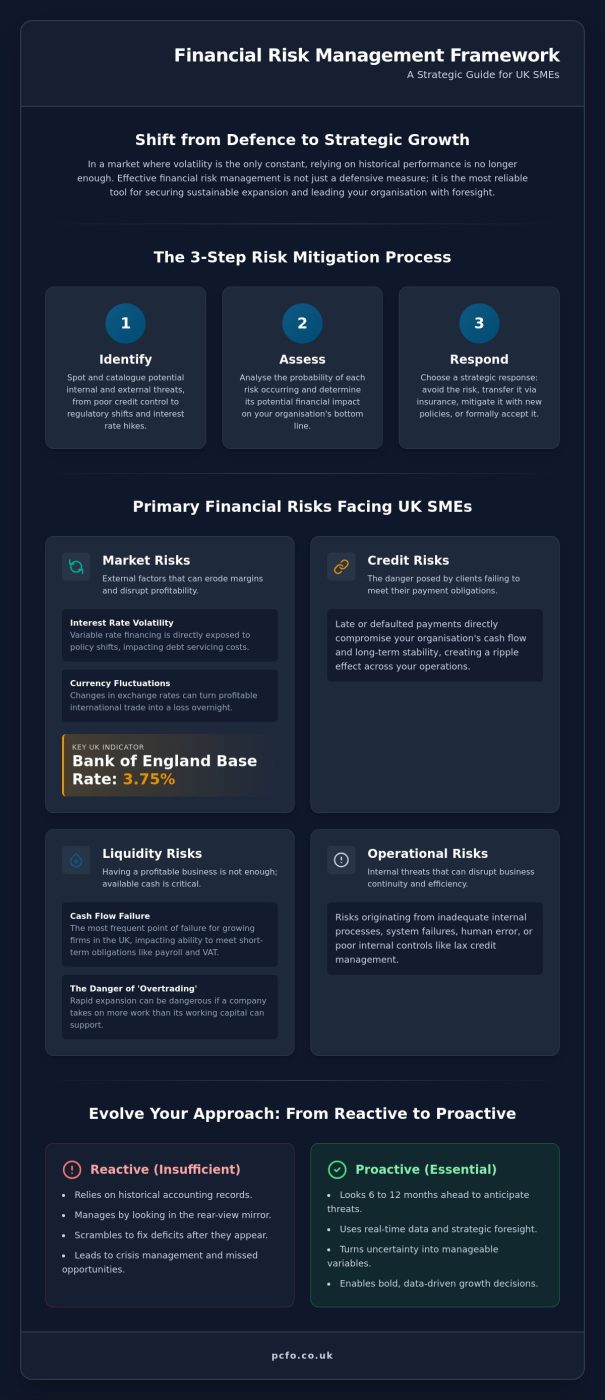
To manage risk effectively, you must follow a methodical progression. First is identification. You need to spot both internal threats, such as poor credit control, and external threats like regulatory shifts or interest rate hikes. Second is assessment. Here, you determine the probability of an event and its potential impact on your bottom line. Finally, you choose a response. You might decide to avoid the risk entirely, transfer it through insurance, mitigate it with new internal policies, or simply accept it as a known cost of doing business. This structured approach ensures that no threat is ignored or underestimated.
Why 2026 Demands a Proactive Approach
Identifying the Primary Financial Risks Facing UK SMEs
Interest Rate and Currency Volatility
The Bank of England’s decision to hold the base rate at 3.75 per cent in June 2026 has direct consequences for your debt servicing costs. If your financing is on a variable rate, even a small shift can erode your margins quickly. Similarly, if your supply chain involves international trade, currency volatility can turn a profitable quarter into a loss overnight. You don’t always need complex derivatives to manage this. Simpler strategies, such as forward contracts or multi-currency accounts, can provide a vital buffer against sudden sterling shifts whilst protecting your bottom line.
Cash Flow and Liquidity Challenges
Cash flow remains the most frequent point of failure for growing firms in the UK. Liquidity risk isn’t just about having a profitable business; it’s about having the cash available to meet short-term obligations like payroll, National Insurance, and VAT. Rapidly expanding companies often face the danger of ‘overtrading’, where they take on more work than their working capital can support. Implementing strategic budgeting and forecasting allows you to predict these shortfalls months in advance. This foresight gives you the time to secure additional funding or adjust your growth trajectory before the situation becomes critical.
Regulatory and Compliance Risks
The UK’s regulatory environment is constantly evolving. From the 25 per cent main rate of Corporation Tax for larger profits to the complexities of the FCA’s Consumer Duty, non-compliance carries heavy financial and reputational penalties. Beyond fines, the cost of audit readiness and maintaining financial transparency can be significant. Managing these risks requires a proactive stance on tax legislation and employment law. If you find these complexities overwhelming, engaging a strategic financial partner can ensure your compliance remains a source of strength rather than a vulnerability. This professional oversight allows you to focus on your core business goals with the confidence that your regulatory obligations are being met with precision.
Strategic Risk Assessment vs. Basic Accounting
Many leaders mistake robust accounting for comprehensive financial risk management uk. Whilst accurate bookkeeping is essential for compliance, it’s inherently historical. Your year-end accounts tell you where your business has been, but they offer very little guidance on where it’s going. Protecting the future requires a fundamental shift from recording transactions to anticipating disruptions. This distinction is what separates a functional business from a strategically resilient one.
The Limitations of Standard Reporting
Standard Profit and Loss statements often mask underlying vulnerabilities. A healthy P&L doesn’t guarantee future stability if your debt-to-equity ratio is creeping up or if your customer concentration is becoming dangerously high. Relying on ‘gut feeling’ or past performance leaves you exposed to blind spots that only manifest when it’s too late to pivot. Strategic oversight moves you beyond simple compliance. It transforms raw data into strategic insight, allowing you to identify risks that a standard bookkeeper might overlook during their routine duties. You don’t just need to know your numbers; you need to know what those numbers imply for your next twelve months of operations.
Predictive Modelling and Scenario Planning
Resilience is built by ‘stress testing’ your business model against potential shocks. What happens if your primary supplier increases prices by 15 per cent, or if your sales volume drops by 20 per cent? Predictive modelling allows you to answer these questions with data rather than guesswork. Sensitivity analysis is particularly valuable when you’re evaluating new investment opportunities or considering a business exit. It helps you identify the exact ‘break-even’ point under various market conditions. This ensures that every growth move is supported by a clear, objective understanding of its risk profile. When selecting the tools to support this process, understanding the trade-offs between an FP&A consultant vs software for UK SMEs is essential to ensuring your forecasting capability is both effective and strategically guided.
Navigating these complex environments requires more than just functional support. Board level financial advice provides the intellectual rigour needed to interpret these models and apply them to your specific goals. A strategic partner doesn’t just report on your history. They help you navigate the future with confidence. This proactive mindset ensures your organisation remains scalable and flexible, regardless of the shifting economic climate. By integrating these assessments into your regular board meetings, you turn risk management into a powerful engine for informed, confident decision-making.
Building a Robust Financial Risk Management Framework
Creating a functional framework for financial risk management uk is not a one-off administrative task. It’s an ongoing commitment to structural integrity. Unlike academic exercises that prioritise theoretical modelling, a practical framework provides your management team with clear, actionable boundaries. This ensures that every decision, from hiring to capital expenditure, is measured against your organisation’s long-term stability. A robust framework consists of five essential pillars that move your business from a state of vulnerability to one of controlled, confident growth.
- Step 1: Establish a risk appetite that aligns with your specific growth goals.
- Step 2: Implement rigorous internal controls and financial policies to prevent error.
- Step 3: Regularly review and update a dynamic risk register to reflect market shifts.
- Step 4: Diversify revenue streams to reduce dependency on single clients or sectors.
- Step 5: Maintain a ‘rainy day’ reserve to handle unforeseen economic shocks.
Establishing Risk Appetite and Tolerance
Defining your risk appetite is the process of deciding how much financial uncertainty your business can realistically handle. It’s about finding the equilibrium between aggressive expansion and prudent capital preservation. You must determine the “red lines” where a potential loss would compromise your core operations. Once these boundaries are set, they must be communicated clearly to your wider management team. This ensures that everyone is operating with the same understanding of what constitutes an acceptable risk. It’s a proactive way to empower your team whilst maintaining high-level oversight.
Implementation of Internal Controls
Internal controls are the mechanics of protection. You need clear authorisation levels for expenditure and contracts to ensure that no single individual can expose the company to significant debt without board approval. Regular audits of these processes are vital to prevent fraud or simple human error. Resilience is also built by identifying inefficiencies. Utilising strategic overhead reduction allows you to trim waste and redirect capital toward your safety net. This disciplined approach to spending ensures that your business remains lean and responsive.
Building and maintaining this framework requires a high level of institutional knowledge and strategic foresight. If you don’t have the internal capacity to manage these complexities, engaging an outsourced Finance Director can provide the steady hand needed to future-proof your organisation. This partnership allows you to focus on leading your business whilst an expert ensures your financial foundations remain unshakable.
How a Fractional Finance Director Protects Your Bottom Line
Implementing the frameworks discussed in previous sections requires more than just intent. It demands a level of seniority and experience that many SMEs struggle to find within their existing team. This is where a fractional Finance Director becomes a critical asset for financial risk management uk. By engaging a specialist on a part-time or project basis, you gain access to boardroom-level expertise without the £150,000 plus salary and overheads of a permanent executive hire. This model provides the high-level strategic oversight you need whilst maintaining the agility of a smaller organisation.
An outsourced FD provides a vital, objective perspective on your organisation’s risks. When you’re embedded in daily operations, it’s easy to overlook systemic vulnerabilities or become overly optimistic about market conditions. An external partner brings a steady, experienced hand to your financial strategy, identifying blind spots and challenging assumptions before they lead to costly errors. This collaborative approach ensures your risk mitigation isn’t just a compliance exercise but a genuine driver of stability and confidence.
Expert Oversight Without the Full-Time Cost
Tailoring the level of support to your business’s specific needs and budget is the primary advantage of the fractional model. You don’t need a full-time presence to achieve ‘big company’ risk management. Instead, you can focus your investment on high-impact strategic advisory during critical periods, such as rapid expansion or market shifts. This flexibility allows you to scale support up or down as your requirements evolve. It ensures your financial foundations remain robust whilst keeping your overheads lean and manageable. You get the benefit of institutional knowledge on a scale that fits your current lifecycle.
Future-Proofing Through Strategic Advisory
Building a resilient financial foundation is about more than surviving today’s challenges. It’s about ensuring your business is ready for its next chapter, whether that involves a strategic acquisition or a future sale. Demonstrating robust risk controls and clear financial foresight makes your organisation significantly more attractive to investors and buyers. A strategic partner ensures your business is ‘investor-ready’ by professionalising your reporting and future-proofing your operations against long-term volatility. This proactive stance turns your financial function into a value-adding asset rather than a back-office cost.
If you’re ready to move beyond basic accounting and secure your company’s trajectory, contact PCFO to see how our Finance Director services can safeguard your business. We provide the intellectual rigour and strategic navigation required to turn financial risk into a managed variable, allowing you to lead with total confidence and clarity.
Securing Your Organisation’s Long-Term Trajectory
Effective leadership requires a fundamental transition from simply recording the past to actively shaping the future. By moving beyond basic accounting and implementing a structured framework, you ensure your organisation remains resilient against domestic market volatility. You now understand how identifying specific threats and establishing a clear risk appetite can turn uncertainty into a manageable strategic variable. Mastering financial risk management uk isn’t just a defensive necessity; it’s the essential foundation for sustainable growth and a successful eventual exit.
We provide professional Finance Director and CFO services tailored specifically for UK SMEs. Our team offers deep expertise in strategic business planning and has a proven track record in providing exit strategy support. You gain the intellectual rigour of a seasoned executive without the full-time overhead, ensuring your financial strategy is proactive rather than reactive. You don’t have to navigate these economic complexities alone.
Protect your business’s future with expert Finance Director services from PCFO.
With the right strategic partner, you can face the evolving UK market with calm confidence and absolute clarity.
Frequently Asked Questions
What are the four types of financial risk?
The four primary categories are market risk, credit risk, liquidity risk, and operational risk. Market risk involves fluctuations in external variables such as interest rates or exchange rates. Credit risk focuses on the danger of customer non-payment, whilst liquidity risk ensures you have enough cash to meet short-term obligations. Operational risk arises from internal process failures or external events that lead to financial loss.
Why is financial risk management important for UK SMEs?
It provides a structured framework to protect cash flow and ensure long-term stability amidst unpredictable market conditions. For many firms, financial risk management uk is the difference between reactive crisis management and proactive growth. It allows leaders to make informed decisions by identifying potential threats like rising overheads or regulatory shifts before they impact the bottom line.
How do interest rates affect financial risk management?
Interest rates directly influence the cost of debt servicing and the overall availability of capital. With the Bank of England base rate held at 3.75 per cent as of June 2026, businesses with variable-rate financing must account for increased repayment costs. Higher rates can also dampen consumer spending; this indirectly affects your revenue projections and necessitates more rigorous sensitivity analysis.
What is the difference between risk appetite and risk tolerance?
Risk appetite is the broad level of risk an organisation is willing to accept in pursuit of its strategic goals. In contrast, risk tolerance is the specific, measurable limit of loss a business can endure without compromising its core operations. Whilst appetite reflects your general philosophy toward growth, tolerance provides the practical red lines that your management team must not cross.
Can a small business manage financial risk without a full-time CFO?
Yes, fractional Finance Director services allow SMEs to access high-level strategic expertise without the significant overhead of a permanent hire. This model provides the intellectual rigour needed for robust financial risk management uk whilst remaining flexible and scalable. You gain an objective, external perspective that helps identify vulnerabilities that internal teams might overlook during routine bookkeeping tasks.
How often should a business review its financial risk management strategy?
You should conduct a formal review of your risk register at least quarterly, or whenever a significant market shift occurs. Regular reviews ensure that your mitigation strategies remain aligned with current economic realities, such as changes in tax legislation or interest rate reviews. This methodical approach turns risk management into a dynamic leadership function rather than a static annual exercise.
What are the best tools for monitoring financial risk in 2026?
Modern businesses rely on real-time cloud accounting software paired with advanced forecasting and scenario planning tools. These platforms allow you to run stress tests on your cash flow and perform sensitivity analysis on new investment opportunities. Integrating these digital tools with professional strategic oversight ensures your data is translated into actionable insights for the board. For SMEs weighing up their options, a detailed comparison of an FP&A consultant vs software in the UK can help determine which approach will deliver the greatest strategic value for your specific stage of growth.
How does risk management impact a business’s valuation during an exit?
Robust risk management significantly increases a business’s valuation by demonstrating stability and predictability to potential buyers. Investors are willing to pay a premium for organisations that have clearly defined risk controls and a history of proactive mitigation. Showing that your business is investor-ready reduces the perceived uncertainty, which directly strengthens your position during price negotiations.