

Why does the annual budget you spent weeks meticulously perfecting feel like a work of fiction by the time February arrives? For many UK business leaders, the traditional approach to strategic budgeting and forecasting has become a static exercise that fails to account for the volatile reality of 2026. You aren’t alone if you’ve felt “blind” when weighing up a critical hire or a new facility, only to find your cash flow projections don’t align with the bank balance. It’s frustrating to work within a framework that feels more like a historical report than a forward-looking map.
We’re here to change that perspective. You’ll learn how to transform your financial planning from a tedious annual chore into a dynamic strategic engine that powers sustainable growth. This guide provides a clear framework for future-proofing your business, giving you the confidence to make decisive investment and hiring moves. We will explore how better overhead management and real-time data can improve your profitability and ensure your financial strategy finally keeps pace with your ambition.
Key Takeaways
- Shift from compliance-led accounting to a strategy-led model that aligns your financial resources with long-term commercial objectives.
- Identify the most effective budgeting methodology for your current business lifecycle to balance operational efficiency with financial rigour.
- Master the use of rolling projections and scenario planning to protect your cash flow runway and navigate economic uncertainty with confidence.
- Implement a clear framework for strategic budgeting and forecasting that turns static reports into a proactive leadership tool for scaling.
- Learn how fractional CFO expertise can provide high-level board insights and strategic navigation without the overhead of a full-time executive.
Beyond the Spreadsheet: Why Strategic Budgeting Matters for UK SMEs
Strategic budgeting is more than just a collection of cells in an Excel file. It’s the deliberate alignment of your financial resources with your long-term commercial objectives. For many UK businesses, accounting has historically been a compliance-led task, focused on looking backwards to satisfy HMRC. However, true leadership requires a shift towards strategic financial management, where the focus moves from historical reporting to future-ready navigation.
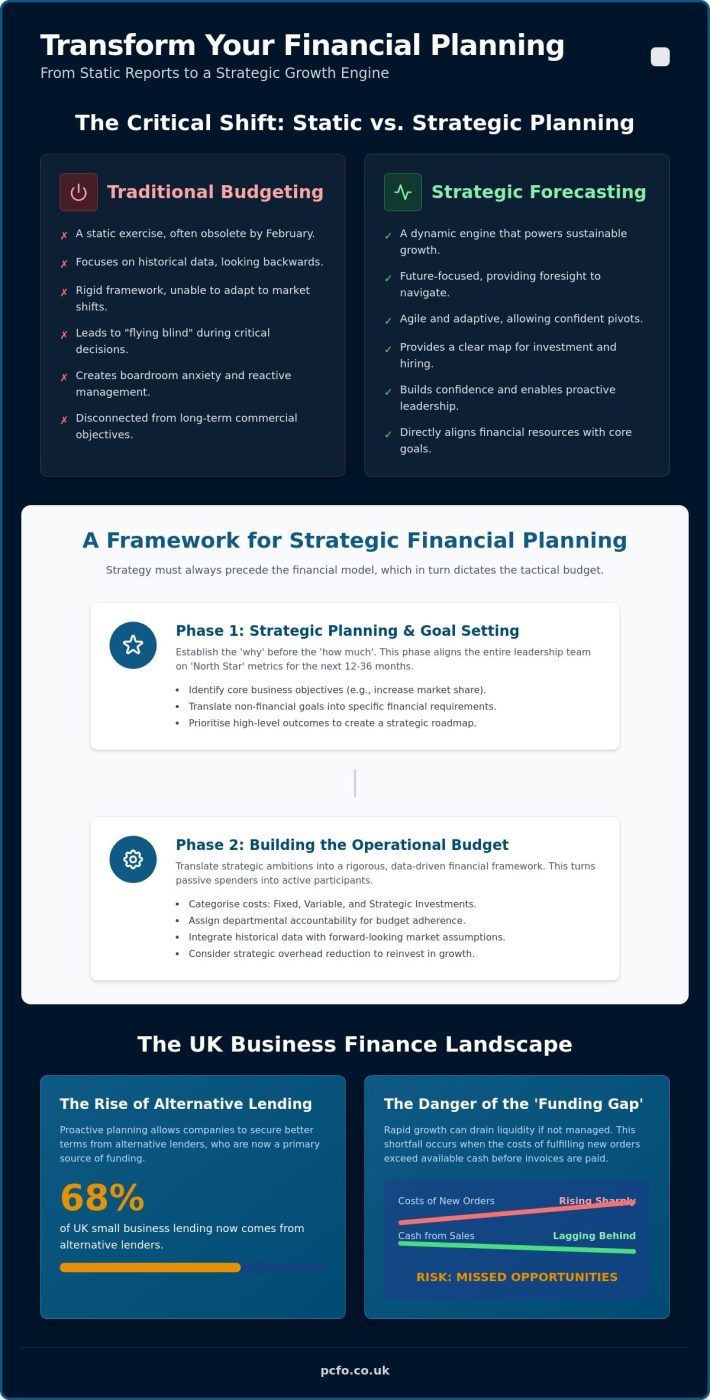
In the current climate, where the Bank of England base rate sits at 3.75% and inflation remains a factor, a static budget created in November rarely survives until spring. Strategic budgeting and forecasting provide the agility needed to pivot when market conditions shift. It’s about developing financial foresight as a core competitive advantage. Companies that anticipate cash flow fluctuations can secure better terms from alternative lenders, who now provide 68% of small business lending, rather than reacting in a crisis. A robust approach to financial risk management uk ensures that these fluctuations are identified and mitigated before they threaten your liquidity position.
Moving from Static to Strategic Financial Planning
The traditional “set and forget” annual budget is often obsolete by the time the first quarter ends. It fails because it focuses on the “how much” without first clarifying the “why”. Strategic planning reverses this hierarchy. It ensures that every pound allocated to marketing, R&D, or payroll directly supports a specific milestone on your business roadmap. When your budget reflects your actual strategy, the sense of boardroom anxiety begins to lift. You’re no longer just managing expenses; you’re investing in a planned outcome.
The Real-World Cost of Poor Financial Foresight
Growth is hungry for capital. Firms often find themselves “flying blind” during rapid expansion, unaware that their success is actually draining their liquidity. A funding gap is the shortfall that occurs when the cost of fulfilling new orders exceeds available cash before customers pay their invoices. Without robust strategic budgeting and forecasting, this gap can lead to missed opportunities or the need for sudden, painful overhead reductions. Instead of seizing a market opening, leaders are forced to spend their time managing creditor pressure. Proactive planning ensures you have the runway to scale safely.
In sectors like hospitality, managing the cost of growth involves balancing payroll with performance; companies like Operational Chef Consultant provide the flexible staffing solutions needed to maintain this equilibrium.
A Step-by-Step Framework for Strategic Financial Planning
Effective financial management follows a strict hierarchy. Strategy must always precede the financial model, which in turn dictates the tactical budget. When these elements are misaligned, you risk funding initiatives that don’t contribute to your long-term goals. Successful strategic budgeting and forecasting require a collaborative partnership between the CEO and the finance function. The CEO provides the vision and commercial direction, whilst the finance team translates those ambitions into a rigorous, data-driven framework.
Phase 1: Strategic Planning and Goal Setting
Your journey begins by identifying core business objectives for the next 12 to 36 months. It’s vital to translate non-financial goals, such as increasing market share or improving customer retention, into specific financial requirements. This process ensures the entire leadership team is aligned on “North Star” metrics. By prioritising these high-level outcomes, you create a roadmap that dictates where capital must be deployed to achieve the greatest impact. Without this clarity, your budget becomes a list of expenses rather than a strategic tool.
Phase 2: Building the Operational Budget
Once the strategy is set, you can categorise costs into fixed, variable, and strategic investments. This distinction is crucial for maintaining flexibility. You might consider strategic overhead reduction to free up capital that can be reinvested into growth initiatives. Assigning departmental accountability for budget adherence is equally important. When managers understand the “why” behind their numbers, they become active participants in the company’s success rather than passive spenders. If you find your current team lacks the bandwidth for this level of detail, engaging Finance Director Services can provide the necessary oversight.
To ensure accuracy, you must integrate historical performance data with forward-looking market assumptions. Relying solely on the past is dangerous in an era of shifting interest rates and evolving consumer behaviour. By adopting expert strategies for financial forecasting, you can build a model that accounts for various economic scenarios. This approach transforms strategic budgeting and forecasting from a rigid annual plan into a responsive navigation system that adapts to reality as it unfolds.
Selecting the Right Budgeting Methodology for Your Business Lifecycle
There is no universal solution for managing company finances. The methodology you choose must reflect your current maturity, market position, and growth ambitions. For a stable business, a simple approach might suffice. However, for firms navigating rapid expansion or economic shifts, strategic budgeting and forecasting require a more rigorous framework. Selecting the right strategic instruments for financial planning ensures that your team remains focused on performance rather than just ticking boxes.
Flexibility is paramount when choosing your framework. If a system is too complex, your department heads will likely ignore it. If it’s too simplistic, it won’t provide the insights needed for high-level decision-making. The goal is to find a balance that your leadership team will actually use to drive commercial results.
Incremental vs. Zero-Based Budgeting (ZBB)
Incremental budgeting is the most common starting point for UK SMEs. It involves taking the previous year’s figures and adjusting them for inflation or planned growth. It’s fast and efficient, but it has a significant flaw: it tends to carry over historical inefficiencies. If a department was overspending last year, that waste becomes “baked in” to the new plan.
Zero-based budgeting (ZBB) offers a more disciplined alternative. It requires managers to justify every single expense from scratch, regardless of what happened in the past. This approach is excellent for maximising ROI and identifying unnecessary overheads. You should consider transitioning from incremental to ZBB, or at least a hybrid model, when your business enters a new lifecycle stage or when profitability begins to plateau despite rising turnover.
Value-Based and Activity-Based Approaches
Modern financial leadership often looks beyond simple cost control. Value-based budgeting focuses on the “value add” of every expenditure. Instead of asking how much something costs, you ask what specific strategic outcome it delivers. This mindset prevents the panicked cost-cutting that can happen during lean months. It ensures that essential growth drivers are protected, even when you’re tightening the belt elsewhere.
Activity-based budgeting takes this a step further by linking costs directly to the specific services or products delivered. This method provides a granular view of your operations and significantly improves the accuracy of gross margin projections for each revenue stream. For companies in the construction sector, incorporating expert insights from Consulting Estimating Consultants ensures that these projections are grounded in precise cost consultancy, turning the budget into a living document that supports every commercial decision.
Mastering Forecasting: The Art of Rolling Projections and Scenarios
A common mistake in financial management is treating the budget and the forecast as the same entity. In reality, they serve distinct purposes. Your budget is the strategic plan, representing your objectives and intended resource allocation. Your forecast is the current reality, reflecting how the business is actually performing against those expectations. By integrating strategic budgeting and forecasting, you create a feedback loop that allows you to adjust your course before a minor variance becomes a major crisis.
Maintaining a healthy cash flow runway requires more than an annual review. It demands a proactive approach where the forecast is treated as a living document. Updating these projections at least monthly ensures that your leadership team is always working with the most accurate data available. This transparency builds the confidence needed to make bold commercial moves, even when the wider economic environment feels uncertain.
Implementing Rolling Forecasts
Traditional budgeting often leads to a “cliff edge” on December 31st, where visibility into the next year is limited until the new budget is finalised. Rolling forecasts eliminate this problem by maintaining a continuous 12 or 18 month view. As each month closes, you simply drop the completed month and add a new one to the end of the projection. This methodical process ensures you always have a clear sightline into the future.
This approach is particularly beneficial for those seeking business growth advisory uk. It allows you to track the real-time impact of growth initiatives and adjust your spending accordingly. Instead of waiting for a quarterly review, you can see the immediate effect of a new hire or a marketing campaign on your long-term liquidity. It’s about being proactive rather than reactive.
Scenario Planning for Market Volatility
Market conditions can change rapidly. Scenario planning involves identifying the “lever” variables that most significantly impact your bottom line. For instance, what happens to your profitability if sales drop by 20%? Or how would a spike in raw material costs affect your margins? By modelling “Best Case,” “Worst Case,” and “Most Likely” outcomes, you can prepare a playbook for each eventuality. Embedding a structured approach to financial risk management uk into this process ensures that your scenario models account for the full spectrum of market, credit, and operational exposures your business faces.
This level of stress-testing is essential when utilising exit strategy planning services. Potential investors or buyers will want to see that the business is resilient and that the leadership team has considered various market shifts. Having these scenarios pre-modelled allows you to react instantly rather than panicking when variables change. If you need assistance building these complex models, our Chief Financial Officer Services can provide the strategic oversight required to future-proof your organisation.
Navigating Financial Complexity with Fractional CFO Expertise
As your business scales, the financial complexity often outpaces the capacity of a standard accountancy function. You might find that whilst your taxes are filed and your books are balanced, you lack the high-level insights needed for strategic budgeting and forecasting. Most SMEs eventually reach this inflection point. They require the expertise of a seasoned financial leader but cannot justify the £150,000 plus annual salary of a full-time Chief Financial Officer. This is where fractional leadership becomes a vital asset for the ambitious business owner.
PCFO acts as the partner that bridges the gap between basic bookkeeping and boardroom strategy. We provide the steady, experienced hand needed to navigate growth phases and economic shifts. By embedding a fractional expert into your team, you ensure that your financial planning isn’t just a compliance task, but a proactive tool for value creation. It’s about having the right level of seniority at the right time to guide your most critical commercial decisions.
The Advantage of Part-Time Financial Leadership
Accessing “big company” expertise allows you to organise your budgeting and forecasting processes with a level of rigour usually reserved for much larger corporations. A finance director brings an objective, external perspective that is often lost when you’re too close to the daily operations. They challenge assumptions, identify hidden risks, and ensure that your financial model is robust enough to withstand market volatility. The ROI of hiring a part-time FD to oversee strategic planning is frequently realised through improved overhead management and the avoidance of costly missteps during expansion.
Turning Data into Strategic Decisions
True financial leadership is about moving beyond “what happened” to determine “what should we do next?”. Raw data only becomes valuable when it’s translated into board-level insights that drive action. During rapid growth, having a partner who can interpret cash flow trends and stress-test your assumptions is the difference between controlled scaling and a liquidity crisis. We encourage you to review fractional cfo pricing uk to understand how this investment provides a scalable, high-impact solution for your leadership team. With the right strategic budgeting and forecasting framework in place, you can lead your business with the calm confidence that comes from total financial clarity.
Securing Your Financial Future Through Strategic Insight
Transforming your financial planning from a static annual chore into a dynamic growth engine is a fundamental shift in leadership mindset. By aligning your resources with long-term commercial objectives and adopting rolling projections, you gain the clarity needed to navigate market volatility. Effective strategic budgeting and forecasting ensure that every investment, from a new hire to a facility expansion, is backed by rigorous data and a clear roadmap.
As your organisation grows, the need for sophisticated financial oversight becomes paramount. Our Strategic Finance Director services provide UK SMEs with deep expertise in business growth, exit planning, and cash flow management. We have a proven track record in overhead reduction, helping leaders bridge the gap between daily operations and boardroom strategy. If you’re ready to move beyond basic bookkeeping, book a consultation with a PCFO strategic advisor to transform your financial planning. With a steady hand at the helm, you can lead your business towards its next milestone with confidence and precision.
Frequently Asked Questions
What is the main difference between budgeting and forecasting?
A budget is your financial roadmap and statement of intent, whilst a forecast is a realistic projection of where the business is actually heading. Think of the budget as the destination you’ve set for the year and the forecast as the GPS that adjusts based on current traffic and road conditions. Maintaining both allows you to identify variances early and make informed adjustments to your operations.
How often should a business update its strategic forecast?
You should update your strategic forecast at least once a month to ensure your data remains relevant. In a volatile economic climate, waiting for a quarterly review can leave you exposed to cash flow risks. Monthly updates allow the leadership team to respond quickly to market shifts, such as changes in interest rates or unexpected supplier price increases, ensuring your projections stay accurate.
Is zero-based budgeting too time-consuming for a small business?
Zero-based budgeting is more labour-intensive than incremental methods, but the financial rigour it provides often outweighs the time investment. For an SME, you don’t necessarily need to apply it to every line item every year. A hybrid approach, where you deep-dive into specific high-cost departments on a rotating basis, can eliminate historical waste without overwhelming your management team.
What are the most important KPIs to include in a strategic budget?
The most critical KPIs focus on liquidity and efficiency, such as your cash flow runway, gross margin percentage, and overhead-to-revenue ratio. You should also track “lever” metrics that are specific to your growth strategy, like Customer Acquisition Cost (CAC) or revenue per employee. These indicators ensure your strategic budgeting and forecasting remain aligned with actual commercial performance rather than just arbitrary targets.
Can I use standard accounting software for strategic forecasting?
Standard accounting software is excellent for recording historical transactions, but it often lacks the sophisticated modelling required for true strategic budgeting and forecasting. Whilst platforms like Xero or QuickBooks provide basic budgeting tools, you’ll likely need a bespoke financial model or a dedicated forecasting integration to perform complex scenario planning. This is where a fractional CFO provides value by building the necessary architecture.
What is a rolling forecast and why is it better than an annual budget?
A rolling forecast is a continuous financial projection that adds a new month to the end of the period as the current month closes. This is superior to a static annual budget because it provides a constant 12-month sightline into the future. It prevents the “cliff edge” effect where visibility disappears at the end of the financial year, allowing for much smoother long-term planning and more confident investment decisions.
When should I hire a fractional CFO to help with my budgeting?
You should consider hiring a fractional CFO when your business reaches a level of complexity where basic bookkeeping no longer supports your decision-making. This often happens during rapid growth, when preparing for an exit, or when you’re facing a significant funding gap. If you feel “blind” during board meetings or struggle to model the impact of new hires, it’s time for expert strategic oversight.
How does scenario planning help with business risk management?
Scenario planning allows you to stress-test your business against potential risks by modelling “Best Case,” “Worst Case,” and “Most Likely” outcomes. By identifying how a 20% drop in sales or a spike in raw material costs would affect your runway, you can create a pre-approved playbook of actions. This proactive mindset transforms risk management from a defensive posture into a clear strategic advantage.