

A report that explains the past is useful; a story that clarifies the next decision is more powerful. Financial storytelling for business leaders turns selected financial data into a clear account of what happened, why it matters to business goals and what action should follow. For CFOs, that shift means moving beyond reporting to guide choices, align teams and strengthen stakeholder trust.
Accurate reporting remains essential, and leaders need clear evidence behind their decisions. The challenge is making that evidence meaningful to people with different priorities, from operational teams to boards and customers. A thoughtful narrative adds context without obscuring the figures or overstating what they show.
This article explores how CFOs can shape a financial story, choose relevant metrics and connect insight to practical action. You’ll see how this approach can support clearer business decisions and help finance leaders communicate strategy more effectively in financial services.
Key Takeaways
- Choose the financial measures that support your main message, then connect the data to its business implications and the action required.
- Shape a clear strategic narrative for each audience and reinforce it consistently across conversations and reporting.
- Move beyond explaining past results by linking performance drivers to business goals, future outlook and practical decisions.
- Use relevant examples and transparent communication to make strategy clearer and strengthen your leadership in financial services.
What is finance storytelling?
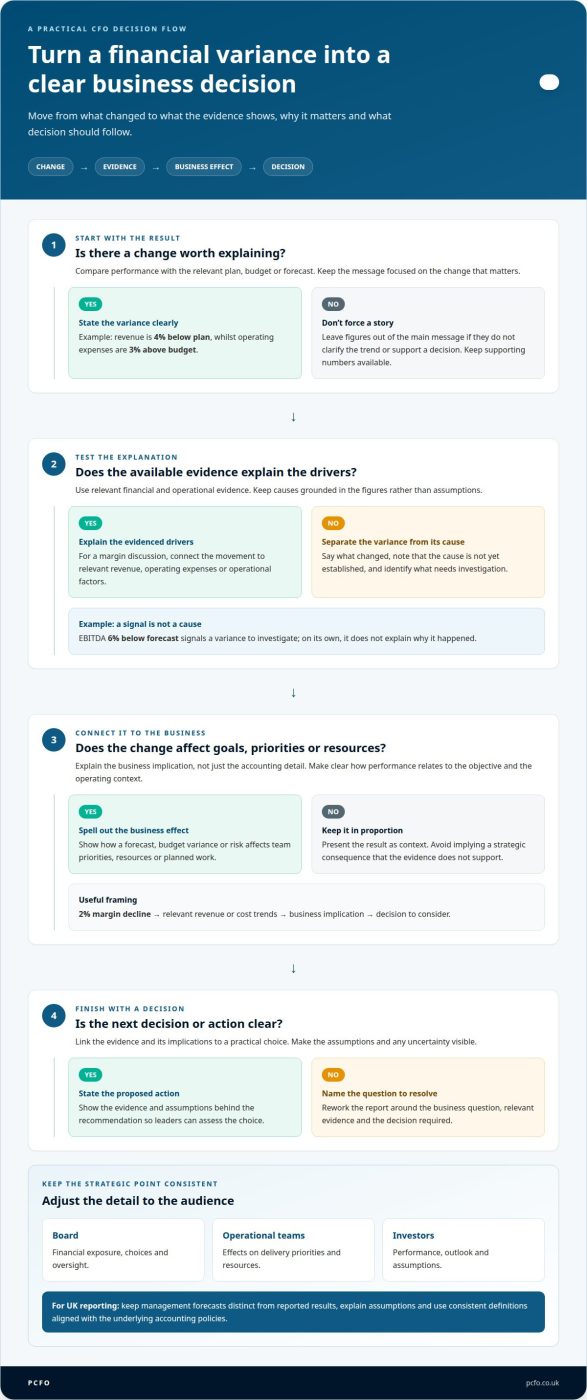
Finance storytelling gives financial figures context, so leaders can understand what changed and decide what to do. For example, a forecast might show revenue 4% below plan alongside operating expenses 3% above budget.
Turning Data into Actionable Stories
A useful story moves from a result to its drivers, business effect and next step. Start with the change, explain what the available evidence says about its causes, then connect it to a decision. For example, a 2% margin decline is more meaningful when presented alongside the relevant revenue or cost trends. Keep the explanation grounded in the figures, not assumptions.
Communicating Financial Data to Non-Finance Audiences
For colleagues outside finance, explain the implication before introducing detailed accounting terms. Show how a forecast, budget variance or business risk affects a team’s priorities, resources or planned work. A useful format pairs one central message with a few supporting figures. Use familiar language and explain necessary terms so operational leaders can follow the reasoning and ask informed questions.
Visualising Trends and Connecting Implications
A visual chart can make a financial trend easier to interpret than a dense table. Choose a format that makes the movement clear, label the relevant period and highlight the change that matters. Then connect data to insight, implication and action: what shifted, what it may mean for the business, and which response deserves consideration. For example, EBITDA 6% below forecast signals a variance to investigate, not a cause by itself.
Selecting Relevant Business Data
Choose measures by starting with the decision the story needs to support. Use financial data that speaks directly to it, then add operational evidence where it helps explain performance. For a margin discussion, relevant measures might include revenue, operating expenses and the operational factors connected to them. Avoid crowding the presentation with figures that don’t clarify the trend, test an explanation or help leaders decide what to do next.
What happens when CFOs step up as strategic storytellers?
For board presentations and investor updates, lead with the strategic message, support it with relevant evidence, then explain the implications and proposed action. In the UK, keep management forecasts distinct from reported results, explain assumptions and use consistent definitions that align with the underlying accounting policies.
Establishing and Repeating Strategic Narratives
Start with the business strategy, then identify the financial message that best expresses progress towards it. A narrative framework can connect the objective, current position, key drivers and next decision. Repeat the central message in board papers, leadership updates and planning discussions. Consistency helps colleagues see how individual decisions contribute to shared organisational priorities, without making every update identical.
Tailoring Narratives to Audiences and Stakeholders
Keep the strategic point consistent, but adjust the detail for each audience. A board may need to understand financial exposure, choices and oversight; an operational team may need to know the effect on delivery priorities and resources. Investors need a clear account of performance, outlook and assumptions. This approach respects each stakeholder’s role while making the strategy and its supporting evidence clear.
Turning Management Reports into Narratives
A management report is more useful when it explains what results mean, rather than presenting isolated variances. Organise the discussion around performance, its drivers, business impact, outlook and the decision required. For example, if a project is delayed, connect the operational delay to its financial implications and the choices available. AI-enabled tools can help analyse data and generate insights, but leaders still need to interpret and communicate them responsibly.
Presenting Financial Narratives to Boards and Investors
For a board presentation, state the decision or risk first, then show the supporting evidence. Use a clear visual or concise table, explain important assumptions, and distinguish actual results from forecasts. Investor updates benefit from the same discipline: connect performance to strategic priorities, explain material changes and set out the outlook without overstating certainty. A focused narrative gives both audiences a clearer basis for discussion and action.
Moving from financial reporting to strategic business guidance
Strategic guidance connects financial data with business goals, decisions and the operating environment. Leaders can assess its influence by recording which decision each narrative supports, then tracking whether actions, resource allocations or priorities change.
Moving from Reporting to Influence
A report describes numbers; influential finance explains what they mean for a critical business choice. Review whether each report answers a decision-maker’s question, such as whether to expand capacity or revise a product plan. Then connect performance to its drivers, business objectives and outlook. The finance team can recommend a decision while showing the evidence and assumptions behind it, making its contribution to strategy visible.
Addressing Reports That Fail to Prompt Action
A report can contain accurate figures yet leave managers unsure what to do next. Look for pages of variance details without a clear priority, explanation or decision owner. For example, a digital sales report might show lower conversion without identifying whether pricing, customer behaviour or campaign changes need investigation. Rework it around the business question, relevant evidence and next discussion. Keep supporting numbers available, but lead with the issue that needs attention.
Measuring Narrative Influence on Decisions
Track whether a narrative leads to a recorded choice, assigned action or changed plan. Compare the recommendation with meeting minutes, approved budgets and subsequent operational decisions; these show whether financial insight entered the decision process. In esports, Team Liquid hired 400 people in seven years, illustrating how organisational growth creates complex planning needs. A finance narrative can connect headcount, investment and business priorities, then make clear which decision leaders took and what they monitor next.
Review the result in the next reporting cycle: did the agreed action happen, and did the relevant measure move? Separate influence from outcome, since market conditions or execution can affect results. This follow-up helps leaders assess whether reporting informed a decision, rather than simply presenting historical numbers.
Storytelling as a leadership tool in financial services
In financial services, a clear narrative helps leaders explain how strategic choices affect customers, teams and business performance. It gives change meaning by connecting the message to practical examples, such as a new payment process or a customer-engagement improvement.
Storytelling strengthens direct, transparent communication rather than replacing it. A CFO can explain the financial rationale for a transformation, identify its expected operational effect and describe how progress will be assessed. This gives colleagues a clearer view of the purpose behind change while keeping the evidence and uncertainties visible.
Rabobank’s agile transformation in its Payments domain shows how communication can support delivery. The programme used a structured communication cascade, including weekly stand-ups across leadership, product and DevOps teams. Vision teams translated strategy into prioritised epics, giving colleagues a shared way to communicate progress and value. The example shows how regular updates and clear priorities can bring strategic plans into day-to-day work.
Leaders can apply the same discipline without adopting another organisation’s model wholesale. First, state the strategic priority in plain language. Then use a relevant example to show what it means for customers or colleagues. Finally, connect progress to the business measures that matter. For a system implementation, explain the intended customer benefit alongside the investment, delivery milestones and key risks.
This approach also develops leadership skills. Rehearsing a message helps a CFO check whether the explanation is clear, while feedback from trusted colleagues can reveal where audiences need more context. Personal anecdotes and examples of positive change can make an update memorable, provided they support the financial evidence rather than distract from it.
Financial services leaders can use storytelling to make innovation understandable, especially when a change affects several teams. A consistent message gives people a basis for discussion and helps leaders explain how decisions support the strategy. For experienced financial leadership that can connect financial insight with business direction, explore strategic finance support.
PCFO: Chief Financial Officer Services
PCFO provides Chief Financial Officer Services for businesses that need financial leadership to connect reporting with strategic decisions. This support can help when forecasts, budgets and performance updates aren’t giving leaders a clear basis for action, or when growth brings more complex planning needs.
Through its Finance Director Services, PCFO helps businesses strengthen financial oversight and link insight to operational priorities. Its Business Growth Advisory and Business Planning Consultant services help owners assess opportunities, plan for change and align resources with business goals. The focus is on making financial information useful for upcoming decisions, not simply presenting historical results.
If your business needs clearer financial guidance for its next stage, contact PCFO to discuss your priorities.
Make your next financial decision clearer
Make financial storytelling for business leaders an ongoing leadership practice, not a one-off presentation. As priorities shift, revisit the message, evidence and decisions your teams need to understand. This keeps financial communication connected to the direction of the business.
PCFO offers Finance Director Services, Chief Financial Officer Services and Business Growth Advisory to help businesses strengthen financial leadership and plan for growth. If you’re considering how to bring greater strategic focus to financial decisions, book a free initial strategy session to discuss your needs.
Contact PCFO to discuss your needs and consider the next step with confidence.
Frequently Asked Questions
Why does storytelling matter in FP&A?
Storytelling helps FP&A teams make analysis useful to people deciding where resources should go. A forecast showing slower sales, for example, can prompt discussion about pipeline quality, planned hiring or stock commitments. The narrative gives colleagues a shared way to interpret assumptions and consider options. It also helps explain why a recommendation follows from the financial analysis.
What is financial storytelling for business leaders?
Financial storytelling for business leaders means using relevant financial evidence to explain a business issue and its significance. It links measures such as margin, cash or operating costs to the choices leaders face. A useful story distinguishes reported results from expectations, explains the reasoning behind its interpretation and identifies the decision or discussion the information supports.
Why is financial storytelling important for business decision-making?
It helps decision-makers see how financial information relates to a choice, rather than treating figures as isolated results. For instance, a proposal to extend customer payment terms can be considered alongside its effect on working capital and customer relationships. A clear narrative makes trade-offs easier to discuss, surfaces assumptions and gives teams a shared basis for assessing the decision.
How can leaders turn financial data into a compelling business narrative?
Start with the business question, then choose evidence that speaks directly to it. Explain what the data shows, identify likely drivers and distinguish evidence from interpretation. For example, a rise in operating costs could be considered alongside staffing or supplier changes before leaders decide on a response. Finish by stating the decision required and what information to monitor afterwards.
What are the key elements of an effective financial story?
An effective financial story has a clear purpose, relevant evidence, context, an honest explanation of implications and a decision or next step. It makes assumptions visible and avoids implying that correlation proves cause. A chart can support the message, but its labels, period and comparison must be clear. These elements help readers understand both the case being made and its limits.
How should leaders explain revenue, costs, cash flow and profit to non-financial audiences?
Define each measure in plain language and explain how it relates to the others. Revenue is money earned from sales; costs are the resources used to operate; profit is what remains after relevant costs are deducted. Cash flow describes money moving into and out of the business, so it can differ from reported profit. Use a simple sales example to show why timing matters.