

A business can thrive beyond its founder when decisions, financial insight and day-to-day work are shared across a capable team. The founder-to-CEO financial mindset shift means moving from doing everything yourself to building the people, systems and financial discipline that keep the company moving without your constant input.
That change can feel uncomfortable. You may be used to solving problems quickly, keeping a close eye on spending and stepping in when work gets busy. But sustainable growth depends on choosing where to focus your time, how to use the business’s money and which responsibilities others can own.
This article explains how to build a business that relies less on you, make considered financial decisions and delegate without losing sight of standards or direction. It also explores the financial mindset SME ownership calls for, helping you focus on the company’s long-term performance and your role as its leader.
Key Takeaways
- Build processes and team capability so routine decisions and work don’t depend on you alone.
- Assess business spending by how it supports future capacity, resilience and sustainable returns.
- Delegate clear outcomes and responsibilities, then give your team room to decide how to deliver them.
- Use financial information to guide ownership decisions, not just review what has already happened.
- Balance growth plans with profitability and cash flow, so expansion supports the business rather than straining it.
1. Building a business that can operate without its owner
A growing company needs to function when its founder is away from daily decisions. That takes more than hiring capable people: document repeatable work, share priorities and give team members authority within clear limits. For example, a customer-service lead can resolve routine complaints using agreed criteria instead of waiting for the founder’s approval.
Put core financial controls in place: use accounting software, reconcile bank transactions, track invoices and review cash flow forecasts. Prepare monthly management reports on cash, revenue, costs and performance against budget, and assign someone to follow up on each item. Clear spending limits and a second-person review of important payments help reduce errors and maintain oversight.
Trust grows when people understand the goal and the boundaries. Explain why a decision matters, what success looks like and which choices they can make independently. Then ask questions that build problem-solving skills: “What have you considered?” and “What would you recommend?” When team members propose solutions, they learn to take ownership instead of passing every issue upwards.
Alignment matters as the company expands. The founder’s original idea becomes shared by the people who contribute to the business, so revisit the mission in team planning and explain how each role supports it. A team can work more effectively when its members believe in that mission. As it grows, regular discussions help connect individual work with the company’s direction.
Systems make good work repeatable. Document key processes such as onboarding a customer, approving a purchase and preparing a monthly report. Give each process an owner, a clear sequence and a way to identify problems. Update the documents when the work changes instead of relying on the founder’s memory or informal instructions.
Protect time for work that builds future capacity. Before opening emails or checking social feeds, decide whether your priority is improving an offer, creating useful content, strengthening a system or building a valuable connection. These efforts can benefit the business repeatedly. A quick inbox response may feel productive, but it rarely replaces a process that prevents the same question from coming back.
Set direction before assigning tasks. Define business goals for the coming months and years, then translate them into team responsibilities and practical measures. Review progress in scheduled meetings, and let people choose their methods within agreed standards. This creates room for initiative while keeping decisions connected to the company’s objectives.
Set priorities for each person and ask questions that encourage them to think through challenges rather than wait for instructions. This builds problem-solving skills and the team’s capacity. As the company grows, the team’s skills may matter more than the founder’s individual expertise. Giving people room to reason through decisions helps those skills contribute and reduces reliance on the founder’s judgement.
2. Working for money versus making money work for you
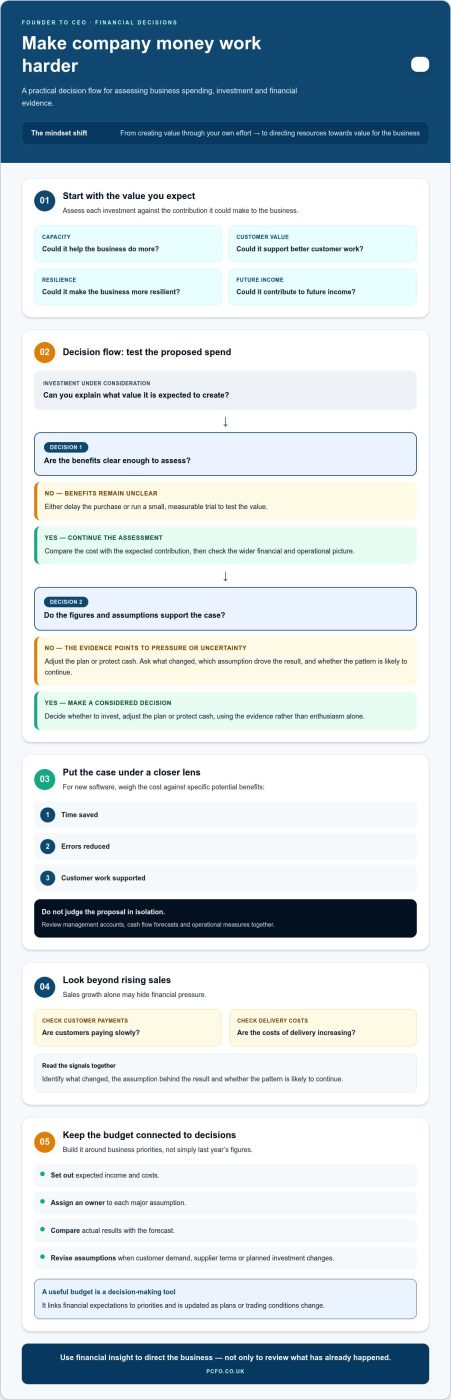
A founder often creates value through personal effort: winning customers, solving delivery problems and making urgent decisions. A CEO must also decide where company resources can create value without relying on the founder’s hours. Assess each investment against its expected contribution to capacity, customer value, resilience or future income.
Start with a specific decision. If the business is considering new software, compare its cost with the time saved, errors reduced and customer work supported. If the benefits remain unclear, delay the purchase or run a small, measurable trial. Base larger business risks on research, intuition and strategy, not enthusiasm alone.
Data makes that judgement more disciplined. Review management accounts, cash flow forecasts and operational measures together. Rising sales, for example, can conceal pressure if customers pay slowly or delivery costs increase. Ask what changed, which assumption drove the result and whether the pattern is likely to continue. Then decide whether to invest, adjust the plan or protect cash.
Build a budget around the company’s priorities, not just last year’s figures. Set expected income and costs, assign an owner to each major assumption, and compare actual results with the forecast. Update it when customer demand, supplier terms or planned investment changes. That makes the budget a decision-making tool, not a document filed after approval.
How does CEO compensation differ from founder compensation in the UK? A CEO may be paid for the role, while a founder may also benefit from ownership through shares and any declared distributions. Keep the distinction clear in business planning, and consider how remuneration affects company cash and personal income.
What UK tax, payroll and Companies House obligations should a founder-CEO know? Businesses need to manage payroll reporting and relevant tax filings with HMRC, alongside required company filings and accurate company information at Companies House. Plan these responsibilities in the financial calendar and assign clear ownership.
How should a CEO build and manage a company budget and forecast? Link each income and cost assumption to an owner, a business priority and supporting evidence. Compare actual performance with the forecast regularly, then revise assumptions when trading conditions or plans change.
How should a founder-CEO approach fundraising, valuation and investor expectations? Prepare a clear account of the company’s performance, funding needs and intended use of capital. Treat valuation as part of a wider discussion about ownership, growth milestones, investor rights and the evidence behind future projections.
For yourself, the central change is to judge money by what it enables, not simply what it earns today. A considered investment should support a business objective and have a way to assess its effect. This helps distinguish strategic spending from activity that merely keeps the founder busy.
3. Delegation and founder workload
In a founder’s early days, doing every task can feel efficient. As the company grows, that habit can turn the founder into a bottleneck. A growing team needs clear ownership, not another person waiting for approval. List recurring decisions and tasks only you currently handle, then mark which require your judgement and which follow a repeatable process.
For each task you delegate, define the outcome, the responsible person and why the task matters. Let the team member choose the method within agreed standards. For example, ask a sales lead to improve follow-up rates, then agree how to review progress. This shifts your attention from taking every action to setting direction and assessing results.
Hiring and delegation need care. Nearly a quarter of startup failures are attributed to hiring problems, so define the role before recruiting. Specify the work it owns, the skills it needs and how success will be recognised. Once someone joins, provide context and feedback. Delegation without support can simply transfer confusion rather than build capacity.
How should founder-CEOs delegate financial decisions and spending authority? Set approval boundaries based on budget, purpose and risk, then specify who can approve each type of spending. Require a second review for unusual or significant commitments, and review exceptions through regular reporting.
Make financial responsibilities visible. Assign budget owners to teams or projects, and ask them to explain significant differences between planned and actual spending. Where practical, separate payment approval from payment processing. This creates accountability without requiring the founder to inspect every routine purchase or invoice.
McKinsey research says founder-CEOs who delegate effectively are more likely to lead companies that outperform competitors and sustain rapid growth. The practical lesson is to delegate decisions with clear context, not just tasks. Share the objective, constraints and relevant financial information. Then let the responsible person decide how to deliver the agreed outcome.
A founder leading a team of 20 people can’t remain the sole decision-maker without slowing work. Protect time for decisions where your influence matters most, such as setting priorities or resolving a strategic risk. Don’t work 72 straight hours and expect to lead effectively afterwards. Preserve energy for moments when leadership has a direct impact.
Delegation also shifts your role from hands-on problem-solving to developing people and systems. Schedule regular one-to-ones to discuss progress, obstacles and decisions. When a team member raises a problem, ask what options they see before offering your answer. This builds judgement, confidence and a stronger leadership team.
4. Financial mindset for SME business ownership
SME ownership asks you to think beyond this month’s sales. The author describes mindset as 80% of the game. In practice, that means treating financial information as a tool for choices, not simply a record of past activity. A founder considering a new hire, for example, should weigh its expected contribution against the company’s capacity to support the role.
Regularly review what the numbers mean. Consider cash, customer demand, costs and commitments together. If revenue rises while cash tightens, investigate payment timing and delivery costs before assuming growth is healthy. A CEO’s responsibility is to understand the reason behind a result and decide what action follows.
Ownership also means facing setbacks directly. If a planned launch misses its sales target, identify which assumption failed: customer interest, pricing, timing or delivery. Record the lesson and adjust the next decision. Taking responsibility doesn’t mean treating every setback as personal failure. It means using what happened to improve the company’s next move.
That approach supports steadier leadership. You don’t need to wait until you feel completely confident to make a considered decision. Confidence develops through action, feedback and learning. For instance, test a new sales process with a defined group of customers, review the response and refine it before committing more resources. Keep the decision grounded in evidence and strategy.
Long-term thinking can be made practical. Set a clear business vision for two years, then identify what progress should look like over the next six months. Connect each milestone to an owner, a measure and a financial implication. A product expansion, for example, may need extra stock, staff time or marketing investment before it generates income.
How can a founder-CEO manage cash runway and reduce the risk of insolvency? Review a rolling cash forecast against expected receipts, committed payments and upcoming costs, then act early on gaps. Follow up overdue invoices, reassess discretionary spending and delay commitments that don’t support immediate priorities or a credible growth plan.
Separate business decisions from personal reactions. A founder may feel attached to a product, supplier or long-standing process, but leadership requires testing its current value. Ask what evidence supports continuing, changing or stopping it. If a product takes substantial time yet contributes little margin, examine its costs and role for customers before allocating more effort.
Finally, recognise that CEO milestones may take longer than the achievements founders celebrate. A stronger management team or dependable reporting process may not produce an immediate sales increase. Track these capabilities as part of progress and revisit them during planning. This makes patience an active discipline, supported by milestones and informed financial decisions.
5. How should a founder-CEO balance growth, profitability and cash flow?
Balance starts by treating growth, profit and cash as connected measures. A new contract can lift sales but strain cash if delivery costs arrive before customer payment. Strong profit on paper also won’t protect the business if invoices remain unpaid. Review the opportunity alongside its costs, payment terms and effect on working capital before committing resources.
Assess growth proposals through a consistent business case. Define the customer need, expected income, direct delivery costs and capacity required. For example, expanding a service may require extra staff or supplier commitments before revenue builds. Identify the assumptions behind the proposal, then test how changes in demand or costs could affect returns and cash needs.
Profitability shows whether the business model creates value after costs. Examine margins by product, service or customer group, rather than relying only on overall sales. If one service generates revenue but absorbs disproportionate delivery time, review its pricing, process or scope. This helps direct effort towards activity that contributes more sustainably to operating profit.
Cash flow needs its own management. Map expected customer receipts against payroll, suppliers, tax payments and other commitments. A profitable business can still face pressure if receipts arrive later than payments are due. Follow up overdue invoices promptly, agree clear payment terms and discuss supplier commitments early. These steps improve visibility and help the company respond before a shortfall becomes urgent.
Use scenarios to compare choices, not to predict one certain outcome. A base case can reflect current trading assumptions; another can show weaker demand, higher costs or delayed customer payments. For each scenario, identify which decisions would change, such as slowing recruitment or postponing an expansion. This turns uncertainty into a practical plan with clear triggers.
Set measures that show whether growth is strengthening the business. Track sales alongside gross margin, operating costs, debtor balances and cash movement. Give each measure a clear owner and review the reasons for material changes. If sales rise while margins fall, investigate discounting, supplier prices or delivery efficiency before increasing marketing spend.
Choose investments according to strategic value and financial capacity. Staged spending can help test a new market or offer before making a full commitment. Define what evidence would justify the next stage, such as repeat demand or improved contribution margin. If the evidence is weak, revise the approach rather than defend the original forecast.
For a clearer link between growth plans and financial performance, explore support for sustainable business growth.
Define what evidence would justify the next commitment, and when the decision will be revisited. Growth involves 10 core elements that can work together more efficiently, so founders should consider how a change in one area affects the others rather than treating each initiative in isolation.
Founders scaling a company should define what needs to happen, who is responsible and why, while leaving the method of execution to the team. This keeps accountability clear without requiring the founder to direct every task. Agree on check-ins around meaningful milestones and use them to spot when growth is putting profitability or cash under pressure.
PCFO: Finance Director Services
PCFO provides Finance Director Services to help growing businesses strengthen financial oversight and make informed decisions. Consider this support when cash flow, reporting or investment choices need closer strategic attention, or when your involvement in every financial decision is limiting progress.
For broader financial leadership, PCFO also offers Chief Financial Officer Services, Business Growth Advisory and Business Planning Consultant support. These services connect financial insight with growth priorities, business plans and the company’s next stage of development.
If you’re ready to build a business that relies less on your day-to-day input, contact PCFO to discuss your financial leadership needs, or visit pcfo.co.uk.
Make your next leadership decision count
The founder-to-CEO financial mindset shift becomes tangible through the decisions you make next. Choose one area where your attention is still needed, then identify what information, responsibility or decision-making support would help the business progress without relying on you. That choice can turn the ambition of greater independence into a practical leadership priority.
As your role changes, an experienced financial perspective can help you assess the company’s position and make decisions with greater clarity. PCFO offers Finance Director Services, Chief Financial Officer Services and Business Growth Advisory to support financial leadership and business development.
If you’re ready to consider the right financial support for your next stage, discuss your financial strategy with PCFO. The next step is yours to shape, and a more independent business can start with one considered decision.
Frequently Asked Questions
What financial mindset shifts are needed when a founder becomes CEO?
The key shift is from measuring your contribution by personal output to judging decisions by the health and capacity they build across the business. The founder-to-CEO financial mindset shift also means separating emotional attachment from commercial evidence. For example, assess a long-standing product by its customer value and contribution, not its history. Use financial measures to choose priorities and make sure others understand the reasoning behind those choices.
What financial metrics should a CEO review weekly and monthly?
Weekly, review available cash, incoming receipts, overdue customer invoices and payments due soon. These indicators can flag timing pressure before it appears in a monthly report. Each month, examine profit and loss, gross margin, operating costs, working capital and performance against budget. Add a short explanation for major variances, such as a delayed contract or higher supplier costs, then assign follow-up actions. The most useful measures depend on how the business earns and spends.