

For a UK business reaching £15 million in annual turnover, the 18-month cost of a full-time CFO can soar to approximately £527,575, yet the same strategic impact often costs just £162,000 via a fractional model. When you’re scaling at pace, the choice between a fractional cfo vs full time lead isn’t just about saving money. It’s about aligning executive expertise with your company’s actual velocity and ensuring you aren’t over-leveraged before you’re ready.
It’s natural to feel overwhelmed by financial complexity whilst worrying about the heavy overhead of a permanent executive hire. You need board-level insights to make confident decisions, but the prospect of a six-figure salary plus the 15% employer National Insurance rate can feel like a significant burden on your cash flow. We understand that you want the best for your business without compromising its financial stability.
Discover the critical differences in cost, impact, and strategic value to determine the right financial leadership for your growth stage. This guide provides a clear framework for your decision, comparing the total cost of ownership and helping you secure the strategic foresight your organisation needs to thrive.
Key Takeaways
- Understand how to align financial leadership with your company’s current velocity to avoid the significant risk of “expensive underemployment” during early growth phases.
- Evaluate the total cost of ownership for a fractional cfo vs full time hire, accounting for base salary, employer National Insurance, and the extensive recruitment fees common in the UK market.
- Identify the five critical trigger points, such as capital raises or preparing for an exit strategy, that indicate your SME requires board-level financial oversight.
- Learn to transition from gut-feel decision-making to a data-driven framework that provides the intellectual rigour and strategic foresight necessary for successful scaling.
- Discover the benefits of an embedded advisor model, providing your organisation with the stability of a seasoned Finance Director without the commitment of a permanent executive contract.
The CFO Gap: Defining Fractional and Full-Time Strategic Leadership
Choosing the correct financial lead requires a clear understanding of the fundamental differences between permanent and flexible roles. A full-time CFO is a permanent, board-level executive dedicated exclusively to one organisation. They manage the daily financial operations, lead the internal finance team, and provide constant strategic oversight. In contrast, a fractional CFO acts as a strategic partner, delivering high-level leadership on a part-time or project basis. This model allows businesses to access elite expertise without the financial commitment of a full-time salary.
Both roles differ significantly from a standard accountant. While an accountant focuses on compliance, tax, and historical record-keeping, a CFO prioritises capital structure, fundraising, and long-term growth. This distinction is vital for UK SMEs that have outgrown basic bookkeeping but aren’t yet ready for a permanent executive. The goal is “Right-Sizing” your leadership, ensuring you have the exact level of expertise required for your current lifecycle.
The Core Responsibilities of Strategic Finance
Establishing the baseline for these roles often starts with the finance director job description, which covers treasury management and risk mitigation. However, the true value of a CFO lies in the shift from historical reporting to forward-looking strategic planning. They provide the board-level financial advice necessary to navigate complex market conditions. This includes detailed cash flow modelling, scenario planning, and investor relations, ensuring your business decisions are backed by data rather than intuition.
Why “Part-Time” Does Not Mean “Partial Impact”
There is a common misconception that a Fractional executive is less committed than a full-time hire. In reality, the fractional model operates on a “dosage” principle. You receive 100% of a veteran’s expertise in 20% of the time. These professionals often leverage their experience across multiple firms to provide unique insights that a siloed executive might overlook. When evaluating a fractional cfo vs full time hire, focus on output rather than hours at a desk. Concentrated strategic impact often delivers more value during rapid scaling than a permanent role that isn’t yet fully utilised.
Accessing this level of expertise ensures your business remains agile. Whether you choose a fractional cfo vs full time lead, the priority remains the same: securing a steady, experienced hand to guide your financial strategy.
Strategic Velocity: Matching Leadership to Your Business Lifecycle
Managing a business through its lifecycle requires different levels of financial intensity at different times. From the early stages of Seed funding through to a rapid Scale-up, the complexity of your financial needs evolves. When weighing the merits of a fractional cfo vs full time hire, you must consider the risk of “expensive underemployment.” This occurs when a high-salaried executive is brought in before the business has the strategic volume to keep them occupied at their highest level of capability. You end up paying a premium for a leader who spends half their time on tasks that a mid-level manager could handle.
One of the most significant advantages of the fractional model is the “cross-pollination” of ideas. Because these leads work across various sectors and boardrooms, they bring diverse perspectives and battle-tested strategies to your organisation. They’ve often seen the exact challenges you’re facing elsewhere and can implement proven solutions quickly. This breadth of experience is often more valuable during scaling than the deep, singular focus of a permanent hire who has only seen one way of operating.
Founders sometimes worry that a part-time lead won’t be “embedded” enough in the company culture. However, modern fractional partners operate as integral members of the leadership team. They utilise your digital collaboration tools, join your management meetings, and lead your internal finance staff. The focus is on strategic foresight and proactive navigation rather than just sitting at a desk for forty hours a week. The priority is strategic alignment, not just physical presence.
When Fractional Wins: The Scaling SME
Companies with a turnover between £2m and £10m often reach a tipping point where basic accounting is no longer sufficient. They require business growth advisory to navigate specific milestones like Series A funding or international expansion. In these scenarios, the ability to access Tier-1 executive talent without the burden of a permanent six-figure overhead is a distinct competitive advantage. It allows you to invest that saved capital back into your core operations whilst still benefiting from expert financial guidance. If you are currently navigating these growth pains, our Finance Director Services can provide the steady hand you need.
When Full-Time Wins: The Mature Enterprise
The fractional cfo vs full time comparison usually shifts in favour of the latter once a company reaches the mature enterprise stage. As turnover exceeds £20m or £30m, the operational complexity usually demands a permanent, daily presence. High-volume operations, complex daily mergers and acquisitions, or intense regulatory requirements require a CFO who is available for every operational decision. Transitioning to a full-time model is a natural progression once the finance function has fully matured and the workload justifies the total cost of ownership.
The Total Cost of Ownership: A UK Financial Comparison
Understanding the financial commitment of a permanent hire requires looking far beyond the base salary. Whilst a UK CFO’s base salary typically ranges between £120,000 and £180,000 for mid-market firms, the “loaded cost” is significantly higher. When you factor in the mandatory and expected “on-costs,” the annual expenditure can quickly exceed £225,000. These additional obligations include:
- Employer National Insurance: 15% for earnings above the secondary threshold (effective from April 2025).
- Pension Contributions: Typically 3-5% of the base salary.
- Private Health Insurance and Benefits: Often costing between £2,000 and £5,000 annually.
- Recruitment Fees: Executive search firms typically charge 20-30% of the first-year salary, creating an immediate one-off cost of £44,000 to £66,000.
When you compare a fractional cfo vs full time hire, the fractional model offers a transparent, flat-fee or day-rate structure. This approach eliminates the need for complex equity packages or performance bonuses that can dilute founder ownership. It also removes the “recruitment friction” and the three-to-six-month wait time common in permanent executive searches. You pay for the strategic expertise you consume, ensuring your capital is preserved for core business operations. For a detailed breakdown of what these engagements typically cost, our guide on fractional CFO pricing in the UK provides a transparent look at the various retainer and day-rate structures available to SMEs.
Calculating the ROI of Your Finance Lead
In this context, ROI is the value of strategic capital allocation versus the cost of the hire.
A fractional lead often pays for themselves by identifying operational inefficiencies and optimising working capital. High-impact deliverables, such as cash flow forecasting services, provide the board with the clarity needed to avoid expensive short-term borrowing. These focused interventions ensure that every pound spent on financial leadership contributes directly to the stability and bottom-line growth of the organisation.
Flexibility and Risk Mitigation
The “cost of a bad hire” at the executive level is devastating, often reaching double the individual’s annual salary when accounting for lost productivity and cultural disruption. Fractional support allows you to scale your financial oversight up or down based on monthly business performance. You avoid the long notice periods and potential redundancy risks inherent in permanent executive contracts. This agility is vital for UK SMEs navigating volatile market conditions, providing a strategic safety net that permanent employment simply cannot match. Choosing a fractional cfo vs full time lead ensures you have the right expertise at the right time, without the burden of a high, fixed-cost base.
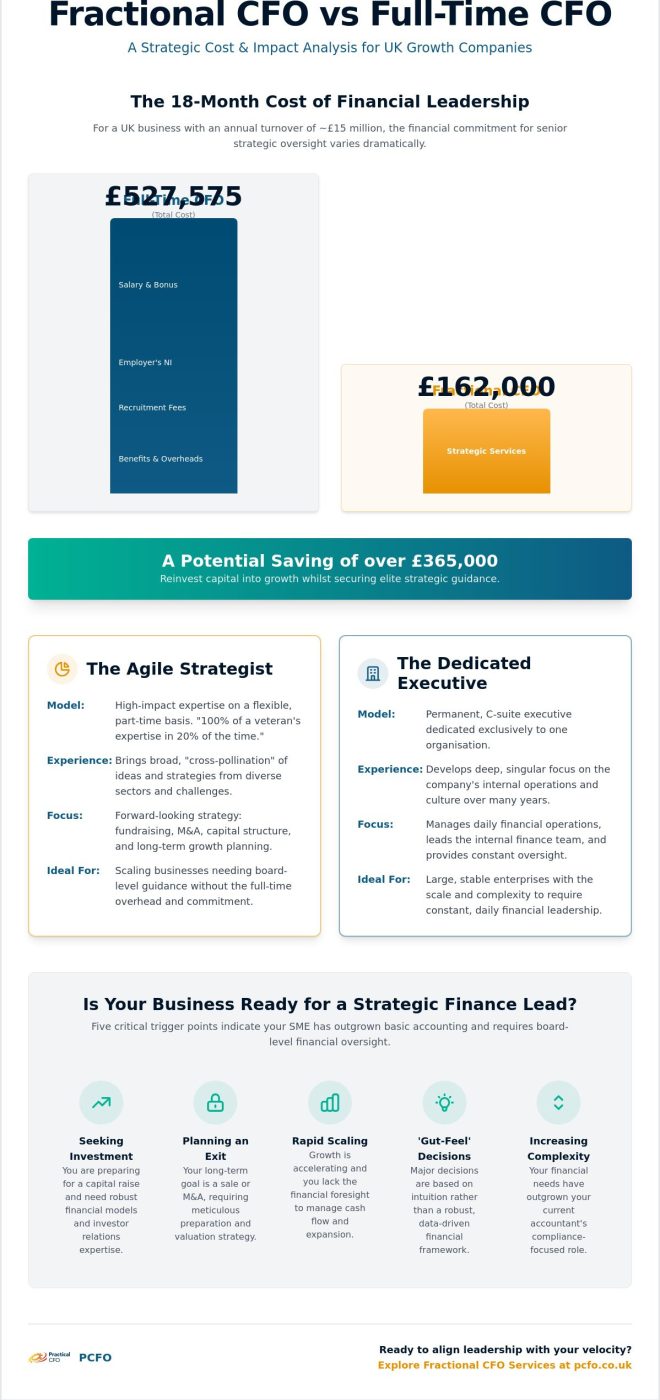
Trigger Points: Five Signs Your SME is Ready for a Strategic Finance Lead
Identifying the precise moment to move beyond basic accounting is a strategic skill in itself. Many UK founders find themselves caught in a growth paradox where the financial complexity of the business begins to outpace their internal capacity to manage it. When evaluating the fractional cfo vs full time dilemma, look for these five critical indicators that your organisation requires a steady, experienced hand at the helm of its financial strategy.
- Capital Raising or Exit Preparation: You are actively seeking investment or preparing for a significant exit strategy. Investors and buyers require sophisticated financial modelling and a level of due diligence that standard bookkeeping cannot provide.
- Gut-Feel Decision Making: Your “strategic” decisions are being made on intuition rather than data-driven forecasts. If you cannot accurately predict the impact of a new hire or a price change on your year-end cash position, you lack the necessary strategic oversight.
- Outgrowing Your Accountant: You have reached the limits of your current accountant’s ability to provide commercial advice. Whilst they may be excellent at compliance, they don’t possess the board-level experience to guide your long-term trajectory. Businesses in this position often benefit from exploring outsourced financial controller services UK as a stepping stone to more comprehensive strategic oversight.
- Cash Flow Blind Spots: Rapid growth is creating unforeseen cash flow pressures despite increasing turnover. This “overtrading” risk is a common cause of failure for UK SMEs that lack proactive treasury management.
- The CEO Time Drain: The Chief Executive is spending more than 20% of their time on finance-related tasks. This is a clear signal that your leadership is being diverted from core growth activities to manage spreadsheets and banking relationships.
If these signs resonate with your current experience, it is time to secure a more robust financial framework. You can explore our Chief Financial Officer Services to see how an embedded partner can alleviate these pressures immediately.
Fractional CFO vs Accountant: The Distinction
It’s vital to recognise that an accountant primarily looks at the past to ensure compliance, whilst a CFO looks at the future to drive value. A CFO manages the entire “Finance Function,” acting as a proactive navigator for the business. This allows the CEO to focus on operational leadership whilst the CFO ensures the capital structure supports those goals. For a more detailed breakdown of these differences, you can review our guide on the fractional cfo vs accountant roles.
Preparing for a Business Sale
A strategic lead is particularly critical when preparing for a business sale in the UK. A fractional lead is often the ideal choice for the 12 to 24-month “grooming” period before an exit. They ensure your data is “clean,” your forecasts are robust, and your financial narrative is compelling for potential acquirers. This preparation significantly reduces the risk of price chips during the due diligence phase. When choosing between a fractional cfo vs full time lead for an exit, the fractional model provides the elite expertise required for the transaction without the long-term executive contract that might complicate a sale.
Fractional CFO Services: The Scalable Path to High-Level Expertise
PCFO delivers a sophisticated alternative to the binary choice of a permanent hire or no leadership at all. We provide seasoned Finance Directors who act as embedded strategic partners within your organisation. This approach ensures you receive the intellectual rigour and corporate authority of a veteran executive without the rigid constraints of a permanent contract. By adopting this “Authoritative Strategic Partner” model, your business gains access to high-level foresight that is typically reserved for much larger enterprises.
Our service-first structure is designed specifically for the UK SME market. It prioritises immediate strategic impact over administrative presence. When the time eventually comes for your organisation to transition from a fractional model to a permanent executive, we support that evolution. We don’t just provide a service; we help you build the financial maturity required to sustain a full-time role in the future. This ensures that the decision between a fractional cfo vs full time lead is always based on your business’s actual readiness rather than a perceived necessity. By right-sizing your leadership now, you protect your margins whilst preparing for the eventual necessity of a permanent hire.
Beyond the Spreadsheet: The PCFO Advantage
Our focus remains on proactive future-proofing rather than simply recounting historical data. We work collaboratively alongside your existing finance teams to elevate their output and align their daily activities with your long-term commercial goals. During turbulent scaling periods, we provide the steady hand needed to navigate uncertainty. This partnership ensures that your financial foundations are robust enough to support rapid expansion without the risk of structural collapse. We focus on the long-term trajectory of your business, ensuring every financial move is a calculated step toward your defined exit or growth goals. For businesses that need robust day-to-day financial oversight to complement this strategic direction, our outsourced financial controller services UK provide the commercial oversight that transforms reactive reporting into proactive growth management.
In addition to financial leadership, ensuring your brand strategy is equally robust is key to sustained expansion; you can discover Fireheart Digital to explore how expert-led digital marketing can support your overall commercial trajectory.
Next Steps for Your Strategic Growth
Determining the correct “dosage” of financial leadership is the first step toward sustainable scaling. We recommend an initial consultation or a Finance Health Check to identify the specific gaps in your current strategy. This allows us to tailor our involvement to your specific needs, whether that involves fundraising support, international expansion, or robust cash flow management. The ultimate goal is to empower you with the clarity needed for informed, confident decision-making at the board level. You don’t have to navigate the complexities of scaling alone. Explore how our Fractional CFO services can capitalise on your growth potential.
Securing Your Company’s Financial Future
Deciding between a fractional cfo vs full time lead is a pivotal moment that dictates your company’s scaling efficiency. You’ve seen that the right choice depends on your current lifecycle, whether you’re navigating a capital raise or managing the rapid turnover growth of a mid-market enterprise. By focusing on the total cost of ownership rather than just base salary, you can protect your margins whilst securing board-level expertise.
We specialise in UK SME growth and exit planning, providing the intellectual rigour your business deserves without the executive salary burden. Our team offers expertise in strategic budgeting and overhead reduction, acting as a steady, experienced hand at the helm of your financial strategy. The goal is to move beyond historical reporting and embrace proactive, future-proofed navigation.
If you’re ready to align your leadership dosage with your business velocity, we’re here to help. Book a Strategic Consultation with a PCFO Finance Director today to determine the best path forward for your organisation. We look forward to supporting your transition to a more robust, data-driven financial future.
Frequently Asked Questions
What is the typical cost of a fractional CFO in the UK?
The cost of a strategic finance lead is typically structured as a monthly retainer or a day rate, allowing for greater budget control. Unlike the fixed overhead of a permanent hire, you only pay for the specific “dosage” of expertise your business requires. This model eliminates the need for expensive recruitment fees, employer National Insurance, and pension contributions that accompany a traditional executive salary. For a comprehensive overview of what to expect, our guide on fractional CFO pricing in the UK outlines the full range of investment levels and the ROI you can anticipate at each tier.
How many days a month does a fractional CFO usually work?
Most engagements range from two to eight days per month, depending on the complexity of your organisation. This flexibility is a core benefit of the model, as it allows the level of support to scale alongside your business velocity. During intense periods such as a capital raise or a merger, the time commitment can be increased temporarily to provide additional strategic oversight.
Can a fractional CFO help with Series A or Series B funding rounds?
Strategic leads are highly effective during Series A or B funding rounds. They manage the heavy lifting of financial modelling, cap table management, and due diligence preparation. This allows the CEO to focus on investor relationships whilst the CFO ensures that the financial data stands up to the rigorous scrutiny of venture capital or private equity firms.
What is the difference between a part-time Finance Director and a fractional CFO?
A part-time Finance Director often focuses on the operational health and historical reporting of the business. A fractional CFO operates at a more strategic level, focusing on capital structure, long-term growth, and investor relations. Whilst the terms are sometimes used interchangeably in the UK, the CFO role usually carries broader board-level responsibilities and a focus on future-proofing.
How long does it take to onboard a fractional CFO compared to a full-time hire?
Onboarding a fractional lead often takes only one to two weeks, providing an immediate solution to leadership gaps. In contrast, a full-time executive search in the UK can take three to six months once recruitment and notice periods are considered. When comparing the fractional cfo vs full time timeline, the fractional model offers significantly more agility for businesses needing urgent strategic support.
Will a fractional CFO manage my existing bookkeeping team?
Yes, a fractional lead acts as the head of your finance function and will provide leadership to your existing bookkeeping or accounting staff. They ensure your internal team is focused on the right priorities and that their output meets the standards required for board-level decision-making. This mentorship often improves the overall performance and accuracy of your junior finance staff.
What happens if our business grows and we need a full-time CFO later?
Transitioning to a permanent hire is a natural part of a company’s evolution. A fractional lead helps define the role and “grooms” the finance function, making it much easier for a permanent CFO to step into a well-organised environment. This ensures a seamless handover and reduces the risk of a bad hire when your turnover eventually justifies the fixed executive overhead.
Is a fractional CFO suitable for a business in financial distress?
Strategic finance leads are vital during periods of distress as they provide the intellectual rigour needed for crisis management. They assist with cash preservation, creditor negotiation, and identifying operational inefficiencies. Their objective, external perspective helps founders make the difficult decisions necessary to stabilise the business and identify a viable path to recovery.