

Rapid growth can leave a profitable business short of cash. Knowing how to manage finances during rapid business growth starts with forecasting cash inflows and outflows at least six months ahead, then updating the forecast monthly so pressure points are visible before they affect day-to-day commitments.
Rising sales are encouraging, but growth can mean paying for stock, staff and capacity before customer payments arrive. That timing gap can make it harder to cover bills, payroll and supplier costs, even when the business is performing well.
This guide explains practical ways to protect cash flow while investing in growth. It covers working capital, borrowing and funding decisions, and planning for different scenarios. Regular forecasts and financial reviews help turn growth into a considered plan rather than a series of urgent decisions.
Key Takeaways
- Assess sales, overheads, customer payments, stock and assets together to identify where growth is putting pressure on cash.
- Forecast cash flow at least six months ahead and update it monthly to spot funding gaps early.
- Weigh financing options against repayment capacity, debt levels and the risks if growth falls short of plan.
- Build growth plans around realistic scenarios, healthy margins and the operational capacity to meet demand.
1. How can a finance professional improve your cash flow while investing in growth?
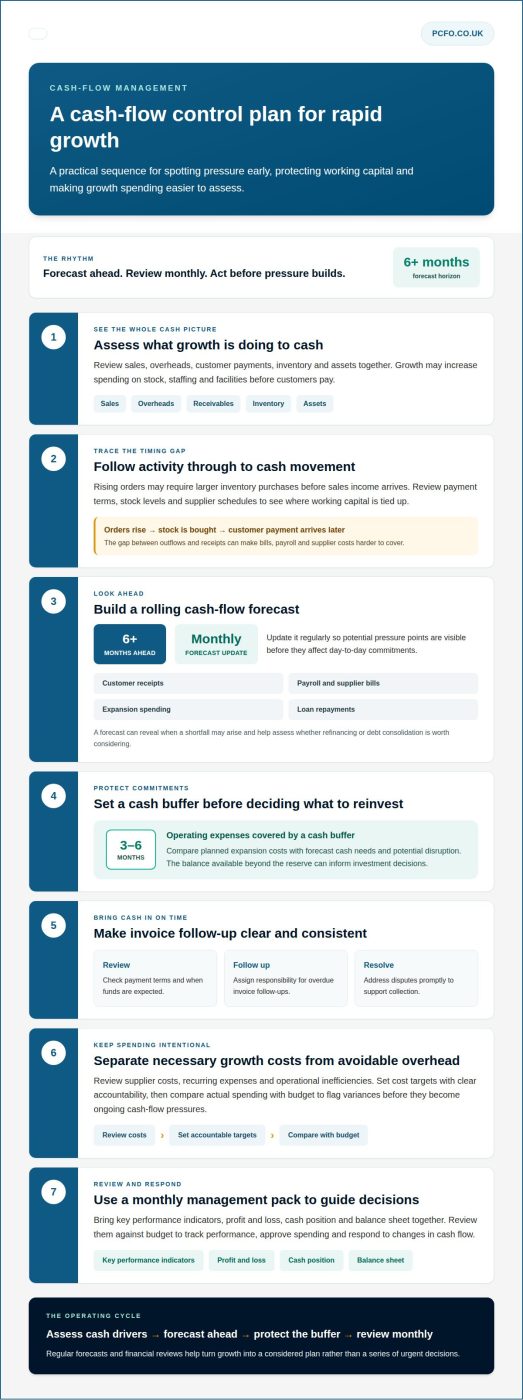
A finance professional can assess whether growth is generating cash or using it up. Expansion may increase spending on stock, staffing and facilities before customers pay. Reviewing sales, overheads, receivables, inventory and assets helps identify pressure points and whether the business should review its financing.
Link operational activity to cash movement. Rising orders, for example, may require larger inventory purchases before sales income arrives. Reviewing payment terms, stock levels and supplier schedules shows where working capital is tied up and which changes could ease the pressure.
Use a rolling cash-flow forecast that covers at least six months, updating it monthly. Include expected customer receipts, payroll, supplier bills, expansion spending and loan repayments. This can reveal when a shortfall may arise and help you assess whether refinancing or debt consolidation is worth considering.
To decide whether to reinvest profits or build reserves, a finance professional compares planned expansion costs with forecast cash needs and potential disruption. A cash buffer covering 3-6 months of operating expenses can support immediate commitments. The balance available beyond that reserve can inform investment decisions.
Late payments can leave a profitable business short of cash. A finance professional can review payment terms, establish a process for following up overdue invoices, and resolve disputes promptly. Assigning responsibility for customer payment follow-ups makes collection activity clearer and helps forecast when funds may arrive.
Review expenses regularly to separate necessary growth spending from avoidable overhead. Examine supplier costs, recurring expenses and operational inefficiencies, then set cost targets with clear accountability. Comparing actual spending with budget helps flag variances before they become ongoing cash-flow pressures.
Growing businesses need reliable financial controls and reporting. A monthly management pack can bring together key performance indicators, profit and loss, cash position and balance sheet. Reviewing these against budget gives decision-makers a consistent basis for tracking performance, approving spending and responding to changes in cash flow.
2. Professional support with managing debt and financing options
Before borrowing, assess whether the funding supports a clear growth plan or masks an ongoing cash shortfall. Review liquidity, profitability, debt levels and repayment capacity against forecast income. This helps you understand the risks if expansion takes longer or generates less profit than planned.
Gearing, often assessed through the debt-to-equity ratio, shows how much a business relies on borrowing compared with shareholder funds. A higher ratio can mean greater exposure to interest-rate changes and economic downturns. Monitor this measure alongside cash flow and profitability to spot challenges before repayments put pressure on operations.
UK businesses may consider invoice finance, an overdraft or a business loan, depending on the need. Invoice finance can release cash tied up in unpaid invoices, but depends on suitable receivables. An overdraft can cover short-term timing gaps, although repeated reliance may leave the business exposed. A business loan provides a defined lump sum with structured repayments for a planned expense, but repayments remain due if growth disappoints.
Compare each funding option with the purpose, timing and expected return of the spending. Assess the amount needed, repayment capacity and risk tolerance, then model repayments under different trading conditions. A business plan can help explain the funding requirement and growth rationale to a lender.
If existing borrowing is straining cash flow, refinancing may reschedule debt over a longer period and reduce monthly payments. It may also combine several debts into one, making repayments easier to manage. Weigh the revised schedule against total obligations and longer-term plans. A lower monthly payment alone does not show whether refinancing is the right decision.
A strategic review of borrowing and professional debt planning can help clarify which financing approach fits the expansion plan and repayment capacity.
3. Planning for sustainable business growth
First, test whether stronger sales reflect lasting demand, seasonal activity or a one-off contract. Compare sales patterns with order backlogs and customer satisfaction, then assess whether stock, facilities and staffing can meet demand. If orders rise faster than fulfilment capacity, service quality and reputation may suffer. Monitor employee workloads alongside delivery performance.
Build scenarios for demand holding steady, accelerating or slowing. For each, map expected revenue against expenses, hiring, stock and operational capacity. Set decision points, such as hiring only when forecast demand and margins support the role. Protect profit margins and consider how reliance on one major customer or product could affect financial stability. Diversifying customers, products or services can reduce exposure to disruption in a single revenue stream. For leaders seeking practical guidance on scaling operations safely, partnering with growth specialists like Growing Organisations can help structure a sound strategy and oversee its implementation.
A business loan can provide a defined lump sum with structured repayments for a specific planned expense. It may suit a clearly costed purchase, such as equipment needed to fulfil a new contract. Compare the repayment schedule with the cash expected from that investment, including a slower-sales scenario. Let the purpose, timing and ability to meet repayments guide the borrowing decision.
Include tax planning in the growth calendar, not just year-end preparation. Review tax obligations quarterly and consider how the timing of significant purchases may affect the business’s tax position. Consulting reputable Chartered Accountants Manchester can help ensure your bookkeeping, payroll, and tax planning keep pace with rapid expansion. Forecast major purchases alongside expected income and other commitments to understand their wider cash impact. Keep business and personal finances separate with a dedicated business bank account for company income and expenses. This gives you clearer records for monitoring performance and making informed decisions as the plan changes.
4. Financial planning and forecasts for growth
A useful growth forecast turns the business plan into financial assumptions, not just a sales target. A finance professional maps expected volumes, pricing, payment timing and direct costs, then links them to capital requirements. For example, entering a new UK market may require marketing spend and stock purchases before customer receipts build. This shows what must happen for the plan to become viable and where assumptions need testing.
Knowing how to manage finances during rapid business growth means connecting investment choices to operational capacity. Model hiring, stock and expansion costs against expected demand, separating one-off setup costs from recurring expenses. Test whether expected gross profit can support additional operating costs and identify which commitments should be phased. This helps leaders assess competing growth opportunities without treating every proposal as equally urgent.
Scenario planning makes assumptions visible. Model base, stronger-sales and slower-sales outcomes to see how each affects cash needs, profitability and delivery capacity. If orders lag behind plan, for example, the forecast can show whether to delay a purchase or adjust recruitment timing. These decision points help the business respond to change while keeping its wider strategy in view.
To decide how to manage finances during rapid business growth, leaders need forecasts linked to operational measures. A professional can connect sales volumes to staffing needs, stock levels and delivery capacity, then compare actual results with the plan. If demand rises but margins fall, management accounts can help reveal whether discounting, supplier costs or fulfilment expenses explain the difference. This keeps decisions tied to performance, not headline revenue alone.
As assumptions change, forecasts can guide choices about timing, capital and priorities. Discuss financial planning for growth to develop a forecast that connects your expansion plans with the resources needed to deliver them.
PCFO: Finance Director Services
PCFO provides Finance Director Services to help growing businesses connect financial decisions with expansion plans. This support can help when rising sales, hiring or investment make cash requirements harder to manage, or when forecasts need to inform decisions about borrowing and capacity.
Through Business Growth Advisory and flexible Chief Financial Officer Services, PCFO can bring financial insight into strategic planning. A Business Planning Consultant can help develop a plan that links forecasts, funding needs and operational priorities, giving decision-makers a clearer basis for evaluating growth scenarios.
If your business needs experienced financial input to plan its next stage of growth, contact PCFO to discuss how its services could support your financial planning.
Make your next growth decision with confidence
Growth also changes how quickly leaders need to make decisions. Agree who owns financial decisions, what information they need and when assumptions should be reviewed. This creates a clearer link between day-to-day choices and the direction you want the business to take.
For each major commitment, record its expected benefit, the assumptions behind it and the signal that would prompt a review. This gives leaders a shared reference point when circumstances change, rather than relying on instinct or outdated targets.
Knowing how to manage finances during rapid business growth is not about predicting every change. It means building a planning process that can adapt as priorities, demand and capacity shift, while keeping long-term resilience in view.
When you’re ready to discuss the financial priorities shaping your next stage, contact PCFO to discuss your finances. A considered conversation can help you identify the decisions that matter now and move forward with purpose.
Frequently Asked Questions
How can a finance professional improve my cash flow while I invest in growth?
A finance professional can help identify why cash is tightening even as sales increase. If you are considering how to manage finances during rapid business growth, map customer receipts against key commitments to see which decisions are creating pressure. Assess whether changing payment terms, order schedules or investment timing could protect operational flexibility.
How can a finance professional assess how much funding I need to grow and advise on where to get it?
They can estimate the funding need by modelling the costs and timing of the growth plan. For example, launching a new service may require staff time, marketing and supplier commitments before income arrives. A finance professional can distinguish upfront capital needs from ongoing working capital, then compare the gap with available cash, expected receipts and existing repayment obligations.
Can a finance professional help me decide whether to take out a loan, seek investors or self-fund?
Yes. Compare the options with the business’s objectives, cash position and appetite for risk. Self-funding may preserve ownership but constrain investment; borrowing brings scheduled repayments, while investors may contribute capital in return for an ownership stake. Consider how much control founders want to retain and how each route could affect future strategic decisions.
What financial metrics can a finance professional help me track to measure progress?
Choose metrics that reflect the business’s priorities, then interpret them as a connected set. Revenue growth alongside gross and net profit margins shows whether sales are translating into earnings. Operating cash flow, working-capital ratio and debt-to-equity add context on liquidity and financing. Return on equity can show how effectively the business uses owners’ capital.
How can a finance professional forecast cash flow for a UK business during rapid growth?
To plan how to manage finances during rapid business growth, build a forecast around when money is expected to enter and leave the business. Include invoice due dates, supplier schedules, payroll, tax commitments and investment plans, then compare actual results with assumptions. This helps show whether a changed sales pattern or delayed receipt calls for a change in spending priorities.
What financial KPIs can a finance professional help a scaling business monitor?
Relevant KPIs depend on what drives performance in the business. A professional can help track revenue growth, gross profit margin, net profit margin, operating expense ratio and operating cash flow, alongside measures such as customer churn where useful. They can connect each KPI to its underlying activity, so leaders can investigate whether a change reflects pricing, costs, customer retention or delivery capacity.