

What if the borrowing choice that gives your business flexibility today makes next year’s cash flow harder to predict? With the Bank of England Bank Rate at 3.75% in October 2026, changes in rates can affect the cost of variable-rate borrowing, the appeal of refinancing and the funds available for investment. Choosing between interest rate risk management strategies for business isn’t simply a matter of fixing every loan or hedging every exposure.
If you’re unsure how rate movements could affect your forecasts, or whether more complex measures are proportionate, start with the facts about your own finances. The right response depends on your debt, cash-flow resilience and plans for growth. A growing business may need a different balance of certainty and flexibility from one preparing for a major investment or managing several borrowing arrangements.
This guide explains where interest rate exposure can affect performance and compares practical responses, including fixed and floating borrowing, debt reviews and hedging approaches. It also shows how to bring rate scenarios into cash-flow planning and management reporting, so you can make informed decisions without treating any single strategy as right for every business.
Key Takeaways
- Map how rate changes could affect borrowing costs, cash position and planned financing.
- Compare interest rate risk management strategies for business by their purpose, benefits and trade-offs, rather than assuming one approach suits every company.
- Use proportionate scenarios to understand how different rate movements could influence forecasts and business decisions.
- Build a repeatable process to assess exposure, compare responses, assign ownership and review assumptions.
- Connect rate-risk planning with management accounts, cash-flow forecasts, KPI reviews and board-level decisions.
What interest rate risk means for a business’s borrowing and cash flow
Interest rate risk is the possibility that a change in interest rates will alter a business’s financing costs or other financial outcomes. It differs from general cash-flow risk. Cash-flow risk concerns whether money will be available when needed, while interest rate risk is one factor that can change expected inflows, outflows or the value of interest-sensitive financial positions.
The scale of exposure depends on how your business borrows and holds cash, and when repayments, refinancing or investment decisions are due. A company with floating-rate debt may feel rate changes sooner than one whose borrowing is fixed for an agreed period. The fundamentals of the concept are outlined in Interest Rate Risk on Wikipedia, but an operating business needs to assess how its own facilities and plans transmit those changes.
Where interest rate exposure can appear in business finances
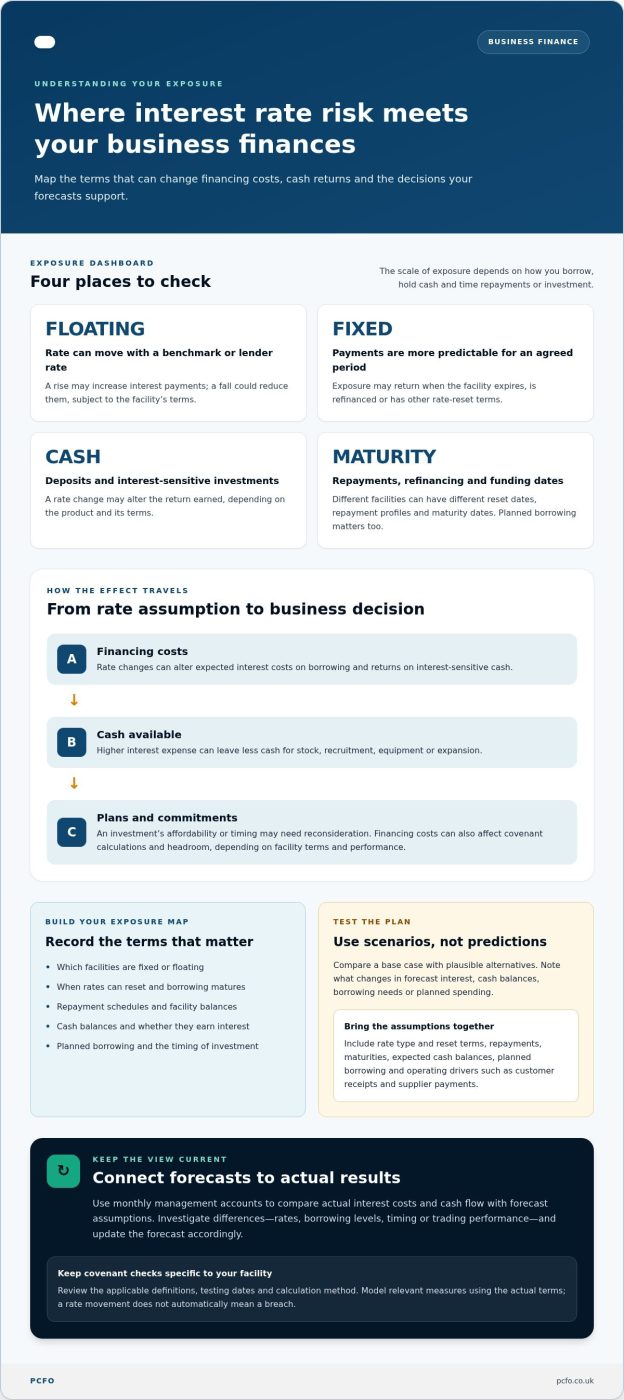
Start with each borrowing arrangement. If the interest rate on a loan or revolving facility varies with a benchmark or lender rate, a rise may increase interest payments, subject to the facility’s terms. A fall could reduce them. With fixed-rate borrowing, the rate is set for an agreed period, making payments more predictable during that time. Exposure may return when the facility expires, is refinanced or has other rate-reset terms.
Cash held in deposits or interest-sensitive investments can also be affected. A change in rates may alter the return earned, depending on the product and its terms. For a practical first assessment, note which facilities are fixed or floating, when rates can reset, when borrowing matures, and whether cash balances earn interest. This map helps distinguish immediate exposure from changes that may arise later.
Why growing businesses should understand their exposure
Financing costs feed into forecasts. If interest expense rises, less cash may be available for stock, recruitment, equipment or expansion. Even without immediate repayment pressure, a different financing assumption can change whether a planned investment remains affordable or whether its timing needs reconsideration. Connect the rate assumption to the decisions it could influence, rather than treating it as an isolated finance line.
Debt terms may also include financial covenants, such as measures linked to interest cover or borrowing relative to earnings. A change in interest expense can affect those calculations and reduce headroom, depending on the facility’s definitions and the company’s performance. Review the actual terms and model how plausible changes could affect both cash availability and covenant measures. Don’t assume a rate movement automatically causes a breach.
For many growing businesses, a proportionate review is a sound starting point, not a complex treasury programme. The right interest rate risk management strategies for business should reflect the amount and type of exposure, forecast resilience, upcoming funding needs and appetite for certainty. A clear view of these factors helps management decide what merits further attention and incorporate rate assumptions into ordinary cash-flow and business planning.
How interest rate movements flow through forecasts, debt and decisions
A rate change affects a business through more than the interest line in its accounts. It can alter the financing assumptions behind a cash-flow forecast, change the cash available for operations and investment, and influence decisions about borrowing or timing. Rate sensitivity connects the cost assumptions attached to borrowing with the cash flows and choices those assumptions support.
Assess the whole funding picture, not just the facility currently attracting attention. Existing loans and revolving credit facilities may have different rate-reset dates, repayment profiles and maturity dates. Planned borrowing matters too: a forecast that assumes new funding will be available on unchanged terms may understate future financing costs. Record the assumptions used and distinguish confirmed figures from estimates.
Scenario analysis helps test how robust a plan is under different rate conditions. It isn’t a prediction of where rates will go. Instead, compare a base case with plausible alternatives, then note what changes in forecast interest, cash balances, borrowing needs or planned spending. This makes uncertainty visible and gives decision-makers a clearer basis for discussion.
Assessing rate sensitivity in cash-flow forecasts
Bring the key inputs together before modelling: facility balances, rate type and reset terms, repayment schedules, maturity dates, expected cash balances and the timing of planned borrowing. Include operating assumptions that drive cash flow, such as customer receipts and supplier payments, so you can assess financing costs in context.
Compare scenarios without relying on a single rate outlook. Then use monthly management accounts to compare actual interest costs and cash flow with forecast assumptions. Where results differ, investigate whether the cause is rates, borrowing levels, timing or trading performance, and update the forecast accordingly.
Connecting rate exposure with covenants and business plans
Higher financing costs may reduce headroom against a covenant, but the effect depends on the facility’s specific definitions, testing dates and calculation method. Model the relevant measures using the terms that apply to your business. A general rule or another company’s approach may not fit.
Link the results to decisions ahead. A planned investment, refinancing or funding requirement may fall at a point when costs or cash availability look different across scenarios. Reviewing these alongside covenant headroom can help management consider whether to adjust timing, funding assumptions or the plan itself.
This is where interest rate risk management strategies for business become part of practical financial planning. Keep scenario assumptions visible, assign responsibility for updating them, and review them when financing or trading conditions change. Finance Director support can help connect cash-flow forecasts, management accounts and business decisions. Outsourced finance leadership support can provide a structured perspective without requiring every business to build a complex treasury programme.
Comparing interest rate risk management strategies and their trade-offs
There’s no single response that suits every business. A company with stable cash flow and limited borrowing may manage exposure through regular forecasting, while one with larger or more complex facilities may consider changes to its debt structure or financial instruments. Compare each option against the exposure it addresses, the certainty it offers, the flexibility it retains and the commitments it creates.
Use the table as a starting point, not a recommendation. The effect of any approach depends on facility terms, cash-flow needs and business objectives. Fixed-rate borrowing, for example, can make interest costs more predictable during the agreed period, but may limit flexibility if the business wants to refinance or repay early. Floating-rate borrowing may retain more direct benefit if rates fall, but leaves costs exposed to increases.
Operational approaches: forecasts, liquidity and funding choices
Forecasting and liquidity planning help a business prepare for a range of outcomes, but don’t remove rate exposure. Reviewing the structure and timing of borrowing can also inform decisions about refinancing, investment or funding needs. For businesses seeking new borrowing or looking to adapt existing facilities, commercial lenders like Allen Capital Funding offer financial solutions that help align debt arrangements with cash-flow requirements. These are practical management actions, but the business remains exposed to changes in rates and other financial pressures.
| Approach | Purpose | Potential benefit | Trade-off and considerations |
|---|---|---|---|
| Forecasting and liquidity planning | Test how financing costs could affect expected cash flow. | Highlights pressure points and supports more informed planning. | Doesn’t fix the interest rate. Results depend on assumptions being reviewed and updated. |
| Reviewing debt structure | Consider the balance of fixed and floating borrowing, maturities and funding timing. | May help align financing with cash-flow needs and planned activity. | Available flexibility and any costs or conditions depend on the facility terms. |
| Interest rate swap | Exchange interest payments based on a variable rate for payments based on a fixed rate, or the reverse. | Can provide greater certainty over the relevant payments. | May limit benefit if rates move favourably. The arrangement’s terms and risks need careful consideration. |
| Interest rate cap | Set an upper limit on the rate used to calculate interest under the arrangement. | Can limit exposure above that level whilst retaining some benefit if rates fall. | Its protection, cost and conditions depend on the specific arrangement. |
| Interest rate collar | Combine an upper limit with a lower rate boundary. | Can define a range for rate exposure. | Benefit from rate movements may be limited at both ends; terms vary by arrangement. |
Financial instruments: swaps, caps and collars
These instruments change how rate movements affect payments, but they don’t remove the need to understand the underlying borrowing. A swap changes the basis on which interest payments are calculated; a cap sets a ceiling, while a collar establishes both an upper and lower boundary. Their suitability depends on the specific terms, the exposure being managed and the business’s ability to meet its commitments.
Effective interest rate risk management strategies for business match the response to the purpose: greater cost certainty, continued flexibility or protection against a particular rate outcome. Weigh these aims against cash-flow requirements and planned decisions before choosing an approach. A proportionate mix of operational planning and financing choices may be more suitable than adopting a complex instrument by default.
A practical process for managing interest rate risk in your business
A repeatable process keeps interest rate exposure visible without creating unnecessary complexity. The aim isn’t to predict rates or eliminate uncertainty. It’s to understand where your business is exposed, assess what that could mean for its plans and make considered decisions based on documented assumptions.
Map the exposure, test its business impact, compare proportionate responses, assign ownership and review the approach as circumstances change. This gives leaders a consistent framework they can adapt to their financing arrangements and planning needs.
Map exposure and assess the potential business impact
Start by recording existing borrowing, whether each rate is fixed or floating, relevant reset and maturity dates, repayments and key facility terms. Add planned financing, then connect the map to cash-flow forecasts, investment plans and any covenants. Use documented scenarios to assess possible effects, rather than treating a rate forecast as a certainty.
- Map the exposure. Bring borrowing and planned funding into one view. Note which arrangements could change the cost of financing, when terms may reset or end, and where the business holds interest-sensitive cash or investments.
- Assess the impact. Use the exposure map alongside cash-flow forecasts and business plans. Consider how different assumptions could affect available cash, investment timing and covenant headroom, using the definitions and testing terms in the relevant facilities.
- Compare responses. Weigh operational steps, such as updating forecasts or reviewing funding timing, against changes to borrowing structure or possible financial instruments. Compare their purpose, potential benefit, trade-offs and fit with the business’s objectives.
- Assign ownership. Make clear who maintains the assumptions, updates forecasts, monitors relevant terms and raises material changes for management consideration. Responsibilities can be shared, but they should be understood.
- Review and record. Keep the rationale for the chosen approach, including assumptions and trade-offs. Revisit it when financing arrangements, forecasts or business priorities change, so decisions remain connected to the current plan.
Set responsibilities and review the chosen response
Regular management accounts provide a useful check against forecast interest costs and cash flow. Pair them with relevant KPIs, such as measures the business already uses to track liquidity, debt or performance against its plans. Investigate variances, update assumptions where needed and report material implications through the appropriate management or board-level discussions.
Keep the review proportionate. A business with straightforward borrowing may need a clear exposure record and forecast updates; more varied facilities or significant funding plans may call for broader input. In either case, recording who is responsible and why a response was selected makes it easier to revisit decisions consistently, rather than starting again whenever conditions shift.
PCFO’s finance leadership support for business planning links cash-flow management, planning and reporting to help leaders build a structured view of exposure and its implications for business decisions.
How finance leadership can embed rate-risk management in business planning
Interest rate exposure is most useful to decision-makers when it sits within the wider financial plan, rather than in a separate analysis that’s rarely revisited. Finance leadership can connect borrowing assumptions with cash-flow forecasts, operating performance and planned investment, helping leaders understand how financing conditions may affect priorities. The aim is not to predict rates, but to make the assumptions behind business decisions clear.
Management accounts, KPI reviews and board-level reporting can turn rate assumptions into an ongoing planning conversation. This keeps attention on what has changed, what it means for cash and strategy, and whether an agreed response still fits the business.
Bringing financing assumptions into management reporting
Include relevant borrowing assumptions in forecasts alongside expected operating cash flow and planned investment. If an assumption changes, show how that affects the outlook and which decisions may need attention. Management accounts can then help compare actual financing costs and cash performance with the plan, while KPI reviews highlight trends in liquidity, debt or other measures relevant to the company.
Keep reports focused. Leaders need a clear view of the movement, its potential business impact and any decisions required, not a dense set of rate data without context. Board-level reporting can bring together the assumptions, scenario outcomes and agreed priorities, making it easier to discuss whether funding plans or investment timing remain aligned with the business’s objectives.
When outsourced finance leadership can support the process
Growing businesses may need senior financial input without adding a permanent finance leadership role. PCFO provides flexible, outsourced Finance Director and CFO support, helping connect cash-flow management and business planning with monthly management accounts, KPI setting and board-level commercial support.
This support can help leaders understand how financing assumptions fit into the wider plan, keep reporting decision-focused and bring financial considerations into conversations about growth or investment. It strengthens financial oversight and planning, rather than providing hedging products or guaranteeing a particular outcome. The right level of input depends on the company’s needs and the complexity of its financing.
Embedding interest rate risk management strategies for business in regular planning gives decision-makers a consistent way to review assumptions as conditions and priorities evolve. It also helps ensure that rate exposure is considered alongside trading performance, liquidity and strategic choices, rather than in isolation. Broader enterprise risk management often goes hand in hand with financial planning; advisory firms such as Putney Insurance Group illustrate how businesses can evaluate commercial risks and protect their balance sheet alongside debt and cash-flow management.
If you’d like clearer financial oversight in your planning, consider how finance leadership can support your business’s goals and current financial picture. That can help identify where support may strengthen cash-flow planning, management reporting and board-level decisions.
Make your next planning decision with confidence
Rate uncertainty doesn’t need to dictate your next move. Start by identifying the financing assumptions that matter most to your plans, then decide how you’ll keep them visible as the business changes. The right interest rate risk management strategies for business should support informed choices while leaving room to pursue growth.
PCFO offers growing businesses flexible, part-time access to finance expertise, with support spanning business planning, cash-flow management, monthly management accounts and board-level reporting. This helps bring financial assumptions into the wider conversation about priorities, rather than leaving them in a forecast without clear ownership.
To explore how finance leadership could support your planning, book a free strategy session with PCFO. You can discuss your business’s financial situation and goals, and consider a practical way to strengthen your planning.
Frequently Asked Questions
Can interest rate risk affect a business without floating-rate borrowing?
Yes. A business without floating-rate debt may still be affected through interest earned on cash, investment choices or the terms available when new funding is needed. For example, a planned equipment purchase may rely on borrowing that hasn’t yet been arranged, so changing rates could alter the forecast repayment burden. List these potential effects alongside existing borrowing, then focus on exposures that could change a decision or weaken financial resilience.
Is fixed-rate borrowing always better for managing interest rate risk?
No. A fixed rate can make payments more predictable for the period it covers, which may suit a business with limited room for unexpected cost changes. But the facility could be less flexible if circumstances change or the company wants to repay or refinance. Compare its terms with the timing of expected cash needs and business plans. The choice should reflect what the business values most, not a general rule that fixed rates are always preferable.
What happens to an existing fixed-rate loan when interest rates change?
Usually, the agreed rate remains in place for the fixed period, so a market movement doesn’t automatically change the loan’s interest rate. For example, a business with a fixed-rate facility may see no immediate change to its scheduled interest cost, but should plan for what happens when that period ends. Check the loan’s terms for repayment, renewal or refinancing provisions, as arrangements can differ. Don’t assume the current rate will carry forward.
What is basis risk in interest rate management?
Basis risk is the chance that two related interest rates move differently. It can arise if a business’s borrowing rate and the rate referenced by a separate arrangement intended to offset it don’t track each other closely. In that case, the arrangement may not move in line with the borrowing cost, leaving some exposure. Understand which rates each contract uses, how they’re adjusted and what the terms mean for the intended protection.
Should a small business hedge all of its borrowing?
Not automatically. The right level of protection depends on how much a rate change could affect the business and whether the arrangement’s commitments fit its plans. Interest rate risk management strategies for business should weigh potential cost certainty against possible costs, obligations and reduced flexibility. A company with changing funding needs may have different priorities from one with stable borrowing. Start by assessing the likely business impact, then decide whether any response is proportionate.
How often should a business review its interest rate risk?
Review it through the business’s regular financial planning, and sooner when something material changes. A new facility, refinancing decision, revised cash-flow outlook or major investment can all alter the exposure or its importance. The review should confirm that forecasts still reflect the borrowing terms and that relevant leaders understand any implications. Rather than applying a fixed interval to every company, make the review frequency fit the scale of exposure and existing reporting process.
How can a business understand the effect of a rate change on its cash flow?
Start with the interest terms on borrowing and cash deposits, then reflect them in the cash-flow forecast. Compare scenarios based on documented assumptions, such as a change in borrowing costs alongside the timing of customer receipts or a planned purchase. This shows where cash pressure could emerge without presenting a scenario as a prediction. Later, compare actual results with the forecast and investigate whether any difference came from financing, trading or timing.