

Why does your bank balance often feel like a mystery even after a month of record-breaking sales? It’s a common frustration for leaders who find themselves steering a ship whilst looking through the rearview mirror. If you’re receiving financial data weeks after the month has closed, you’re likely making critical decisions based on intuition rather than evidence. Implementing robust management accounts for SMEs changes this dynamic by providing the real-time clarity needed to lead with composure.
We understand that cash flow anxiety and uncertainty regarding service profitability can hinder your growth ambitions. You deserve a clear dashboard of your business health that allows for confident decisions on hiring, investment, and long-term strategy. This article demonstrates how bespoke reporting transforms raw figures into a strategic roadmap for scaling your UK business. We’ll examine the essential components of effective management reporting and how this level of insight prepares you for meaningful conversations with investors and banks.
Key Takeaways
- Understand why management accounts for SMEs are the essential bridge between simple bookkeeping and strategic leadership, shifting your focus from historical records to future navigation.
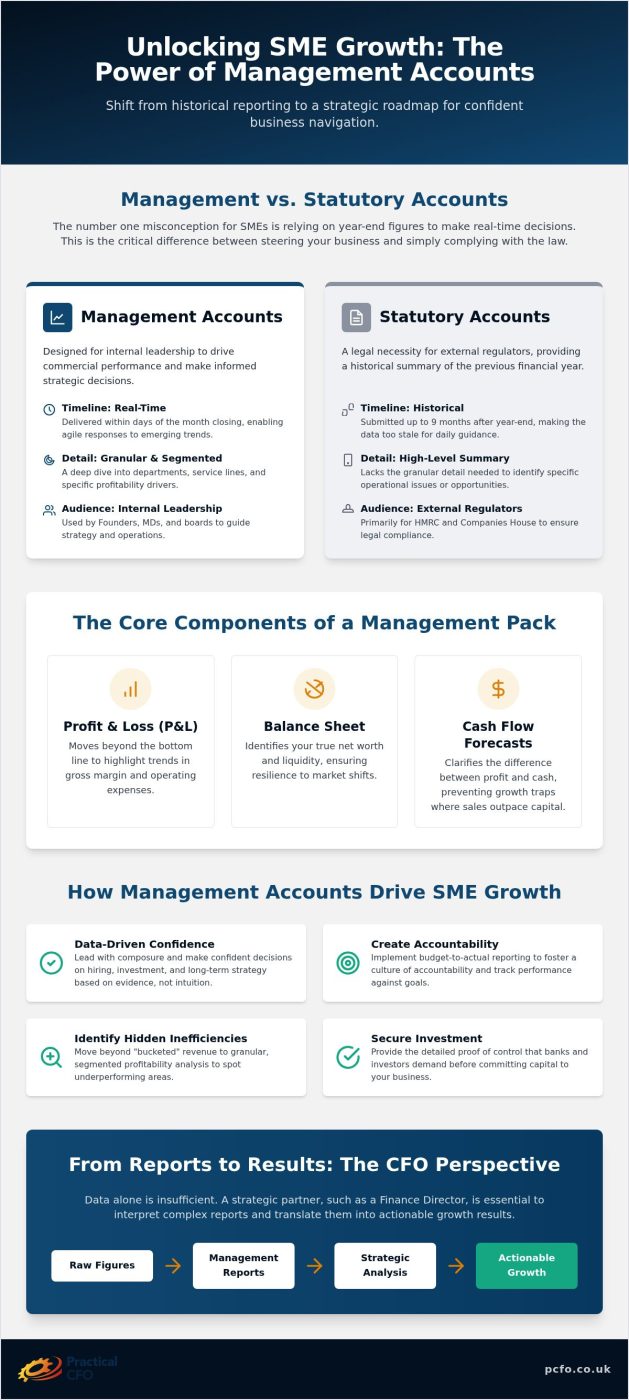
- Learn the critical distinction between compliance-driven statutory accounts and the real-time performance data required to steer your business effectively.
- Discover how budget-to-actual reporting creates a culture of accountability and provides the data-driven confidence needed to scale operations.
- Identify hidden inefficiencies by moving beyond “bucketed” revenue to granular, segmented profitability analysis by department or service line.
- Recognise why data alone is insufficient and how a strategic partner, such as a Finance Director, turns complex reports into actionable growth results.
What are Management Accounts and Why are They Vital for UK SMEs?
Management accounts for SMEs are far more than just a summary of your recent transactions. They serve as internal financial snapshots that provide a clear view of your company’s performance at a specific point in time. Whilst many business owners rely on year-end figures, these are often too stale to guide daily operations. By shifting from historical recording to future-focused navigation, you transform your finance function into a strategic asset. Data without context is noise.
Most successful UK firms produce these reports on a monthly or quarterly basis. This frequency is vital for agility; it allows you to identify a dip in margins or a spike in overheads before they become systemic issues. When viewed through a CFO lens, these figures cease to be just rows on a spreadsheet. They become a narrative of where your business is heading and how you can influence that trajectory. This proactive approach ensures you’re never caught off guard by shifting market conditions.
The Core Components of a Management Pack
A standard management pack isn’t a one-size-fits-all document; it’s a tailored suite of reports that highlights your specific drivers of success. At its heart, it includes three pillars:
- Profit and Loss (P&L) statements: These move beyond the bottom line to highlight trends in gross margin and operating expenses.
- Balance Sheet: This identifies your true net worth and liquidity, ensuring you have the resilience to weather market shifts.
- Cash Flow Forecasts: This clarifies the vital difference between accounting profit and actual cash in the bank, preventing growth traps where sales outpace available capital.
Who Uses Management Accounts within an SME?
Effective reporting serves multiple layers of your organisation. For the Founder or Managing Director, these accounts provide the confidence to lead and the evidence needed to delegate tasks without losing control. You stop managing by gut feel and start managing by objective data.
Implementing robust management accounts for SMEs ensures your board has the evidence needed to validate strategic pivots. If a particular service line is underperforming, the management pack provides the empirical proof required to reallocate resources. Finally, external stakeholders such as banks and investors demand this level of detail. They want to see that you’re in control of the variables that drive your profitability before they commit further capital.
Management Accounts vs Statutory Accounts: Addressing the #1 Misconception
Statutory accounts are a legal necessity, yet they are often the primary source of financial anxiety for business owners. Because they are designed for external regulators like HMRC and Companies House, they lack the granular detail required for leadership. Management accounts for SMEs serve a different master: the internal leadership team. Whilst statutory filings look back at the previous year, management reporting looks at the current month and the next quarter. The distinction is fundamental to how you lead.
To understand the difference in value, consider these three core contrasts:
- Purpose: Statutory accounts ensure legal compliance; management accounts drive commercial performance.
- Timeline: Statutory filings can be submitted up to nine months after your year-end. Management data is typically delivered within days of a month closing.
- Detail: Annual accounts provide a high-level summary. Management packs offer a deep dive into specific departments, products, and cash flow drivers.
Relying solely on statutory accounts to run your business is effectively driving a car whilst looking in the rear-view mirror. You can see exactly where you’ve been and what obstacles you’ve passed, but you have no visibility of the road ahead. By the time you see a problem in your annual accounts, the opportunity to fix it has usually passed.
The Danger of the “Compliance Gap”
When you lack real-time oversight, you fall into what we call the compliance gap. This is where “the fog” sets in. You might see healthy sales figures in your bank account, but without monthly reporting, you may fail to notice that your margins are eroding or that you are over-trading. Over-trading is a silent killer for scaling firms; it occurs when a business expands faster than its cash flow can support, leading to exhaustion even whilst profitable on paper. Without management accounts for SMEs, you also risk significant “year-end shocks” in the form of unexpected Corporation Tax liabilities that you haven’t reserved for.
How Management Reporting Streamlines Year-End
Regular reporting isn’t just about strategy; it’s about operational efficiency. By maintaining a clean set of books through monthly management packs, the annual accounts process becomes a formality rather than a crisis. This reduces the time, stress, and cost associated with your year-end filings. It also allows your statutory accountants to focus on tax optimisation rather than fixing basic ledger errors from twelve months ago. Many firms find that outsourced accountancy solutions provide this consistency, ensuring that the transition from monthly data to annual compliance is seamless and stress-free. Accurate data throughout the year builds a foundation of trust with your stakeholders and ensures your financial house is always in order.
The Strategic Benefits: How Data Drives SME Growth
Accurate financial visibility is the foundation of sustainable scaling. Management accounts for SMEs provide the empirical evidence required to transition from a reactive state to a proactive growth phase. One of the most powerful tools within this pack is “Budget vs Actual” reporting. By comparing your forecast against reality every month, you hold your department heads accountable for their spending and performance. This process ensures that variances are identified and addressed immediately, preventing small overspends from ballooning into significant deficits. Precision is the precursor to profit.
Strategic reporting also illuminates the effectiveness of your pricing. As supply chain costs or utility prices fluctuate, management accounts allow you to see the immediate impact on your gross margins. You can then make informed adjustments to your pricing strategy rather than waiting for a year-end review. Protecting your margins requires a granular understanding of overheads; seeing these figures monthly ensures you can trim waste and reallocate capital to high-growth areas. It’s about making every pound work harder for the business.
Empowering Data-Driven Decision Making
Leaders often struggle with the timing of significant investments. Moving from a gut feel to an evidence-based approach mitigates the risk of expansion. For instance, you can set specific financial triggers for recruitment. Instead of hiring because the team feels busy, you hire when your management accounts show a sustained revenue-per-head threshold has been met. This logic applies to capital expenditure as well. Whether you are investing in new infrastructure or software, the data confirms if the business has the liquidity to support the purchase without compromising operational stability.
Preparing for Fundraising and Investment
If you intend to seek Series A or B funding, your management pack becomes your most persuasive sales tool. Professional investors look for transparency and a deep understanding of unit economics. They want to see that the leadership team is steering the business with precision. This level of reporting builds immense trust, showing that your firm is “investment ready” at any given moment. Additionally, robust data is essential for an accurate business valuation for exit. Potential buyers pay a premium for companies that can demonstrate a history of controlled growth and predictable financial performance through consistent management accounts for SMEs.
Advanced Reporting: Segmented Profitability and KPIs
Total revenue figures often provide a false sense of security. If your management accounts for SMEs only show a single “top line” figure, you’re looking at bucketed revenue that may hide significant operational drag. True financial clarity comes from breaking down these numbers by department, service line, or even specific clients. This level of granularity reveals which parts of your business are actually generating cash and which are merely consuming it. You cannot fix what you haven’t measured at a granular level.
Identifying Your Most (and Least) Profitable Areas
Many firms find that the 80/20 rule applies to their profitability; often, 20% of clients drive 80% of the actual profit. Advanced reporting identifies “zombie” projects or products that appear busy but drain resources without contributing to the bottom line. By utilising outsourced accountancy solutions, you can automate this segmentation. This ensures that your leadership team spends their time on high-margin activities rather than subsidising loss-making divisions. It’s about pruning the weak branches to strengthen the core.
Customising Your Management Pack
A generic report is rarely useful for a scaling firm. Every industry requires a bespoke set of Key Performance Indicators (KPIs) to track progress effectively. Whilst a manufacturing firm might focus on gross margin per unit, a SaaS business will prioritise Monthly Recurring Revenue (MRR) and Customer Acquisition Cost (CAC). Identifying your “North Star Metric” for your current growth stage ensures the whole team is pulling in the same direction. These reports must be visual and digestible; a non-financial leader shouldn’t need a degree in accounting to understand the month’s performance. Using heat maps or trend lines can highlight issues far faster than a wall of numbers.
Your management pack should also include non-financial data that predicts future financial health. Metrics such as customer churn rate, employee utilisation, or pipeline velocity provide a more holistic view of the company’s health than the bank balance alone. For instance, a high customer acquisition cost might be sustainable if your lifetime value is increasing, but you’ll only see this by blending financial and operational data. By implementing advanced management accounts for SMEs, you gain a comprehensive dashboard for strategic navigation. To see how bespoke reporting can illuminate your path to growth, explore our CFO and Finance Director services today. We help you turn these advanced insights into a tangible roadmap for success.
The CFO Perspective: Turning Reports into Results
Generating accurate management accounts for SMEs is a significant milestone, yet the data itself represents only half of the challenge. The true value lies in the interpretation of those figures to drive commercial outcomes. Without a seasoned expert to interrogate the numbers, a management pack is merely a reflection of the past rather than a tool for the future. This is where the role of an experienced Finance Director becomes indispensable. They translate complex ledgers into a strategic narrative that the board can actually use.
At PCFO, we bridge the gap between routine bookkeeping and high-level board strategy. We don’t just deliver reports; we provide the insight that explains why your margins have shifted or how your cash runway is evolving. Our fractional CFO model allows scaling businesses to access this level of institutional knowledge without the overhead of a permanent executive hire. This partnership ensures that your financial strategy is always aligned with your growth ambitions.
The Value of a Fractional Finance Director
A fractional FD provides executive-level oversight without the burden of a six-figure salary. This model is particularly effective for SMEs navigating complex growth phases where the financial stakes are high. Your FD acts as a strategic partner who uses management accounts to both challenge and support the CEO’s vision. By providing an objective, data-driven perspective, they ensure that every decision is weighed against its financial impact and long-term viability. It’s about having a steady hand at the helm whilst you focus on leading your team and serving your clients.
Next Steps: Implementing Professional Management Reporting
To move forward, you should first assess your current accounting infrastructure. Modern platforms like Xero or Sage provide the raw data, but they require professional configuration to produce meaningful management accounts for SMEs. Once your systems are aligned, establish a monthly reporting rhythm. This ensures that your board meetings are focused on strategic navigation rather than debating the accuracy of the figures. Consistency in reporting builds the discipline required for sustainable scaling.
If you’re ready to transform your financial function from a back-office necessity into a strategic engine, contact PCFO for a consultation. We can discuss your specific organisational needs and provide clarity on fractional CFO pricing uk. Investing in strategic oversight today secures the scalability and resilience of your business for the years ahead.
Steering Your Business with Strategic Precision
Leading a company without real-time financial oversight is like navigating a complex route with an outdated map. You’ve seen how management accounts for SMEs bridge the gap between simple bookkeeping and board-level strategy, providing the granular detail required to protect your margins and scale sustainably. By focusing on segmented profitability and “Budget vs Actual” reporting, you move from a reactive posture to one of proactive leadership.
Realising these benefits requires more than just software; it demands the intellectual rigour of an authoritative strategic partner. Our flexible fractional CFO models offer expert board-level financial advice and specialist strategic business growth advisory tailored to your unique business lifecycle. You’re invited to gain strategic clarity with PCFO’s fractional Finance Director services and transform your raw data into a powerful roadmap for success. With the right financial oversight in place, you can face your next growth phase with absolute composure and confidence today.
Frequently Asked Questions
What should be included in a standard management accounts pack?
A standard management pack includes a Profit and Loss statement, a Balance Sheet, and a Cash Flow Forecast. Beyond these core components, professional management accounts for SMEs should feature “Budget vs Actual” variance analysis and industry-specific Key Performance Indicators (KPIs). Including a summary of aged debtors and creditors is also essential to monitor liquidity. These documents provide the comprehensive snapshot required to lead your organisation with absolute confidence and strategic clarity.
How much do management accounts cost for a UK SME?
The cost of management reporting varies depending on the complexity of your operations and the depth of strategic analysis required. Most UK firms access these insights through an outsourced accountancy solution or a fractional CFO model. Rather than a standalone expense, this service is an investment in your company’s scalability. The value gained from identifying inefficiencies and protecting your margins typically far exceeds the monthly fee associated with professional oversight.
Can I prepare management accounts myself using Xero or QuickBooks?
Whilst software like Xero or QuickBooks can generate basic reports, they often require professional oversight to ensure accuracy. Automated reports frequently lack necessary adjustments for accruals, prepayments, and work-in-progress. A Finance Director ensures your management accounts for SMEs are interpreted correctly; they turn raw data into a strategic roadmap rather than just a collection of automated charts. Professional configuration is essential to ensure the data you rely on is truly representative of your performance.
How do management accounts help with business valuation and exit?
Professional reporting significantly enhances business value by demonstrating a history of controlled growth and intellectual rigour. Management accounts provide potential buyers with granular evidence of unit economics and sustainable margins, which reduces their perceived risk. This transparency often leads to a higher valuation during an exit process. It proves that the leadership team steers the business through data rather than intuition, making the company a much more attractive prospect for sophisticated investors.
What is the difference between a bookkeeper and a management accountant?
A bookkeeper focuses on the accurate daily recording of transactions and basic administrative compliance. In contrast, a management accountant or Finance Director focuses on the strategic interpretation of that data to drive future performance. Whilst the bookkeeper ensures your records are up to date, the management specialist uses those records to forecast cash flow, identify inefficiencies, and advise on high-level investment decisions. They bridge the gap between historical data and future-focused business navigation.
How often should a business owner review their management accounts?
You should review your management pack at least once a month to remain agile in a competitive market. Quarterly reviews might suffice for very stable organisations, but monthly oversight allows you to identify negative trends before they become systemic issues. This regular rhythm ensures that your board meetings stay focused on strategic navigation and future growth rather than debating historical figures. Consistent review builds the financial discipline required to scale a business with confidence.
Will management accounts help me get a bank loan or investment?
Banks and investors view professional management reporting as a hallmark of a well-managed, low-risk organisation. When you apply for a loan or seek Series A funding, providing a clear dashboard of your financial health builds immediate credibility. It proves you understand your cash runway and profitability drivers. This level of transparency often results in more favourable lending terms and increased interest from investors who value data-driven leadership over gut feel.
How do I transition from annual-only reporting to monthly management accounts?
The transition begins with ensuring your underlying bookkeeping is accurate, consistent, and timely. You must move away from a traditional “year-end mindset” by closing your books every month and implementing a strict reporting deadline. Partnering with a fractional CFO can accelerate this change, as they help you define relevant KPIs and establish a reporting rhythm that your board can actually follow. This process transforms your finance function into a proactive strategic engine.