

Your business is only truly a high-value asset when it no longer requires your daily presence to function. Whilst building a company from the ground up is a significant achievement, many UK business owners find themselves trapped by high key-person dependency, fearing that their departure might diminish the value of their life’s work. Effective succession planning for founders is not merely a retirement strategy; it is a vital financial exercise in de-risking your legacy and ensuring the organisation can thrive independently.
We recognise the quiet anxiety that stems from uncertain valuations and the weight of responsibility towards your staff. This guide provides a strategic framework to maximise your company’s valuation and orchestrate a seamless transition into a founder-independent model. By following this roadmap, you will learn how to navigate the latest UK fiscal changes, such as the £2.5 million cap on Business Property Relief and the 18% rate for Business Asset Disposal Relief, ensuring your eventual exit is both profitable and composed.
Key Takeaways
- Understand why succession planning for founders is a multi-year financial strategy that must begin long before your intended departure date.
- Learn how to build a robust financial architecture using management accounts that demonstrate operational independence to potential successors.
- Compare the financial and cultural outcomes of internal talent development versus an external market sale to find your ideal exit route.
- Follow a step-by-step roadmap to achieve founder redundancy by systematically delegating high-value strategic responsibilities.
- Discover how a Fractional CFO acts as an authoritative partner to provide the objective perspective required for a high-value transition.
Succession Planning for Founders: Beyond the Exit Strategy
For many UK SME owners, the journey of building a company is so consuming that the end-game remains a distant abstraction. However, true succession planning for founders is not just an exit strategy; it’s a deliberate transformation of a business from a personal project into a self-sustaining asset. Whilst the broad definition of Succession planning often focuses on general talent management, for a founder, it’s specifically about de-risking the entity from their own personal involvement. This move requires shifting from the centre of every operational decision to a position of strategic oversight.
The process must ideally begin three to five years before your intended departure date. This lead time is necessary because strategic succession is vastly different from emergency planning. An emergency plan is a reactive safety net used during an unexpected crisis or illness. In contrast, a strategic plan is a proactive value-creation exercise. It ensures that when you choose to step back, the business doesn’t just survive; it thrives under new leadership. This transition requires an emotional evolution where you move from being the indispensable engine to the architect of systems.
The Key Person Risk: Why Your Presence May Be Devaluing Your Business
Investors and potential buyers scrutinise key person dependency with clinical precision. If your business relies on your personal relationships, technical expertise, or daily sign-off to function, it’s considered a high-risk investment. This dependency directly suppresses your EBITDA multiples because a buyer isn’t just purchasing your profits; they’re purchasing the risk that those profits will vanish when you do. This is the Founder Trap, where growth stalls because the owner is a bottleneck. Buyers always prefer system-led businesses over founder-led ones because systems are scalable, predictable, and transferable. By succession planning for founders early, you aren’t just preparing for a departure; you’re actively increasing the market value of your company.
Succession as a Growth Strategy, Not Just an Exit
Implementing a robust plan improves current operational efficiency long before any sale or handover occurs. It forces the introduction of corporate governance and clear reporting lines, which are often overlooked in smaller enterprises. This structure provides essential clarity for your team. High-calibre talent is far more likely to join and remain with an organisation that has a clear roadmap for future leadership. When staff see a path for internal progression and a stable future, retention rates improve, and the business becomes more attractive to the UK’s top professional talent. A business that’s ready to be sold is, by definition, a business that’s running at its peak performance.
Building the Financial Architecture for a Seamless Transition
A business is only as strong as the data that supports it. For effective succession planning for founders, you must move beyond basic year-end compliance toward a level of financial transparency that invites external scrutiny. This begins with producing management accounts to an audited standard. These reports should clearly demonstrate that the company’s profitability is driven by robust systems and market demand, rather than your personal intervention. Potential successors or buyers need to see that the financial engine runs autonomously without your constant adjustments.
One common hurdle in UK SMEs is the entanglement of personal and business finances. To maximise your valuation, you must rigorously separate founder-related expenses from true operational costs. This process, often referred to as “normalising” the accounts, ensures that the true EBITDA is visible and defensible. By stripping away non-essential costs, you present a leaner, more attractive prospect to any incoming leader. As highlighted in this guide to Succession Planning For Owners, establishing these boundaries early is critical for a smooth handover.
De-risking the Balance Sheet for Future Leadership
Incoming leaders require a healthy runway to maintain momentum after you step back. Optimising your working capital is essential here. You should aim to reduce aged debt and manage inventory levels to ensure the business possesses sufficient liquidity for daily operations. Automated financial systems further reduce risk by removing the bottleneck of “founder’s knowledge.” When cash flow forecasting is integrated into your monthly routine, it proves the business’s sustainability to any interested party. If you are unsure where to start, our Chief Financial Officer Services can help you audit these internal processes and identify hidden liabilities.
Tax-Efficient Succession and Exit Preparation in the UK
Financial architecture also involves preparing for the UK’s specific tax landscape. From 6 April 2026, the Capital Gains Tax rate for qualifying disposals under Business Asset Disposal Relief (BADR) is 18%. Engaging a business planning consultant allows you to align your financial goals with these shifting tax thresholds well in advance. This includes managing the £2.5 million cap on Business Property Relief (BPR) which also takes effect in April 2026. Structuring your balance sheet with these limits in mind ensures you retain as much value as possible whilst providing a clear, de-risked path for your successor.
Evaluating Succession Pathways: Internal Talent vs. External Sale
Determining the right exit route is one of the most significant decisions in succession planning for founders. Each pathway carries distinct financial and cultural implications that must be weighed against your personal goals. Whilst an internal transition preserves the company’s DNA, an external sale often provides a higher immediate valuation. You must decide whether you prioritise the continuity of your legacy or the maximisation of liquidity. When considering succession planning for founders, the choice between an internal Management Buyout (MBO) and an external trade sale defines the financial structure of your departure.
Nurturing Internal Successors and the MBO Pathway
The Management Buyout is a popular choice for UK founders who wish to reward loyal staff. Financially, this often involves the management team securing leveraged finance or the founder accepting a portion of the sale price as a deferred payment. Authority must be transitioned in stages whilst you maintain financial oversight through a structured handover. This allows the new leadership to build confidence with creditors and suppliers before you fully depart. It’s a collaborative process that requires transparency regarding the company’s debt capacity and future cash flow requirements.
Preparing for an External Trade Sale or M&A
If you opt for an external sale, your business must be presented as a “plug-and-play” asset. Buyers look for a history of founder-independent growth and a clean financial track record. During this phase, having robust exit strategy support is essential to survive the rigours of due diligence. Most trade sales include an “Earn-out” period, where a portion of the final price is contingent on the business hitting specific performance targets over twelve to twenty-four months. You’ll likely remain as a consultant during this time, moving from the primary decision-maker to a strategic advisor. This ensures the buyer achieves their expected return whilst you secure your full valuation. Understanding how buyers will assess your company is equally important; a thorough business valuation for exit will help you identify the key EBITDA multiples and value drivers that determine your final sale price.
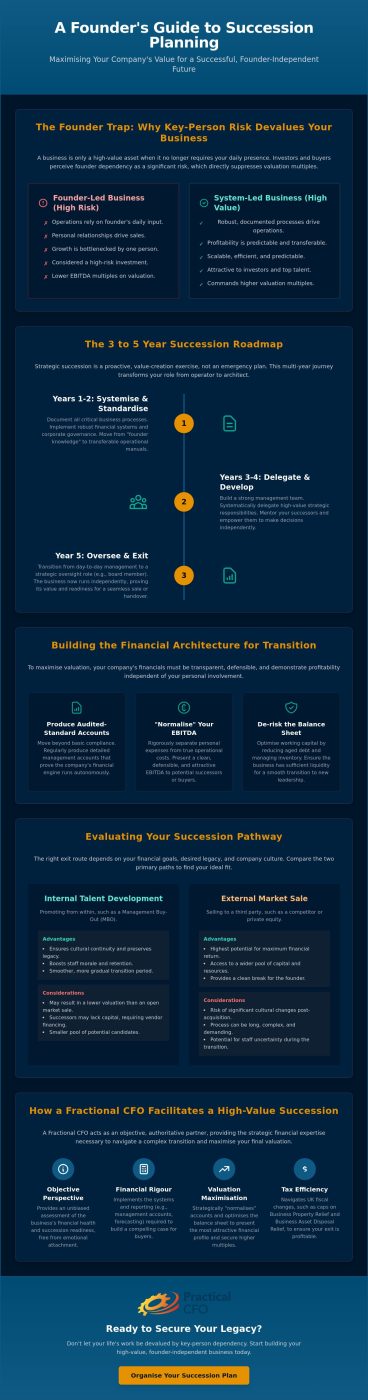
The Founder Redundancy Roadmap: A Step-by-Step Transition
Achieving founder redundancy is the ultimate objective of a successful transition. It requires a methodical, chronological framework that prioritises business stability whilst you gradually reduce your operational footprint. Effective succession planning for founders begins with identifying ‘High Value, Low Skill’ tasks. These are the critical processes, such as payroll approvals or specific supplier negotiations, that keep the business running but don’t necessarily require your unique strategic vision. By delegating these first, you create the capacity to focus on the higher-level strategic handover.
Trust is the currency of any leadership change. Clear communication with stakeholders, clients, and staff is essential to maintain this trust. You must present the transition as a planned evolution rather than a sudden departure. This transparency prevents the ‘key-person’ anxiety that can lead to staff turnover or client churn during a period of change.
Phase 1: Operational Decoupling and Process Documentation
The first phase focuses on moving from ‘doing’ to ‘reviewing’. You must implement robust management reporting that allows you to monitor performance without being involved in the minute details. This is often the ideal time to integrate a fractional CFO to take over high-level financial strategy and risk management. Simultaneously, you should compile a ‘Business Bible’. This document must contain all critical operational knowledge, including ‘founder-only’ relationships and undocumented workflows. It ensures that the company’s institutional memory isn’t lost when you eventually exit the building.
Phase 2: Strategic Handover and Mentorship
Once operational tasks are documented, the focus shifts to a ‘Shadowing’ period. During this stage, your successor begins to lead strategic meetings whilst you move into an advisory role. It’s a delicate balance. You must establish clear boundaries to prevent yourself from stepping back into decisions once they’ve been delegated. We recommend setting specific KPIs for your successor that align with your long-term exit goals. These metrics should prove they can maintain growth and manage capital effectively without your intervention. If you’re ready to begin your transition, our Business Planning Consultant services provide the structural roadmap required to step back with confidence.
This roadmap isn’t just about leaving; it’s about future-proofing. By the end of this process, the business should function as a self-sustaining asset. Your value shifts from being the primary engine of growth to being the architect of a legacy that survives your daily presence.
How a Fractional CFO Facilitates Founder Succession
Hiring a full-time Finance Director often feels like a premature expense for many UK SMEs. However, the complexity involved in succession planning for founders requires a level of strategic expertise that goes beyond basic accountancy. A fractional Chief Financial Officer provides this high-level guidance without the overhead of a permanent executive salary. This model allows you to access seasoned leadership exactly when you need it. It effectively bridges the gap between founder-led operations and the professional corporate governance that a successor or buyer will demand. You don’t need a full-time hire to achieve a professional-grade exit.
An outsourced CFO offers a vital, objective perspective that’s often missing in founder-led businesses. You’ve likely spent years being the primary engine of your company, which can make it difficult to see financial risks or valuation hurdles with total clarity. A fractional partner acts as an authoritative strategic partner, identifying the systemic gaps that could derail a transition. They transform the finance function from a historical reporting tool into a forward-looking engine. This shift is what makes a business attractive to external buyers or capable internal management teams who want to see a clear roadmap for future growth.
Professionalising the Finance Function for the Next Leader
Incoming CEOs or institutional buyers expect a specific standard of financial control. A fractional CFO implements the automated systems and rigorous reporting structures that satisfy this requirement. They provide the board-level financial advice that founders often lack, ensuring every strategic decision is backed by defensible data. When it’s time for a sale or an MBO, your CFO manages the intense financial due diligence process. They protect your interests whilst ensuring the buyer’s confidence remains high throughout the transaction. This professionalisation ensures the business is ready for scrutiny at any time.
Securing Your Legacy with PCFO
At PCFO, we recognize that your business is your life’s work. Our strategic business growth advisory helps founders scale their companies specifically for an eventual exit. We specialise in the UK SME lifecycle, providing the intellectual rigour needed to navigate complex tax changes and operational handovers. We don’t just report on the past; we help you navigate the future. Our team acts as an embedded advisor, invested in the long-term trajectory of your business. We take the time to be thorough, building a foundation of trust that allows you to step back with peace of mind.
Ready to start your redundancy roadmap? Contact PCFO for a confidential succession consultation and ensure your business is ready for its next chapter. Succession planning for founders is a journey that requires a steady, experienced hand at the helm of your financial strategy.
Securing Your Legacy Through Strategic Financial Leadership
Transitioning from a founder-led business to a founder-independent asset is a multi-year process that requires intellectual rigour and strategic foresight. By professionalising your financial architecture and decoupling your daily involvement from operational success, you turn your company into a high-value, de-risked asset. Effective succession planning for founders ensures that your hard work translates into a lasting legacy and a maximised valuation when the time comes to exit.
We provide the steady, experienced hand needed to navigate this transition. Our expert fractional CFOs possess extensive SME exit experience and specialise in UK business growth advisory. We offer the strategic financial leadership you require without the commitment of a full-time executive salary. Secure your business legacy with PCFO’s Exit Strategy Support and take the first step towards a composed, profitable transition. You’ve built a remarkable company; now it’s time to ensure it thrives for years to come.
Frequently Asked Questions
When is the best time to start succession planning for a founder?
The ideal timeframe to begin the process is three to five years before your intended departure date. This lead time allows you to move from operational dependency to strategic oversight without rushing the transition. Starting early ensures you have sufficient time to professionalise your management accounts and mentor potential leaders, which ultimately protects your company’s market valuation.
What is the difference between an exit strategy and a succession plan?
An exit strategy focuses on the financial transaction and the mechanism of your departure, such as a trade sale or liquidation. In contrast, succession planning for founders is a broader leadership strategy focused on business continuity. It addresses who will lead the organisation and how the culture and systems will survive your absence to remain a high-value asset.
How does key person dependency affect my business valuation?
High key person dependency significantly increases the perceived risk for buyers and investors, which typically leads to lower EBITDA multiples. If the business cannot function without your personal relationships or technical sign-off, it’s considered a personal project rather than a scalable asset. Reducing this dependency through systemisation is the most effective way to maximise your eventual sale price.
Can I use a Management Buyout (MBO) as my primary succession route?
Yes, a Management Buyout is a highly effective route for founders who wish to reward a loyal leadership team whilst ensuring continuity. This process usually involves the management team securing leveraged finance, often supported by the founder accepting a portion of the payment as deferred consideration. It requires a high level of transparency regarding the company’s debt capacity and future cash flow.
What role does a Fractional CFO play in succession planning?
A Fractional CFO provides the objective, board-level financial leadership required to de-risk the business before a transition. They professionalise the finance function, implement robust controls, and manage the due diligence process during a sale or MBO. This model offers the strategic foresight of an experienced Finance Director without the overhead of a full-time executive salary during the planning phase.
How do I tell my employees about my succession plan without causing panic?
The best approach is to frame the transition as a proactive evolution designed to ensure the company’s long-term stability and growth. Transparency is essential; by communicating the plan as a structured roadmap, you alleviate the anxiety associated with sudden leadership changes. Presenting the move as an investment in the company’s future helps maintain staff morale and retention during the handover.
What are the tax implications of founder succession in the UK?
Effective succession planning for founders must account for significant fiscal changes, such as the increase in the Business Asset Disposal Relief (BADR) rate to 18% from 6 April 2026. Additionally, the new £2.5 million cap on 100% Business Property Relief (BPR) requires careful balance sheet structuring. Managing these thresholds correctly is vital to ensuring your exit remains as tax-efficient as possible.
How do I choose between an internal successor and an external hire?
An internal successor offers cultural continuity and deep institutional knowledge, which can be less disruptive for staff and clients. However, an external hire may bring the fresh strategic perspective needed to scale the business into a new lifecycle. You must assess whether your internal managers possess true “Board Level” strategic potential or if the business requires an experienced outsider to lead the next chapter.