

A strong investor update does more than present figures. It gives investors a clear view of performance, challenges and where their support could help. Creating an investor update report starts with a consistent format and set of key metrics, making progress easier to track over time. Early-stage businesses often share updates monthly, while growth or late-stage companies typically send them quarterly.
Deciding what belongs in the report, and how much detail to include, can be difficult. Focus on what investors need to know: financial performance, business developments, risks and priorities, plus specific requests such as introductions or hiring support. This guide explains what an investor update is, what to include and how investors can help. It also shows how to adapt a template to your business, stage and audience, so each update stays concise, useful and easy to compare with the last.
Key Takeaways
- Use an investor update to give shareholders a clear view of business health and the decisions ahead.
- Turn requests for introductions, hiring support or other help into specific, actionable asks.
- Choose a template that reflects the areas investors need to understand, then adapt it to your business.
- Shape each report around its audience and stage, bringing the most important information to the top.
What is an investor update?
An investor update is a regular communication about a company’s financial performance, team changes and customer wins. It helps investors assess business health, understand cash runway and see where their support may be useful. For founders, creating an investor update report also provides a structured opportunity to review progress beyond day-to-day activity.
For most UK private companies, investor updates are optional unless a shareholders’ agreement sets information-sharing expectations, such as monthly, quarterly or annual updates. Public companies are required to report their numbers quarterly. For issuers within scope, the Financial Conduct Authority says DTR 4.1.8R and DTR 4.2.7R require annual and half-yearly management reports to describe principal risks and uncertainties.
Consistent metrics make each report easier to compare with the previous one. Choose measures that reflect your business model, then keep their definitions and reporting periods stable. A SaaS company might track monthly recurring revenue and net revenue retention; another business may focus on customer numbers, sales or product usage. Put the most relevant KPI near the top, alongside progress against the previous period and the goal.
Include financial measures such as revenue, cash in the bank, monthly burn and months of runway. Runway is the number of months remaining before the company runs out of cash. Add context for material changes, such as increased spending linked to a product launch. Keep the explanation factual and connect the figure to its business impact.
Use tools that make trends clear without crowding the report. An Excel spreadsheet can organise recurring metrics and track changes between periods. A Power BI dashboard can display selected figures as charts, helping readers spot movement quickly. Use simple graphs rather than dense tables, label periods clearly and explain notable shifts. A standardised format, stable metrics and concise insights help investors understand results and risks.
Investor requests and ways investors can help
Clear requests make an investor update a practical way to strengthen relationships. Investors may offer introductions, hiring support, sector knowledge or help with funding conversations. State what you need, why it matters now and what kind of response would be useful.
To make highlights and requests clear, lead with the development or obstacle, explain its business impact, then make a specific ask. For example: “A potential customer introduction would support our next sales milestone. We’re looking for a connection to UK retailers with established online channels.” This gives investors enough context to act without burying the request in background.
Keep the asks section concise. One or two bullets can set out the company’s most important needs. Name a relevant contact, skill or resource in each bullet rather than asking generally for “help”. If the business needs a senior finance hire, state the role and useful experience. If it needs customer introductions, describe the target customer clearly.
- Introductions: Specify the sector, organisation type or decision-maker you hope to reach.
- Hiring: Identify the role and expertise needed for the next stage.
- Capital: Explain whether you need fundraising introductions or advice on preparing for a future round.
- Expertise: Ask for focused input, such as feedback on a pricing model or route to market.
Use an investor update template to keep requests visible and consistent between reports. Email makes it easy for investors to respond beside each ask. A shared spreadsheet can track the request, the investor offering help, the next action and its status. A customer relationship management tool can also record introductions and follow-up conversations, keeping useful context in one place.
Close the section with a clear next step, such as arranging an introduction or sharing a role description. Track outcomes in the next update, including progress and any remaining obstacle. If investor conversations are shaping a future ownership transition, exit strategy support can help bring planning into focus.
Investor update templates
A useful investor update template gives founders a repeatable structure, not a fixed script. Group information by business area, such as customer developments, product and technology, finance, operations, team changes and investor requests. This helps stakeholders find the sections relevant to their interests. Keep headings that reflect current priorities and remove sections that add no insight.
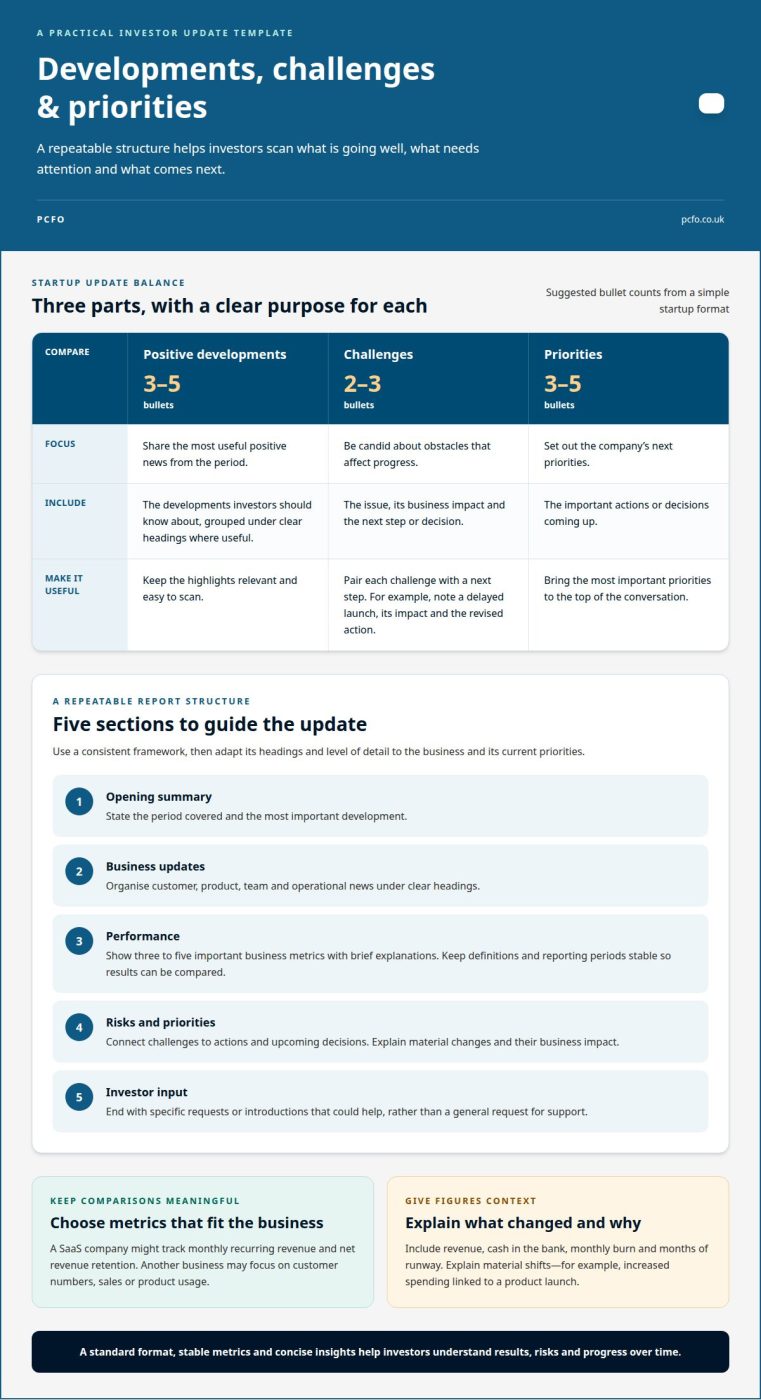
For startups, a simple structure can separate positive developments, challenges and priorities. One example uses three to five bullets for positive news, two to three for challenges, then ends with three to five priorities. Pair each challenge with a next step. For instance, describe a delayed launch, explain its impact, then note the revised action or decision.
- Opening summary: Set out the period covered and the most important development.
- Business updates: Organise customer, product, team and operational news under clear headings.
- Performance: Show three to five important business metrics with brief explanations.
- Risks and priorities: Connect challenges to actions and upcoming decisions.
- Investor input: End with specific requests or introductions that could help.
Y Combinator’s investor update template highlights repeatable KPIs and major investor asks. This approach helps founders maintain useful comparisons while adapting the detail to their stage. Investors may prefer different levels of financial detail, so make the main message easy to scan without hiding important context. A monthly profit and loss statement may also be relevant, depending on the startup’s stage.
Choose a tool that suits the report’s purpose. Google Docs works well for drafting and editing a text-led update with collaborators. Google Sheets can organise metric tables and supporting calculations. PowerPoint suits a presentation-style report, especially when charts help explain trends. Keep the section order consistent between editions, even as the content changes.
Templates are starting points. Adapt headings to the company’s model, audience and current priorities, then remove content that does not help investors understand progress or decisions. A focused format makes each update easier to prepare and review.
Creating and customising an investor report
Start with the audience and the decision the report should support. Existing shareholders may need detailed financial context, while prospective investors may need a focused view of progress and opportunity. Separate versions can help give investors relevant information without sharing proprietary details with external stakeholders.
Set a monthly preparation routine and keep the report proportionate to the period’s activity. One founder recommends setting aside one hour each month. Put the most important takeaway first, then explain what changed, why it matters and what happens next. If revenue is below plan, describe the cause and the action being taken rather than presenting the figure without context.
Match the emphasis to the company’s stage and immediate priorities. During fundraising, investors may need a clearer view of cash, runway, milestones and funding plans. During a product launch, foreground customer response, delivery progress and any risks affecting the launch. Keep core measures consistent, then add a few stage-specific insights.
Choose a format that suits the information and how recipients will use it. A PDF can preserve a polished, fixed report; an email can make a short update easy to read and reply to. Be mindful that sensitive material in attachments could be forwarded. A presentation tool such as Canva can help organise a board-meeting pack, while a spreadsheet remains useful for supporting calculations.
Before sending, review the report in sequence: confirm the period, reconcile figures with the underlying management information, and check that explanations match the numbers. Remove detail that does not inform a decision. When performance is strong, one guide recommends keeping the update to one page; when results are difficult, another advises a two-page limit. Treat these as editing prompts, not substitutes for relevant context.
A considered process makes creating an investor update report easier to repeat and tailor. For help aligning reporting with business plans and fundraising priorities, work with a business planning consultant.
PCFO
PCFO can help connect investor reporting with the financial decisions behind it. If updates are difficult to prepare or figures need clearer links to business priorities, PCFO’s Finance Director Services and Chief Financial Officer Services provide strategic financial support. Business Growth Advisory and business planning consultancy can also help align reporting with your company’s plans and growth objectives.
This support is most relevant when reporting needs to inform decisions, not simply record past performance. A clearer view of financial position, priorities and progress can help you communicate with investors more confidently and prepare for the next stage of your business.
For support with financial reporting and planning, book a free strategy session with PCFO.
Make investor reporting part of your growth plan
As your business evolves, the information investors need will change too. Treat creating an investor update report as an ongoing management discipline, not a document produced only when fundraising begins. Use each reporting cycle to connect financial decisions with the company’s direction and identify where stronger insight could support the next stage.
PCFO can provide that perspective through Finance Director Services, Chief Financial Officer Services and Business Growth Advisory. This support can be useful when reporting needs to inform planning, clarify priorities or help leadership communicate with investors. The approach should fit your business and its current needs.
Take the next step at a pace that suits you. Discuss your reporting and growth priorities with PCFO, and build a clearer foundation for the decisions ahead.
Frequently Asked Questions
How frequently should you send?
Set a cadence investors can rely on, then adjust it when circumstances change. Monthly updates suit early-stage businesses, while growth or late-stage companies commonly report quarterly. During a fundraising round or when urgent investor input is needed, the Founder Institute recommends sending updates every two weeks. Also align timing with any information-sharing schedule in the shareholders’ agreement.
What is an investor report?
An investor report is a management communication that helps investors understand a company’s direction and performance. It can be an email, document or presentation, depending on the audience and purpose. Unlike a one-off fundraising pitch, a recurring report creates a record of decisions, milestones and changing priorities. For example, a board pack may include more operational detail than an update for prospective investors.
What should an investor update report include?
Include the reporting period, material developments, financial information, current risks and next priorities. Label each figure clearly and explain meaningful changes, so readers can interpret the result rather than guess at its cause. For example, note whether a revenue change reflects customer demand, timing or a one-off contract. Add a concise request when investor input could advance a specific objective.
How often should startups send investor updates?
Startups commonly send updates monthly, especially when the business is changing quickly. The Founder Institute recommends monthly updates during a startup’s first 24 to 36 months, with a more frequent rhythm during fundraising or when external help is needed. A stable schedule helps investors know when to expect an update. Choose a cadence the team can maintain with accurate, useful information.
How do you structure a monthly investor update email?
Use a subject line that names the company and reporting month, then open with the main development. Follow with short sections on performance, key changes, current challenges and upcoming priorities. End with a direct request or state that no help is needed this month. Consider sensitive information carefully: an email attachment can be forwarded beyond its original recipients.
What key metrics should a startup report to investors?
Choose measures that show financial health and progress in the context of your business model. Cash flow, monthly burn and runway help explain funding needs; revenue growth, customer retention or product usage can show commercial traction. A marketplace might also track gross merchandise value, while a subscription business could report recurring revenue. Define each measure consistently and explain any change in calculation.