

What if your fastest-growing opportunity is also the one most likely to strain your business? Thinking like a CFO for business growth means looking beyond headline revenue to ask what an opportunity will require, what it could return and what risks it may bring.
Growth decisions can be difficult when financial reports focus on what has already happened. A strong sales forecast alone won’t show when cash will be needed, whether margins are sustainable or whether your team and operations can deliver. Those questions need clear, forward-looking financial evidence.
This guide shows you how to assess growth opportunities through cash flow, profitability, operational capacity and risk before committing resources. You’ll learn how to connect commercial plans with realistic forecasts, identify assumptions to test and make more confident decisions about investment, hiring or expansion.
CFO thinking is a management discipline you can apply at any stage of growth. When decisions become more complex, flexible CFO or Finance Director support can also help you plan your next move with greater clarity.
Key Takeaways
- Thinking like a CFO for business growth means connecting commercial plans to the financial and operational realities behind them.
- Review cash flow, margins, costs and working capital to see what headline revenue alone can miss.
- Test a growth idea by checking its assumptions, modelling possible outcomes and agreeing what would make it worth pursuing.
- Turn decisions into clear ownership, practical actions and measures that show whether the opportunity is delivering.
- Recognise when growing complexity calls for deeper financial insight, and consider flexible CFO or Finance Director support when needed.
Thinking like a CFO for business growth starts with better questions
Growth brings opportunity, but it can also add complexity. More customers may mean higher delivery demands, extra costs and greater pressure on cash. Thinking like a CFO for business growth helps you look beyond the sales opportunity and consider what the business needs to make it work.
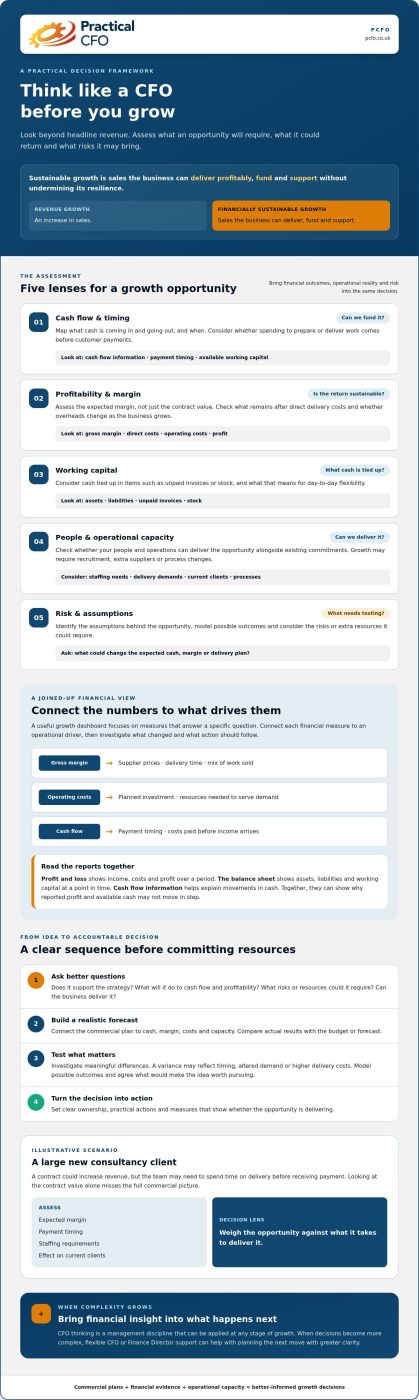
Revenue growth is an increase in sales; financially sustainable growth is sales the business can deliver profitably, fund and support without undermining its resilience. This is the central distinction. CFO thinking isn’t an accounting tutorial or simply a job title. It connects commercial choices with financial outcomes, risk and the capacity available across the business.
What does thinking like a CFO mean in practice?
Financial insight should help shape what happens next, not simply explain what happened last month. The Chief financial officer (CFO) role includes financial planning, reporting and risk management. Applying that perspective to growth means bringing these considerations into decisions about priorities, investment and resources.
Before committing, ask: Does this opportunity support our strategy? What will it do to cash flow and profitability? What risks or additional resources could it require? Can our people and operations deliver it alongside existing commitments?
Hypothetical example: A consultancy is considering taking on a large new client. The contract could increase revenue, but the team may need to spend time on delivery before receiving payment. A CFO-style assessment would consider the work’s expected margin, payment timing, staffing requirements and effect on current clients. The decision then reflects the full commercial picture, rather than the contract value alone.
Why revenue growth alone does not tell the whole story
Sales growth and cash generation aren’t the same thing. A business can record strong sales while waiting for customers to pay, or find that delivery costs and overheads leave less profit than expected. Payment timing matters too: money going out to prepare for work may be needed before income comes in.
Capacity also affects the value of an opportunity. If a team is already stretched, extra work could require recruitment, additional suppliers or changes to processes. Without considering those demands, a sales forecast may overstate what the business can realistically deliver and understate the resources involved.
Thinking like a CFO for business growth means assessing both the reward and what it takes to achieve it. For a broader view of scaling priorities, explore this business growth advisory guide.
Build a CFO view of cash flow, profitability and capacity
A useful growth dashboard brings financial results together with the operational factors that drive them. Thinking like a CFO for business growth means choosing measures that answer a specific question, rather than tracking every available figure. The right measures depend on your business model and the decision in front of you. A product business and a consultancy, for example, may need different indicators.
Start with four connected areas:
- Cash flow: What cash is coming in and going out, and when?
- Gross margin: How much remains from sales after the direct costs of delivering goods or services?
- Operating costs: What ongoing costs support the business, and how might they change as it grows?
- Working capital: How much cash is tied up in items such as unpaid invoices or stock, and what does that mean for day-to-day flexibility?
Connect each financial measure to an operational driver. A change in gross margin, for example, may reflect supplier prices, delivery time or the mix of work sold. A rise in costs may be planned investment, or it may signal that demand is taking more resources to serve than expected. The useful question is not just whether a figure changed, but what caused it and what action should follow.
Read management accounts for decision-useful signals
The profit and loss statement shows income, costs and profit over a period. The balance sheet gives a view of assets, liabilities and working capital at a point in time, while cash flow information helps explain movements in cash. Each offers a different perspective. Together, they can reveal why reported profit and available cash may not move in step.
Compare actual results with the budget or forecast, then investigate differences that matter to the decision. A variance might reflect timing, altered demand or higher delivery costs. Focus your review on the signals relevant to the decision, rather than assuming one reporting format or ratio works for every business.
Connect growth plans to cash and delivery capacity
Map the expected timing of spending against receipts. Include stock purchases, recruitment, supplier commitments and other costs required to serve forecast demand. Consider whether your people, systems and working capital can support that level of activity without weakening existing delivery. A plan can be profitable on paper and still create cash pressure if costs arrive before customer payments.
Harvard Business Review’s growth guidance also highlights the need to develop the financial, human, and organizational capabilities to support expansion. For a more detailed look at projecting cash needs, see these cash flow forecasting services. If you need experienced finance leadership to support growth decisions, explore PCFO’s CFO and Finance Director services.
Assess a growth opportunity before committing resources
Thinking like a CFO for business growth means testing an opportunity before committing cash, people or management attention. Use the same sequence each time: define the opportunity, test its assumptions, model possible outcomes and agree decision criteria. Then compare the results with your strategy and evidence from customers and operations.
Start by describing the opportunity clearly. Is it a new market, product, sales channel or a larger commitment to existing customers? Identify the expected commercial benefit, the resources required and the risks if demand, costs or delivery differ from expectations. Past customer enquiries, repeat purchases, conversion rates and current delivery performance can help ground the assessment. Separate what you know from what you’re assuming.
Test assumptions with scenarios, not a single forecast
A single forecast can make an uncertain opportunity look more certain than it is. Build base, upside and downside cases, and state the assumptions behind each. For example, a business considering a new service might vary expected customer uptake, delivery costs and the time taken to receive payment. These are illustrative assumptions, not benchmarks.
Identify which assumptions have the greatest effect on cash, margin or delivery capacity. Agree in advance what new evidence should prompt a review, such as weaker-than-expected enquiries, higher supplier costs or delays in preparing the team. Review points should reflect the pace and risk of the specific decision, rather than a universal timetable.
Compare growth options using consistent criteria
Assess each option against the same criteria so its appeal isn’t driven by a persuasive sales forecast alone. Include strategic fit, resource needs, timing and financial exposure. A comparison can also make gaps in the evidence visible:
| Criterion | Evidence to consider | Dependencies | Review trigger |
|---|---|---|---|
| Strategic fit | Alignment with stated priorities and customer needs | Leadership focus and existing commitments | Priorities or customer demand shift |
| Financial exposure | Expected costs, margin and cash timing | Payment terms, suppliers and funding available | Costs rise or receipts are delayed |
| Delivery capacity | Current workload and service performance | People, systems and operational readiness | Quality or delivery times come under pressure |
Use the comparison to decide whether to proceed, gather more evidence, adjust the plan or pause. It won’t remove uncertainty, but it makes the trade-offs explicit and helps the business avoid treating assumptions as facts. For more role-specific context, read this guide to the strategic role of a Finance Director.
Turn CFO-style analysis into accountable growth decisions
A growth decision needs more than approval. It needs a clear owner, agreed actions and a way to tell whether the original case is holding up. This turns thinking like a CFO for business growth into a practical management discipline: people know what they’re responsible for, what progress looks like and when the plan may need to change.
Before work begins, record the opportunity’s objective, key assumptions and expected outcomes. Assign someone to lead delivery and identify who will provide the information needed to assess progress. Choose a small set of financial and operational measures connected to the goal. For a new sales channel, for example, these might include sales generated, margin after delivery costs, cash received and the team’s capacity to fulfil orders.
Agree measures that reveal progress and pressure early
Each measure should have a clear definition, a reliable data source and an owner. Agree how often decision-makers will review it, based on the nature and pace of the opportunity. A measure that updates frequently may support closer monitoring, whilst a longer-term initiative may need a different review rhythm.
Set early-warning thresholds that prompt a conversation, not an automatic verdict. If margin falls below the level assumed in the plan, investigate the cause. It could be a change in costs, sales mix or delivery effort. A signal is useful because it directs attention to a question that needs answering, not because it explains the problem on its own.
Use review meetings to adjust the plan
At each review, compare actual performance with the agreed case. Explain material differences, check whether the original assumptions still hold and consider what the latest evidence means for cash, profitability and delivery. End the meeting with a decision: continue, adapt, pause or investigate further.
Record the decision, its rationale, any revised assumptions and the actions agreed. This creates a clear baseline for the next review and helps prevent the business from judging progress against a forecast that no longer reflects reality. If evidence changes, update the plan rather than relying on the original projection.
Accountability doesn’t mean every growth initiative will follow its first plan. It means making considered adjustments while there’s still time to respond. If you need support connecting growth plans with financial insight, explore PCFO’s growth advisory support. You can also discuss business growth advisory support as a possible next step.
When growing businesses need CFO-level support
You can apply CFO thinking without having a CFO in your team. The need for experienced financial leadership may become clearer when growth decisions grow more complex, or leaders can’t get the financial insight they need to make them with confidence. There isn’t one revenue threshold that suits every business. Complexity, goals and the consequences of a decision matter just as much.
Signs your current finance capability may need strengthening
Consider whether decision-makers can access timely, decision-ready information, not just records of past performance. If it’s difficult to understand likely cash needs, assess forecasts or judge the financial implications of investment, the business may need deeper insight. Recurring uncertainty is a prompt to investigate the gap, not proof that a particular role or service is automatically required.
Consider the demands ahead, too. Expansion, significant hiring, changing markets or pressure on cash and margins can make decisions more interdependent. You may be able to manage these questions internally, especially if responsibilities and information are clear. If financial analysis is consistently delayed or strategic choices lack a well-tested financial view, additional expertise may help.
How fractional CFO support can complement the leadership team
Applying CFO thinking is a management discipline: leaders can ask better questions, connect plans to financial outcomes and review evidence. Engaging experienced finance leadership adds specialist perspective to that process. Fractional or outsourced CFO and Finance Director services can give growing businesses access to financial leadership without assuming that every business needs a permanent executive in the role.
PCFO provides CFO and Finance Director support, business growth advisory and business planning. The right scope depends on the business’s needs and decisions. Support can help leadership examine plans, understand financial implications and consider options, but it can’t guarantee a particular growth outcome. For more context on investment considerations, read this fractional CFO pricing guidance.
The aim isn’t to outsource every decision. It’s to strengthen the financial perspective available to your leadership team, while keeping commercial ownership with the people responsible for the business. If your growth plans would benefit from a considered financial discussion, you can discuss your growth plans with PCFO.
Make your next growth decision with clarity
Growth decisions are stronger when they’re grounded in more than sales potential. Thinking like a CFO for business growth means connecting your ambitions to the cash, profitability and capacity needed to deliver, then staying ready to adapt as evidence emerges.
The practical lesson is to test assumptions before committing resources and give each chosen opportunity clear ownership, measures and review points. This creates a better basis for deciding whether to continue, adjust or pause, without expecting every forecast to unfold exactly as planned.
You can apply this discipline within your leadership team. If your plans need deeper financial insight, PCFO provides fractional and outsourced CFO and Finance Director services, alongside business growth advisory and business planning support for growing businesses. The right support depends on your goals and the decisions ahead.
Discuss your growth plans with PCFO and consider what financial perspective would help you take the next step. With clear questions and a considered plan, you can move forward with greater confidence.
Frequently Asked Questions
What does it mean to think like a CFO?
Thinking like a CFO means using financial insight to guide business decisions, not just record past results. It involves considering how a choice affects cash, profitability, risk and the resources available to deliver it. For example, before accepting a large contract, a leader might check expected margin, payment timing and team capacity. The aim is to understand the trade-offs and likely implications before committing the business.
How can thinking like a CFO help a business grow?
Thinking like a CFO for business growth helps you test whether an opportunity is commercially attractive and practical to deliver. You can assess its effect on cash, margins and operational capacity, then compare actual progress with the assumptions behind the plan. This gives leaders a clearer basis for deciding whether to continue, adapt or pause an initiative as evidence changes. It supports considered decisions, but can’t guarantee growth.
Can a small business think like a CFO without hiring one?
Yes. A small business can adopt CFO-style decision-making without appointing a CFO. Leaders can compare financial results with plans, understand upcoming cash requirements and connect proposed investments with their expected returns and resource demands. Clear ownership of forecasts and regular reviews can help make this approach part of day-to-day management. If decisions become more complex or financial insight is difficult to maintain internally, experienced finance leadership may be worth considering.
What financial information should I review before expanding a business?
Review current and forecast cash flow, sales, gross margin, operating costs and working capital, alongside the assumptions behind your expansion plan. Check when costs will arise and when customer payments are expected. Consider whether available people, systems and supplier arrangements can support the additional demand. Your profit and loss statement, balance sheet and cash flow information provide complementary views, but focus on the measures most relevant to the decision and your business model.
How do CFOs assess whether a growth opportunity is worth pursuing?
CFOs assess an opportunity by testing its commercial case, financial implications and delivery requirements. They clarify the expected benefit, examine the assumptions and consider base, upside and downside outcomes. They also weigh strategic fit, resource needs, timing and exposure if demand or costs differ from expectations. Customer and operational evidence can help challenge assumptions. The assessment informs a decision to proceed, gather more evidence, adapt the proposal or pause.
When should a growing business consider fractional CFO support?
Consider fractional CFO support when important growth decisions need financial insight that your current team can’t readily provide. Possible signals include recurring uncertainty about cash requirements, forecasts or investment choices, or difficulty getting timely information for decision-making. No single revenue threshold applies to every business. Complexity, goals and the consequences of upcoming decisions matter. PCFO provides fractional and outsourced CFO and Finance Director services for growing businesses.
Is CFO thinking the same as accounting?
No. Accounting focuses on recording and organising financial information, while CFO thinking uses that information to inform decisions and future plans. The two are connected: reliable records help leaders understand performance, but a strategic assessment also considers what may happen next and what resources a plan requires. A business can apply CFO thinking alongside its accounting processes, whether financial information is handled internally or through outsourced accountancy solutions.