

Scale-ups fail not from a lack of sales, but from an infrastructure that cannot support the weight of their own success. It’s a frustrating paradox to see record-breaking revenue figures on your dashboard whilst simultaneously feeling the intense pressure of cash runway anxiety. You’ve likely felt the sting of a surprise tax liability or the frustration of opaque reporting that makes it impossible to plan for next month, let alone next year. Identifying the common financial mistakes for scale-ups uk is the essential first step toward reclaiming control over your company’s trajectory.
This 2026 strategic guide identifies the critical pitfalls that threaten to derail British businesses and provides the roadmap to rectify them. We’ll explore how to transform your current reporting into a tool for strategic clarity and ensure your financial statements are permanently investment-ready. By addressing these gaps now, you can shift from reactive firefighting to a composed, proactive stance that secures your path to a successful exit or continued expansion. Our focus is on future-proofing your organisation through intellectual rigour and strategic foresight.
Key Takeaways
- Learn why revenue growth often masks underlying liquidity issues and how to transition from reactive accounting to proactive strategic finance.
- Understand how to eliminate “data fog” by shifting from simple statutory reporting to sophisticated management accounts that drive informed decision-making.
- Identify the common financial mistakes for scale-ups uk when hiring senior leadership, ensuring you don’t overpay for an administrator when you require a strategist.
- Discover the fractional advantage and how outsourced CFO services provide the high-level oversight needed to future-proof your organisation without the cost of a full-time hire.
- Gain clarity on building an investment-ready financial infrastructure that supports sustainable expansion and maximises your eventual exit valuation.
Crossing the Scale-up Chasm: Why Startup Habits Fail
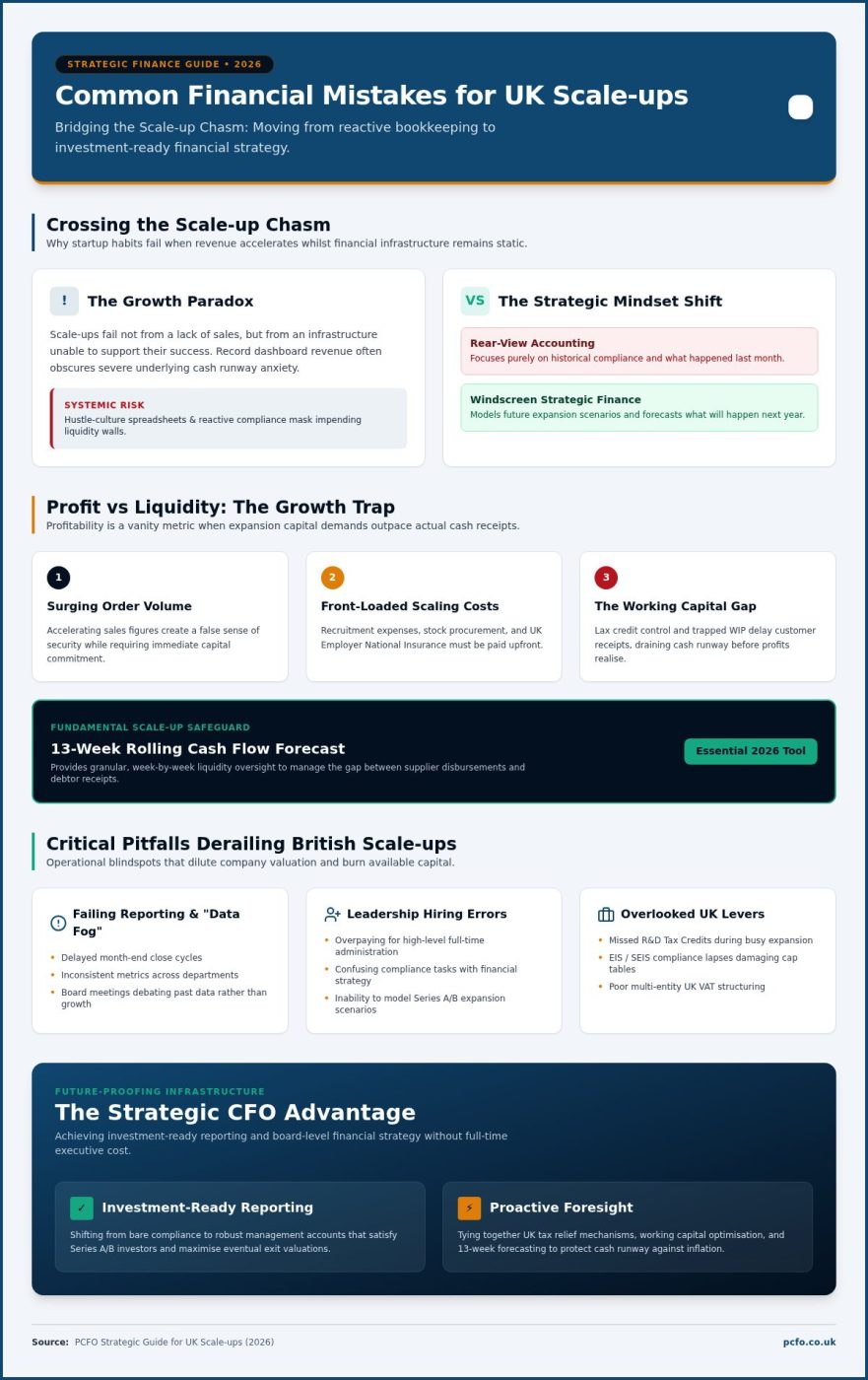
Many British founders find themselves trapped in a “Scale-up Chasm.” This occurs when revenue growth accelerates rapidly, yet the internal financial infrastructure remains static. In the early days, “hustle culture” in finance might involve manual spreadsheets and reactive bookkeeping. Whilst this suffices for a lean startup, it creates systemic risk during expansion. Relying on outdated methods is one of the most common financial mistakes for scale-ups uk, as it obscures the true state of your company’s cash flow.
The transition requires a shift from “rear-view” accounting to “windscreen” strategic finance. Traditional accountants focus on what happened last month. Strategic leaders look at what will happen next year. If your board meetings are spent debating historical data rather than future strategy, you’ve likely outgrown your founding accountant. Addressing these common financial mistakes for scale-ups uk early ensures your infrastructure can support the weight of your success.
The Danger of the “Good Enough” Accountant
Basic compliance is no longer the benchmark for success. As you prepare for Series A or B funding, investors demand sophisticated reporting that a standard high-street accountant cannot provide. Tax filing is a transactional necessity, but strategic financial planning is a growth engine. Signals that your finance function is failing include delayed month-end closes, inconsistent data across departments, and an inability to model different expansion scenarios. You need a partner who bridges the gap between basic bookkeeping and high-level strategy.
Ignoring UK-Specific Scaling Incentives
Operational intensity often leads leaders to overlook significant financial levers. Many companies miss out on R&D Tax Credits because they’re too focused on daily delivery. Similarly, failing to maintain EIS or SEIS compliance during follow-on rounds can alienate early investors and complicate your cap table. Poor VAT structuring across multiple UK entities is another common pitfall. These oversights represent lost capital that could have funded your next hire or marketing campaign. Future-proofing your business requires a proactive approach to these UK-specific incentives, ensuring no value is left on the table.
Cash Flow vs. Profit: The Fatal Scale-up Misconception
Profitability is often a vanity metric for a business in rapid expansion. It’s entirely possible to be profitable on paper whilst your bank account is empty. This disconnect is a primary reason why many British companies fail during their most successful sales periods. Falling into the “Growth Trap” is one of the most common financial mistakes for scale-ups uk. It occurs when the capital required to fulfil new orders, hire staff, and increase stock outstrips the cash received from previous sales.
Maintaining a 13-week rolling cash flow forecast is now a fundamental requirement for any serious leadership team. This tool provides a granular, week-by-week view of your liquidity. It allows you to manage the delicate gap between paying suppliers and receiving customer receipts. Strategic leaders use this data to negotiate better payment terms or time their expansion spend more effectively. Without this foresight, you risk hitting a liquidity wall just as your market opportunity peaks.
Over-optimistic Runway Calculations
Many leaders assume their cash burn will follow a predictable, linear path. In reality, scaling costs are lumpy and often front-loaded. You must account for the substantial “hidden” costs of UK expansion, including Employer National Insurance contributions and the rising costs of specialist recruitment. Cash Runway defines the duration your business can operate before capital is exhausted, and maintaining a clear view of this figure is vital as borrowing costs remain sensitive to UK inflation trends in 2026.
Poor Working Capital Management
Lax credit control can quickly stall your scaling momentum. If your customers aren’t paying on time, your own expansion plans are effectively funding their operations. Inventory and Work-In-Progress (WIP) levels also act as “cash leaks,” where capital is trapped in unfinished projects or unsold stock. Implementing robust outsourced accountancy solutions can provide the oversight needed to tighten these cycles and release vital capital.
Managing these complexities requires a level of expertise that goes beyond basic compliance. It involves a proactive mindset that anticipates bottlenecks before they become existential crises. If your current reporting feels inadequate, our Business Growth Advisory services can help you build a more resilient financial foundation for the future.
Inadequate Reporting and the “Data Fog” Problem
As a company scales past the £2m turnover mark, the leadership team often encounters a phenomenon known as “Data Fog.” You have access to more numbers than ever before, yet you lack the specific insights required to make confident decisions. Relying on intuition served you well during the startup phase, but at this level of complexity, gut feeling is no longer a reliable compass. One of the most common financial mistakes for scale-ups uk is failing to transition from statutory reporting to a robust management accounting framework.
Statutory accounts exist to satisfy HMRC and Companies House. They are historical and compliance-focused. In contrast, management accounts provide the real-time visibility needed to steer the business. Effective board meetings in 2026 require a deep dive into unit economics, such as Customer Acquisition Cost (CAC), Lifetime Value (LTV), and Churn. Without these metrics, you’re essentially flying blind, unable to see if your growth is sustainable or merely a temporary surge.
The Spreadsheet Ceiling
Manual workbooks are the silent killers of scaling efficiency. Whilst a spreadsheet is a flexible tool, it quickly becomes a single point of failure as your transaction volume increases. Dirty data, which refers to inaccurate or inconsistent figures, is a significant risk during investment due diligence. This can devalue your company or stall a funding round. When deciding how to scale your reporting, you must weigh the benefits of an FP&A consultant vs software to ensure your infrastructure is resilient and professional.
Failure to Track Departmental ROI
Treating marketing and sales expenditure as a combined black hole prevents you from identifying which channels actually drive value. High-growth firms must implement cost-centre accounting to track the specific Return on Investment (ROI) of each department. This level of granularity allows you to reallocate capital from underperforming areas to high-growth opportunities. By using financial data to centre your business growth strategy, you ensure that every pound spent is an investment in your company’s long-term trajectory rather than just an operational expense.
Hiring Pitfalls: The Cost of Improper Financial Leadership
Founders often struggle with the transition from managing their own finances to delegating control to a professional. Hiring an “administrator” when you actually require a “strategist” is a significant risk that can stall your momentum. An administrator tracks the past, but a strategist models the future. This lack of high-level oversight is amongst the most common financial mistakes for scale-ups uk, as it leaves the leadership team without the intellectual rigour needed to navigate complex expansion hurdles. A strategic Finance Director does more than report numbers; they professionalise the board of directors by shifting the focus from operational firefighting to long-term governance.
The Full-Time CFO Trap
A full-time executive hire at the scale-up stage often represents a poor allocation of vital capital. With salaries for experienced CFOs in the UK frequently exceeding £150,000, plus bonuses and National Insurance contributions, the total cost to an SME is substantial. Most businesses at this stage do not have enough high-level strategic work to occupy a senior CFO for forty hours a week. Instead, a fractional model allows you to access the same institutional knowledge at a fraction of the cost. You can review fractional CFO pricing UK to understand how this flexible approach provides a higher ROI whilst ensuring your financial strategy is led by a seasoned expert.
Neglecting Exit Strategy Early On
Waiting until you’re ready to sell to “tidy up” your finances is a critical error that devalues your hard work. Maximising your valuation requires at least 24 months of clean, strategically presented data that can withstand the scrutiny of intense due diligence. An experienced FD identifies red flags that often scupper UK M&A deals, such as irregular revenue recognition or poorly documented internal costs. Engaging exit strategy planning services early ensures your financial narrative is compelling and defensible to potential buyers. This proactive preparation prevents the common financial mistakes for scale-ups uk that lead to “valuation hair-cuts” or deal fatigue during final negotiations.
The right leadership ensures your business is not just growing, but is also structurally sound and attractive to investors. If you are concerned that your current finance function lacks the strategic depth required for your next phase, our Finance Director Services provide the steady, experienced hand needed to guide your company toward a successful future.
Securing the Future: Implementing Strategic Financial Oversight
The transition from reactive bookkeeping to proactive strategic oversight is the defining moment for any successful British business. Whilst early-stage finance is often about survival and compliance, the scale-up phase requires a shift toward intellectual rigour and future-proofing. Implementing a robust financial framework allows you to anticipate market shifts rather than merely responding to them. Correcting the common financial mistakes for scale-ups uk involves more than just better software; it requires a fundamental change in how your leadership team perceives the finance function.
The “Fractional Advantage” has emerged as the most efficient solution for UK scale-ups in 2026. It offers a strategic middle ground between the basic services of a traditional accountant and the prohibitive costs of a full-time executive. PCFO bridges this gap by providing board-level strategy that integrates directly with your existing operations. This model ensures you have a steady, experienced hand at the helm of your financial strategy without the overhead of a permanent hire. It transforms finance from a back-office necessity into a core pillar of your expansion roadmap.
Building a Scalable Finance Function
A scalable finance function must evolve at the same pace as your product or service. This involves integrating advanced technology with high-level human oversight to ensure your data remains clean and actionable. As your transaction volume grows, your financial infrastructure must be capable of supporting multi-departmental reporting and complex unit economics. Utilising business growth advisory uk services ensures that your financial architecture is built for the long-term trajectory of your business, preventing the systemic risks associated with “hustle culture” finance.
Your Strategic Roadmap
Creating a culture of financial accountability amongst your team is the final step in securing your company’s future. When department heads understand the financial impact of their decisions, the entire organisation becomes more resilient. A part-time FD acts as a strategic partner rather than a distant contractor, embedding themselves in your business to foster long-term success. They provide the intellectual rigour needed to audit your own financial health and identify any lingering common financial mistakes for scale-ups uk that could devalue your firm during an exit.
Securing the future of your organisation requires a proactive mindset and a commitment to strategic navigation. If you are ready to move beyond basic reporting and implement a truly sophisticated finance function, we invite you to book a strategic review with PCFO. Let us help you turn your financial data into a powerful tool for clarity, expansion, and eventual exit success.
Elevating Your Financial Strategy for Sustainable Expansion
Rapid growth is a significant achievement, but it demands a shift in operational maturity. Moving away from the common financial mistakes for scale-ups uk requires a commitment to intellectual rigour and proactive navigation. We’ve explored how transitioning from reactive bookkeeping to strategic management reporting creates the clarity needed for Series A or B funding. By prioritising cash flow over vanity profit metrics and avoiding the trap of premature executive hiring, you’ll build a resilient infrastructure that supports long-term success.
PCFO provides the expert fractional CFOs you need to bridge the gap between your founding accountant and a full-time hire. Our team specialises in UK SME growth and exit strategies, offering tailored leadership without the burden of a full-time executive salary. If you’re ready to professionalise your board and future-proof your organisation, book a strategic financial consultation with PCFO today. It’s time to navigate the complexities of expansion with composed confidence and a steady hand at the helm.
Frequently Asked Questions
What is the most common financial mistake for UK scale-ups?
Confusing profit with cash flow is the most frequent issue. Many founders assume that record sales automatically equate to financial health, but rapid expansion often consumes working capital faster than it’s generated. This “Growth Trap” is one of the most common financial mistakes for scale-ups uk. Without a rolling 13-week forecast, you risk a liquidity crisis even whilst your order book is full. Proactive cash management is essential for survival during scaling.
How does a fractional CFO differ from a traditional accountant?
A traditional accountant focuses on historical compliance and statutory filings like VAT and year-end accounts. In contrast, a fractional CFO provides forward-looking strategic leadership. They model future scenarios, optimise capital structure, and professionalise your board-level reporting. Whilst an accountant looks in the rear-view mirror to tell you what happened, a CFO looks through the windscreen to help you navigate the road ahead and secure your company’s long-term trajectory.
When should a UK business move from spreadsheets to ERP software?
Most businesses reach a “spreadsheet ceiling” around the £2m turnover mark or when transaction volume makes manual entry a single point of failure. If your team spends more time consolidating workbooks than analysing data, it’s time to transition. Moving to an ERP or integrated accounting suite ensures data integrity during due diligence. This shift eliminates “Data Fog” and provides a scalable foundation that supports multi-departmental ROI tracking and complex unit economics.
Can a scale-up survive without a full-time Finance Director?
Yes, many companies successfully scale using fractional FD services to bridge the gap between their founding accountant and a full-time executive hire. This model allows you to access high-level strategic oversight without the £150,000+ annual salary and executive overheads. A fractional leader provides the same intellectual rigour and board-level experience on a part-time basis. It’s an efficient way to professionalise your finance function whilst retaining capital for operational growth.
How do R&D tax credits impact a scale-up’s cash runway?
R&D tax credits act as a significant non-dilutive funding source that can extend your cash runway by several months. For scale-ups investing heavily in innovation, these credits provide a vital cash injection to fund further recruitment or product development. It’s crucial to work with a strategic advisor to ensure your claims are maximised and compliant with the latest 2026 HMRC regulations. Missing these incentives is a frequent oversight that unnecessarily drains working capital.
What are the red flags in a scale-up’s management accounts?
Red flags often include a persistent delay in month-end reporting or a disconnect between your CRM data and your bank balance. If your management accounts lack granular unit economics like Customer Acquisition Cost (CAC) and Lifetime Value (LTV), you’re missing the insights needed for strategic navigation. Inconsistent reporting across different departments is another warning sign. These issues suggest that your current financial infrastructure is struggling to support the weight of your company’s success.
How much does a fractional FD cost for a UK SME?
The cost of a fractional FD is significantly lower than a full-time executive hire, as you only pay for the specific strategic time you require. Whilst a permanent CFO often commands a six-figure salary plus bonuses and National Insurance, a fractional model provides high-level expertise for a manageable monthly fee. This flexible approach allows UK SMEs to access seasoned leadership tailored to their specific lifecycle stage, ensuring financial strategy remains a priority without compromising operational budgets.
How can I prepare my finances for a Series A funding round?
Preparation should begin at least 24 months before the round. You must ensure your financial data is clean, consistent, and capable of withstanding intense due diligence. Investors look for a clear narrative supported by robust management accounts and a defensible business plan. Addressing common financial mistakes for scale-ups uk, such as poor working capital management or opaque reporting, is vital. A strategic FD will help you present an investment-ready infrastructure that maximises your eventual valuation.