

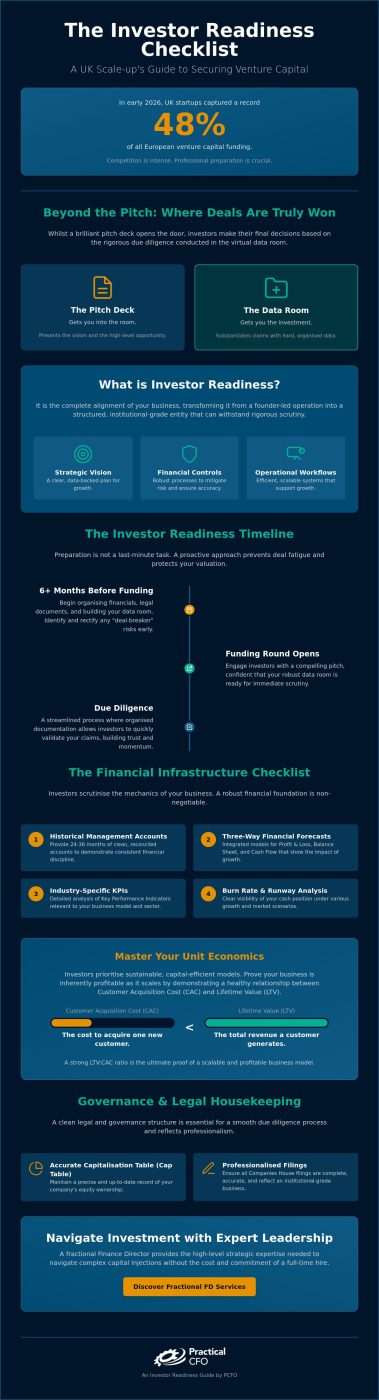
Most founders believe a brilliant pitch deck secures investment, but the truth is that deals are often won or lost in the data room. With UK startups capturing a record 48% of all European venture capital funding in early 2026, the competition for capital has never been more intense. You likely feel the pressure to scale rapidly, yet the anxiety of failing a rigorous due diligence process often lingers in the background. To move from a promising startup to an investable scale-up, you need a comprehensive investor readiness checklist uk that aligns your internal operations with the high expectations of institutional investors.
We understand that professionalising your financial reporting whilst maintaining daily control is a delicate balancing act. This guide will help you master the financial and operational requirements needed to secure venture capital or private equity. We’ll explore the critical impact of recent FRS 102 amendments and the Economic Crime and Corporate Transparency Act on your business’s valuation. By the end of this article, you’ll have a clear roadmap to achieve a clean bill of health for due diligence; this ensures you approach the boardroom with absolute confidence and a strategy built for long-term success.
Key Takeaways
- Understand the rigorous transparency requirements of the 2026 UK investment landscape and why standard reporting is no longer sufficient for institutional VCs.
- Learn how to implement a comprehensive investor readiness checklist uk that prioritises three-way financial forecasts and meticulous management accounts.
- Discover the essential legal housekeeping steps, including maintaining an accurate Cap Table and ensuring your Companies House filings are fully professionalised.
- Identify the strategic steps for organising a Virtual Data Room (VDR) to streamline due diligence and secure a favourable business valuation.
- Explore how fractional Finance Director services provide the high-level expertise needed to navigate complex capital injections without the cost of a full-time hire.
What is Investor Readiness in the UK Market?
Investor readiness represents the point where your business transitions from a founder-led operation to a structured, institutional-grade entity. It is the comprehensive alignment of your strategic vision, financial controls, and operational workflows. In the current UK market, where Venture Capital Explained through the lens of late-stage “megarounds” shows a concentration of capital in proven scale-ups, being “ready” is no longer optional. It’s the difference between a successful capital injection and a collapsed deal.
Whilst a pitch deck might get you into the room, it’s your internal infrastructure that keeps you there. Investors in 2026, including Private Equity and Angel syndicates, demand a level of transparency that goes far beyond basic statutory accounts. They are looking for a “clean bill of health” across your entire organisation. This is where an experienced Finance Director provides immense value. They act as the strategic architect, translating your high-level vision into the granular, data-driven evidence that institutional investors require.
The Shift from Growth-at-all-costs to Sustainable Unit Economics
The investment climate has fundamentally changed. UK investors now prioritise sustainable unit economics over raw, uncurbed user growth. Demonstrating a “capital efficient” model is vital; you must prove that every pound of investment will be deployed strategically to generate a measurable return. Robust management accounting is your primary tool here. It allows you to dissect your cost centres and prove you have a firm grip on your margins. This level of detail provides the reassurance that your business is not just growing, but is inherently scalable and profitable.
When to Start Your Investor Readiness Journey
Preparation is not a weekend task. We recommend starting your investor readiness journey at least six months before you intend to open a funding round. This lead time allows you to identify and rectify any “deal-breaker” risks in your financials or governance. Many founders fall into the “due diligence trap,” where disorganised documentation leads to deal fatigue. This delay often results in lower valuations or investors walking away entirely. You must assess whether your current finance function is merely built for historical reporting or if it’s equipped for strategic growth. Using an investor readiness checklist uk early in the process ensures your internal systems are robust enough to withstand the scrutiny of a top-tier VC firm.
The Financial Infrastructure Checklist: Beyond the Balance Sheet
Investors often look past the glossy pitch deck to scrutinise the underlying financial mechanics of your business. A robust financial foundation is the cornerstone of any investor readiness checklist uk. It’s about substantiation rather than just presentation. You must provide clean, fully reconciled management accounts covering the last 24 to 36 months. This historical data provides the necessary context for your future growth claims and proves you’ve maintained consistent financial discipline.
Beyond historical reporting, you need detailed three-way financial forecasts. These models must integrate your Profit & Loss, Balance Sheet, and Cash Flow statements. If you’re predicting a significant increase in revenue, your forecast must also account for the impact on your working capital and potential tax liabilities. Sophisticated investors expect to see:
- Analysis of Key Performance Indicators (KPIs) specifically tailored to your industry sector.
- Evidence of robust internal controls and clear financial authorities to mitigate the risk of error or fraud.
- Detailed visibility of your “burn rate” and “runway” under various growth and market scenarios.
Mastering Your Unit Economics
Investors want to see that your business model is inherently profitable as it scales. This requires a precise calculation of Customer Acquisition Cost (CAC) versus Lifetime Value (LTV). If your CAC is climbing whilst your LTV remains flat, your scalability is compromised. A strategic outsourced accountancy solution should provide more than just compliance; it must offer the deep analysis required to demonstrate gross margin improvements as your operations expand. Engaging with a Business Planning Consultant can help refine these metrics before you approach the market.
Cash Flow: The Investor’s Favourite Litmus Test
Bank balances only tell half the story. Sophisticated investors focus on working capital management and how seasonal fluctuations affect your liquidity. This level of foresight is a key recommendation in the British Business Bank Investment Guide. You must identify exactly when cash outflows occur and how they align with your revenue cycles. Cash flow runway is the primary metric for venture capital survival, representing the number of months your business can continue to operate before running out of liquid capital. Demonstrating that you understand your “zero-cash date” across various scenarios proves you have the strategic foresight to manage their capital responsibly.
Governance and Legal Housekeeping for UK Scale-ups
Structural integrity is as vital as financial performance when navigating the due diligence process. A key component of any investor readiness checklist uk is ensuring your legal housekeeping is beyond reproach. Institutional investors often start their investigation at Companies House; any discrepancies in your filings or outdated information can immediately erode trust. Under the Economic Crime and Corporate Transparency Act 2023, which saw significant updates in early 2026, you must ensure all directors have completed mandatory identity verification and that your registered email address is active. These are not merely administrative tasks. They are indicators of a well-governed business that is ready for external capital.
A clean Capitalisation Table, or Cap Table, is another non-negotiable requirement. Investors need to see a transparent history of share issuances and a clear path to their own equity position. Similarly, Intellectual Property (IP) must be legally owned by the company rather than the founders. If your core technology or brand assets aren’t properly assigned to the corporate entity, your business valuation will likely suffer. Protecting your human capital is equally important. You should ensure all employment contracts are robust and consider “Key Man” insurance to mitigate the risk of losing essential team members during a critical growth phase.
SEIS and EIS: The UK Investor’s Advantage
For many UK-based startups, the Seed Enterprise Investment Scheme (SEIS) and Enterprise Investment Scheme (EIS) are powerful tools for attracting capital. Securing Advance Assurance from HMRC is a critical step because it provides investors with the certainty they need regarding tax reliefs. As of June 2026, SEIS allows for 50% income tax relief on investments up to £200,000 per tax year, provided your company has been trading for less than three years. Navigating these strict compliance rules requires precision. A single error can disqualify your investors from their tax advantages, which is why the GOV.UK Investor Readiness Essentials framework is so helpful for maintaining the necessary standards.
Board Minutes and Statutory Registers
Professional governance is evidenced through a methodical paper trail. Your board minutes should reflect a clear history of strategic decision-making and risk management. Disorganised legal records often signal a lack of internal control to institutional investors, creating a “red flag” that can stall negotiations. Whilst the recent reforms mean companies are no longer required to maintain certain internal registers if the data is filed at Companies House, keeping your own records organised remains a best practice. It ensures you’re ready for immediate inspection and prevents the deal fatigue that occurs when legal teams have to hunt for basic documentation.
The Virtual Data Room: Presentation vs. Substantiation
The Virtual Data Room (VDR) is the central repository where your investor readiness checklist uk moves from strategic theory to tangible proof. It’s the environment where investors verify every claim you’ve made during the preliminary meetings. A disorganised data room suggests a disorganised business; conversely, a structured VDR builds immediate confidence and accelerates the closing process. To ensure your repository is boardroom-ready, we recommend a methodical five-step approach:
- Step 1: Select a secure, professional VDR platform rather than relying on basic cloud storage.
- Step 2: Categorise all documentation into logical folders, typically Finance, Legal, HR, Commercial, and IP.
- Step 3: Maintain strict version control on all financial models to ensure investors aren’t viewing conflicting data sets.
- Step 4: Perform a “dry run” due diligence check to identify any missing contracts or expired certificates before the room goes live.
- Step 5: Manage granular access permissions to protect sensitive commercial information from being viewed prematurely.
Aligning the Pitch Deck with the Data Room
Every metric, partnership, and growth projection in your pitch deck must be backed by a specific document in the VDR. Discrepancies here are a primary cause of deal fatigue. Industry reports indicate that approximately 40% of deals fail during the due diligence phase because of inconsistencies found between the initial pitch and the supporting documentation. If there’s “bad news,” such as an ongoing dispute or a historic liability, it’s better to be transparent. Presenting the issue alongside a clear, documented plan for resolution demonstrates professional maturity and protects your valuation from sudden drops later in the process.
Commercial Contracts and Customer Concentration
Investors will scrutinise your revenue streams to assess their long-term stability. This involves an analysis of your top ten customer contracts, specifically looking for “change of control” clauses that might trigger a termination if the business is sold or receives significant investment. We also look for customer concentration risks; if a single client represents a significant portion of your turnover, you must demonstrate a robust sales pipeline to mitigate the impact of their potential departure. Exporting clean CRM data into the VDR provides the evidence needed to prove your sales process is both predictable and scalable. If you need assistance structuring your repository for maximum impact, our Finance Director Services can manage the entire preparation process for you.
Navigating Investment with Fractional Finance Leadership
Securing investment is a marathon, not a sprint. For many SMEs, the cost of a full-time Chief Financial Officer is a significant barrier; however, the requirement for senior financial expertise remains absolute. A fractional Finance Director fills this gap by providing high-level strategy and institutional knowledge on a part-time basis. They manage the heavy lifting of the fundraising process, allowing founders to focus on operational growth whilst ensuring every item on the investor readiness checklist uk is meticulously addressed. This approach provides the intellectual rigour of a large-scale finance function without the associated executive overhead.
An embedded financial advisor acts as an authoritative strategic partner. They don’t just report on the past; they future-proof your business by representing your financial interests to sophisticated investors. During the high-pressure weeks of due diligence, they provide a steady hand, ensuring that data requests are met with speed and accuracy. This presence builds trust with venture capital and private equity firms, as it demonstrates that the company has adult supervision over its capital management. Once the round closes, the focus shifts from being “investor ready” to being “investment managed,” ensuring you deploy your new capital effectively from day one.
The Value of an Embedded Financial Advisor
Modern finance leadership moves beyond simple compliance and historical reporting. By integrating proactive business growth advisory into your leadership team, you gain a partner who understands the nuances of the UK investment landscape. A fractional CFO is particularly vital when negotiating term sheets. They help you understand the long-term implications of liquidation preferences, anti-dilution clauses, and board seats. Their primary objective is to protect your equity and maintain founder control whilst securing the capital needed for expansion. This strategic oversight ensures you aren’t just getting a deal, but the right deal for your company’s future.
Building Long-Term Scalability
The fundraising process should serve as a catalyst to professionalise every aspect of your finance function. By meeting the rigorous standards of institutional investors, you build a foundation for long-term scalability. This includes ensuring your exit strategy is baked into your financial planning from the very beginning. Whether you’re targeting a trade sale or an IPO, your financial records must reflect that ultimate goal. Professionalising your systems now prevents costly “re-work” in the future and ensures your business remains attractive to subsequent tiers of investors. Ready to professionalise? Discover how our Fractional CFO services prepare you for investment and provide the strategic navigation your business deserves.
Future-Proofing Your Path to Capital
Securing venture capital or private equity in the UK is a rigorous process that demands more than just a compelling vision. It requires a commitment to operational excellence and financial transparency. By following a structured investor readiness checklist uk, you ensure that your business survives the intense scrutiny of due diligence whilst protecting your valuation. We’ve explored the importance of three-way forecasting, the necessity of clean legal housekeeping, and the strategic value of a well-organised Virtual Data Room.
Professionalising your finance function doesn’t require the immediate overhead of a permanent hire. Our expert fractional FD and CFO services for UK SMEs provide the strategic business growth and exit planning expertise you need to navigate complex negotiations with confidence. We offer professionalised financial leadership without the full-time executive cost, acting as an embedded advisor throughout your entire growth lifecycle. Secure your business future with our fractional CFO services and approach your next funding round with absolute certainty. Your business is ready for its next chapter; it’s time to ensure your infrastructure matches your ambition.
Frequently Asked Questions
What is the most important part of an investor readiness checklist in the UK?
The most critical element is the substantiation of your financial claims through reconciled management accounts and detailed three-way forecasts. Investors look for a logical link between your historical performance and your future projections. A robust investor readiness checklist uk ensures these documents are prepared to institutional standards, providing the intellectual rigour required to survive the due diligence process.
How long does it take to become investor-ready?
Preparation typically requires at least six months of focused effort before you begin active fundraising. This timeframe allows you to identify and rectify any deal-breaker risks, such as disorganised legal filings or gaps in your financial controls. Starting early prevents deal fatigue and ensures your valuation isn’t compromised by avoidable administrative delays.
Do I need a full-time CFO to raise Series A funding?
You don’t necessarily need a full-time CFO to secure Series A funding, as a fractional Finance Director often provides the necessary expertise at a more manageable cost. Fractional leadership offers the strategic navigation and boardroom authority required to negotiate term sheets whilst maintaining daily financial control. It’s about having the right level of seniority rather than a permanent headcount.
What are the most common reasons UK businesses fail due diligence?
UK businesses often fail due diligence because of inconsistent financial data, unresolved IP ownership, or high customer concentration. Discrepancies between the pitch deck and the virtual data room are a significant red flag for institutional investors. Investors also look for change of control clauses in commercial contracts that could impact the business’s future stability.
How does SEIS or EIS status affect investor readiness?
Securing Advance Assurance for SEIS or EIS is a powerful advantage that makes your business significantly more attractive to UK angel investors. It provides them with essential tax relief, which can be a deciding factor in their investment decision. Maintaining strict compliance with these schemes is a vital component of your investor readiness checklist uk to ensure investors don’t lose their tax-advantaged status.
What documents should be in a virtual data room for a UK fundraise?
Your virtual data room should include categorised folders for Finance, Legal, HR, Commercial, and Intellectual Property. Specifically, you’ll need reconciled management accounts for the last 24 to 36 months, statutory registers, employment contracts, and evidence of IP assignment to the company. Version control on all financial models is essential to avoid presenting conflicting information to potential investors.
Can my current bookkeeper handle the investor readiness process?
A bookkeeper focuses on historical recording, but investor readiness requires a strategic Finance Director who can provide forward-looking analysis and growth advisory. Preparing for investment involves complex financial modelling and term sheet negotiation that falls outside the standard bookkeeping remit. You need a partner who can translate founder vision into investor-grade data that withstands professional scrutiny.
How much does it cost to prepare a business for investment in the UK?
The cost of preparation is an investment in your company’s infrastructure rather than a simple expense. It varies based on the current state of your finance function and the complexity of your legal structure. Professionalising your systems early often results in a higher valuation and a smoother capital injection, which far outweighs the initial cost of senior financial advice.