

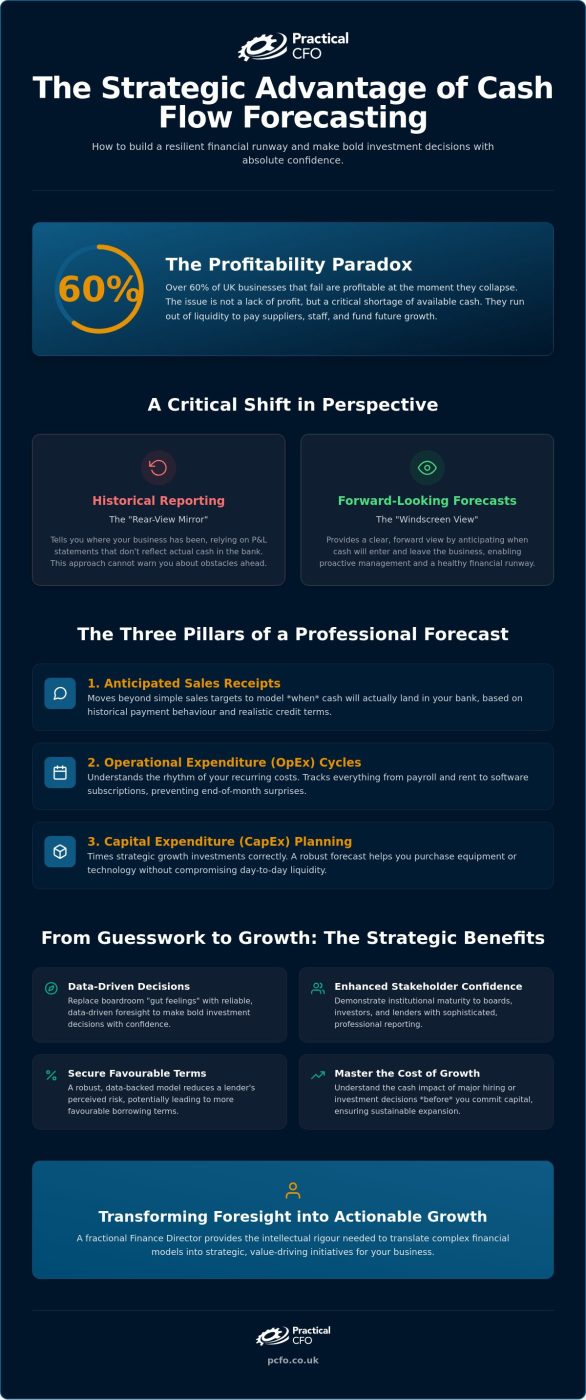
Over 60% of UK businesses that fail are actually profitable at the moment they collapse. They don’t fail because of a lack of ambition or market share; they simply run out of liquid cash. If you’ve ever felt a sense of unease whilst reviewing a spreadsheet, wondering if the balance truly supports your next big hire or supplier payment, you’re experiencing a common leadership challenge. Professional cash flow forecasting services move beyond these manual, error-prone templates to provide a composed and reliable view of your company’s future.
We understand that you need more than just a historical record of where your money went. You require a strategic steering mechanism that dictates your capacity for growth. This guide demonstrates how professional forecasting becomes a proactive engine for stability, providing the clarity needed to make bold investment decisions with absolute confidence. We will examine how to build a resilient financial runway and produce the sophisticated reporting that modern stakeholders and lenders expect in today’s economic climate.
Key Takeaways
- Distinguish between historical profit and future cash availability to ensure your business maintains a healthy financial runway.
- Explore how professional cash flow forecasting services replace boardroom “gut feelings” with reliable, data-driven strategic foresight.
- Master dynamic scenario planning to test the impact of major hiring or investment decisions before you commit your capital.
- Implement a methodical review cadence that integrates real-time data from your accounting software for up-to-the-minute visibility.
- Identify how a fractional Finance Director provides the intellectual rigour needed to translate complex financial models into actionable growth.
What are Cash Flow Forecasting Services?
At its core, cash flow forecasting services represent a forward-looking strategic exercise designed to map out a company’s financial trajectory. Unlike standard accounting, which looks at what has already occurred, this service focuses on the timing and volume of future liquidity. Cash flow forecasting allows business leaders to see beyond the immediate horizon, ensuring that growth plans are backed by actual available funds rather than just paper profits. For a scaling organisation, relying on a simple bank balance check is a high-risk strategy. It fails to account for upcoming tax liabilities, payroll cycles, or the capital required to fulfil new contracts.
Historical Reporting vs. Forward-Looking Projections
A common pitfall for UK business leaders is over-relying on the Profit and Loss (P&L) statement. Whilst your P&L might show a healthy surplus, it doesn’t account for the lag between invoicing a client and receiving payment. This timing gap is where many scaling businesses stumble. Historical reports act like a rear-view mirror; they tell you where you’ve been, but they can’t warn you about the obstacles ahead. Professional services provide a clear windscreen view, allowing you to anticipate exactly when cash will enter and leave the business. This foresight is critical for maintaining a healthy “runway”, which is the amount of time your business can operate before it needs a fresh injection of capital.
The Core Components of a Professional Forecast
Effective cash flow forecasting services break down your financial environment into three primary pillars. This structure ensures that every decision made in the boardroom is grounded in reality rather than optimistic guesswork.
- Anticipated Sales Receipts: This isn’t just about sales targets. It involves modelling when cash will actually land in your bank account based on historical payment behaviour and realistic credit terms.
- Operational Expenditure (OpEx) Cycles: We track your recurring costs, from payroll and rent to software subscriptions. Understanding the rhythm of these fixed and variable outgoings prevents end-of-month surprises.
- Capital Expenditure (CapEx) Planning: Strategic growth often requires significant upfront investment in equipment, technology, or property. A robust forecast helps you time these purchases so they don’t compromise your day-to-day liquidity.
By shifting the focus from historical data to predictive modelling, you gain the ability to navigate market volatility with composure. You aren’t just reacting to your bank balance; you’re actively managing your resources to support long-term objectives. This proactive approach transforms cash management from a source of anxiety into a strategic advantage, providing the intellectual rigour necessary for sustainable expansion.
The Strategic Benefits of Professional Cash Flow Modelling
Professional cash flow modelling transforms financial data from a passive record into an active leadership tool. Whilst many small businesses rely on basic spreadsheets, high-growth organisations require a more sophisticated approach to navigate the complexities of the UK market. By utilising expert cash flow forecasting services, you replace boardroom “gut feelings” with intellectual rigour. This shift allows you to manage liquidity with the same precision you apply to sales or product development. It ensures that every pound in the business is working toward your long-term objectives rather than sitting idle or being committed prematurely.
Stakeholder confidence is a primary beneficiary of this structured approach. Whether you are reporting to a board of directors, seeking investment, or negotiating with lenders, a professional forecast demonstrates institutional maturity. With the Bank of England base rate currently at 3.75% as of June 2026, the cost of capital remains a significant consideration for any business leader. Presenting a robust, data-backed model can reduce a lender’s perceived risk, potentially leading to more favourable borrowing terms. If you are just starting to build these internal processes, referring to a practical guide to cash flow forecasting can provide a useful baseline for the mechanics involved.
Informed Decision Making for Growth
Scaling a business requires a clear understanding of the “cost of growth.” Before committing to a new senior hire or a significant software rollout, you must know exactly how that expenditure will impact your cash position over the next six to twelve months. Professional modelling allows you to map these outgoings against your anticipated receipts. Many leaders find that outsourced accountancy solutions provide the objective clarity needed to make these calls without emotional bias. It’s about knowing you can afford to grow, rather than just hoping the revenue arrives in time.
Managing Supplier and Creditor Relationships
Maintaining strong relationships with HMRC and your supply chain is vital for operational stability. A professional forecast allows you to anticipate Corporation Tax liabilities, which currently stand at 25% for profits over £250,000, months before the payment is due. This foresight prevents the frantic scramble for funds that often occurs during tax season. It also protects you from the 7.5% interest rate HMRC currently charges on late payments. By proving your payment capacity through consistent cash management, you can often negotiate better credit terms with suppliers, further optimising your working capital. This proactive stance helps you avoid the “overtrading” trap, where rapid sales growth actually outpaces your available cash, putting the entire organisation at risk.
Ultimately, these strategic insights allow you to lead with composure. If you feel your current financial reporting lacks this level of foresight, exploring a partnership with a strategic finance partner can help bridge the gap between basic bookkeeping and high-level financial strategy. Complementing your forecasting with robust strategic financial reporting for SMEs in the UK ensures that your data becomes a real-time GPS for decision-making rather than a historical record for compliance alone.
Static vs. Dynamic Scenario Planning
A single-line forecast often fails to capture the complexity of a volatile market. Static models, typically built in manual spreadsheets, provide a fixed snapshot that becomes obsolete the moment a variable shifts. In contrast, dynamic cash flow forecasting services offer a living financial architecture that updates in real-time. This agility is essential for business resilience, as it allows you to move beyond a single “likely” outcome to prepare for multiple eventualities. Recognising the strategic importance of cash flow forecasting means acknowledging that your business environment is in constant flux. Having a “Plan B” and “Plan C” already mapped out provides a significant psychological benefit, replacing panic with prepared, methodical action when the unexpected occurs.
Modelling Growth Scenarios
Strategic expansion often requires a temporary dip in liquidity before the rewards manifest. Dynamic modelling allows you to visualise these transitions before they happen. We typically help leaders explore three primary growth scenarios:
- Scenario A: The New Contract. Winning a major client is a milestone, but the upfront costs of delivery and recruitment can strain your reserves. We model the precise impact on your runway.
- Scenario B: Cost Fluctuations. With UK inflation (CPI) sitting at 2.8% in May 2026, even small increases in labour or material costs can erode margins. We simulate a 10% rise to see if your cash position remains stable.
- Scenario C: Headcount Expansion. Scaling your team is a high-stakes investment. We determine the exact timing for new hires across different departments to ensure your cash flow supports the increased payroll.
Stress Testing for Resilience
Resilience isn’t just about planning for success; it’s about identifying your “break-point.” By simulating adverse conditions, you can build a defensive strategy that protects the organisation’s long-term health. We test the impact of delayed payments from your largest client, which remains a primary cause of insolvency amongst otherwise healthy firms. We also model the effect of interest rate shifts. With the Bank of England base rate at 3.75%, understanding how further changes affect your existing debt facilities is crucial. This stress testing identifies exactly when the business might require external funding, allowing you to secure finance whilst your position is strong rather than during a crisis.
This methodical approach ensures you aren’t just reacting to the market. You’re anticipating it. By integrating these scenarios into your monthly financial reviews, you maintain a composed and proactive stance regardless of external economic pressures.
How to Implement a Robust Forecasting Process
Implementing a robust process requires more than just a software subscription; it demands a cultural shift within your management team. To move from simple data collection to strategic interpretation, you must establish a regular cadence for financial reviews. For most UK businesses, a monthly deep dive is sufficient for long-term planning, whilst a weekly check is essential for managing immediate liquidity. Modern cash flow forecasting services leverage real-time data integration from accounting platforms like Xero or Sage. This ensures your decisions are based on current bank positions rather than month-old reports. Assigning clear accountability for data accuracy is vital. Your sales team must provide realistic pipeline dates, and your operations team must communicate upcoming expenditure changes early.
The transition to a professional model also involves moving away from manual entry. By using real-time bank API connectivity, your forecast stays synchronised with your actual bank balance. This automation reduces the risk of spreadsheet errors, which can lead to poor board-level decisions. It allows your finance function to stop chasing numbers and start analysing what those numbers mean for your future stability. When your data is reliable, you can focus on the “so what?”—the strategic implications of your current cash trajectory. Businesses that have already embraced outsourced accountancy solutions for scaling UK businesses often find this transition significantly smoother, as the infrastructure for automated, real-time reporting is already in place.
Step-by-Step Integration
The first step is defining your forecast period. We typically recommend a rolling 13-week view for operational liquidity and a 12-month view for strategic growth planning. You should aggregate data from all reliable sources, including CRM pipelines and aged debtor reports. To ensure realism, apply probability weighting to your sales pipeline. For example, a lead at the “proposal” stage might be weighted at 50%, whereas a “contract sent” lead sits at 90%. This prevents over-optimism from skewing your projected cash position.
Review and Refine
A forecast is only as good as its last refinement. Comparing your “Actuals vs. Forecast” every month is the only way to improve accuracy over time. If you consistently over-predict receipts, you may need to adjust your assumptions regarding client payment behaviour or credit terms. Variance analysis is the systematic process of identifying and explaining the discrepancies between your projected cash movements and your actual bank transactions. By understanding these gaps, you can fine-tune your model to be more resilient against future market shifts.
Transitioning from manual spreadsheets to a professional, automated system reduces human error and frees up your time for high-level leadership. If you are ready to professionalise your financial oversight, our Finance Director Services can help you design and maintain a bespoke forecasting framework tailored to your business lifecycle.
Transforming Foresight into Value with a Fractional FD
Implementing cash flow forecasting services is a vital technical milestone, but the true value lies in the expert interpretation of the output. Whilst a bookkeeper ensures your transactions are recorded accurately, a finance director translates those figures into a strategic narrative for the boardroom. They look beyond the surface level of your bank balance to assess the health of your working capital cycle and the sustainability of your expansion rate. This level of oversight is what allows an organisation to transition from a state of survival to a state of scaling, where capital is deployed with precision to capture market opportunities. Professional interpretation ensures you aren’t just seeing the numbers; you’re understanding the “so what” behind them.
A CFO’s strategic advice differs fundamentally from standard financial reporting. It focuses on future-proofing and risk mitigation rather than just historical compliance. By identifying trends in your cash movements, an FD can warn you of a liquidity crunch months before it occurs, giving you the time to adjust your strategy or secure funding whilst your position is strong. This proactive stance is the hallmark of a business that is in control of its destiny.
Strategic Leadership without the Executive Salary
Many UK SMEs don’t require a full-time executive hire but desperately need the intellectual rigour a seasoned CFO provides. Fractional expertise allows you to access this high-level guidance on a flexible basis. An FD often identifies “hidden” cash trapped in the balance sheet, such as capital tied up in inefficient debtor collection or stagnant inventory. They act as a critical bridge between the CEO’s vision and the practical reality of the company’s bank account. This partnership ensures that your growth ambitions are always backed by a resilient financial foundation.
Partnering with PCFO for Sustainable Growth
At PCFO, we provide bespoke forecasting models built for your specific industry sector. We understand that a professional services firm has different liquidity rhythms than a manufacturing business or a retail operation. Our proactive advisory service anticipates challenges before they become crises, providing a steady hand at the helm of your financial strategy. This level of control is also essential when positioning your business for a successful exit strategy. Potential acquirers look for a history of proven financial discipline; accurate, long-term forecasting is one of the most persuasive ways to demonstrate that value.
Sustainable growth is built on clarity, not guesswork. If you are ready to move beyond basic spreadsheets and gain a strategic advantage, we invite you to enquire about our cash flow forecasting and FD services today.
Securing Your Financial Future through Strategic Oversight
Transitioning from reactive bookkeeping to proactive financial leadership is a defining step for any scaling SME. By moving beyond static spreadsheets and embracing dynamic cash flow forecasting services, you gain the clarity needed to navigate market volatility with absolute composure. We’ve explored how robust modelling provides a clear runway for investment, whilst scenario planning ensures you’re prepared for every eventuality in the UK’s evolving economic landscape.
Expert interpretation is the final piece of the puzzle. Our experienced UK-based Finance Directors provide the strategic growth advisory necessary to turn complex data into boardroom confidence. Through bespoke scenario modelling and intellectual rigour, we help you bridge the gap between your current position and your long-term ambitions. It’s about more than just survival; it’s about creating a stable platform for sustainable expansion.
Discover how our Fractional FD services can secure your business runway. We are ready to help you future-proof your organisation and lead with renewed certainty.
Frequently Asked Questions
What is the difference between cash flow and profit?
Profit is a historical figure representing what remains after expenses are deducted from your revenue on paper. Cash flow is the actual, physical movement of money into and out of your bank account. It’s entirely possible for a UK business to be profitable whilst simultaneously running out of cash due to delayed client payments or high stock levels.
How far ahead should my business forecast its cash flow?
Most scaling organisations benefit from a dual-track approach. A 13-week rolling forecast provides essential visibility for immediate operational liquidity and payroll. For strategic planning, a 12-month model is necessary to map out capital expenditure, tax liabilities, and long-term growth targets without compromising your financial stability.
Why do I need professional services if I use accounting software like Xero?
Software is excellent for aggregating raw data, but cash flow forecasting services provide the strategic interpretation that algorithms cannot replicate. A professional advisor identifies the “so what” behind the numbers, building complex “what-if” scenarios that help you make informed boardroom decisions rather than just viewing automated charts.
Can cash flow forecasting help me secure a business loan?
Lenders and investors prioritise businesses that demonstrate institutional maturity and rigorous financial control. A professional forecast provides a clear, data-backed repayment plan that reduces a bank’s perceived risk. With the Bank of England base rate currently at 3.75%, proving your liquidity can be the deciding factor in securing favourable borrowing terms.
What is a “rolling” cash flow forecast and why is it better?
A rolling forecast adds a new period, such as a week or month, as the current one expires. This maintains a constant forward-looking window rather than focusing on a fixed year-end. It’s superior to static budgeting because it allows your business to adapt to actual performance and changing market conditions in real-time.
How often should a growing SME update its cash flow projections?
High-growth SMEs should ideally review their projections weekly for short-term liquidity management and monthly for strategic alignment. Regular updates allow you to identify variances early. This proactive cadence ensures you can adjust your recruitment or investment plans before any potential shortfall impacts your business runway.
What are the most common mistakes in DIY cash flow forecasting?
The most frequent errors include over-optimism regarding client payment dates and failing to account for major tax liabilities like VAT or Corporation Tax. Many business leaders also overlook “hidden” costs or rely on manual spreadsheets that are prone to formula errors. These inaccuracies can lead to poor strategic choices and unexpected liquidity crises.