

Rapid revenue growth is often the very thing that breaks a promising company. You’ve likely reached a stage where your sales are climbing, yet your cash reserves feel more volatile than ever and your internal finance team is struggling to keep pace with operational demands. It’s a common paradox where success begins to feel like a liability. When growth starts to feel out of control, engaging a specialist business scale up consultancy provides the high-level financial data and strategic oversight required to maintain order.
We understand that scaling is not just about growing revenue; it’s about building the financial infrastructure to survive that growth. This guide demonstrates how a specialist consultancy provides the framework required to expand your UK business without compromising stability. We’ll outline how to establish a clear roadmap for sustainable expansion, improve your cash flow visibility during high-spend periods, and ensure your operations are prepared for a future Series A funding round or a strategic exit.
Key Takeaways
- Understand the critical distinction between general advice and the specialised financial frameworks provided by a business scale up consultancy to manage rapid expansion.
- Identify how to stabilise your cash flow whilst scaling by implementing strategic financial planning and automated operational processes.
- Evaluate why a fractional CFO model often provides a more cost-effective and flexible solution for UK SMEs compared to traditional project-based consultants.
- Learn how to prepare your organisation for a strategic partnership by conducting a financial health check and ensuring your management accounts are investor-ready.
- Gain insights into future-proofing your business for Series A/B funding rounds or a potential exit through high-level strategic oversight.
What is a Business Scale Up Consultancy?
The transition from a proven business model to a high-growth trajectory is a vulnerable period for any UK company. Whilst rising turnover is usually a cause for celebration, it often hides underlying structural weaknesses. A business scale up consultancy provides the strategic framework needed to manage this volatility. Unlike generalist advisors who might focus on broad operational improvements, these specialists concentrate specifically on the financial and structural pressures that occur when a business expands at pace.
Many organisations fall into the ‘Valley of Death’. This is a phase where the complexity of the business grows faster than the internal finance team’s ability to manage it. You might find that your current accounting processes, which worked perfectly for a smaller team, are now overwhelmed by transactional volume. Typical triggers for seeking external expertise include preparing for a Series A funding round, managing a sudden influx of international clients, or noticing that despite record sales, cash flow visibility is decreasing. Engaging a business scale up consultancy ensures that your financial foundations are reinforced before the weight of expansion causes them to crack.
The Difference Between Growth and Scaling
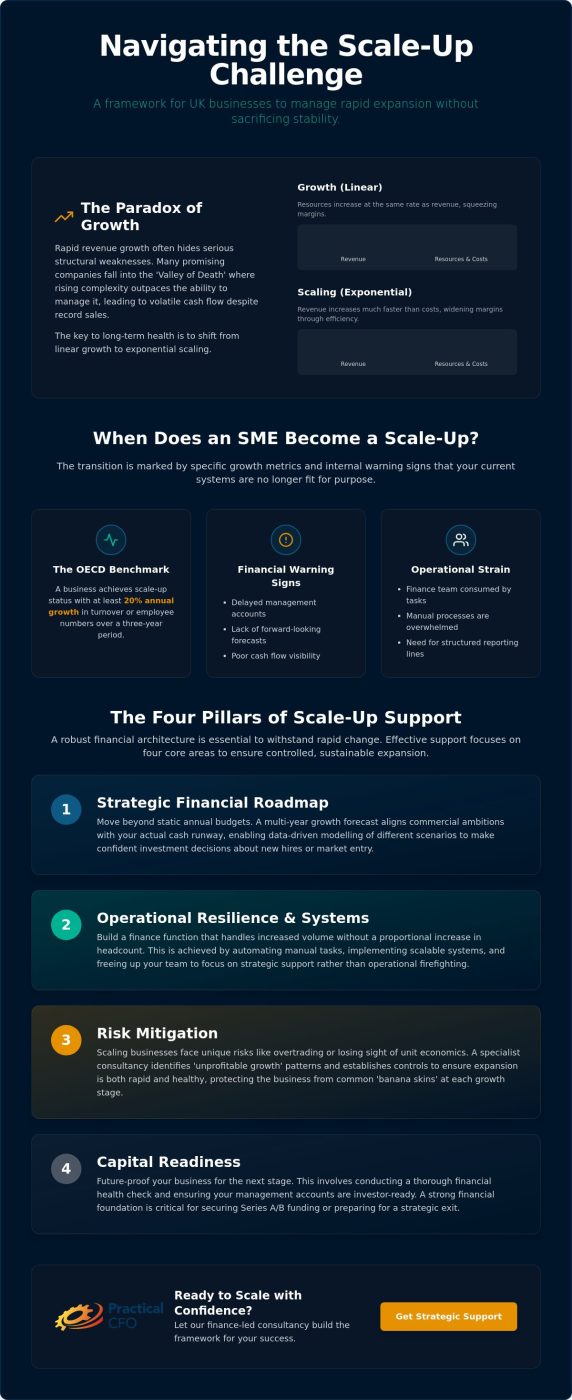
It’s easy to confuse growth with scaling, but the distinction is vital for long-term health. Growth is linear; it occurs when a business adds resources like new staff or equipment at the same rate it gains revenue. Scaling is exponential. It involves increasing revenue whilst maintaining or improving efficiency, allowing margins to widen. A specialist consultancy identifies ‘unprofitable growth’ patterns. These are scenarios where you’re working harder for less return because your overheads are climbing too quickly. We help you shift the focus toward scalable systems that support higher volume without a proportional increase in costs.
When Does an SME Become a Scale-Up?
Defining this transition helps in choosing the right support. According to the OECD, a business enters the scale-up phase when it achieves at least 20% annual growth in either turnover or employee numbers over a three-year period. You can read more about the specific criteria in this overview of what is a scale-up company? beyond the initial startup phase.
Beyond the numbers, you’ll notice a cultural shift. The ‘family feel’ of a small team often gives way to the need for a structured corporate entity with clear reporting lines. Common financial signals that your current setup is no longer fit for purpose include delayed management accounts, a lack of forward-looking forecasts, and a finance team that’s entirely consumed by operational tasks rather than strategic support. Transitioning to a scale-up mindset requires moving away from historical reporting and toward proactive, data-driven decision-making. Engaging professional business growth advisory UK services can provide the structured three-year roadmap and investment-ready data needed to make this transition with confidence.
The Core Pillars of Effective Scale-Up Support
Effective support during high-growth phases requires more than just marketing prowess or aggressive hiring. It demands a robust financial architecture that can withstand rapid change. A professional business scale up consultancy focuses on four core pillars: strategic planning, operational efficiency, risk mitigation, and capital readiness. By addressing these areas, you move beyond the reactive “firefighting” stage and into a phase of controlled, sustainable expansion.
Scaling businesses often encounter unique risks, such as overtrading or losing sight of unit economics as volume increases. Understanding where your organisation sits within The Five Stages of Small Business Growth helps identify the specific ‘banana skins’ likely to appear at your current milestone. Whether you’re moving from ‘Success’ to ‘Take-off’, the financial foundation must be ironclad to support the weight of a larger operation.
Strategic Financial Roadmap
A static annual budget is rarely sufficient for a company in a high-growth phase. You need a multi-year growth forecast that aligns your commercial ambitions with your actual cash runway. This roadmap acts as a live document, allowing you to model different scenarios and understand the financial impact of every new hire or market entry. Using tools like our Strategic Business Planning UK: A Template for Sustainable Expansion provides the foresight required to make confident investment decisions.
Operational Resilience and Systems
Your finance function should handle increased volume without a linear increase in headcount. This is achieved through automating manual tasks and transitioning to scalable, cloud-based ecosystems. We focus on implementing ‘Board Level’ reporting that provides real-time visibility into your KPIs. Management accounts should do more than list historical figures; they must tell a story that informs your next move. If your current reporting feels sluggish, exploring outsourced accountancy solutions can provide the technical lift required to modernise your systems.
Leadership and Board Development
As you scale, the role of the finance leader must evolve. It’s no longer about simple record-keeping; it’s about becoming a strategic partner to the CEO. A business scale up consultancy provides a ‘Critical Friend’ perspective, challenging assumptions and preparing the leadership team for the rigorous scrutiny of external investors or debt providers. This preparation is essential for maintaining credibility during future funding rounds or exit negotiations.
Consultancy vs. Fractional CFO: Choosing the Right Model
Selecting the correct support structure is a pivotal decision for any founder. Whilst the UK market is saturated with advisors, not every engagement model is suited to the forensic rigours of a high-growth phase. A business scale up consultancy typically offers various styles of partnership. Understanding the nuance between a coach, a project consultant, and a fractional CFO is essential for protecting your margins and your long-term stability.
The choice often comes down to the depth of financial integration you require. Scaling is not merely about sales; it is a complex financial puzzle. You need a partner who doesn’t just offer advice from the sidelines but understands the mechanics of your balance sheet. This distinction becomes critical when preparing for the intense scrutiny of a Series A or B funding round, where investors demand more than just optimistic projections.
The Generalist Growth Coach
Growth coaches are typically best suited for early-stage founders who need sales motivation or mindset shifts. They excel at helping you define a vision and pushing for commercial targets. Their primary weakness is a frequent lack of technical financial depth. When your cash flow forecast turns red or your overheads become unmanageable, “rah-rah” coaching fails to provide the forensic analysis required. Scaling is a numbers game; you need data-driven strategy, not just encouragement.
The Specialist Scale-Up Consultant
Specialist consultants are ideal for discrete, high-impact projects such as international market entry or specific operational restructuring. They bring deep, niche expertise to a single problem. The risk with this model is “siloed” advice. A project consultant might successfully optimise your supply chain but fail to account for the wider impact on your working capital. Without a cohesive financial strategy, these individual improvements can lead to unexpected cash strains elsewhere in the business.
The Fractional Finance Director (FD)
The fractional model is the gold standard for scaling UK SMEs. It provides the strategic impact of a heavy-weight CFO at a fraction of the cost of a full-time hire. This role acts as the bridge between the CEO’s vision and the accounting team’s output. Unlike one-off project consultants, a fractional FD provides the continuity required to see a multi-year growth plan through to fruition. This embedded partnership ensures your business remains investor-ready at all times. To understand how this fits into your leadership team, explore The Strategic Role of a Finance Director: A Guide for Growing UK Businesses.
Preparing Your Business for a Consultancy Partnership
Engaging a business scale up consultancy is a significant investment in your company’s future. However, the efficacy of the partnership depends heavily on your internal preparation. To ensure a high return on investment, you must transition from a founder-led “gut feel” approach to a system-led financial operation. This begins with a rigorous internal review before your first strategic session.
You should start by conducting a comprehensive financial health check. This involves more than just looking at your bank balance; it requires a deep dive into your unit economics, customer acquisition costs, and churn rates. Ensuring buy-in from your existing finance team and department heads is equally critical. They need to view the consultant as an embedded strategic partner rather than an external auditor. If you are unsure where to start, you can speak with our team about a strategic review to assess your current readiness.
Data Readiness and Transparency
Clean management accounts are non-negotiable for a successful engagement. We often see the “Garbage In, Garbage Out” principle at play in financial forecasting. If your underlying data is messy, even the most sophisticated strategic model will yield flawed results. Your consultant needs full access to the “ugly” numbers, not just the polished versions found in a pitch deck. Identifying gaps in your current reporting early allows the consultancy to build a roadmap based on reality rather than optimism.
Defining the Scope of the Engagement
Clear KPIs prevent “scope creep” in a fast-moving environment. You should define exactly what success looks like for your scale-up. Is the primary goal reducing your monthly burn rate, or is it securing a specific debt facility for international expansion? It’s also important to distinguish between “doing the work” and “advising on the work.” A clear division of responsibilities ensures that your internal team remains productive whilst the consultant focuses on high-level strategic oversight.
Mindset Shift for Founders
The most challenging part of scaling is often the emotional transition for the founder. You must be prepared to delegate financial control to a strategic partner. This means moving away from impulsive decision-making and toward regular, structured board meetings where progress is reviewed against hard data. Establishing this “North Star” metric keeps the entire organisation aligned, ensuring that every strategic move is backed by intellectual rigour and financial foresight. For a practical framework on making this transition, our guide on how to scale a business provides the essential financial and operational roadmap to move from reactive management to strategic foresight.
The PCFO Approach: Finance-Led Scale-Up Consultancy
Scaling a business is often described as a series of operational hurdles; however, we view it as a complex financial puzzle. Every decision, from hiring a new department head to entering a foreign market, has a ripple effect on your balance sheet. Our business scale up consultancy model is built on the belief that sustainable expansion requires a CFO’s eye for detail paired with a Finance Director’s strategic foresight. We integrate high-level strategy with practical outsourced accountancy solutions to ensure your growth is both profitable and resilient.
Our focus remains on avoiding the “boom and bust” cycle that plagues many high-growth firms. By establishing a robust financial framework early, we help you scale without compromising your underlying stability. This long-term partnership evolves with your business, moving from initial growth advisory to comprehensive exit strategy planning. We don’t just point you in the right direction; we walk the path with you.
Beyond Advice: Execution and Accountability
We don’t believe in providing advice from a distance. Our team helps your internal staff execute the financial systems we design. This regular oversight ensures the strategy stays on track whilst you focus on driving sales and innovation. During high-pressure growth periods, we act as the steady hand at the helm, providing the intellectual rigour needed to navigate complex commercial negotiations and operational shifts. This embedded approach ensures that your financial data is always accurate and actionable.
Maximising ROI on Your Investment
Investing in high-level financial support should be a value-driver, not a drain on resources. Fractional fees are significantly more cost-effective than the overheads associated with a full-time executive hire. We link our support to tangible outcomes, such as improved cash flow visibility and increased company valuation. For a detailed breakdown of how this model fits your budget and the projected returns, consult our guide on Fractional CFO Pricing UK: A Strategic Guide to Investment and ROI in 2026.
Planning for the Ultimate Goal: The Exit
A successful business scale up consultancy engagement should always have an eye on the eventual sale or transition of the company. We begin preparing your “Data Room” for future due diligence from day one, ensuring that your records are immaculate and your systems are transparent. This proactive approach maximises your business value when the time comes for a strategic sale. You can learn more about our specialised Exit Strategy Planning Services: Maximising Business Value for a Strategic Sale to see how we future-proof your legacy.
Future-Proofing Your High-Growth Phase
Scaling a business is a high-stakes transition that requires more than just increased sales. It demands a sophisticated financial infrastructure and the strategic foresight to anticipate challenges before they impact your cash runway. By engaging a specialised business scale up consultancy, you transition from a reactive, founder-led operation to a system-led corporate entity prepared for the forensic scrutiny of external investors. This shift is essential for maintaining stability whilst your operations expand at pace.
Our team of expert Finance Directors brings decades of SME growth experience to your boardroom. We specialise in fractional CFO leadership, providing high-growth firms with the technical lift required to manage complex balance sheets whilst maintaining operational agility. Our comprehensive support spans from initial strategic planning through to the eventual execution of a successful exit strategy. We provide the intellectual rigour and proactive mindset needed to turn rapid growth into a sustainable, long-term success story.
Take the first step toward securing your company’s financial future and book a strategic review with a PCFO partner today. We look forward to providing the steady hand your business needs to reach its full potential.
Frequently Asked Questions
What is the difference between a business coach and a scale-up consultant?
A business coach primarily focuses on leadership behaviour and sales motivation, whereas a business scale up consultancy provides technical financial frameworks and strategic execution. Whilst a coach might ask questions to help you find your own path, a consultant brings a proven roadmap to solve specific structural gaps. They act as an embedded strategic partner rather than a purely external advisor.
How much does a business scale up consultancy typically cost in the UK?
Fees for scale-up support in the UK are typically structured around the specific scope of work and the level of strategic expertise required. Most firms offer either project-based fees for discrete tasks or monthly retainers for ongoing fractional leadership. This flexible model ensures you only pay for the high-level oversight you need without the overheads of a full-time executive hire.
Does my business need to be a certain size before hiring a consultant?
Your business doesn’t need to reach a specific turnover milestone, but you should have a proven model ready for expansion. Most organisations engage a consultancy when they hit the ‘scale-up’ definition of 20% annual growth in turnover or headcount. It’s more about your readiness for increased complexity rather than just a specific revenue figure.
Can a scale-up consultant help me secure venture capital or private equity?
Yes, a consultant is instrumental in preparing your organisation for the rigours of external investment. They assist by building robust financial models, organising your data room for due diligence, and ensuring your unit economics are investor-ready. This strategic oversight significantly increases your credibility during Series A or B funding rounds. A structured business growth advisory UK engagement ensures your financial controls and forecasting models meet the exacting standards demanded by lenders and venture capital firms.
How long does a typical consultancy engagement last?
Engagement lengths vary depending on whether you require a specific project delivery or ongoing leadership. A discrete project, such as a financial health check or system implementation, might last three to six months. Many firms prefer a long-term fractional partnership that scales alongside the business lifecycle from growth to exit.
Will a consultant replace my existing accountant or bookkeeper?
A consultant does not replace your existing bookkeeper or accountant; they provide the high-level strategic layer that sits above them. They bridge the gap between transactional record-keeping and CEO-level decision-making. This partnership ensures your finance team is aligned with your commercial goals whilst maintaining operational efficiency.
What are the most common financial mistakes businesses make whilst scaling?
The most common error is ‘overtrading’, where a business grows its sales faster than its cash reserves can support. Other frequent mistakes include losing sight of unit economics as volume increases and failing to automate the finance function. These errors often lead to a ‘boom and bust’ cycle that threatens the long-term stability of the organisation.
What specific sectors do scale-up consultancies usually focus on?
Professional consultancies are often sector-agnostic because the financial mechanics of scaling remain consistent across industries. However, they are most frequently engaged by high-growth firms in technology, professional services, and manufacturing. Any business experiencing rapid expansion and increasing operational complexity can benefit from this specialised strategic oversight.