

Recent data suggests that 71% of UK business leaders believe the role of cfo in business growth uk is now central to corporate success, yet many SMEs still treat the position as a luxury reserved for larger corporations. You’ve likely experienced the frustration of watching turnover climb whilst net profit remains stubbornly flat, or found it difficult to articulate your financial health to lenders and stakeholders. It’s a common challenge that leaves many founders feeling as though they’re losing control of the very engine they’ve built.
This article shows you how a strategic CFO transforms raw financial data into a clear roadmap for sustainable scaling and long-term value creation. We’ll explore the specific value proposition of high-level financial leadership, provide a framework for deciding between fractional and full-time support, and share actionable strategies for scaling your business with confidence. By the end, you’ll understand how to move beyond historical reporting and start navigating your company’s future with precision and intellectual rigour.
Key Takeaways
- Identify the “growth ceiling” where rapid revenue expansion often masks underlying cash flow risks whilst operational constraints begin to compound.
- Distinguish between compliance-focused accounting and the role of cfo in business growth uk as a strategic co-pilot for the CEO.
- Master the four critical financial levers—cash flow, funding, efficiency, and exit readiness—required to navigate sustainable scaling.
- Explore how a fractional leadership model provides access to board-level expertise and intellectual rigour without the overhead of a full-time hire.
- Learn how to transform raw financial data into a proactive, multi-year roadmap that communicates confidence to stakeholders and lenders.
The UK SME Growth Ceiling: Why Revenue Alone is a Risky Metric
Revenue is a seductive metric. It’s easy to track and satisfying to report. However, for many UK SMEs, a growing top line can actually be a harbinger of structural failure. This phenomenon is known as the “Growth Ceiling.” It’s the point where manual processes, basic bookkeeping, and a lack of strategic oversight cause the business to buckle under its own weight. You can’t manage a £10 million business with the tools you used at £1 million.
At this stage, the role of cfo in business growth uk becomes indispensable. Whilst a standard accountant focuses on business survival through compliance and tax filing, a Chief Financial Officer (CFO) focuses on business value creation. They design the financial architecture. This is the collection of systems, controls, and forecasting models that allow a company to scale without losing its grip on profitability. Without this foundation, scaling is often just an exercise in increasing risk.
The Over-Trading Trap in Growing UK Businesses
Many founders fall into the trap of chasing growth at all costs. They pursue every contract and new market without considering the strain on their liquid assets. This often leads to over-trading; a situation where a company expands its sales faster than its working capital can support. It’s a paradox where your business looks successful on paper but is physically running out of cash.
The early warning signs are often subtle. You might see revenue increasing whilst your bank balance remains static or even declines. You might find yourself constantly renegotiating terms with suppliers just to meet payroll. A strategic CFO identifies these pressures before they become a crisis. They act as a steady hand, ensuring that aggressive sales targets are balanced with rigorous capital preservation strategies. They provide the calm confidence needed to say “no” to the wrong kind of growth.
Moving Beyond Historical Reporting
If your boardroom discussions are centred on last month’s P&L, you’re driving whilst looking only in the rear-view mirror. Historical reporting tells you where you’ve been, but it offers very little guidance on where you’re going. It’s reactive rather than proactive. To scale effectively, you need to know what the road ahead looks like.
A CFO shifts the conversation from “What happened?” to “What will happen if we scale?”. This transition involves several key elements:
- Developing predictive modelling to stress-test various growth scenarios.
- Implementing real-time dashboards that track leading indicators rather than lagging ones.
- Providing the intellectual rigour needed to make informed, data-driven decisions.
This shift is vital for any ambitious SME. It moves finance from a back-office function to a primary strategic co-pilot. By introducing this level of foresight, the role of cfo in business growth uk ensures that expansion is not just fast, but sustainable for the long term.
From Financial Controller to Strategic Partner: The Evolving Role
The traditional image of a CFO as a backward-looking bookkeeper is obsolete. In the current UK landscape, the role of cfo in business growth uk has evolved into that of a primary strategic co-pilot. They work alongside the CEO to ensure that every commercial ambition is underpinned by financial feasibility. This partnership is essential because business growth is no longer just about selling more; it’s about building a resilient organisation that can withstand economic volatility. A modern CFO doesn’t just record the history of the company; they help write its future.
Modern CFOs integrate finance with every other functional area. They work with operations to optimise supply chains, with technology teams to ensure ROI on digital transformation, and with HR to align recruitment with long-term capital plans. This cross-functional perspective allows the CFO to act as a bridge, ensuring that the company’s financial health is a shared responsibility rather than a siloed department. They provide the calm confidence needed to navigate the complex regulatory and economic shifts that define the UK market.
The CFO as the Architect of Business Value
Profit maximisation is often a short-term goal, but value creation is about building an asset that is attractive to investors or future buyers. A CFO identifies the specific value drivers, such as recurring revenue models, intellectual property, or operational scalability, that increase a company’s valuation. By using data-driven decision-making, they guide the CEO on which products to scale and which to divest. For a 2026 UK SME, value creation is the process of building a sustainable, scalable, and risk-adjusted business model that delivers long-term equity growth for all stakeholders.
For businesses looking to integrate strategic marketing alongside their financial planning, check out Carter Strategies for insights into fractional leadership for mid-size growth.
Bridging the Gap Between Strategy and Execution
A CEO’s vision can often be abstract. The CFO’s job is to translate that vision into a multi-year financial roadmap. This isn’t just a spreadsheet; it’s a strategic document that outlines how the business will fund its expansion, manage its cash reserves, and hit specific milestones. They ensure every department has the budget and KPIs needed to support the overarching plan. This methodical approach ensures that strategy doesn’t just remain a boardroom concept but becomes an operational reality.
Managing stakeholder expectations is equally vital. Whether it’s communicating with shareholders or presenting to a board, the CFO provides the intellectual rigour that builds trust. They navigate regulatory shifts and economic changes with a proactive mindset, ensuring the business stays ahead of the curve. Engaging a business growth advisory service can help founders bridge this gap without the immediate need for a full-time executive hire, providing the expertise required to scale with precision.
CFO vs Accountant: Choosing the Right Growth Partner
Many business owners use the terms “accountant” and “CFO” interchangeably, but their functions are fundamentally different. A bookkeeper manages the daily data entry; an accountant ensures your statutory filings are accurate and your tax obligations are met. A CFO, however, takes this raw data and interprets it to drive commercial strategy. The role of cfo in business growth uk is to look beyond the balance sheet to identify opportunities for expansion and risk mitigation.
Relying solely on a compliance-focused accountant can inadvertently stall your progress. Whilst they keep your business legal, they rarely have the remit to ensure your business is scalable. A strategic CFO provides a significant ROI by identifying operational efficiencies and securing better terms for capital. They don’t just cost the business money; they often pay for themselves by uncovering hidden value and preventing expensive strategic missteps. For an SME, this shift from reactive reporting to proactive leadership is the catalyst for moving beyond a plateau.
When to Move Beyond Your Traditional Accountant
There are specific triggers that indicate your financial needs have outpaced a standard accounting service. If you’re seeking Series A or B funding, preparing for a business exit, or navigating a complex international expansion, a compliance-led approach is no longer sufficient. You need someone who can “organise the future” rather than just “keep the books.” To understand which path is right for your current stage, you can read our guide on Fractional CFO vs Accountant: Which Does Your Business Need?
The Fractional Advantage for UK SMEs
Accessing board-level expertise doesn’t require a six-figure executive salary. Fractional CFO services allow UK SMEs to benefit from high-level financial leadership for a few days a month, providing the intellectual rigour of a full-time hire at a fraction of the cost. This model is particularly effective because it brings “cross-pollination” to your boardroom. A fractional CFO often works across multiple industries, bringing proven strategies from other sectors to solve your specific challenges.
This cross-sector expertise is invaluable; for example, professionals in the counselling and therapeutic fields often seek specialised business mentorship from Martin Hogg (Private Practice Success) to apply high-level growth principles to their clinical work.
Flexibility is a core benefit of this partnership. As your business evolves, you can scale your CFO support up or down to match your requirements. Whether you’re navigating a temporary funding round or need long-term strategic oversight, the fractional model ensures you have the right level of support at the right time. It bridges the “missing link” for businesses in the £2m to £20m turnover bracket, providing the steady hand needed to navigate the complexities of the UK market.
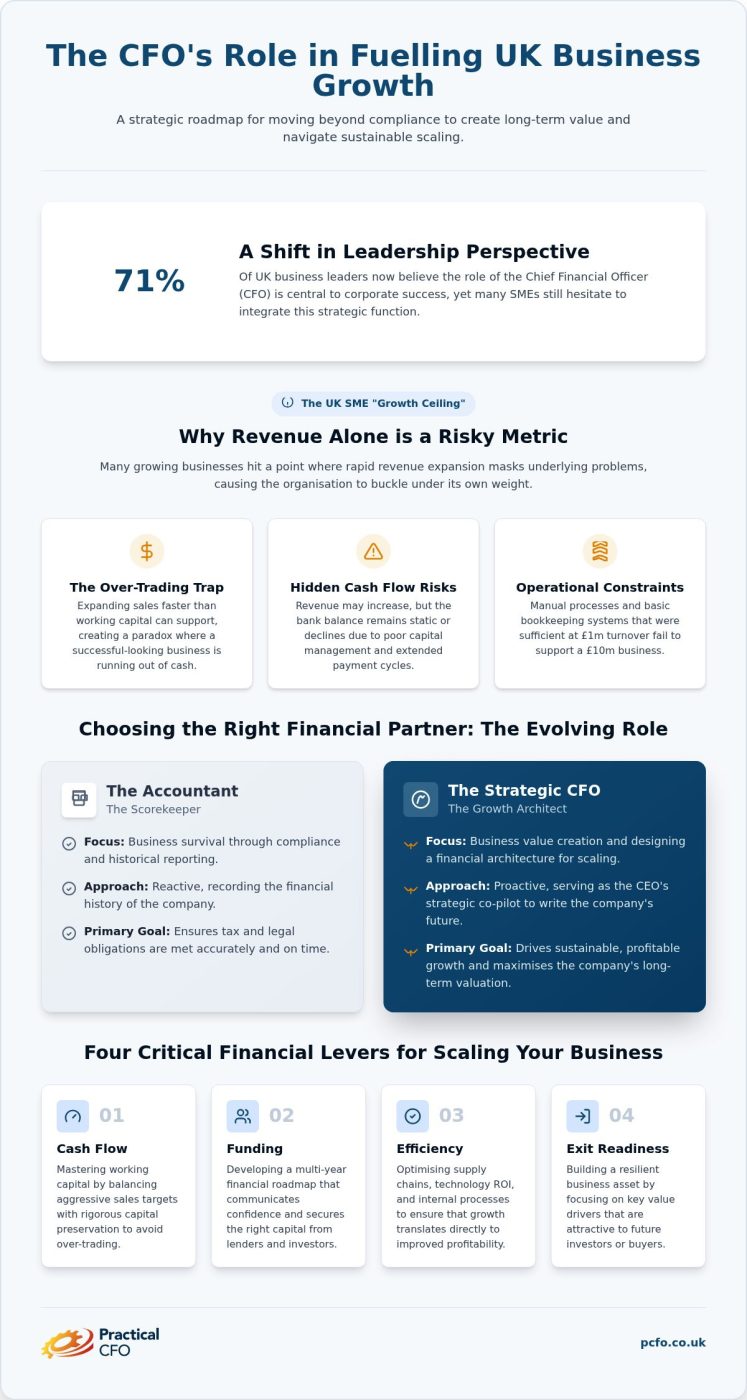
Four Critical Financial Levers for Scaling Your Business
Scaling an SME requires more than just sales momentum; it requires the precise manipulation of specific financial levers. The role of cfo in business growth uk involves pulling these levers in unison to create a defensible business model that remains resilient against market shocks. By focusing on cash flow, funding, operational efficiency, and exit readiness, a CFO ensures that your expansion is built on a foundation of stability rather than speculation. Partnering with a dedicated business growth advisory uk specialist ensures these levers are calibrated to your specific business lifecycle.
Lever 1: Cash Flow and Working Capital Mastery
The most common cause of failure for growing businesses isn’t a lack of profit, but a lack of cash. A CFO manages this risk by optimising your Cash Conversion Cycle, which is the time it takes for an investment in inventory or labour to turn back into liquid cash. This process involves a rigorous analysis of payment terms, inventory turnover, and credit control efficiency.
A rolling 13-week cash flow forecast is the most vital document in your business during a growth phase. It provides a granular view of your liquidity, allowing you to anticipate shortfalls and make informed decisions about capital expenditure. Paper profit is merely an accounting opinion, whereas bankable cash is the objective reality that determines your ability to survive and scale.
Lever 2: Strategic Funding and Capital Structure
Navigating the UK lending landscape requires sophisticated preparation, especially with the Bank of England base rate currently at 3.75%. A CFO determines the optimal mix of debt and equity to fuel your expansion whilst minimising the cost of capital. They prepare “lender-ready” financial packs that go far beyond basic P&L statements, providing the intellectual rigour that banks, venture debt providers, and private equity firms require.
By presenting clear debt-service coverage ratios and detailed use-of-funds statements, a CFO builds the confidence necessary to secure competitive terms. This proactive approach ensures you have the capital runway needed to execute your strategy without being forced into expensive, last-minute financing arrangements.
Lever 3: Exit Strategy and Value Maximisation
Preparation for a sale or transition shouldn’t begin when you’re ready to leave; it should be an integral part of your growth strategy. Engaging exit strategy planning services at least three years before a planned departure allows you to “clean up” the balance sheet and address any operational weaknesses that might reduce your valuation.
The CFO ensures that your financial records are due-diligence ready, which significantly reduces the risk of a deal falling through. They focus on increasing the “multiple” achieved at exit by demonstrating consistent margin improvement and a clear path to future growth. To see how these levers apply to your specific turnover and industry, explore our Chief Financial Officer Services for tailored support.
Implementing Fractional CFO Leadership with PCFO
Implementing a high-level financial strategy shouldn’t be a disruptive event. PCFO integrates into your organisation as a composed, authoritative partner, focusing on the specific growth levers that matter most to your business lifecycle. We understand that no two UK SMEs have the same requirements. Our approach is therefore highly tailored, ensuring that we address your unique organisational gaps whilst providing the steady hand needed to navigate complex financial waters. Having a seasoned expert embedded in your leadership team provides the intellectual rigour required for long-term success.
We work collaboratively alongside your existing finance team to provide strategic oversight. We don’t aim to replace your current staff; instead, we provide the “strategic brain” that empowers them to excel in their daily operations. This partnership ensures that the role of cfo in business growth uk is fully realised within your company, transforming your finance department from a back-office function into a proactive engine for value creation. The long-term impact is a more resilient, scalable, and defensible business model.
The PCFO Onboarding Process
Our engagement begins with a methodical onboarding process designed to build a foundation of trust and transparency. We start with a comprehensive financial health check and a strategic gap analysis to identify exactly where your current systems might be hindering expansion. From there, we establish a 12-month financial roadmap that aligns with your CEO’s vision and sets clear, measurable milestones.
We prioritse “quick wins” to deliver immediate value, such as optimising working capital or identifying cost-saving efficiencies. Following this, we implement a consistent rhythm of board-level reporting and strategic reviews. This methodical flow ensures that every stakeholder has a clear understanding of the company’s financial trajectory and is empowered to make informed, confident decisions about the future.
Take the Next Step in Your Growth Journey
Assess whether your current finance function is an accelerator or a bottleneck. If you find yourself feeling out of control as revenue increases, or if you struggle to communicate financial health to stakeholders, it’s time to introduce professional oversight. The peace of mind that comes from expert financial leadership is invaluable. It allows you to focus on your core strengths whilst knowing that your financial architecture is being managed with precision and foresight.
The role of cfo in business growth uk is about more than just numbers; it’s about providing the calm confidence needed to scale with certainty. If you’re ready to move beyond basic accounting and start building long-term equity value, book a consultation with a PCFO strategic advisor today to discuss how we can support your specific growth objectives.
Future-Proofing Your Financial Architecture
The transition from a reactive finance function to a proactive strategic partnership is the most significant step a founder can take to break through the growth ceiling. By mastering the four critical financial levers, you ensure that expansion is a controlled, value-driven process rather than a high-risk gamble. Understanding the role of cfo in business growth uk allows you to move beyond historical reporting and start navigating with intellectual rigour.
PCFO offers the board-level insight and bespoke strategic roadmaps needed to maximise your company’s valuation, all through a fractional model that respects your capital constraints. Our expertise in exit planning and value maximisation ensures your business is always due-diligence ready, providing the calm confidence needed to engage with lenders and investors. You don’t have to navigate this trajectory alone; we are here to serve as your authoritative strategic partner.
Secure your business growth with expert Fractional CFO services from PCFO. Your vision deserves a financial foundation that is as ambitious as your goals.
Frequently Asked Questions
What is the difference between a Finance Director and a CFO in the UK?
In the UK, a Finance Director typically focuses on internal reporting, compliance, and the management of the finance team. A CFO takes a broader strategic view, acting as a co-pilot to the CEO and focusing on external factors like capital structure and investor relations. The role of cfo in business growth uk is often more focused on long-term value creation and future-proofing than daily accounting oversight.
How much does a fractional CFO cost for a UK SME?
A fractional CFO provides board-level expertise at a fraction of the cost of a full-time executive hire. Instead of a permanent six-figure salary and associated overheads, you pay for the specific days of support your business requires. This flexible model allows SMEs to access high-level strategic guidance without the financial burden of a permanent C-suite appointment.
At what turnover level does a business need a part-time CFO?
Businesses typically require strategic financial leadership when they reach the £2 million to £20 million turnover mark. At this stage, the complexity of the business often outpaces the capabilities of a standard accountant. It’s the point where “growth at all costs” must be replaced by a structured financial architecture to ensure sustainable scaling.
Can a CFO help my business secure a bank loan or private equity?
Yes, a CFO is instrumental in securing bank loans or private equity by preparing “investor-ready” financial packs. They provide the intellectual rigour and data-driven evidence that lenders require, such as detailed debt-service coverage ratios. By managing these technical conversations, they build the confidence necessary to secure competitive terms in the current UK lending landscape.
How does a CFO improve business profitability?
A CFO improves profitability by identifying high-margin revenue streams and eliminating operational inefficiencies. They shift the focus from simple revenue growth to net profit health through rigorous margin analysis and cost-control strategies. This ensures that every pound of turnover contributes effectively to the bottom line whilst maintaining the cash reserves needed for future expansion.
What is the role of a CFO in a business exit or sale?
In a business sale, the CFO prepares the company for due diligence and works to maximise the valuation multiple. They “clean up” the balance sheet and ensure all financial records are robust and transparent, which reduces deal risk. Their involvement often leads to a more efficient sale process and a significantly higher final achievable price.
Does a fractional CFO work on-site or remotely?
Most fractional CFOs offer a hybrid model that blends on-site presence with remote strategic support. They typically attend board meetings and key leadership sessions in person to foster a sense of partnership. Remote work is then utilised for deep-dive financial modelling and data analysis, providing a flexible solution that adapts to your business’s specific rhythm.
How long does it take to see the impact of hiring a strategic CFO?
You can expect to see “quick wins,” such as improved cash flow visibility or cost savings, within the first few weeks of engagement. Significant strategic impact, such as a refined multi-year roadmap or a successful funding round, typically materialises within three to six months. The role of cfo in business growth uk is designed for long-term value, but the initial stabilising effects are often felt almost immediately.