

The persistent fog many founders feel regarding their real-time cash position isn’t a failure of leadership; it’s often a symptom of using the wrong tools for the job. You likely started your business to build something of lasting value, yet you may still find yourself making critical investment decisions based on a gut feeling rather than verified data. It’s a common source of anxiety, particularly whilst managing the 2026 FRS 102 amendments and a 3.75% base rate that demands absolute capital efficiency.
Robust management accounts for SMEs act as the essential bridge between mere survival and strategic scaling. This guide demonstrates how to transform your monthly financial data into a sophisticated navigation system that drives growth and prepares your firm for a high-value exit. We will examine how to gain real-time visibility of your profitability, clear the path for future investment, and ensure your reporting meets the latest revenue recognition standards. By shifting from historical reporting to proactive foresight, you can finally invest in your business with the confidence of a seasoned chief executive.
Key Takeaways
- Learn how to transition from gut-feel decision-making to a data-driven strategy that clears the financial fog and supports sustainable scaling.
- Discover why high-impact management accounts for SMEs must go beyond the Profit & Loss statement to include the Balance Sheet as a vital health check.
- Understand the critical distinction between historical statutory compliance and the forward-looking “live pulse” provided by regular management reporting.
- Identify how to implement a scalable framework by defining your unique Critical Success Factors and organising your data for strategic clarity.
- Realise the value of a Fractional Finance Director in transforming raw financial data into a strategic navigation system that maximises your business exit value.
Beyond the Financial Fog: Why Management Accounts for SMEs are Non-Negotiable
Managing an SME without regular financial reporting is like navigating the English Channel in thick mist without radar. You might have a general sense of direction, but you lack the precision to avoid the hazards beneath the surface. For many founders, the “financial fog” is a constant source of quiet anxiety. It’s the feeling of knowing there’s money in the bank today, but not being certain if that cash is truly yours or simply earmarked for a future VAT bill or Corporation Tax payment. Relying on gut feel might work for a solo venture, but as you scale, intuition becomes a liability rather than an asset.
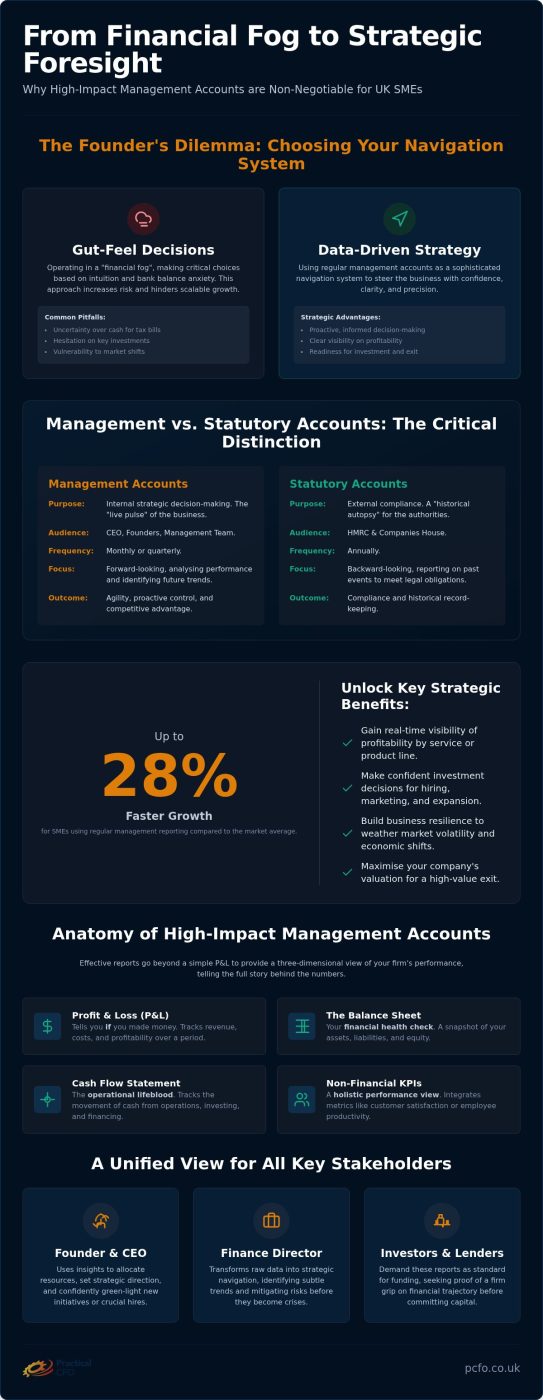
Management accounts for SMEs are regular, forward-looking reports designed specifically for internal leadership. Unlike statutory accounts, which serve as a historical autopsy for HMRC and Companies House, management accounts provide a live pulse of your organisation. By adhering to core management accounting principles, businesses can shift from reactive survival to proactive steering. These reports don’t just record what happened; they explain why it happened and what is likely to happen next. Waiting for year-end accounts is a high-risk strategy in the 2026 UK market. With the Bank of England base rate at 3.75% and new FRS 102 lease accounting rules affecting balance sheets, you need to know your exact position every month, not every year.
The 28% Growth Factor: Data-Driven Success
Industry data consistently shows that SMEs utilising regular management reporting grow significantly faster than the market average. This isn’t a coincidence; it’s a result of agility. When you have visibility, you can pivot faster. If a specific service line shows a declining margin in June, you can adjust your pricing or renegotiate supplier contracts in July. You don’t wait twelve months to discover a leak in your profitability. This monthly monitoring builds business resilience, ensuring you have the runway to weather volatility whilst your competitors are still squinting at bank statements. Clarity provides the psychological reassurance needed to make bold moves with confidence.
Who Actually Uses Management Accounts?
The CEO or Founder is the primary user, utilising these insights to allocate resources and set strategic direction. They provide the “green light” for new hires or the “red light” for capital expenditure that the business can’t yet afford. A Fractional Finance Director uses these reports to identify subtle trends and hidden risks before they become crises. Finally, external stakeholders have become increasingly rigorous. High-street banks and private investors now demand management accounts for SMEs as a standard requirement for funding. They want to see that you possess a firm grip on your financial trajectory before they commit their capital to your growth.
The Anatomy of High-Impact Management Accounts: What Every Founder Must See
High-impact reporting transcends the basic summary of income and expenses. Whilst a standard Profit & Loss (P&L) statement tells you if you made money last month, it rarely explains why. Effective management accounts for SMEs peel back the layers to reveal the “story” behind the numbers, identifying which specific behaviours or market shifts drove your results. This clarity is particularly vital for firms scaling between £1m and £5m in turnover, where operational complexity often outpaces traditional accounting methods.
The Balance Sheet is the “health check” that many founders overlook until a liquidity crisis occurs. In 2026, with the FRS 102 amendments bringing most leases onto the balance sheet, your debt-to-equity ratio and working capital position have likely shifted. Ignoring these metrics can jeopardise your ability to manage your business finances effectively when negotiating with lenders or preparing for a high-value exit. A robust report should also integrate non-financial KPIs, such as customer satisfaction scores or employee productivity, to provide a holistic view of organisational health.
Essential Financial Statements and Their Strategic Value
Strategic reporting requires a three-dimensional view of your firm’s performance. It’s not enough to look at total revenue; you must understand the mechanics of your profitability. By dissecting these statements, you can make informed decisions about where to invest your capital next.
- P&L Analysis: Go beyond the bottom line to analyse gross margins by product line or department. This reveals which areas of your business are truly profitable and which are merely consuming resources without adequate return.
- Balance Sheet Monitoring: Keep a close eye on working capital and debt-to-equity ratios. This is essential for maintaining the “live pulse” of your business’s financial stability.
- Cash Flow Forecasting: Move away from historical reporting and implement rolling 12-month forecasts. This allows you to manage your “runway” during expansion, ensuring you don’t run out of cash whilst chasing growth.
Advanced SME Metrics: CAC, LTV, and Contribution Margins
To scale safely, you must understand the unit economics of your business. Monitoring Customer Acquisition Cost (CAC) against Lifetime Value (LTV) ensures you’re buying profit, not just volume. If your CAC exceeds your LTV, your growth is unsustainable. Similarly, a break-even analysis provides the precise data needed to know exactly when a new hire or a new office location begins to contribute to the bottom line.
Contribution Margin is the profit remaining after variable costs are deducted from sales. Integrating these advanced metrics into your reporting framework transforms your management accounts for SMEs from a compliance burden into a strategic asset. If your current reporting lacks this level of depth, transitioning to professional outsourced accountancy solutions can provide the board-level insights required to future-proof your firm and maximise its eventual exit value.
Management Accounts vs Statutory Accounts: Moving from Compliance to Competitiveness
The common misconception that annual accounts provide an accurate measure of current profitability often leads to strategic stagnation. Statutory accounts are essentially a historical autopsy. They record what happened up to nine months after your financial year has ended. By the time you review them, market conditions have shifted, competitors have moved, and the data is often too stale to influence today’s decisions. In contrast, management accounts for SMEs provide a live pulse of the organisation, typically delivered within ten working days of the month-end.
The audience for these reports differs fundamentally. Statutory filings are prepared for HMRC and Companies House to ensure tax compliance and public transparency. Management reports are crafted specifically for the Board of Directors and Shareholders. They focus on the future rather than the past. Relying solely on your annual filing to steer your business is like trying to drive a car whilst looking only in the rear-view mirror. It tells you where you have been, but it offers no guidance on the hazards or opportunities currently appearing on the horizon.
The Danger of Lagging Indicators
Tax-focused accounting often obscures true operational performance. For instance, aggressive year-end adjustments, capital allowances, or R&D tax credits can significantly distort your view of monthly trends. A business might show a healthy paper profit in its statutory accounts whilst suffering from a genuine operational cash shortfall. These lagging indicators don’t reflect the daily reality of your runway or your ability to fund a sudden expansion. Professional outsourced accountancy solutions bridge this gap by aligning your internal reporting with your actual operational rhythm, ensuring that your data reflects current commercial reality rather than just tax positioning.
Flexibility and Customisation
Whilst statutory accounts must adhere to the rigid formats of FRS 102 or FRS 105, management accounts follow your specific business logic. This flexibility allows you to segment data by region, salesperson, or project to find “hidden” losses that are otherwise buried in a consolidated P&L. You can tailor the reports to track the metrics that actually drive your success. This level of granular detail is indispensable for exit strategy planning. When the time comes to sell, being able to present 24 to 36 months of consistent, detailed management accounts for SMEs provides potential buyers with the confidence they need to offer a premium valuation.
Implementing a Management Accounting Framework for Scalable Growth
Transitioning from basic bookkeeping to strategic management accounts for SMEs requires a structured approach. It isn’t merely about installing software; it’s about building a repeatable process that produces reliable data for decision-making. A robust framework ensures that your financial reporting evolves alongside your business, providing the stability needed to scale without losing sight of your cash position.
The implementation process follows five critical stages:
- Define Critical Success Factors: Identify the three to five metrics that truly move the needle for your specific SME. These might include billable utilisation, lead conversion rates, or average order value.
- Organise your Chart of Accounts: Cleanse your data and restructure your ledger to reflect how you actually run the business. This allows for the granular segmentation mentioned in earlier sections.
- Select your Tech Stack: Utilise cloud platforms like Xero or QuickBooks, which in 2026 offer advanced features for backorder recording and automated trial balance reports.
- Establish a Month-End Discipline: Commit to a “hard close” of your books within days of the month-end. Accuracy is non-negotiable if the data is to be trusted.
- Strategic Review: Interpret the findings with a professional partner, such as a Fractional Finance Director, to turn raw numbers into actionable growth plans.
The Role of Technology in 2026
Automation has shifted the focus from data entry to high-level analysis. By automating routine ledger tasks, your leadership team can spend more time discussing strategic implications rather than questioning the validity of the numbers. Whilst real-time dashboards offer immediate visibility, they should complement, not replace, a formal monthly board pack that provides context and commentary. When choosing your path, consider the trade-offs between an FP&A consultant vs software to ensure you have the right level of human insight to guide your technology choices.
Preparing for a High-Value Exit
A clean “data room” of historical management accounts is a powerful asset during a business sale. Consistent monthly reporting proves the “Quality of Earnings” to potential buyers, demonstrating that your profits are sustainable and not the result of year-end accounting manoeuvres. This level of transparency significantly increases buyer confidence and allows you to justify a higher valuation multiple during negotiations. If you are prioritising long-term value, our Finance Director Services can help you build the financial foundations required for a successful and lucrative exit.
Elevating Data into Strategy: The Fractional Finance Director Advantage
Raw data possesses no inherent value if it remains trapped in an unread monthly PDF. Whilst many bookkeepers can produce management accounts for SMEs, the true commercial advantage lies in the expert interpretation of those figures. A traditional compliance accountant focuses primarily on the accuracy of historical filings. In contrast, a Strategic Accountant looks through the windscreen, using those same numbers to navigate future risks and capitalise on emerging opportunities before they pass.
A Fractional Finance Director acts as a critical friend to the CEO. They use the management pack to challenge assumptions and drive performance across the entire organisation. This partnership provides the high-level financial leadership of a full-time CFO without the associated £100,000 plus annual salary and executive overheads. For a scaling SME, this cost-benefit ratio is compelling. You gain board-level expertise on a flexible basis, ensuring your financial strategy is as sophisticated as your growth ambitions.
Turning Insight into Action
The transition from insight to action is where real value is created for the shareholders. An experienced FD will often identify “unprofitable revenue”, which refers to customers or projects that appear healthy on the top line but actually drain your operational resources. Having the data-backed courage to cut these areas allows you to refocus on high-margin work. Similarly, by optimising working capital, an FD can often find the cash needed to fund growth internally, reducing your reliance on external borrowing at the current 3.75% base rate. A strategic FD identifies margin creep by spotting incremental increases in supplier costs or operational inefficiencies before they quietly erode your annual profits.
Strategic Partnership with PCFO
PCFO provides the steady hand and intellectual rigor required to navigate the complexities of a scaling business. We don’t just deliver reports; we embed ourselves as your authoritative strategic partner. Our team customises management accounts for SMEs to speak the specific language of your industry, ensuring every KPI is relevant to your commercial reality. The next step in your journey is moving away from seeing accounting as an unavoidable cost. By partnering with us, you transform your finance function into a proactive profit driver that secures your firm’s future and maximises its eventual exit value.
Securing Your Firm’s Financial Future
The shift from historical compliance to forward-looking strategy is the defining characteristic of a resilient organisation. By implementing robust management accounts for SMEs, you move beyond the limitations of statutory reporting and gain the visibility required to scale with precision in the 2026 market. This process involves more than just cloud software; it requires the intellectual rigor to identify margin creep and optimise working capital whilst preparing for a high-value exit.
As your authoritative strategic partner, PCFO provides the steady hand needed to navigate these financial complexities. Our expert fractional CFOs possess multi-sector experience and specialise in bespoke outsourced finance functions tailored to your specific scale. We focus on turning your raw data into a strategic navigation system that maximises business value and ensures every investment decision is backed by intellectual rigor rather than gut feel.
Book a consultation with a PCFO Strategic Finance Director to transform your management reporting and gain the confidence to invest in your next phase of growth. Your business deserves the clarity that only board-level financial leadership can provide. We look forward to helping you navigate your path to success.
Frequently Asked Questions
What are the main components of a management accounts pack?
A standard pack includes the Profit and Loss statement, Balance Sheet, and a rolling Cash Flow forecast. High-impact reporting also incorporates Key Performance Indicators tailored to your specific industry, such as staff utilisation or customer acquisition costs. These components work together to provide a 360-degree view of your firm’s health, moving beyond simple revenue tracking into detailed margin analysis and working capital monitoring.
How often should a UK SME produce management accounts?
Most UK SMEs should produce management accounts on a monthly basis. This frequency allows the leadership team to identify trends and address operational issues before they escalate into crises. Whilst some smaller firms opt for quarterly reporting, this often creates a significant data lag. Monthly reporting ensures your financial data remains a live pulse rather than a historical record, allowing for much faster pivoting.
Do I need a full-time Finance Director to prepare these?
You don’t require a full-time Finance Director to prepare or interpret these reports. Many scaling businesses utilise fractional FD services to gain board-level expertise without the substantial executive salary and overheads. This model provides the intellectual rigor needed to challenge the CEO and drive performance, whilst keeping costs manageable for a growing firm that isn’t yet ready for a permanent hire.
What is the typical cost of management accounting services for SMEs?
The investment for these services depends on the complexity of your business and the depth of analysis required. Rather than a fixed industry price, costs are typically scaled to the volume of transactions and the level of strategic advisory involved. Many firms find that the return on investment through identified efficiencies and improved margins far outweighs the fee for professional management accounts for SMEs.
Can management accounts help my business secure a bank loan or investment?
Robust reporting is essential for securing external funding in the current economic climate. Lenders and investors look for evidence of financial discipline and a clear understanding of your cash runway. Providing a consistent history of monthly reporting demonstrates that the leadership team has a firm grip on the business. This significantly reduces the perceived risk for the bank or investor during the due diligence process.
How do management accounts differ from a simple cash flow forecast?
A simple cash flow forecast only tracks the movement of money in and out of your bank account. Management accounts provide a much broader perspective by including the P&L and Balance Sheet. This allows you to understand profitability and asset value, which cash flow alone cannot show. You might have cash in the bank whilst being fundamentally unprofitable; management accounts reveal that hidden reality.
Is cloud software like Xero enough to produce management accounts?
Cloud software like Xero is an excellent tool for data collection, but it is rarely enough on its own. Software provides the raw data, but it lacks the strategic context needed for high-level decision-making. You need a professional to cleanse the data, ensure proper accruals are made, and interpret the story behind the numbers. Human insight is what turns a report into an actionable growth strategy.
What is the “Month-End Close” and why does it matter for accuracy?
The Month-End Close is a disciplined process of finalising all financial transactions for the preceding month. It involves reconciling bank accounts, verifying invoices, and making necessary adjustments for depreciation or prepayments. This matters because it ensures your data is accurate and complete. Without a formal close, your reports may contain errors or omissions that lead to flawed strategic decisions and financial anxiety.