

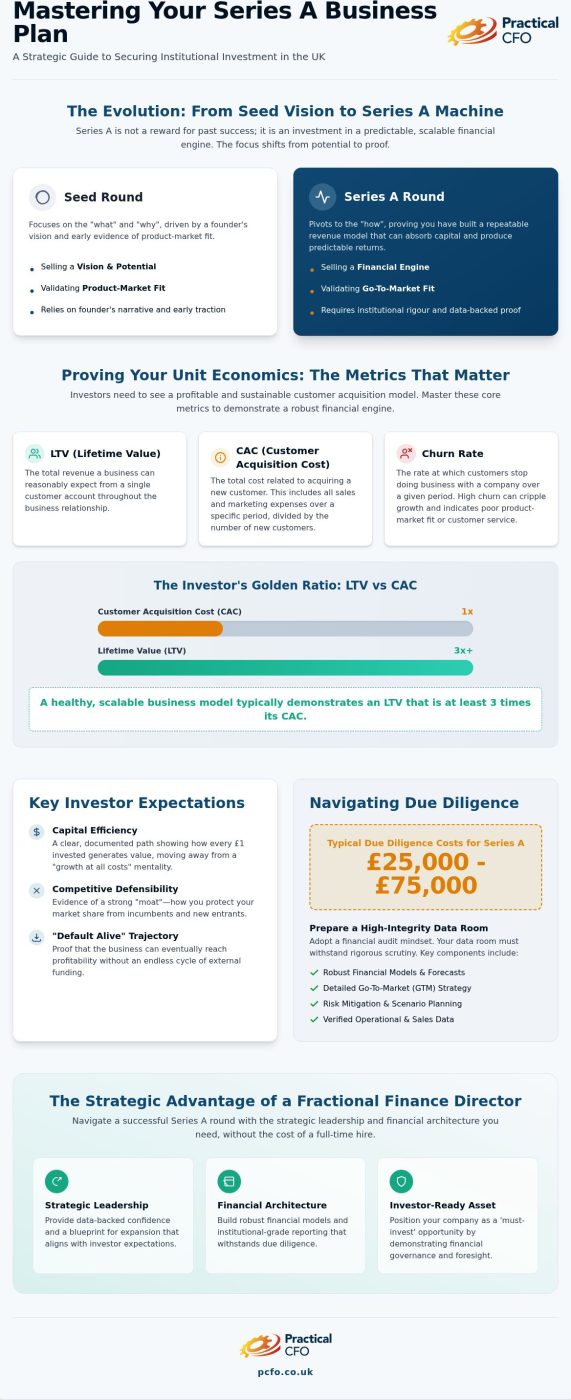
Series A is not a reward for your past success. It is a calculated investment in a predictable, scalable financial machine. Whilst your Seed round may have relied on vision and potential, business planning for series A funding UK requires a shift toward institutional rigour. You likely feel the pressure of looming due diligence, especially when typical costs for these checks now range between £25,000 and £75,000. It’s natural to feel anxious about your valuation or the lack of internal financial expertise to build the robust models that VCs expect.
This guide will help you master the complexities of Series A preparation. We provide a clear roadmap to ensure your business plan satisfies even the most rigorous venture capital scrutiny. You’ll learn which financial metrics matter most to UK investors and how to position your company as a truly investor-ready asset. By following this strategic framework, you can approach the fundraising process with calm confidence and secure the institutional investment needed to scale your operations effectively. We will explore the specific evidence investors require to trust your trajectory in a competitive market.
Key Takeaways
- Understand how to transition your strategy from Seed-stage vision to Series A execution by proving a repeatable and scalable revenue model.
- Master the essential components of professional business planning for series A funding UK to ensure your executive summary and market analysis meet institutional standards.
- Identify the core scale-up metrics, including LTV, CAC, and Churn, to build a financial model that serves as a robust engine room for your future growth.
- Prepare a high-integrity data room that withstands rigorous due diligence by adopting a financial audit mindset for every figure presented to investors.
- Learn how a fractional Finance Director provides the strategic leadership and financial architecture needed to navigate a successful funding round without the cost of a full-time hire.
The Evolution of the Business Plan: From Seed to Series A
Seed funding is often about the “what” and the “why,” driven by a founder’s vision and evidence of early product-market fit. However, understanding Series A funding requires a pivot toward the “how.” It’s no longer just about the dream; it’s about the machine. Effective business planning for series A funding UK focuses on proving you’ve built a repeatable revenue model that can absorb capital to produce predictable returns. You aren’t just selling a product anymore. You’re selling a financial engine.
In 2026, the UK venture capital market has matured significantly. With the Bank of England base rate at 3.75%, investors have moved away from the “growth at all costs” mantra. They now prioritise capital efficiency. You must demonstrate that you’ve crossed the “Traction Gap,” which is the space between having a great product and having a scalable business. Your plan needs to show that every £1 invested has a clear, documented path to generating value. This shift from vision to execution is the hallmark of a successful transition to institutional-grade operations.
The Shift in Investor Expectations
Institutional investors in the UK are looking for “Go-To-Market (GTM) Fit.” Whilst Seed rounds validate the product, Series A validates the sales and marketing engine. VCs now demand institutional-grade financial reporting from the outset. They want to see that your leadership team understands its numbers as well as its technology. Most importantly, your plan must show a clear route to “default alive” status. This means proving the business can eventually reach profitability without relying on an endless cycle of external capital. It’s about building a sustainable entity, not just a high-burn startup that relies on the next round to survive.
Core Objectives of a Series A Business Plan
The primary goal is securing a lead investor who will set the terms for the round. This requires data-backed confidence that only a detailed financial architecture can provide. Beyond the fundraise, your plan acts as the baseline for post-investment board reporting. It identifies the specific “Levers of Growth” that the new capital will pull. These might include sales headcount, geographic expansion, or product R&D. By defining these now, you position yourself as a proactive leader ready for the rigours of institutional governance. You’re presenting a blueprint for expansion that respects the investor’s need for transparency and strategic foresight.
The Anatomy of an Investor-Ready Series A Business Plan
A pitch deck captures the imagination, but the business plan survives the scrutiny of due diligence. When approaching business planning for series A funding UK, your executive summary must position the company as a “must-invest” asset. This means moving beyond the excitement of the product to the cold reality of the opportunity. It isn’t just about market size. It’s about competitive defensibility. Investors want to see your “moat” and how you protect your market share from incumbents. You also need to prove that your operational infrastructure can handle 10x growth without collapsing. This requires a management strategy that identifies talent gaps early. Highlighting the role of a Finance Director shows you’re serious about financial governance and board-level reporting.
The GTM Strategy and Sales Pipeline
Your Go-To-Market (GTM) strategy needs to be granular. Investors look for a detailed breakdown of customer acquisition channels and their respective ROI. They want to see a predictable sales cycle with stable lead-to-close ratios. Sales Velocity is a critical metric here; it measures the speed at which leads move through your pipeline and the revenue they generate over a specific timeframe. High sales velocity suggests a refined, efficient engine that’s ready for institutional scaling. Effective business planning for series A funding UK ensures that your GTM strategy is grounded in reality, explaining why specific channels are prioritised based on historical data rather than intuition.
Risk Mitigation and Strategic Foresight
Institutional investors are risk-averse. You must address regulatory, market, and financial risks head-on. Effective financial risk management uk protects investor capital from unforeseen volatility. Use scenario planning to demonstrate strategic foresight. For instance, show what happens to your cash runway if growth is 50% slower than forecasted. This transparency builds deep trust and shows you’ve considered the downside. If you’re looking to refine these projections, our Business Planning Consultant services can offer the steady hand required to navigate these complexities.
Financial Modelling: Proving Your Unit Economics
Your financial model is the engine room of your Series A strategy. It serves as the numerical proof that your business vision translates into a sustainable reality. Whilst the pitch deck sets the scene, the model provides the intellectual rigour that institutional investors demand. We focus on the “Holy Trinity” of scale-up metrics: Lifetime Value (LTV), Customer Acquisition Cost (CAC), and Churn. These figures reveal the fundamental health of your customer relationships and the efficiency of your growth engine. Business planning for series A funding UK must include a deep dive into cohort analysis. This proves that your newest customers are just as profitable as your earliest adopters, confirming that your success is repeatable rather than a series of fortunate one-off events.
Post-investment, cash flow management becomes your primary operational focus. Investors will scrutinise your “Runway” and “Burn Rate” to ensure that the injected capital lasts until you reach your next significant milestone. You must demonstrate a clear understanding of how the typical £2 million to £10 million Series A round will be deployed. This level of foresight reassures your partners that you are a steady hand capable of managing significant resources with precision.
The Three-Statement Financial Model
A robust model must integrate the Profit and Loss (P&L), Balance Sheet, and Cash Flow statements for a truly holistic view. This integration ensures that every strategic decision is reflected across your entire financial position, leaving no room for hidden liabilities or cash gaps. We prioritising “bottom-up” forecasting, which builds projections from individual sales and cost drivers rather than relying on broad “top-down” market assumptions. This method is far more credible during due diligence because it’s rooted in your actual operational reality. The importance of strategic budgeting and forecasting cannot be overstated. It provides the framework for accountability that institutional boards expect from their portfolio companies.
Unit Economics and Efficiency Ratios
In 2026, UK VCs are increasingly focused on the LTV:CAC ratio and the CAC Payback Period. A healthy LTV:CAC ratio of 3:1 or higher is often the benchmark for institutional readiness in the current market. We also track the “Rule of 40,” where your combined growth rate and profit margin should ideally exceed 40%. This metric has become a standard for valuations as it balances aggressive expansion with fiscal discipline. Strong unit economics prove that the business model is inherently scalable, demonstrating that increasing investment will lead to predictable, profitable growth. By perfecting these ratios, you transition from a promising startup to a high-performance financial machine ready for international expansion.
Navigating Due Diligence: Preparing the Data Room
Due diligence is the phase where your strategic vision is tested against the cold reality of historical data and legal documentation. It’s a rigorous process that demands a “Financial Audit” mindset. Every projection made during your business planning for series A funding UK must be backed by verifiable evidence. Institutional investors don’t just look at what you say; they look at what you can prove. A disorganised data room is one of the quickest ways to erode trust and stall a deal. You should approach this stage as a collaborative verification process rather than an interrogation.
Common red flags in Series A due diligence often include messy cap tables, inconsistent revenue recognition, or poorly documented intellectual property rights. To avoid these pitfalls, ensure that your data room is structured logically from the outset. This includes historical financial statements, tax filings, and executed customer contracts. Your Finance Director plays a pivotal role here, acting as the primary point of contact for technical queries. They ensure that the narrative in your business plan is perfectly synchronised with the underlying data, providing the steady hand needed to maintain momentum.
Legal and Compliance Readiness
Your cap table must be clean and your shareholder agreements fully executed before you enter the room. Investors will scrutinise employment contracts and IP protection to ensure the company’s core assets are secure. It’s essential that all outsourced accountancy solutions used by the business are audit-ready. This means having clear reconciliations and a transparent trail for every transaction. When your compliance is beyond reproach, you signal to VCs that your business is built on a foundation of institutional-grade governance.
The Stress Test: Defending Your Assumptions
Expect aggressive questioning regarding your growth margins and market penetration rates. You must be prepared to defend the assumptions in your financial model with external market data and internal performance history. Having access to board level financial advice during this negotiation phase is invaluable. It allows you to respond to complex financial stress tests with composure and precision. If you need support in structuring your data room to meet these rigorous standards, our Finance Director Services provide the expert oversight required to secure your funding round.
The Strategic Advantage of a Fractional CFO for Series A
Scaling startups often reach a point where financial complexity outpaces internal capacity. Whilst hiring a full-time CFO at the Series A stage is frequently premature and prohibitively expensive, an experienced Finance Director is essential to handle the rigours of institutional investment. A fractional CFO builds the necessary financial architecture, ensuring your business planning for series A funding UK is robust enough for high-level scrutiny. This approach professionalises the finance function, which is a critical factor in building long-term investor trust. It provides cost-effective access to high-level business growth advisory uk without the overhead of a permanent executive hire. By embedding a senior financial expert into your team, you gain a steady hand to navigate the transition from a founder-led startup to an investor-backed scale-up.
Bridging the Expertise Gap
Founders are visionaries, but they often struggle to translate that vision into the technical language required by venture capitalists. A fractional CFO bridges this gap by articulating growth plans through the lens of risk, return, and unit economics. This takes the administrative and technical burden of the funding round off the CEO’s plate, allowing them to focus on the company’s core mission and team leadership. Having a credible “Finance” presence in investor meetings signals to VCs that the business is managed with intellectual rigour and fiscal discipline. It ensures that complex questions about capital efficiency or tax treatments are handled with immediate authority, which is vital when typical due diligence costs can reach £75,000.
Preparing for the Post-Funding Reality
Securing the investment is only the first hurdle in your growth journey. The post-funding reality involves new board members who expect sophisticated monthly reporting and clear accountability for every pound spent. A fractional leader sets up these reporting structures before the ink is dry on the term sheet. They manage the rapid deployment of capital, ensuring that spending remains strictly aligned with the agreed growth levers. Exploring fractional cfo pricing uk reveals a superior ROI for scaling startups. You gain board-level strategic foresight and a proactive mindset at a fraction of the cost of a full-time equivalent. This future-proofs your business planning for series A funding UK as you move toward the eventual complexities of Series B and beyond.
Securing Your Scalable Future
Transitioning from Seed to Series A is a fundamental shift in how you operate and report. Success in this phase requires you to move beyond vision and prove that your business is a predictable, high-performance machine. By mastering the rigours of unit economics and maintaining a high-integrity data room, you demonstrate the institutional maturity that VCs demand in the current UK market. Comprehensive business planning for series A funding UK ensures that every growth lever is backed by verifiable data, reducing the friction of due diligence and protecting your valuation.
PCFO provides the board-level financial leadership needed to navigate this high-pressure journey. Our expert Finance Director services and strategic business growth advisory help you build a robust financial architecture that scales with your ambitions. We offer fractional CFO solutions that provide the expertise of a full-time executive at a fraction of the cost, giving you a steady hand at the helm of your financial strategy. Book a consultation with a PCFO strategic advisor to prepare your Series A roadmap and gain the clarity required to scale with confidence. You’ve built the foundation; now it’s time to fuel the engine.
Frequently Asked Questions
How much does it cost to prepare a Series A business plan in the UK?
Preparation costs vary based on the complexity of your financial model and the level of external support required. Whilst internal costs are difficult to quantify, professional due diligence for a sub-£10 million deal typically ranges from £25,000 to £75,000. Investing in professional advisory early can reduce these costs by ensuring your documentation is high-integrity and audit-ready from the first day of the process, preventing expensive delays during the final negotiations.
How long does the Series A funding process typically take for a UK startup?
A typical Series A round in the UK takes between six and nine months from initial preparation to completion. This timeline includes approximately three months of internal planning and financial modelling, followed by three to six months of active pitching and due diligence. Market conditions and the complexity of your cap table can influence this duration, making early preparation essential to maintain momentum and avoid cash runway issues.
What is the difference between a pitch deck and a Series A business plan?
A pitch deck is a high-level visual narrative designed to capture investor interest, whereas a business plan is a detailed operational and financial blueprint. Whilst the deck focuses on vision and market opportunity, the plan provides the granular evidence required for due diligence. Effective business planning for series A funding UK ensures that every claim made in your deck is supported by robust financial models and verified historical data.
Can I raise Series A funding without a full-time CFO?
Yes, many UK startups successfully close Series A rounds without a permanent CFO by utilising fractional Finance Director services. Institutional investors prioritise the quality of your financial leadership over the employment status of the individual. A fractional CFO provides the board-level strategic oversight and technical expertise required for the round at a fraction of the cost, allowing you to deploy capital more efficiently into growth-generating activities post-investment.
What are the most important financial metrics for Series A investors in 2026?
UK investors in 2026 prioritise capital efficiency and unit economics, specifically looking at the LTV:CAC ratio and the CAC Payback Period. The “Rule of 40” remains a critical benchmark for balancing growth with profit margins in a maturing market. Additionally, VCs increasingly scrutinise your “Sales Velocity” and cohort retention rates to ensure your revenue model is truly scalable and defensible against competitors in an increasingly AI-driven landscape.
Do I need an interim Finance Director for the due diligence process?
Engaging an interim or fractional Finance Director is highly recommended to manage the intense technical scrutiny of the due diligence phase. They act as a steady hand, managing investor Q&A and ensuring the data room is perfectly organised according to institutional standards. This professional presence alleviates the administrative burden on the CEO and provides investors with confidence that the company’s financial governance is handled by a seasoned expert.
How does a fractional CFO help with business planning for Series A?
A fractional CFO builds the financial architecture required to translate your strategic vision into a credible investment case. They develop the three-statement financial models and bottom-up forecasts that institutional investors expect. By professionalising your finance function, they ensure your business planning for series A funding UK is grounded in reality, identifying potential risks and growth levers that might otherwise be overlooked by a founder-led team without deep financial expertise.
What happens if my business plan fails to meet investor expectations during due diligence?
If a business plan fails to meet expectations, it often leads to a “down round,” reduced valuation, or the withdrawal of the lead investor. Inconsistencies in your data suggest a lack of internal control, which quickly erodes investor trust. However, identifying these gaps early through a pre-due diligence audit allows you to rectify issues before they become deal-breakers. Proactive financial leadership is the best defence against these negative outcomes.