

What if the very success you’ve worked for becomes the catalyst for your firm’s collapse? It’s a sobering thought, but for many UK SMEs, a rapid business growth strategy that lacks a solid financial foundation often leads to overtrading and terminal cash flow crises. You likely recognise that scaling requires more than just a full order book. It demands a level of financial sophistication and board-level oversight that many companies haven’t yet established. The pressure to expand whilst maintaining profitability is intense, particularly when navigating the complexities of the current UK market.
We’re here to help you bridge that gap. This guide provides a clear roadmap to build a robust financial framework that transforms expansion from a high-stakes gamble into a sustainable competitive advantage. You’ll discover how to secure growth capital in an environment where the prime rate sits at 6.75 per cent and learn to implement the strategic finance pillars necessary for 2026. We will examine how fractional expertise can provide the leadership you need to scale with confidence, ensuring your next phase of growth is both profitable and permanent.
Key Takeaways
- Understand the critical distinction between “growth at all costs” and a sustainable business growth strategy that prioritises healthy margins and long-term value creation.
- Identify the core financial pillars, including cash flow mastery and robust unit economics, to ensure your expansion remains properly funded and inherently profitable.
- Evaluate the specific capital requirements and risk profiles of organic development versus strategic acquisitions to determine the most viable path for your organisation’s lifecycle.
- Learn how to implement three-way forecasting and SMART financial objectives to build a data-driven roadmap that supports confident decision-making at the board level.
- Discover how fractional CFO leadership provides the high-level strategic oversight needed to navigate scaling complexities without the overhead of a full-time executive.
Defining Business Growth Strategy: More Than Just Increasing Revenue
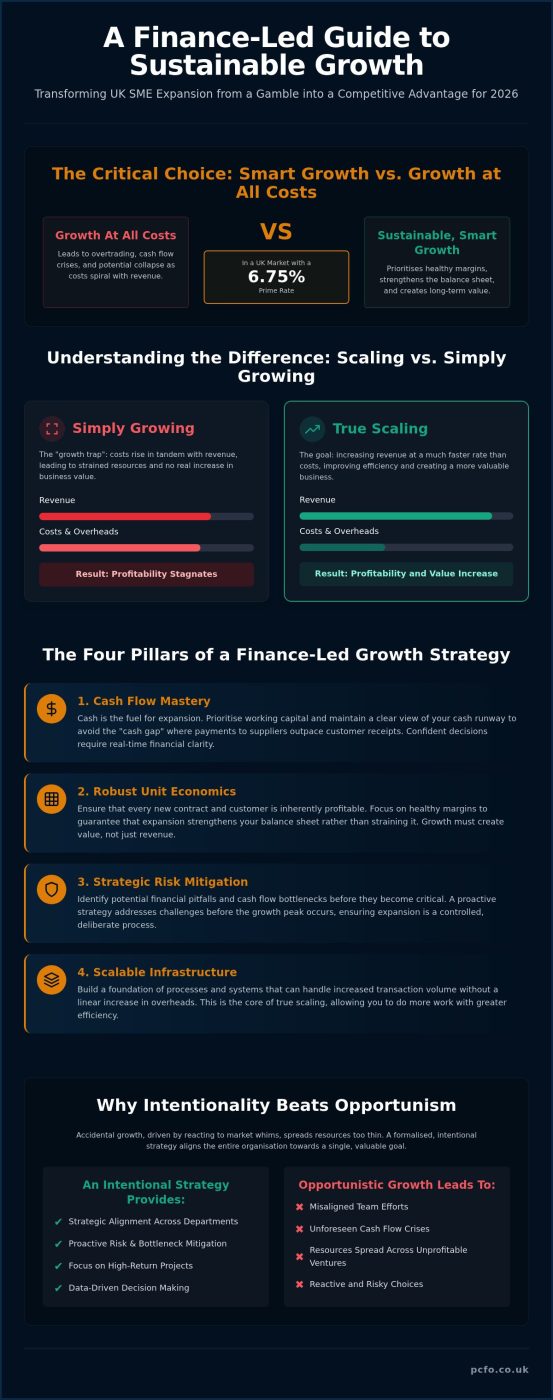
A business growth strategy is often mistaken for a simple sales forecast or a collection of ambitious revenue targets. In reality, it’s a deliberate roadmap designed for sustainable value creation rather than just top-line expansion. For UK SMEs entering 2026, the distinction between “growth at all costs” and “smart growth” has never been more critical. Smart growth prioritises healthy margins and ensures that every new contract strengthens the balance sheet instead of straining it. Without this focus, expansion can quickly become a liability.
Your Finance Director acts as the primary architect of this feasibility. They don’t just record historical data; they validate whether your targets are achievable within your current capital structure. With the UK prime rate currently at 6.75 per cent, the cost of funding expansion is a primary consideration that cannot be ignored. A dynamic strategy must adapt to these shifting economic pressures to remain viable. The FD ensures that the numbers behind the vision are robust, providing the board with the confidence to move forward.
The Difference Between Scaling and Simply Growing
Scaling is the process of increasing revenue whilst maintaining or improving operational efficiency. It’s distinct from simple growth, which often leads to the “growth trap.” This trap occurs when costs rise in tandem with, or even faster than, income. It usually happens when a company lacks the financial infrastructure to support a larger volume of transactions. You might see your turnover double, but if your administrative and delivery costs also double, you haven’t actually created a more valuable business. True scaling requires a foundation of automated processes and scalable systems that allow you to handle more work without a linear increase in overheads.
Why Intentionality Beats Opportunism in 2026
Accidental growth, driven by reactive responses to market whims, carries significant risk. Without a strategic financial plan, you might find your resources spread too thin across unprofitable ventures or customers who don’t fit your long-term vision. A formalised strategy aligns your team’s behaviour with your eventual exit goals, ensuring every decision moves the needle toward a higher valuation. Engaging with a business growth advisory uk partner can help you move from being reactive to proactive. Sustainable growth is the ability to expand without compromising operational liquidity.
- Strategic Alignment: Ensuring every department understands how their targets contribute to the overall business growth strategy.
- Risk Mitigation: Identifying potential cash flow bottlenecks before they become critical.
- Efficiency Focus: Prioritising projects that offer the highest return on investment and capital.
The Four Pillars of a Finance-Led Growth Strategy
A successful business growth strategy is built on more than just market demand. It requires a robust financial architecture to prevent the company from buckling under its own weight. To scale effectively in 2026, leaders must move beyond sales metrics and focus on the “financial plumbing” that keeps the organisation operational. This involves four key areas: cash flow mastery, unit economics, risk mitigation, and scalable infrastructure. Identifying and managing the financial pitfalls of new markets is a core component of a resilient business growth strategy. By addressing these before the growth peak occurs, you ensure that expansion remains a controlled, deliberate process rather than a chaotic scramble for resources.
Prioritising Cash Runway and Working Capital
Cash is the fuel for expansion. Whilst profit is a vital long-term goal, it doesn’t pay the bills during a high-growth phase. Many SMEs fall into a “cash gap” where they must pay suppliers and staff for increased output long before customers settle their invoices. This timing mismatch can be fatal if your working capital isn’t managed with precision. You need clear visibility into your future cash position to make informed hiring or procurement decisions. Utilising outsourced accountancy solutions provides this high-level clarity, allowing you to monitor your runway in real-time. It’s about having the confidence to invest because you know exactly how much “fuel” is left in the tank.
Analysing Unit Economics for Profitable Expansion
Growing a business with a negative contribution margin is simply scaling a loss. You must verify that every new customer is actually profitable after accounting for all variable costs. This requires a deep dive into Customer Acquisition Cost (CAC) versus Lifetime Value (LTV). If your CAC exceeds the LTV, or if the payback period is too long, rapid growth will only deplete your reserves faster. It’s a risk that many founders overlook in the rush to capture market share.
Our Finance Directors play a critical role here. They audit these metrics for accuracy, ensuring that marketing and sales data reflects the true financial reality of the business. They look beyond the surface-level “vanity metrics” to identify which customer segments offer the best return on investment. If you are unsure whether your current model is truly scalable, our Business Growth Advisory services can help you stress-test your unit economics before you commit significant capital to expansion. We help you build a model where every new pound of revenue contributes to the bottom line.
Organic Growth vs Strategic Acquisition: Choosing Your Path
Deciding between internal expansion and acquisition is a defining moment for any business growth strategy. Organic growth represents a “virtuous cycle” where reinvested profits fuel steady, manageable expansion. This path allows you to maintain total control over your corporate culture whilst refining your operational model. Conversely, strategic acquisitions offer a shortcut to market dominance or new capabilities. Whether you pursue horizontal integration to remove a competitor or vertical integration to secure your supply chain, the capital requirements are significantly higher than building from within.
Every acquisition must serve the long-term trajectory of the firm. It’s not just about adding revenue; it’s about adding value that will be recognised by future investors. This is why we integrate exit strategy planning services into the decision-making process. We ensure that any purchase you make today actually enhances your eventual valuation rather than complicating your corporate structure with incompatible assets. It’s about building a legacy, not just a larger payroll.
The CFO’s Role in M&A and Strategic Growth
A Chief Financial Officer or Finance Director acts as the primary safeguard during the M&A process. Their first priority is conducting rigorous financial due diligence to uncover hidden liabilities or inflated valuations that could jeopardise the parent company. They don’t just look at the balance sheet; they evaluate cultural and operational fit from a cost-integration perspective. If two companies have radically different systems or management styles, the “synergy” promised in the pitch deck often evaporates into unexpected restructuring costs. A seasoned CFO structures the deal to protect your existing cash flow, ensuring the debt service or cash outlay doesn’t starve your core operations of vital resources.
Maximising Internal Growth Efficiency
Before looking outward, it’s often more prudent to optimise what you already own. Diversifying too early can dilute your brand and stretch your management team too thin. We encourage our clients to use data to identify their most profitable market segments and double down on those high-margin product lines first. This focused approach ensures your foundation is ironclad before you add the complexity of new markets or entities. Organic growth typically offers lower risk but requires longer timeframes than inorganic alternatives.
Developing Your Growth Roadmap: Metrics, Forecasting, and Funding
Your business growth strategy requires a technical blueprint to succeed. This blueprint is the three-way forecast, a comprehensive model that integrates your Profit & Loss, Balance Sheet, and Cash Flow. Relying on a P&L alone is a common mistake; it tells you if you’re profitable, but it won’t tell you if you’re about to run out of cash. By modelling all three elements, you gain a panoramic view of your financial health, allowing you to see how an increase in sales will impact your VAT liabilities, stock levels, and bank balance simultaneously. Setting SMART financial objectives that align with a business growth advisory uk framework ensures these targets are specific, measurable, and, most importantly, funded.
Successful execution also depends on a culture of accountability. Monthly management reporting shouldn’t just be a look back at the previous month’s performance. It’s a strategic tool used to compare actual results against your forecast, identifying variances before they become systemic issues. This disciplined approach ensures the leadership team remains focused on the levers that actually drive value, rather than getting distracted by operational noise. If you’re ready to build a data-driven path to expansion, our Business Planning Consultant services can help you design a roadmap tailored to your specific objectives.
Strategic Budgeting and Scenario Planning
Static annual budgets are often obsolete by the end of the first quarter. In a scaling business, you need rolling forecasts that adapt to real-world changes. We implement “What-If” analysis to stress-test your business growth strategy against various scenarios. What happens if a key supplier raises prices by 10 per cent? What if a major contract is delayed by three months? By performing these analyses, you can prepare contingency plans whilst things are calm, rather than making panicked decisions during a crisis. Linking these financial forecasts to operational KPIs ensures every department head understands how their team’s performance affects the company’s liquidity.
Navigating the UK Funding Landscape in 2026
Securing capital in 2026 requires a sophisticated approach, especially with the prime rate at 6.75 per cent making debt more expensive than in previous years. Investors and lenders now look for “funding-ready” balance sheets that demonstrate lean operations and strong unit economics. They want to see that you’ve considered the optimal funding mix between debt, equity, and internal bootstrapping. Professional strategic business planning is vital here. It shows potential backers that you possess the financial maturity to manage their capital responsibly. We help you present a narrative that combines ambitious growth targets with a realistic, risk-adjusted financial model.
Executing the Strategy: The Impact of Fractional Finance Leadership
Most SMEs fail at growth execution because they lack the high-level financial oversight required to turn a vision into reality. Whilst a business growth strategy may look impressive on paper, the complexity of managing debt, cash flow, and unit economics simultaneously often overwhelms internal resources. This is where a fractional CFO or Finance Director becomes an essential partner. They provide the board-level leadership necessary to navigate these hurdles without the prohibitive cost of a full-time executive. This model allows you to access seasoned expertise on a part-time basis, ensuring your financial architecture remains robust as you scale.
The fractional model is specifically designed for companies that have outgrown their current financial systems but aren’t yet ready for a permanent C-suite hire. Understanding fractional cfo pricing uk allows you to see how this investment pays for itself through improved profitability and reduced risk. It bridges the gap between historical accounting and forward-looking strategy, providing the “architect” needed to oversee your expansion. This strategic partnership ensures that your growth is not just rapid, but also sustainable and well-funded.
From Bookkeeping to Boardroom Strategy
A standard accountant or bookkeeper is vital for compliance, but they are rarely equipped to act as a strategic advisor. A fractional CFO coaches the CEO on financial leadership, helping them understand the long-term implications of their daily decisions. They transform raw data into actionable insights for the board, ensuring that every strategic move is backed by rigorous analysis. This partnership ensures the leadership team isn’t just reacting to the bank balance but is proactively steering the organisation toward its targets. It’s about moving from simple reporting to true financial foresight.
Future-Proofing Your Business for Sale or Succession
Scaling with an eventual exit in mind requires a “clean” financial structure from the outset. A fractional lead implements robust internal controls and reporting frameworks that make the company inherently attractive to potential buyers or investors. They ensure the business can thrive independently of the founder, which is a key driver of valuation during any due diligence process. By future-proofing your operations now, you maximise your options for the future and ensure a smoother transition when the time comes. If you are ready to professionalise your financial leadership, enquire about our Business Growth Advisory services today to begin your scaling journey with confidence.
Securing Your Company’s Future Through Strategic Financial Leadership
Scaling a business is a complex undertaking that requires more than just ambition. It demands a sophisticated financial framework where cash flow and unit economics are prioritised over vanity metrics. By implementing a finance-led business growth strategy, you ensure that your organisation remains resilient against market shifts and capital pressures. You’ve seen how a fractional CFO can act as the architect of this expansion, providing the strategic foresight needed to navigate the UK’s unique economic landscape in 2026.
We provide expert Finance Director services tailored specifically for UK SMEs. Our strategic growth advisory focuses on building long-term value through a flexible fractional model that adapts to your specific business lifecycle. If you’re ready to professionalise your board-level leadership and scale with confidence, book a consultation with a PCFO growth advisor today. We’re here to help you turn your scaling ambitions into a sustainable and profitable reality.
Frequently Asked Questions
What is the most effective business growth strategy for a UK SME?
The most effective business growth strategy for a UK SME is one that prioritises sustainable value creation over raw turnover. Whilst many founders focus on sales volume, a finance-led approach ensures that every new customer contributes a healthy margin. This involves rigorous analysis of your cost base and market positioning. By focusing on “smart growth,” you protect your operational liquidity and ensure the business remains resilient against external economic shifts during the scaling process.
How does a growth strategy differ from a standard business plan?
A standard business plan provides a general overview of your goals and operations, whereas a business growth strategy is a specific, actionable roadmap for expansion. It focuses on the mechanics of scaling, such as capital allocation, market penetration, and infrastructure investment. Whilst a business plan might be used to secure initial support, the growth strategy serves as a dynamic tool for daily decision-making at the board level, ensuring every move aligns with long-term exit goals.
When should a business owner hire a growth consultant or fractional CFO?
You should consider hiring a fractional CFO or growth consultant when your financial complexity outpaces your current team’s expertise. This often happens when you’re preparing for a funding round, navigating an acquisition, or experiencing a cash flow gap despite rising sales. A fractional leader provides high-level strategic oversight without the permanent cost of a full-time executive. They bridge the gap between basic bookkeeping and the strategic financial leadership required to scale an organisation safely.
What are the main risks associated with rapid business expansion?
The primary risk of rapid expansion is overtrading, where a company’s sales outpace its available working capital. This often leads to terminal cash flow crises as the business struggles to pay suppliers and staff before customer payments arrive. Other risks include a dilution of service quality and a lack of high-level financial oversight. Without robust controls, the “growth trap” can cause costs to rise faster than revenue, ultimately eroding the company’s overall valuation.
How can I fund my business growth strategy without giving up too much equity?
Funding your business growth strategy without excessive equity dilution often involves a mix of debt financing and internal bootstrapping. With the UK prime rate at 6.75 per cent, debt is more expensive, but it allows founders to retain control. Asset-based lending or invoice discounting can also provide the necessary liquidity to bridge the cash gap. A strategic finance partner helps you identify the optimal funding mix that supports expansion whilst protecting your long-term ownership stake.
What financial metrics are most important when scaling a company?
When scaling, you must monitor metrics that reflect the health of your expansion rather than just top-line revenue. Key indicators include your cash runway, Customer Acquisition Cost (CAC), and Lifetime Value (LTV). You should also track your contribution margin to ensure each sale is inherently profitable. Monthly management reporting that compares actual performance against a three-way forecast is essential. These metrics provide the data-driven insights needed to make confident, proactive decisions at the board level.
Is organic growth better than growth through acquisition?
Neither path is objectively “better,” as the choice depends on your specific goals and capital structure. Organic growth typically offers lower risk and allows for a more controlled cultural evolution, though it requires longer timeframes. Acquisitions offer a faster route to market dominance or new capabilities but carry significant integration risks and higher capital requirements. A balanced approach often yields the best results, using organic growth for stability whilst pursuing strategic acquisitions when the valuation is right.