

A strategic plan is not a static document; it’s an active steering wheel for your balance sheet. When you’re scaling an SME, it’s easy to get trapped in relentless operational firefighting, watching turnover climb whilst cash flow anxieties and strategic blind spots cloud your long-term direction. Partnering with an experienced strategic business planning consultant UK business owners can rely on isn’t about commissioning theoretical slide decks. It’s about embedding the calm, disciplined financial leadership required to steer your company from founder-led reactivity to strategy-led growth.
You already possess the commercial drive, but turning that momentum into a robust, fundable enterprise requires institutional rigour. In this guide, you’ll discover how a strategic business planning consultant can transform your financial trajectory, protect your working capital, and build a clear roadmap towards sustainable scale or a lucrative exit. We examine how embedded strategic planning aligns daily operations with long-term valuation, giving you the clarity and control needed to build lasting enterprise value.
Key Takeaways
- How partnering with an experienced strategic business planning consultant UK founders trust bridges the critical gap between ambitious vision and boardroom-grade financial discipline.
- The vital difference between qualitative business coaching and CFO-led strategic leadership that actively aligns overheads, working capital, and cash forecasting with your growth targets.
- The distinct operational pathways of scaling for sustainable expansion versus preparing your balance sheet years in advance for a high-value enterprise exit.
- How an embedded financial partner delivers ongoing strategic navigation and execution, helping your business successfully transition from founder-led reactivity to strategy-led growth.
What Does a Strategic Business Planning Consultant in the UK Actually Do?
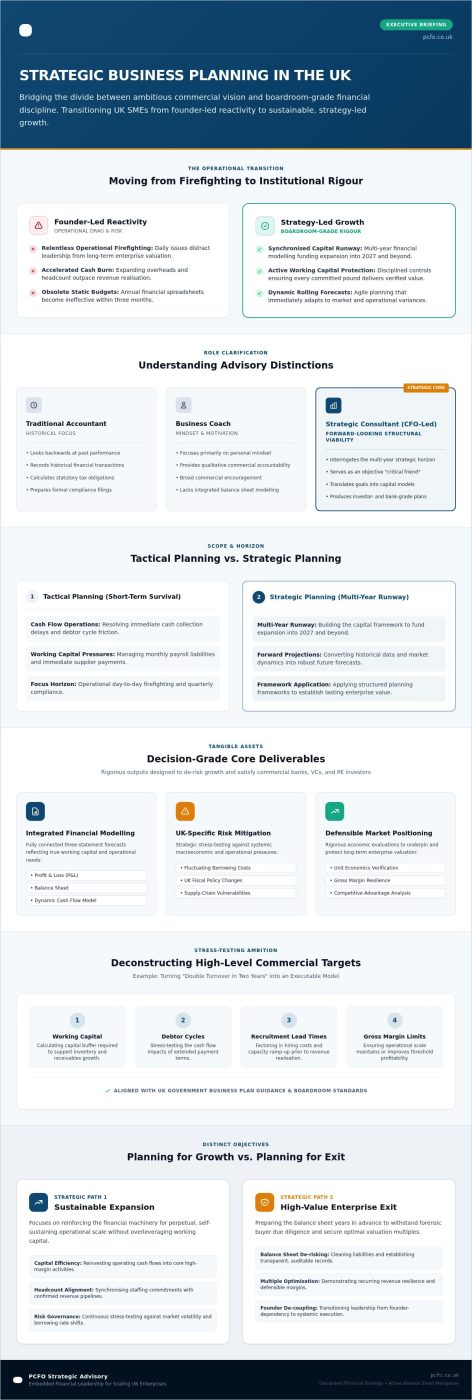
A strategic business planning consultant serves as an objective “critical friend” who bridges the divide between a founder’s ambitious vision and the operational reality of the balance sheet. While a standard business coach focuses primarily on personal mindset, accountability, or broad commercial motivation, a strategic financial consultant focuses on structural viability. They stress-test assumptions, interrogate margin contributions, and ensure your commercial roadmap translates into boardroom-ready documentation that satisfies UK commercial banks, venture partners, and private equity investors. Strategic business planning is the systematic synchronisation of financial resources with commercial ambitions.
The Difference Between Tactical and Strategic Planning
Tactical planning concentrates on short-term survival, such as resolving immediate cash collection delays or managing monthly payroll liabilities. Strategic planning, by contrast, builds the multi-year capital runway required to fund expansion into 2027 and beyond. Without experienced external challenge, scaling SME owners frequently find themselves trapped in reactive tactical loops. Establishing long-term value requires applying established strategic planning frameworks to convert market data and historical performance into reliable forward-looking forecasts.
Core Deliverables of a Strategic Engagement
Engaging a seasoned strategic business planning consultant UK companies rely on yields tangible, decision-grade assets designed to de-risk growth:
- Integrated Financial Modelling: Fully connected three-statement forecasts (profit and loss, balance sheet, and dynamic cash flow) that reflect true working capital requirements.
- UK-Specific Risk Mitigation: Strategic stress-testing against fluctuating borrowing costs, fiscal policy changes, and supply-chain vulnerabilities.
- Defensible Market Positioning: Rigorous evaluation of unit economics, gross margin resilience, and competitive advantages to underpin enterprise valuation.
The CFO-Led Approach: Why Financial Leadership is the Centre of Strategy
A business strategy formulated without an experienced finance director is little more than a wish list. Growth requires capital, disciplined cost structures, and tight operational controls; without them, scaling simply accelerates cash burn. When commercial ambitions aren’t balanced by board-level financial oversight, expanding headcount and overheads quickly outpace revenue realisation. Bringing CFO-calibre leadership into your leadership team instils the calm confidence needed to make bold, measured decisions, ensuring every operational pound committed is expected to return verifiable value.
Many founders remark, “We already have an accountant, so why do we need strategic advisory?” The distinction is profound. Traditional accountants look backwards; they record historical transactions, calculate tax obligations, and prepare statutory filings. A fractional CFO or strategic business planning consultant looks forwards. They interrogate the strategic horizon, translating corporate goals into working capital models and capital expenditure pathways that safeguard your runway whilst you pursue new markets.
Translating Vision into Financial Models
Saying “we want to double our turnover in two years” sounds ambitious in a management meeting, but it creates significant operational drag if unmodelled. A seasoned consultant deconstructs that high-level goal into tangible assumptions: working capital requirements, debtor cycle extensions, recruitment lead times, and gross margin thresholds. They stress-test these projections against market realities, in line with official UK government business plan guidance, ensuring your strategic milestones remain realistic and fundable. If your current plans require strategic grounding, reviewing our bespoke Finance Director Services can help align your commercial vision with board-level execution.
Strategic Budgeting vs. Traditional Accounting
Static annual budgets frequently become obsolete within three months of delivery. CFO-led planning introduces agile, dynamic forecasting methods that respond to operational variances as they occur:
- Forward-Looking Rolling Forecasts: Replacing static spreadsheets with continuous 13-week and 12-month projections that highlight cash deficits well before they emerge.
- Decision-Ready Operational Insights: Utilising reliable outsourced accountancy solutions to capture accurate source data, allowing the consultant to interpret management accounts for board members rather than merely presenting balance sheet balances.
- Variance Interrogation: Systematically tracking departmental spend against pre-agreed performance indicators, holding leadership teams accountable to strategic outcomes.
Planning for Growth vs. Planning for Exit: Different Strategic Paths
A business built solely to expand operates under a fundamentally different architectural blueprint than one structured for an imminent trade sale or private equity transaction. The scale-up mindset prioritises customer acquisition velocity, product development, and operational capacity, frequently reinvesting surplus capital back into top-line expansion. Conversely, the exit-ready mindset prioritises net margins, institutional governance, recurring revenue predictability, and the elimination of key-person dependencies. Engaging a strategic business planning consultant UK founders trust ensures that your current operational trajectory doesn’t inadvertently damage your future enterprise value.
Exit planning shouldn’t begin six months before an anticipated deal; it demands a structured, multi-year preparation cycle. Strategic acquirers look far beyond basic revenue figures. They scrutinise balance sheet purity, customer concentration risks, and internal succession frameworks. An experienced strategic advisor acts as an objective navigator, identifying latent valuation drivers, establishing autonomous management layers, and aligning long-term resource deployment with Harvard Business School’s strategic planning insights regarding agile, value-focused organisational execution.
Scaling Strategies: Managing the “Growth Gap”
Rapid expansion frequently triggers the classic “growth gap,” where working capital commitments outpace receivables collection. Preparing for Series A or B rounds requires granular financial choreography rather than general optimism. Specialised business growth advisory UK partners de-risk this operational phase by modelling cash conversion cycles, establishing sustainable debt covenants, and ensuring debt-service thresholds remain resilient during rapid hiring phases.
Exit Planning: Maximising Your Sale Price
Strategic buyers apply strict valuation methodologies based on risk-adjusted earnings multiples. Preparing early allows you to run a systematic “clean house” process before external scrutiny begins:
- Due Diligence Pre-Emption: Deploying specialist exit strategy planning services to uncover and rectify uncapitalised liabilities, weak supplier agreements, or revenue quality discrepancies.
- Contractual Predictability: Restructuring ad-hoc commercial terms into multi-year recurring agreements, which command significantly higher valuation multiples from UK corporate acquirers.
- Founder Decoupling: Building robust internal reporting systems and management autonomy, proving to prospective acquirers that commercial momentum persists independent of founder involvement.
How to Choose the Right Strategic Business Planning Consultant
Selecting an advisor requires looking beyond impressive presentation decks. You need an authoritative strategic partner who understands boardroom governance and speaks the industry-standard language of institutional lenders, corporate finance houses, and private equity sponsors. A qualified strategic business planning consultant UK founders partner with should possess direct experience navigating your company’s specific lifecycle stage, whether you are bootstrapping an operational rollout, securing external growth equity, or preparing balance sheets for an M&A transaction.
Evaluating the commercial value of advisory support means examining how strategic inputs translate into tangible balance sheet performance. When considering advisory structures, reviewing the transparent economics of fractional CFO pricing UK business leaders utilise reveals how high-calibre financial guidance delivers a direct return through enhanced cash conversion, improved margins, and avoided overheads.
Key Questions to Ask a Potential Advisor
Before committing to an external engagement, interrogate the practicalities of how the consultant operates:
- “How will you integrate with our existing finance function?” Reliable advisors collaborate closely with your internal bookkeepers or finance controllers, elevating their outputs rather than working in isolation.
- “What is your track record with UK SME debt, equity, or M&A?” The consultant should demonstrate clear familiarity with UK banking covenants, institutional funding expectations, and transaction due diligence.
- “How do you measure the ROI of your strategic input?” Look for quantifiable milestones such as working capital compression, gross margin optimisation, and verified valuation uplift rather than vague assurances.
The Fractional vs. Full-Time Decision
Hiring a full-time, seasoned Chief Financial Officer places a significant fixed overhead onto a scaling SME’s balance sheet, particularly when factoring in pension obligations, employer National Insurance, and performance bonuses. A fractional engagement eliminates this burden. You gain flexible access to top-tier financial stewardship precisely when you need it, whether that involves two days per month of high-level board oversight or intensive weekly navigation during major corporate reorganisations. To explore how this embedded expertise transforms your company’s commercial trajectory, speak with our strategic advisory team today.
The PCFO Embedded Approach: Strategy that Executes
Most strategic planning exercises fail because they end where execution begins. A bound presentation deck delivered by an external consultant gathers dust on a shelf while the executive team returns to daily operational firefights. PCFO operates differently. Serving as your steady, experienced hand at the helm, we function as an embedded partner invested in your long-term commercial trajectory. Rather than providing transactional advice and departing, our fractional CFOs and Finance Directors sit alongside leadership teams, turning high-level commercial objectives into operational reality and sustained enterprise value.
Engaging a strategic business planning consultant UK SMEs can rely on should deliver persistent forward momentum. By embedding board-level financial stewardship directly into your management structure, PCFO instils the calm confidence needed to navigate complex market conditions, future-proof your commercial model, and transition seamlessly from founder-led reactivity to strategy-led growth.
From Management Accounts to Boardroom Strategy
Bridging the divide between foundational bookkeeping and strategic boardroom decision-making requires active translation. Working alongside our sister brand, Practical Accounting, we ensure routine transactional data transforms into forward-looking intelligence. Having an experienced CFO in your corner shifts the dynamic during commercial landlord negotiations, banking facility renewals, and investor presentations. Your multi-year business plan ceases to be a static snapshot; it becomes an active roadmap that adapts to operational variances whilst preserving your valuation goals.
Taking the Next Step with PCFO
Beginning a partnership starts with an objective, methodical discovery process designed to surface the strategic and financial gaps holding your enterprise back:
- Diagnostic Evaluation: Interrogating your current working capital cycles, balance sheet vulnerabilities, gross profit margins, and reporting cadence.
- Bespoke Fractional Support: Tailoring our Business Planning Consultant and Finance Director Services to your precise operational stage, scaling input up or down as milestones are achieved.
- Disciplined Implementation: Establishing rolling 13-week forecasts, board packs, and clear accountability structures across departmental heads.
Gaining control over your financial trajectory does not require an expensive full-time executive hire. It requires seasoned leadership that integrates with your team to drive measurable performance. If you are prepared to replace operational firefighting with structured commercial foresight, contact PCFO today to arrange a composed, confidential discussion about your business’s future.
Transform Commercial Ambition into Lasting Enterprise Value
Scaling an enterprise requires moving beyond the exhausting friction of daily operational firefighting. Sustainable expansion demands structural discipline, forward-looking cash forecasting, and boardroom-grade financial governance. Whether your objective is aggressive market penetration or preparing for a lucrative sale, partnering with a dedicated strategic business planning consultant UK founders trust ensures your commercial vision rests on sound financial modelling.
At PCFO, our expert fractional CFOs bring extensive UK SME experience directly to your leadership table. As specialists in exit strategy and growth advisory, we provide professional, board-level financial oversight that protects your working capital and systematically enhances your company’s valuation. Take the first decisive step away from reactive management: Book a Strategic Consultation with PCFO and navigate your future with clarity and calm confidence.
Frequently Asked Questions
What is the difference between a business consultant and a strategic business planning consultant?
A general consultant often focuses on narrow operational processes or sales tactics. A strategic business planning consultant UK founders engage aligns your commercial ambitions directly with financial architecture, cash runway, and long-term enterprise valuation. They don’t just offer broad suggestions; they build integrated financial models and stress-test assumptions against balance sheet realities to ensure sustainable scale and institutional readiness.
How much does a strategic business planning consultant cost in the UK?
Advisory costs vary depending on the scope of your engagement, company size, and required frequency of support. Engagements typically operate on project-based arrangements for initial financial modelling or on a monthly fractional retainer for continuous board-level oversight. This flexible structure gives you access to seasoned financial leadership at a fraction of the overhead required for a permanent executive hire.
Does my small business really need a formal strategic plan?
Yes, particularly if you intend to scale beyond founder-led capacity or seek commercial investment. Without a formal plan, expanding companies often encounter severe working capital bottlenecks, where overheads increase faster than cash collection. A structured plan clarifies your operational priorities, establishes defensible unit economics, and provides the governance required to make confident, de-risked investment decisions.
How long does the strategic planning process usually take?
An initial strategic engagement typically requires between four and eight weeks. This timeframe encompasses an exhaustive diagnostic of historical performance, stakeholder interviews, and the construction of integrated three-statement financial models. Following this foundational phase, strategic planning becomes an ongoing, embedded discipline, using monthly variance tracking and dynamic forecasting to keep your commercial roadmap aligned with operational performance.
Can a strategic consultant help me secure bank funding or private equity?
Yes. Commercial lenders and private equity sponsors expect institutional-grade documentation before committing capital. A strategic consultant prepares robust debt covenant calculations, dynamic cash forecasts, and comprehensive financial models that satisfy strict credit committees and investor due diligence. Their presence at the boardroom table reassures external funders that your growth is guided by experienced financial governance.
What happens if our business strategy needs to change mid-year?
Effective planning is designed to absorb market volatility and operational shifts. Rather than delivering a static binder, a strategic business planning consultant UK leadership teams rely on develops dynamic forecasting models that update as conditions change. When commercial variances or cost pressures occur, your financial model allows you to reallocate capital quickly, protecting margins without losing sight of your ultimate valuation.
How do you measure the success of a strategic business plan?
Success is measured through objective balance sheet performance and operational milestones. Key financial indicators include working capital cycle compression, gross margin preservation, resilient cash reserves, and steady progress towards enterprise valuation targets. Qualitatively, success is evident when founder dependency decreases, departmental accountability improves, and your executive team makes board decisions with complete clarity and calm confidence.
Is strategic planning the same as a traditional business plan for a startup?
No, they serve completely different commercial purposes. A startup business plan is primarily a qualitative pitch narrative designed to validate an unproven concept or raise initial seed funding. A strategic plan for an established SME is a sophisticated operational roadmap rooted in historical data, focusing on margin defence, cash conversion optimisation, and preparing corporate infrastructure for sustained scale or exit.