

Why does your monthly financial review feel like reading a history book rather than a roadmap for growth? For many founders, the current state of outsourced accounting services for small business UK is stuck in the past, focusing on what happened last quarter rather than what’s coming next month. It’s exhausting to feel blind to future cash flow issues whilst spending your evenings on VAT admin and payroll. You’ve likely realised that a reactive accountant who only talks about historical data is no longer enough to support your scaling ambitions.
We believe your finance function should be a steady hand at the helm, providing the intellectual rigour needed to navigate a complex regulatory environment. This guide explores how to transition from basic bookkeeping to strategic leadership, ensuring you have real-time visibility of profit margins. We’ll examine the 2026 impact of Making Tax Digital for Income Tax, the updated 10.75% dividend tax rate, and how an embedded strategic partner can build a professional finance department that runs without founder intervention. You’ll gain the clarity needed to make informed, confident decisions about your company’s future.
Key Takeaways
- Understand how modern outsourced accounting services for small business UK have transitioned from reactive tax filing to becoming a proactive, full-service finance department.
- Gain the ability to identify profit leakage and maintain real-time visibility over your margins with advanced management reporting.
- Recognise the specific value of fractional Finance Director leadership in converting historical accounting data into forward-looking growth strategies.
- Learn how to audit your internal financial gaps and select a partner with a cloud-first tech stack that is ready for the 2026 landscape.
- Transition your role from financial administrator to strategic leader by embedding a professional finance function that runs independently.
The Evolution of Outsourced Accounting for UK SMEs in 2026
The definition of accounting has shifted dramatically. It’s no longer just a way to tick a compliance box or file a year-end return. Instead, modern outsourced accounting services for small business UK represent a complete, embedded finance department. Whilst the foundational principles of accounting remain the same, the delivery has changed. We’ve moved from a reactive model, where you hear from your accountant once a year, to a proactive strategic partnership. This evolution allows founders to focus on scalability whilst a dedicated team manages the financial architecture in the background.
Choosing a national strategic partner over a local high-street firm provides access to a broader range of expertise. You aren’t just hiring a person to balance the books; you’re securing a team that understands the nuances of business growth advisory and exit planning. This transition from transactional support to strategic leadership is what separates stagnant businesses from those that scale successfully in a volatile economy.
Why Traditional Bookkeeping is No Longer Enough
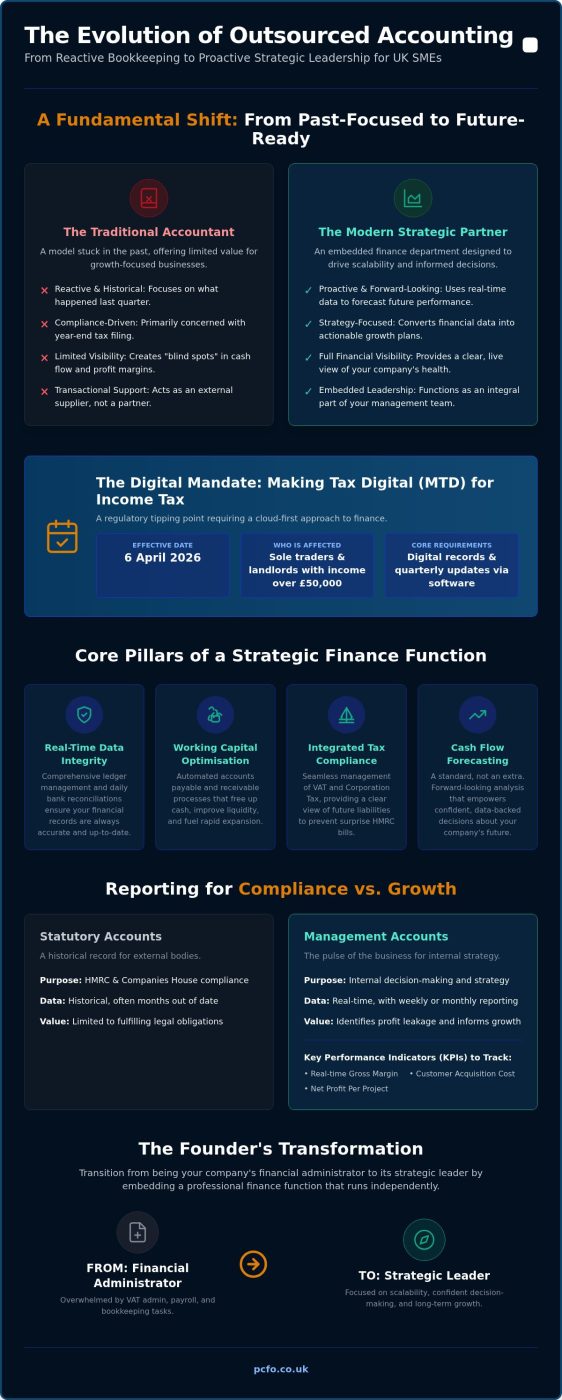
Relying on historical data is a significant risk for any fast-scaling firm. Traditional high-street accountants often focus on what happened months ago. This creates a “blind spot” in your cash flow. If you only see your profit margins after the quarter ends, you’ve already missed the opportunity to fix leakage or pivot your strategy. A standard high-street model often lacks the capacity for deep-dive advisory. It’s purely transactional. A strategic partner provides real-time financial visibility. You need to know your exact position today to make confident decisions for tomorrow.
The Digital Mandate: Accounting in the 2026 Regulatory Landscape
The UK regulatory environment has reached a digital tipping point. As of April 6, 2026, Making Tax Digital (MTD) for Income Tax is mandatory for sole traders and landlords with income over £50,000. This isn’t just a compliance hurdle; it’s a mandate for digital record-keeping and quarterly updates. AI-integrated cloud software now processes transactions with incredible speed, changing how we view reporting. The 2026 standard for financial transparency requires a system where data is captured, categorised, and analysed in real-time. This level of digitisation ensures that your business stays compliant whilst providing the insights needed for aggressive growth.
Core Pillars of a Strategic Outsourced Finance Function
A high-performing finance function relies on four structural pillars that transform raw data into actionable intelligence. Choosing the right outsourced accounting services for small business UK ensures that these pillars are not just tasks, but strategic assets. The first pillar is comprehensive ledger management coupled with real-time bank reconciliations. This ensures your financial records are accurate today, not just at the end of the quarter. Whilst many founders understand the basics of small business accounting, scaling an SME requires a more sophisticated, daily approach to data integrity.
Optimising working capital is the second pillar. Automated accounts payable and receivable processes ensure that cash isn’t trapped in unpaid invoices or missed supplier discounts. This efficiency is critical for maintaining the liquidity needed for rapid expansion. When these systems integrate with VAT and Corporation Tax compliance, you gain a clear view of your future liabilities. This integration allows for precise tax planning, ensuring you never face a surprise bill from HMRC that disrupts your growth trajectory. If your current setup feels disjointed, professional financial leadership can provide the cohesion your business deserves.
Management Accounts vs. Statutory Accounts
Statutory accounts are a historical requirement for HMRC and Companies House. They are necessary for compliance but offer little value for day-to-day operations. Management accounts, however, are the pulse of a growing organisation. In 2026, agile UK businesses should track specific KPIs such as real-time gross margin, customer acquisition cost, and net profit per project. Monthly reporting is the minimum standard for a scaling firm. For those in fast-moving sectors, weekly snapshots are often required to identify profit leakage before it impacts your bottom line. This level of detail allows you to make informed decisions based on current performance rather than guesswork.
Cash Flow Forecasting as a Standard, Not an Extra
Scaling a business is often a cash-intensive process that leaves little room for error. A rolling 13-week cash flow forecast is no longer a luxury; it’s a necessity for any SME with growth ambitions. This predictive tool allows you to see potential shortfalls months in advance, preventing the “growth traps” that often sink profitable but cash-poor companies. By utilising outsourced accountancy solutions, you ensure this data is both accurate and proactive. Our team acts as an embedded partner to help you navigate these transitions with intellectual rigour and steady foresight, ensuring your capital is always working as hard as you are.
Compliance vs. Strategy: The Finance Director Advantage
Founders often view their financial function as a hierarchy of increasingly complex paperwork. This is a misconception. To truly scale, you must distinguish between the foundational recording of a bookkeeper, the reporting accuracy of an accountant, and the strategic foresight of a Finance Director. Whilst bookkeeping keeps you organised, it doesn’t tell you where to invest next. Modern outsourced accounting services for small business UK provide the intellectual rigour needed to move beyond mere compliance. According to the ICAEW, the advice that businesses want most from their accountants in 2026 centres on forward-looking strategy rather than historical filing.
A Finance Director transforms raw ledger data into a growth roadmap. They provide board-level advice that helps you navigate complex decisions, such as when to hire or how to price a new service. Many SMEs hesitate, asking if they can afford such high-level expertise. The reality is that you can’t afford to operate without it. Without an FD’s oversight, you risk making major decisions based on incomplete or misunderstood data. This leadership doesn’t require a six-figure full-time hire; it requires a partner who is embedded in your business lifecycle.
The Fractional Model: High-Level Expertise Without the Salary
The fractional model is designed specifically for scaling firms that need executive-level talent without the overhead of a permanent recruitment. Hiring a full-time FD in the UK often involves significant costs including National Insurance, pensions, and bonuses. In contrast, fractional finance director services allow you to access the same calibre of expertise on a part-time basis. This support scales alongside you. You get the strategic navigation you need today, with the flexibility to increase involvement as your turnover grows.
Strategic Advisory: Preparing for Funding or Exit
If your long-term goal involves a Series A funding round or a trade sale, your accounting must be impeccable. “Clean data” is the bedrock of business valuation. During due diligence, potential investors or buyers will scrutinise every ledger entry. Any discrepancies can lead to a “haircut” on your valuation or cause the deal to collapse entirely. Our exit strategy planning services ensure that your finance function is “exit-ready” years before you actually go to market. We focus on building a robust financial narrative that proves your company’s value to external stakeholders.
How to Choose the Right Outsourced Accounting Partner
Selecting the right partner is a pivotal decision that defines your company’s financial maturity. It requires a move away from the traditional search for a “local accountant” towards finding an embedded strategic advisor. To ensure you secure the best outsourced accounting services for small business UK, you must follow a rigorous evaluation framework. This process begins with an internal audit of your current financial bottlenecks. Identify where your team spends too much time on manual labour, such as spreadsheet reconciliations or chasing overdue invoices. These gaps represent the immediate value an outsourced partner should fill.
Once you’ve identified your needs, assess the strategic depth of potential providers. You need a partner who understands the nuances of your specific sector and can provide more than just balance sheets. They should offer a proactive communication rhythm, reaching out with insights before you even realise there is a problem. Finally, review their Service Level Agreements (SLAs) regarding data accuracy and reporting deadlines. A reliable partner will commit to high standards of data integrity, ensuring you always have a “single version of truth” for your business. For a partnership that prioritises your long-term success, explore our outsourced accountancy solutions today.
The Importance of a Cloud-First Tech Stack
In 2026, integration with cloud platforms like Xero, Sage, or QuickBooks is non-negotiable. A cloud-first approach ensures that your data is accessible, secure, and updated in real-time. Automated data capture tools, such as Dext, are essential for reducing human error and streamlining the accounts payable process. This technological foundation is what allows for the fp&a consultant vs software uk debate; whilst software provides the data, it takes a seasoned consultant to interpret it. Your partner should use these tools to provide a clear, predictive view of your financial health, rather than just recording past transactions.
Red Flags to Avoid in an Outsourced Provider
Be wary of providers who offer opaque pricing or hide software fees in the fine print. Transparency is the bedrock of a strategic partnership. Another significant red flag is the use of junior staff to handle complex strategic queries without senior oversight. You are paying for expertise, not just data entry. Furthermore, avoid firms that only contact you during tax season. If the communication is infrequent and reactive, they are acting as a compliance contractor, not a strategic partner. A true partner is invested in your trajectory and provides the intellectual rigour needed to navigate scaling challenges throughout the entire year.
Transforming Your SME with PCFO’s Integrated Solutions
At PCFO, we’ve redefined the relationship between a business and its finance function. We don’t operate as a distant, external contractor. Instead, we position ourselves as an Authoritative Strategic Partner, deeply embedded in your long-term trajectory. Our approach combines accounting excellence with the intellectual rigour of fractional CFO and Finance Director leadership. This integrated model ensures that your outsourced accounting services for small business UK provide more than just compliance; they provide a foundation for scalable, sustainable growth.
The peace of mind that comes from a future-proofed finance function is invaluable for a founder. When your financial architecture is managed by experts who specialise in business growth advisory and exit strategies, you’re free to focus on your core mission. We provide the steady hand at the helm, ensuring that every financial decision is backed by intellectual rigour and a proactive mindset. This transformation turns your finance department from a cost centre into a strategic asset that drives value across every area of your organisation.
Seamless Integration with Your Growth Strategy
Aligning your day-to-day accounting with your eventual exit goals is a cornerstone of our service. We don’t just record what happened yesterday; we prepare your books for the scrutiny of future investors or buyers today. Our collaborative process involves setting and tracking bespoke KPIs that reflect your specific industry and scaling stage. By utilising our business growth advisory uk, you ensure that every ledger entry contributes to a narrative of financial strength and operational efficiency. This foresight is what separates a standard accounting service from a true strategic partnership.
Taking the Next Step Towards Financial Control
Professionalising your finance department is the most significant step you can take in 2026 to secure your company’s future. Our onboarding process is designed to transition you from “financial mess” to “strategic clarity” with methodical precision. We audit your existing systems, implement a cloud-first tech stack, and establish a communication rhythm that keeps you informed without adding to your workload. This is the year to move beyond reactive bookkeeping and embrace outsourced accounting services for small business UK that run without constant founder intervention. We invite you to explore our bespoke outsourced solutions and discover how a dedicated financial leadership team can transform your business trajectory.
Securing Your Business Future with Strategic Financial Leadership
Transitioning to a professional finance function is a fundamental step for any founder aiming to scale. You’ve seen how modern outsourced accounting services for small business UK have evolved beyond mere compliance to become a strategic engine for growth. By integrating real-time reporting with high-level Finance Director oversight, you move from reacting to historical data to proactively navigating your company’s trajectory. This shift ensures you have the intellectual rigour required for complex decisions, whether you’re optimising margins or preparing for a strategic exit.
Future-proofing your business requires a partner who acts as an embedded advisor rather than a distant contractor. Our bespoke solutions provide the specialist business growth advisory and exit strategy planning needed to professionalise your operations. You’ll gain the confidence to lead without being bogged down by financial administration. We ensure your financial architecture is robust, transparent, and ready for whatever challenges the 2026 landscape presents.
Take the first step towards total financial control. Book a Strategic Consultation with PCFO to discover how our integrated leadership can support your scaling ambitions. We look forward to helping you navigate your next stage of growth with clarity and precision.
Frequently Asked Questions
What is the average cost of outsourced accounting for a UK small business?
Fees vary based on your turnover, transaction volume, and the level of strategic oversight required. Whilst basic bookkeeping is transactional, comprehensive outsourced accounting services for small business UK often scale with your company’s complexity. Investment levels typically reflect whether you require standard compliance or integrated Finance Director leadership. We focus on providing a service that pays for itself through identified efficiencies and improved profit margins rather than acting as a simple cost centre.
How does outsourced accounting differ from hiring a part-time bookkeeper?
Bookkeeping focuses on the accurate recording of historical transactions. In contrast, our outsourced solutions provide a full-service finance department. This includes high-level strategic oversight, management reporting, and future-looking financial planning. Whilst a bookkeeper maintains the ledger, an outsourced partner acts as an embedded advisor, using your data to drive scalability and navigate complex regulatory changes such as Making Tax Digital. This ensures your finance function supports long-term growth.
Can an outsourced accounting service help with R&D tax credit claims?
Strategic accounting partners often oversee the identification and preparation of R&D tax credit claims. We ensure your financial records are structured to capture qualifying expenditure throughout the year. This proactive approach simplifies the claim process and maximises your potential return. By integrating this with your broader tax strategy, we ensure your business remains compliant whilst fully utilising available government incentives for innovation and growth. It’s about future-proofing your claims through intellectual rigour.
Is my financial data secure when using an outsourced provider?
Your financial data is protected by bank-grade encryption and multi-factor authentication. We utilise cloud-first platforms such as Xero or Sage, which provide superior security compared to traditional desktop software or manual spreadsheets. These systems ensure that your sensitive information is backed up in real-time and accessible only to authorised personnel. We maintain rigorous internal protocols to ensure your data integrity and privacy are never compromised, providing the reassurance you need to scale safely.
How often will I receive management reports and financial insights?
Management reports are typically delivered on a monthly basis to provide a steady pulse on your performance. For fast-scaling firms, we can provide more frequent weekly snapshots to identify profit leakage early. These insights go beyond basic balance sheets, focusing on specific KPIs such as gross margin and customer acquisition costs. This regular communication rhythm ensures you have the real-time visibility needed to make informed, confident leadership decisions without founder intervention.
Will I need to change my current accounting software to work with you?
You don’t always need to change your software, but we strongly recommend cloud-based platforms for maximum efficiency. Systems like Xero, Sage, or QuickBooks allow for seamless integration with automated data capture tools. This setup reduces human error and provides the real-time visibility essential for modern outsourced accounting services for small business UK. We can manage the transition to a more robust tech stack if your current system limits your scalability or strategic navigation.
Can you help me prepare for a business sale or investment round?
Preparing for a trade sale or an investment round is a core part of our strategic advisory. We focus on building “clean data” and a robust financial narrative that stands up to rigorous due diligence. Our team helps you identify and fix financial gaps years before you go to market. This preparation maximises your business valuation and ensures that potential investors see a professional, future-proofed finance function that operates with boardroom-level precision.
What is the typical ROI of hiring a fractional Finance Director?
The ROI of a fractional Finance Director is measured through improved operational efficiency and strategic navigation. By identifying profit leakage and optimising working capital, an FD often uncovers savings that far exceed their service fee. Beyond immediate cash flow improvements, they increase the long-term value of your business by implementing scalable systems. This leadership provides the intellectual rigour needed to turn financial data into a roadmap for sustainable growth and a successful eventual exit.