

A rising turnover often acts as a veil, masking the structural fractures that lead to corporate insolvency. With corporate failures reaching a 16-year high in the first half of 2026, many directors find themselves watching sales climb whilst their cash reserves mysteriously dwindle. It’s a stressful paradox to lead a growing firm that feels financially fragile. If you are currently grappling with inaccurate reporting or difficulty securing vital funding, you are likely observing the core signs of poor financial management in a company.
We believe that true stability comes from moving beyond basic compliance towards genuine strategic oversight. This guide provides a diagnostic framework to assess your finance function and identify the red flags that threaten your long-term viability. You will gain total clarity on the difference between historical accounting and forward-looking leadership. We’ve outlined a roadmap to help you stabilise your cash flow, restore your confidence, and ensure your organisation is built to scale safely in a volatile economic climate.
Key Takeaways
- Understand why top-line growth often masks structural weaknesses and how to distinguish between basic bookkeeping and strategic financial oversight.
- Learn to recognise the critical signs of poor financial management in a company, such as persistent overdraft reliance or falling behind on HMRC obligations.
- Discover the shift from historical reporting to proactive management accounts that offer the forward-looking projections necessary for confident board-level decisions.
- Identify operational red flags, including inconsistent pricing models and high staff turnover, that prevent your business from scaling efficiently.
- Explore a roadmap for restoring stability through fractional Finance Director services, providing high-level expertise to future-proof your organisation.
Identifying the Root Causes of Financial Instability
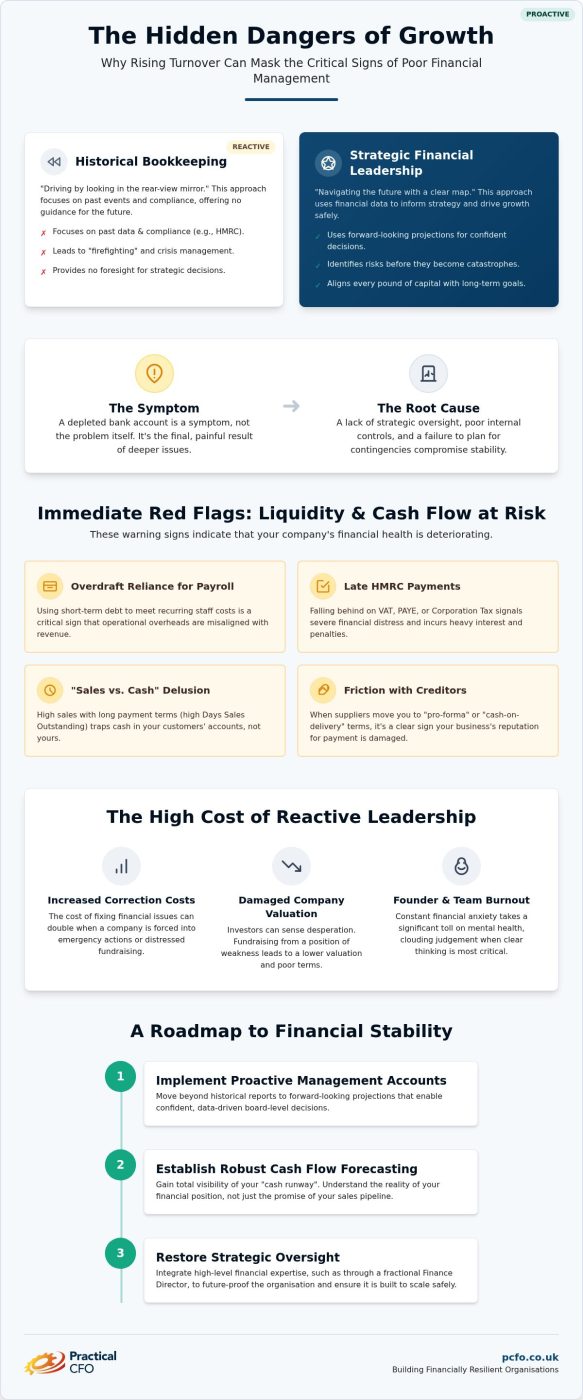
Many directors mistakenly equate financial management with basic bookkeeping. Whilst keeping accurate records for HMRC is essential for compliance, it doesn’t provide the strategic insights needed to navigate a competitive market. True financial leadership involves interpreting data to make informed decisions about the future. When a board lacks this oversight, they often miss the early signs of poor financial management in a company, such as eroding margins or an unsustainable debt-to-equity ratio.
Profitability is not a guarantee of survival. It’s entirely possible for a company to show a healthy profit on paper whilst heading towards insolvency because its cash is tied up in slow-paying debtors or excessive stock. This disconnect often stems from a lack of “financial sanity” at the board level. If directors treat finance as a secondary concern, this behaviour trickles down. Operational teams may stop prioritising cost-efficiency, leading to a culture of waste that eventually compromises the entire organisation’s stability.
Symptoms vs. Root Causes
A depleted bank account is rarely the problem itself; it’s a symptom of a deeper strategic failure. Directors who only review their finances during year-end tax preparation are effectively driving while looking in the rear-view mirror. This reactive approach makes it difficult to distinguish between external market shocks and internal financial mismanagement. Whilst a sudden increase in interest rates or a supplier price hike is a market-driven setback, the inability to absorb that shock often points to a lack of contingency planning and poor internal controls.
The High Cost of Reactive Leadership
Waiting for a crisis to occur before acting is a recipe for value destruction. Reactive leadership often leads to “firefighting,” where directors spend their time placating creditors rather than growing the business. This constant state of anxiety takes a significant toll on founder mental health, often clouding judgment when clear-headed decision-making is most critical. By the time a director notices the signs of poor financial management in a company, the cost of correction has often doubled. When a company is forced into emergency fundraising, its valuation typically suffers, as investors can sense the desperation. It’s much more effective to build a finance function that identifies risks before they become catastrophes. Financial management is a proactive, forward-looking discipline that aligns every pound of capital with the company’s long-term strategic goals.
Liquidity and Cash Flow: The Immediate Red Flags
Liquidity is the lifeblood of any organisation. When cash flow begins to tighten, the first visible signs of poor financial management in a company typically appear in the payroll cycle. Relying on an overdraft or short-term bridging loans to meet recurring staff costs is a critical red flag. It suggests that your operational overheads are out of sync with your revenue collection. This lack of visibility into your “cash runway” makes it impossible to plan for growth or withstand sudden market fluctuations.
Struggling to meet statutory obligations like VAT, PAYE, or corporation tax is another urgent warning sign. In the UK, HMRC acts as a preferential creditor. Falling behind on these payments doesn’t just incur heavy interest; it signals to authorities that the business is in distress. Directors often find that implementing professional outsourced accountancy solutions can restore the visibility needed to manage these liabilities proactively rather than reactively.
The “Sales vs. Cash” Delusion
High growth can be deceptive. Many directors believe that a full sales pipeline guarantees stability, but “over-trading” is a common cause of corporate failure. If you are winning large contracts but lack the working capital to deliver them, you are effectively growing yourself into insolvency. A sales pipeline is a target; a cash flow forecast is a reality. Without a robust forecast, you cannot see the gap between invoicing a client and receiving the funds. This delay, measured as Days Sales Outstanding (DSO), can quickly trap your cash in your customers’ bank accounts rather than your own.
Relationship Friction with Creditors
Your reputation with suppliers is a leading indicator of financial health. When payments become erratic, suppliers often move businesses to “pro-forma” or “cash-on-delivery” terms. This shift is one of the most significant signs of a company in trouble, as it immediately drains your remaining liquidity. In the UK market, these delays are often reported to credit agencies, damaging your business credit score and making future funding more expensive or entirely inaccessible.
Identifying these signs of poor financial management in a company early allows for a strategic pivot before the damage becomes permanent. If you’re spending more time managing creditor calls than strategic planning, it’s time to seek a steady hand for your financial strategy. Proactive cash management ensures that your growth is funded by sustainable margins rather than emergency debt.
Reporting Failures and Strategic Blind Spots
Effective financial leadership relies on the speed and accuracy of information. When management accounts arrive more than 15 days after the month-end, they transition from a steering tool into a historical curiosity. This delay is one of the most common signs of poor financial management in a company. It leaves directors making decisions based on outdated realities, unable to course-correct before small issues evolve into systemic failures. Information must be timely to be actionable.
A robust reporting suite must look beyond the past. Many firms focus exclusively on historical profit and loss statements, yet they lack the forward-looking projections needed to anticipate future capital requirements. Without an ability to explain variances between actual performance and original budgets, the board operates in a vacuum. These gaps often stem from internal control weaknesses that prevent the finance function from providing a single version of the truth. If your team cannot explain why a specific department exceeded its budget, your oversight is purely superficial.
The Dangers of “Blind” Decision-Making
Strategic growth requires more than ambition; it requires a calculated assessment of risk and reward. Making significant capital investments based on a “gut feel” rather than a rigorous ROI analysis is a frequent precursor to insolvency. Without data-backed insights, you cannot determine if a new project will enhance or dilute your company’s value. To understand how a high-performing finance function should operate, it’s helpful to review the strategic role of a Finance Director. This transition ensures that every board-level decision is rooted in objective reality rather than optimistic guesswork.
Inaccurate or Fragmented Data
Many SMEs find themselves trapped in “Excel Hell”, where critical financial data is scattered across disconnected spreadsheets. This fragmentation is a clear sign that your finance team is overwhelmed by manual data entry, leaving little time for high-level analysis. When different departments present conflicting figures, it leads to “boardroom paralysis”. Directors become so preoccupied with debating which number is correct that they fail to address the underlying strategic challenges. Restoring data integrity involves:
- Implementing integrated systems that provide real-time visibility across the organisation.
- Standardising data entry to eliminate human error and duplication.
- Developing tailored KPIs that reflect the nuances of your specific business model.
By addressing these reporting failures, you move from a reactive posture to a position of informed, proactive leadership. Recognising these signs of poor financial management in a company is the first step towards building a resilient, data-driven organisation.
Operational Inefficiencies and Scalability Barriers
Financial health is inextricably linked to operational efficiency. When internal processes are weak, profit “leaks” through the cracks in service delivery or inventory management. High staff turnover within the finance or administration departments is one of the most telling signs of poor financial management in a company. It often indicates a chaotic environment where a lack of clear systems leads to burnout and errors, further destabilising the organisation’s foundation.
Inconsistent pricing strategies represent another significant barrier to growth. If your pricing model doesn’t accurately reflect true overhead costs, including indirect expenses and inflation, your margins will inevitably compress as you scale. Without a formalised budget or a robust “spend-control” framework, departments often operate in silos. This lack of coordination makes it impossible to maintain a lean, efficient operation that can withstand economic pressure.
The Complexity Trap of Scaling
Systems designed for a company with a £1m turnover rarely survive the transition to £5m or £10m. As an organisation grows, the complexity of its financial requirements increases exponentially. Many SMEs fall into the “middle-market trap,” where their legacy processes are no longer fit for purpose. This is the point where seeking business growth advisory uk becomes essential to restructure for the next stage of development.
The “Founder Bottleneck” is a common symptom of this trap. When a CEO is still required to approve every minor invoice or expense, it signals a lack of trust in internal controls and a failure to delegate financial authority. This behaviour limits the company’s agility and prevents the leadership from focusing on high-level strategy. Transitioning to a professionalised finance function allows for the decentralisation of decision-making without losing oversight.
Exit Readiness and Long-Term Value
A business is only as valuable as its records suggest. Poor record-keeping and fragmented data are clear signs of poor financial management in a company that can derail a potential sale. If your accounts aren’t “due diligence ready,” you’ll struggle to secure the best possible terms during an acquisition. Investing in professional exit strategy planning ensures that your organisation is structured to maximise its market appeal from the outset.
Clean, transparent, and audited-standard financials directly impact company valuation multiples by reducing the perceived risk for potential buyers. By addressing operational inefficiencies today, you protect the equity you’ve built for tomorrow. If you’re ready to future-proof your business, our Finance Director services provide the strategic hand needed to navigate these scalability barriers.
Restoring Financial Health with Strategic Leadership
Identifying the signs of poor financial management in a company is a vital diagnostic step, but restoration requires a fundamental shift in leadership. Many SMEs remain trapped in a cycle of reactive accounting, where the finance function exists merely to satisfy HMRC or file year-end returns. To protect growth, directors must transition towards proactive financial leadership. This involves moving beyond simple record-keeping to a model where data informs every strategic move, ensuring the organisation is resilient enough to thrive amidst the high corporate failure rates seen in 2026.
This transformation often requires a psychological shift at the board level. Directors must move from a mindset of “saving tax” to one of “building value”. Whilst tax efficiency is important, it shouldn’t be the primary driver of your financial strategy. A value-oriented approach focuses on strengthening the balance sheet, improving liquidity, and ensuring the business is attractive to future investors or buyers. It’s about professionalising the finance function so it becomes a driver of profit rather than just an administrative cost centre.
The Fractional FD/CFO Solution
Most growing SMEs don’t yet require a full-time executive salary on their payroll. However, they do need the high-level expertise that a seasoned professional provides. A fractional Finance Director or CFO offers this board-level oversight at a fraction of the cost of a permanent hire. This model provides the “steady hand” needed to fix historical mismanagement and implement robust internal controls. If you are looking for an established firm to help professionalise your finance function, click here to find out more. Doing so immediately improves confidence amongst lenders and stakeholders, as they can see a clear, expert-led path toward financial stability.
If you’ve recognised the signs of poor financial management in a company, you need a structured roadmap to mastery. This four-step framework serves as an immediate remediation plan:
- Step 1: Conduct a comprehensive financial health audit. Review all historical data to identify hidden liabilities, margin leaks, and process inefficiencies.
- Step 2: Establish a 13-week rolling cash flow forecast. This provides the short-term visibility needed to manage liquidity and anticipate funding requirements before they become crises.
- Step 3: Define clear KPIs and a monthly reporting rhythm. Ensure management accounts are delivered within 10 days of month-end, focusing on forward-looking metrics tailored to your business model.
- Step 4: Align the finance function with your long-term exit strategy. Every financial decision today should contribute to the valuation you hope to achieve tomorrow.
Implementing this roadmap restores “financial sanity” and allows directors to focus on their core mission: growing the business. By embedding strategic oversight into your daily operations, you ensure that your organisation is not just surviving, but actively building sustainable, long-term value. If you’re ready to move from reactive firefighting to proactive growth, our Finance Director services provide the strategic partnership necessary to navigate this transition with confidence.
Securing Your Organisation’s Financial Future
Recognising the signs of poor financial management in a company is the first essential step toward long-term stability. The transition from reactive bookkeeping to proactive strategic oversight is what separates scaling businesses from those that succumb to corporate distress. By prioritising cash flow visibility, data integrity, and operational efficiency, you protect your equity and ensure your firm remains “due diligence ready” for any future exit.
Restoring financial health doesn’t require a full-time executive salary. Our expert Finance Director services provide growing UK businesses with the board-level expertise needed to navigate complex growth cycles and exit support. We offer deep experience in business growth advisory to help you move from financial anxiety to strategic confidence. If you’re ready to professionalise your finance function and build a more resilient organisation, you can book a strategic finance consultation with PCFO today. Let’s work together to turn your financial data into your greatest competitive advantage.
Frequently Asked Questions
What is the first sign of poor financial management in a company?
Unexpected cash shortages often serve as the earliest warning. You might find that whilst sales are strong, the bank balance doesn’t reflect the growth. This usually points to underlying signs of poor financial management in a company, such as inefficient credit control or high overheads. When a director begins to rely on short-term lending or overdrafts to meet recurring obligations like payroll, it indicates that the current financial structure is no longer fit for purpose.
Can a company be profitable but still have poor financial management?
Profitability on a Profit and Loss statement does not guarantee liquidity. A business can be profitable but still face insolvency if its cash is trapped in slow-paying debtors or excessive inventory. This “paper profit” delusion is a classic sign of inadequate oversight. Without a strategic hand to manage working capital, a growing firm can easily over-trade, leading to a situation where the business literally runs out of cash whilst technically making money.
How does poor financial management affect business growth in the UK?
In the UK market, poor oversight creates a “glass ceiling” that prevents sustainable scaling. It leads to margin compression as overheads grow faster than revenue, and it often results in a damaged business credit score due to erratic supplier payments. This makes securing competitive funding nearly impossible. Beyond the balance sheet, it causes boardroom paralysis, where directors spend their time firefighting operational crises rather than executing the long-term strategic growth plans necessary for success.
What is the difference between an accountant and a Finance Director?
A standard accountant typically focuses on historical reporting and compliance, ensuring your returns are filed correctly with HMRC. In contrast, a Finance Director acts as a strategic partner who looks forward. They interpret the numbers to guide board-level decisions, manage investor relations, and oversee business planning. Whilst the accountant ensures you are compliant with the law, the Finance Director ensures your organisation is actually built to scale and maximise its eventual exit value.
How much does a fractional CFO cost for a UK SME?
The cost of a fractional CFO is structured to provide high-level expertise at a fraction of the expense of a full-time executive hire. Instead of a permanent six-figure salary, UK SMEs pay for only the specific days or hours required to manage their strategic needs. This model offers flexibility, allowing firms to scale their level of support up or down as the business evolves. It ensures that even mid-sized organisations can access board-level financial leadership.
What are the legal implications for directors of poor financial management?
UK directors have a fiduciary duty to act in the best interests of the company and its creditors. Persistent signs of poor financial management in a company can lead to personal liability if the business continues to trade whilst insolvent. Under the Insolvency Act 1986, directors can face disqualification or be held personally liable for company debts if they are found guilty of “wrongful trading” or failing to maintain adequate financial records and internal controls.
How can I fix my company’s financial management quickly?
A standard accountant typically focuses on historical reporting and compliance, ensuring your returns are filed correctly with HMRC. When evaluating potential partners, The Sphere Group offers a detailed guide on how to find the right accountant to support your specific business goals. In contrast, a Finance Director acts as a strategic partner who looks forward. They interpret the numbers to guide board-level decisions, manage investor relations, and oversee business planning. Whilst the accountant ensures you are compliant with the law, the Finance Director ensures your organisation is actually built to scale and maximise its eventual exit value.
You should consider a part-time Finance Director when your turnover reaches a point where basic bookkeeping no longer provides the insights you need to scale. Common triggers include preparing for a funding round, managing complex growth across multiple departments, or planning a strategic exit. If you find yourself making major capital investments based on “gut feel” rather than ROI data, it is time to secure a steady, experienced hand to guide your strategy.