

A capital expenditure request isn’t a plea for funds; it’s a strategic invitation for the board to co-author the company’s future growth. Many finance leaders approach the boardroom with a sense of trepidation, fearing that a meticulously prepared proposal might be dismissed due to cash flow concerns or a perceived lack of immediate ROI. You likely recognise the frustration of a project stalling because the strategic value didn’t translate clearly into the board’s financial language. Understanding how to get board approval for capital expenditure requires more than just spreadsheets; it demands a narrative that mitigates risk whilst proving commercial resilience.
With UK business investment increasing by 1.7% in the second quarter of 2026, there’s a clear momentum for expansion, yet boards remain cautious. This article provides a professional framework designed to secure board buy-in and drive sustainable growth. You’ll master the art of the CapEx business case through a structured approach that aligns your financial requests with long-term corporate strategy. We’ll examine how to quantify returns effectively and present your proposal with the calm confidence of a seasoned strategic partner, ensuring your next investment is seen as a vital catalyst for the business.
Key Takeaways
- Understand the board’s shift towards risk mitigation in the 2026 economic climate and how to align your proposal with their strategic oversight.
- Master a structured 5-step framework on how to get board approval for capital expenditure by bridging the gap between operational needs and financial rigour.
- Utilise sophisticated financial metrics and sensitivity analysis to move beyond simple payback periods and prove long-term commercial value.
- Implement the “no surprises” rule to build consensus with key stakeholders and influencers before the formal boardroom presentation.
- Recognise how a fractional CFO or Finance Director provides the objective leadership and technical expertise required to secure approval for critical growth investments.
Understanding the Boardroom Perspective on Capital Expenditure
The board of directors serves as the ultimate arbiter of a company’s financial health and strategic direction. Their primary focus isn’t merely on the “what” of a proposal, but the “why” and the “what if”. In 2026, this scrutiny has intensified. With the main rate of corporation tax at 25% for profits over £250,000 and economic uncertainty lingering, directors are acutely aware of their fiduciary duty to protect shareholder value. They view every pound spent as a trade-off between growth and liquidity. Understanding this perspective is the first step in learning how to get board approval for capital expenditure.
To the board, there’s a fundamental distinction between maintaining operations and funding growth. Whilst operational spending keeps the business running today, What is Capital Expenditure? refers to the funds used by a company to acquire, upgrade, and maintain physical assets. These investments are strategic; they’re bets on the future. Because these projects often involve significant cash outlays and long-term commitments, boards are naturally skeptical. They’ve seen projects fail to deliver promised returns or, worse, become “sunk cost” traps that drain resources without moving the needle.
The Psychology of Approval: Risk vs Reward
Every board member evaluates a proposal through the lens of opportunity cost. If they approve a £500,000 investment in new machinery, they’re simultaneously deciding not to spend that money on marketing, hiring, or debt reduction. Their hesitation often stems from specific psychological barriers. Directors worry about the accuracy of long-term economic forecasts and the impact of the investment on the company’s ability to handle unforeseen shocks. Mitigating these risks through comprehensive commercial protection, such as that provided by WS Insurance Brokers, can help reassure the board that physical assets are secured against external threats. They also weigh execution risk, questioning whether the management team can deliver the project on time and within the projected budget.
A successful proposal never exists in a vacuum. It must be the logical next step in your three-year business plan. Boards are far more likely to approve requests that directly support established Key Performance Indicators (KPIs), such as increasing production capacity or reducing operational overheads. Timing is equally critical. Presenting a major request when the Bank of England base rate is 3.75% requires a narrative that accounts for the cost of capital. You must demonstrate that the investment isn’t just a good idea, but the right idea for this specific moment in the business lifecycle. Aligning your request with these strategic goals is essential for anyone mastering how to get board approval for capital expenditure.
The 5-Step Framework for a Compelling CapEx Proposal
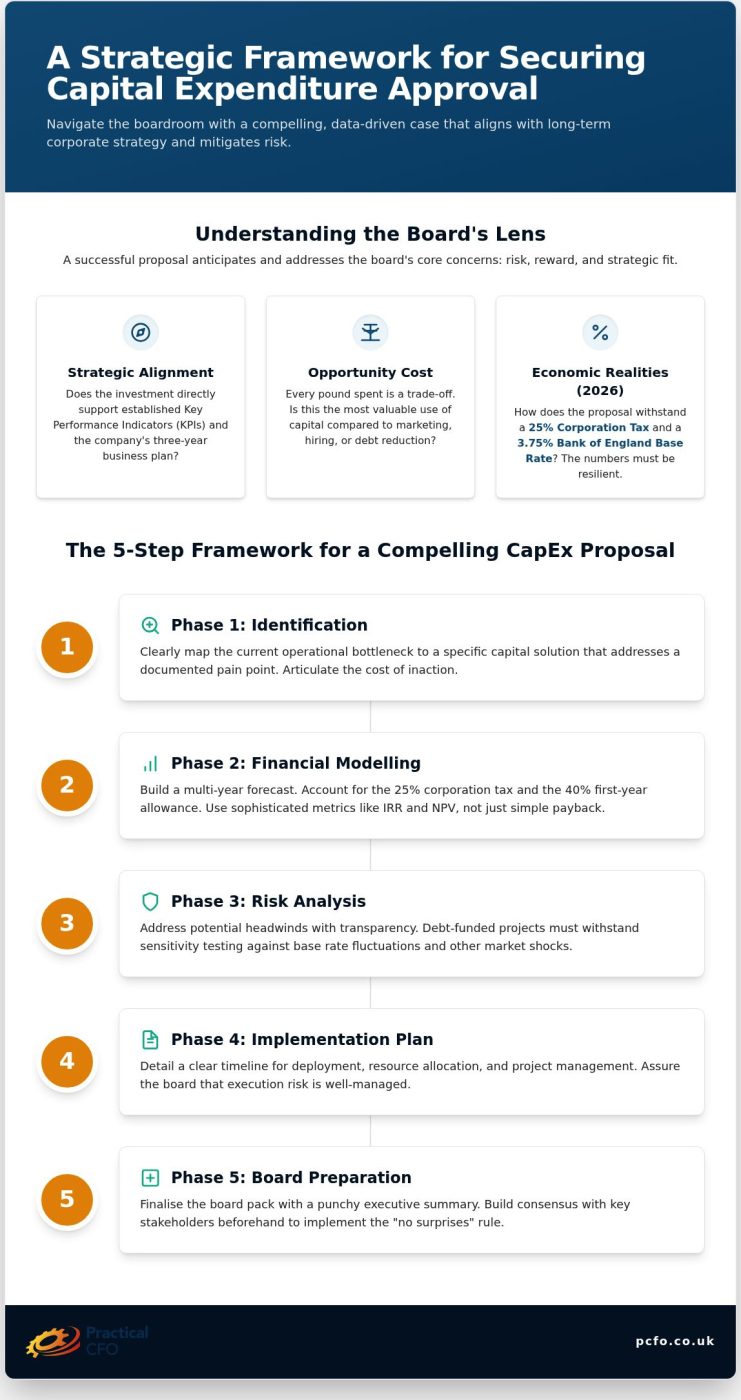
Securing a “yes” in the boardroom requires a methodical approach that mirrors how directors evaluate risk. A fragmented proposal often leads to rejection, even if the underlying project is sound. To understand how to get board approval for capital expenditure, you must transition from an operational request to a strategic business case. This five-phase framework provides the necessary rigour to satisfy even the most skeptical board members whilst demonstrating exactly how to get board approval for capital expenditure.
- Phase 1: Identification. Clearly map the current operational bottleneck to a specific capital solution that addresses a documented pain point.
- Phase 2: Modelling. Build a multi-year forecast. Ensure you account for the 25% main rate of corporation tax and the 40% first-year allowance for main rate assets introduced in January 2026.
- Phase 3: Risk. Address potential headwinds with transparency. With the Bank of England base rate held at 3.75% in July 2026, debt-funded projects must withstand sensitivity testing against further rate fluctuations.
- Phase 4: Implementation. Detail the timeline for deployment. Boards need to know how this investment affects current production cycles and resource allocation.
- Phase 5: Preparation. Finalise the board pack with a focus on clarity, strategic alignment, and a punchy executive summary.
Defining the Business Case
The business case serves as a bridge between current capacity and future goals. It’s not enough to list the benefits of new technology; you must articulate the cost of inaction. Compare the proposed investment against a “do nothing” scenario. If maintaining the status quo leads to a documented decline in efficiency or a loss of market share, the board sees the expenditure as a defensive necessity rather than a discretionary luxury. To strengthen the financial viability of your case, you can learn more about TMS Finance and their IT equipment finance options. This shift in perspective is vital for gaining traction and proving that the investment is a catalyst for sustainable growth.
Structuring the Board Pack
A board pack shouldn’t be a dense collection of spreadsheets. It must be a curated narrative that respects the reader’s time. Use high-level visualisations to illustrate ROI and payback periods, ensuring the most critical data is accessible at a glance. Utilising an outsourced accountancy solution can provide the independent financial rigour that boards trust. External validation often removes the perception of internal bias, making your forecasts more credible. If you need assistance in crafting a narrative that resonates, our Chief Financial Officer services can provide the strategic oversight required for success.
Quantifying the Return: Financial Metrics that Move the Needle
A spreadsheet of optimistic projections rarely wins over a boardroom. Directors expect a level of technical depth that moves beyond basic arithmetic. Mastering how to get board approval for capital expenditure requires you to demonstrate that you’ve accounted for the time value of money, tax efficiencies, and potential economic volatility. By integrating these metrics into your strategic budgeting and forecasting, you present a proposal that is grounded in financial reality rather than aspiration. This technical rigour builds the trust necessary for the board to release significant funds.
NPV, IRR, and Payback Periods Explained
Net Present Value (NPV) remains the gold standard for capital allocation. It tells the board what future cash flows are worth in today’s pounds, accounting for the current 3.75% base rate. Internal Rate of Return (IRR) provides a percentage that the board can benchmark against other investment opportunities or the company’s weighted average cost of capital. Simple payback periods are easy to grasp, but they often ignore the value of cash flows after the initial outlay is recovered. Presenting a discounted payback period shows a more sophisticated understanding of risk and liquidity, which is essential when explaining how to get board approval for capital expenditure.
UK tax implications significantly alter the net cost of any investment. From 1st April 2026, the main rate of writing-down allowance for plant and machinery was reduced to 14%. This slows the pace of tax relief compared to previous years. However, the 40% first-year allowance introduced in January 2026 provides an immediate benefit for many assets. Your proposal must reflect these specific 2026 regulations to remain credible. Failing to account for these changes can lead to a significant overestimation of the project’s net cash flow in the early years.
Non-Financial Returns and Intangible Benefits
Intangible benefits often tip the scale in a close decision. In a competitive UK labour market, capital expenditure that improves staff retention or operational safety carries immense weight. Similarly, Environmental, Social, and Governance (ESG) factors are no longer optional extras. Projects that align with sustainability goals often face less resistance, as they future-proof the business against regulatory shifts. Quantifying these as “strategic value drivers” helps the board see the bigger picture. It transforms the request from a simple purchase into a vital component of the company’s long-term market positioning and brand reputation.
Navigating the Boardroom: Presentation and Stakeholder Management
Securing a positive outcome in the boardroom is rarely the result of a single brilliant presentation. Instead, it’s the culmination of weeks of strategic alignment and relationship management. If you’re learning how to get board approval for capital expenditure, you must understand that the formal meeting is often where decisions are ratified, not where they’re made. The most successful proposals follow the “no surprises” rule, ensuring that every director is already familiar with the core arguments before the papers are even tabled.
Pre-Meeting Diplomacy
A proactive approach involves conducting one-to-one briefings with key stakeholders. You need to identify the “Economic Buyer”, often the CEO or Chairman, who focuses on the bottom line, and the “Technical Influencer”, such as an Operations Director, who cares about the practical deployment. Addressing departmental concerns early prevents friction during the formal session. For example, if the Operations team worries about downtime during a machine upgrade, you should solve that problem in your draft rather than defending it in public. Refining your proposal based on this informal feedback demonstrates a collaborative mindset rather than a rigid, transactional one.
Managing the Presentation
When the day of the board meeting arrives, your focus should shift from the granular data to the overarching narrative. Whilst the spreadsheets must be robust, the board needs to hear the strategic “why”. Use board level financial advice to lend weight to your claims, positioning the investment as a proactive step towards future-proofing the business. It’s vital to remain composed when facing difficult questions. If a director challenges a specific ROI figure, know when to stand firm on your modelling and when to concede that certain variables, like future energy costs, are subject to sensitivity ranges.
Common objections often centre on cash flow impact or timing. With the Bank of England base rate at 3.75%, boards are naturally protective of liquidity. You should be prepared to explain why delaying the investment is more expensive than proceeding now. A fractional Finance Director often plays a crucial role here, acting as an objective facilitator who can translate complex financial risks into clear, strategic choices. If you’re struggling to bridge the gap between financial data and board-level persuasion, our Finance Director services can help you navigate these complex internal dynamics with confidence.
How a Fractional FD Secures CapEx Approval for SMEs
UK SMEs often face a unique challenge: they possess the ambition for significant growth but lack the internal executive-level financial leadership to navigate complex capital cycles. A fractional Finance Director provides the strategic rigour of a full-time CFO at a fraction of the cost, acting as the catalyst for successful investment. For many business owners, this outsourced expertise is the defining factor in learning how to get board approval for capital expenditure. By providing an independent and objective voice, a fractional FD removes the perception of internal bias, presenting a business case that is grounded in intellectual rigour rather than departmental optimism.
The primary benefit of this arrangement is the implementation of professional business growth advisory. This ensures that every CapEx request isn’t just a purchase, but a calculated move to drive ROI. Whilst the CEO remains focused on operational execution and the broader vision, the FD manages the intricate details of financial modelling and stakeholder diplomacy. This partnership alleviates the financial anxieties of the leadership team and provides the board with the reassurance that the company’s financial strategy is in a steady, experienced hand.
The Strategic Advantage of Outsourced Leadership
Accessing “Big 4” level expertise allows SMEs to present proposals that meet the highest corporate standards. A fractional FD effectively bridges the gap between the board and the internal finance team, translating operational needs into the high-level language of risk and return. Implementing this level of professional oversight is often the most effective method for how to get board approval for capital expenditure, as it demonstrates that the request has been vetted by an independent expert. This oversight ensures that every proposal remains compliant with UK financial standards and corporate governance, instilling a sense of calm confidence in the boardroom.
Long-term Value Creation
The FD’s role continues long after the board provides its initial approval. Disciplined capital management requires post-approval monitoring to ensure projects stay on budget and deliver the projected efficiency gains. In the volatile economic environment of 2026, this involves iterative forecasting to adjust for fluctuations in the Bank of England base rate or shifts in consumer demand. This level of financial discipline is vital for future exit strategy planning. Acquirers look for businesses that can demonstrate a history of successful capital allocation, and a fractional FD ensures your CapEx history becomes a compelling part of your value narrative.
Securing the Future of Your Capital Investment Strategy
Mastering the art of capital allocation is a transformative step for any scaling UK business. It requires a shift from requesting funds to presenting a robust, risk-mitigated narrative that aligns with long-term strategic goals. By employing technical rigour through sophisticated metrics and staying current with 2026 tax allowances, you provide the board with the confidence they need to sanction growth. Success hinges on a methodical approach that combines financial precision with proactive stakeholder diplomacy. Ultimately, understanding how to get board approval for capital expenditure is about proving that you’re a steady, experienced hand at the helm of the company’s financial trajectory.
If you’re ready to elevate your business case and secure the backing your project deserves, we’re here to support you. Secure your next major investment with professional Finance Director services from PCFO. Our expert fractional CFOs provide the strategic business growth advisory and board-level financial leadership required to turn ambitious plans into reality. With the right partner by your side, the boardroom becomes an environment of opportunity rather than anxiety.
Frequently Asked Questions
What is the most common reason board members reject CapEx proposals?
Rejection usually stems from a failure to demonstrate how the investment mitigates a specific business risk or supports a long-term strategic goal. If the board perceives the request as a discretionary luxury rather than a commercial necessity, they will prioritise cash preservation. Clear communication regarding how to get board approval for capital expenditure involves showing that the cost of inaction exceeds the initial investment outlay.
How much detail should be included in a CapEx board pack?
A board pack should prioritise clarity over volume, featuring a concise executive summary followed by detailed financial modelling in the appendices. Directors need to see the “bottom line” impact quickly, including NPV and payback periods. Whilst the technical data must be robust, the primary document should focus on strategic alignment. Providing too much granular detail in the main presentation can distract from the narrative and invite micro-management.
What is the difference between CapEx and OpEx for board reporting?
CapEx involves spending on long-term assets that appear on the balance sheet, whilst OpEx covers day-to-day operational costs found on the profit and loss statement. For board reporting, CapEx requires a more rigorous approval process due to its impact on liquidity and long-term depreciation. Understanding this distinction is vital when discussing how to get board approval for capital expenditure, as it dictates the tax treatment and the internal rate of return.
How can a small business calculate ROI for intangible investments?
Small businesses can calculate ROI for intangibles by identifying measurable proxy indicators, such as reduced recruitment costs or increased customer lifetime value. If an investment improves brand reputation, you might track the resulting decrease in lead acquisition costs. Whilst these figures are estimates, grounding them in historical data provides the board with a logical basis for approval. This approach effectively transforms “soft” benefits into tangible commercial drivers.
Should I present multiple options or a single recommendation to the board?
You should always present a single, clear recommendation supported by a brief analysis of the alternatives considered. Boards appreciate seeing that you’ve evaluated the “do nothing” scenario and at least one other viable path. This demonstrates due diligence and prevents the board from feeling cornered into a single choice. However, providing too many options can lead to decision paralysis, so keep the focus on your primary strategic preference.
How often should a company review its capital expenditure budget?
Companies should ideally review their capital expenditure budget on a quarterly basis to ensure projects remain aligned with shifting market conditions. In the 2026 economic climate, more frequent monthly reviews may be necessary if interest rates or material costs fluctuate significantly. Regular oversight allows the leadership team to reallocate funds from underperforming projects to those showing higher potential. This iterative approach ensures that capital is always working toward the most profitable goals.
What role does a part-time Finance Director play in the approval process?
A part-time Finance Director acts as an objective strategic partner who brings high-level financial rigour to the proposal process. They are responsible for building the underlying financial models and ensuring the request complies with UK governance standards. Their presence in the boardroom provides an independent perspective that alleviates director anxiety. By acting as a bridge between operations and the board, they ensure the commercial narrative is both persuasive and technically sound.
Can a fractional CFO help with securing external funding for CapEx?
A fractional CFO is instrumental in securing external funding by preparing the “investor-ready” documentation required by banks or venture capitalists. They manage the relationship with lenders and ensure that any debt taken on for CapEx is structured sustainably. Their expertise in business planning and exit strategy support makes the company a more attractive prospect for external investment. They provide the professional oversight that lenders expect when committing significant capital to a growing SME.