

What if the record profits shown in your target company’s latest accounts are actually the result of clever accounting rather than genuine commercial success? It’s a question that keeps many UK business owners awake during a deal. Conducting thorough financial due diligence for acquiring a business isn’t just about ticking boxes for your lender; it’s a strategic stress-test of future cash flow. You’ve likely felt the pressure of a transaction moving quickly and the nagging fear that you might be overpaying for an asset that isn’t quite what it seems on the surface.
We understand that the shift from viewing a business as an opportunity to scrutinising it as a liability is a significant mental hurdle. This guide provides a clear framework to help you master these complexities and mitigate risk effectively. You’ll gain the confidence to negotiate the deal price based on hard facts rather than optimistic projections. We will explore how to distinguish between statutory and management accounts, identify manipulated profit figures, and ensure your next acquisition delivers the long-term value you expect whilst minimising post-completion surprises.
Key Takeaways
- Learn why financial due diligence for acquiring a business is a strategic stress-test of future cash flow rather than a mere historical audit of the past.
- Master the process of assessing the Quality of Earnings to identify non-recurring items and ensure the target’s profitability is genuinely sustainable.
- Recognise common SME red flags, including owner-dependency and inconsistencies between management accounts and year-end statutory filings.
- Utilise a step-by-step checklist to organise the data room and streamline the analysis of tax returns and financial performance.
- Understand how engaging a fractional Finance Director provides high-level expertise to bridge the gap between accountants and business owners during a transaction.
What is Financial Due Diligence for Acquiring a Business?
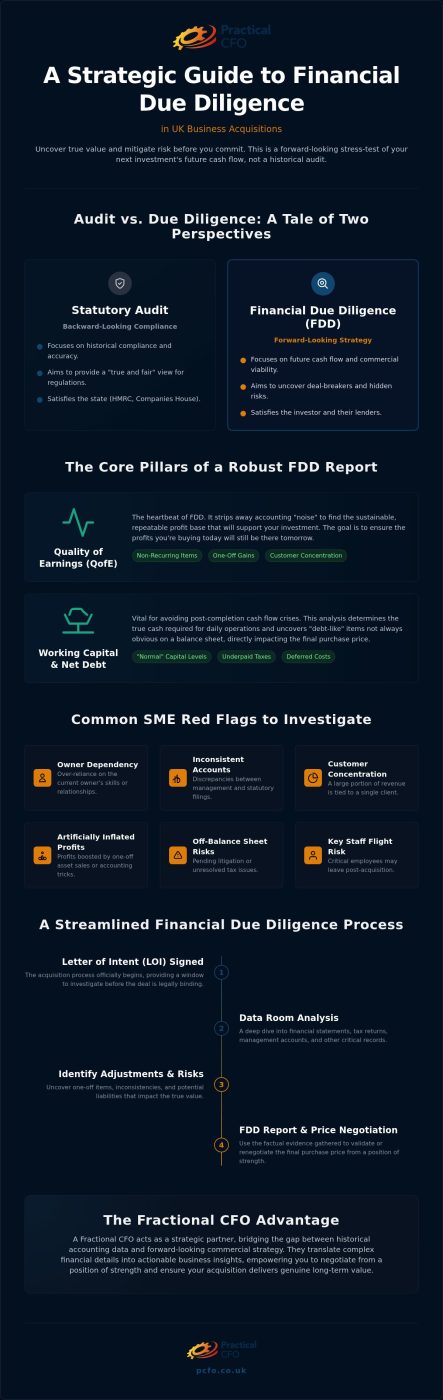
Financial due diligence for acquiring a business is a rigorous investigation into a target company’s financial health. It goes far beyond a cursory glance at bank statements or tax returns. For a UK SME owner, this process serves as the final safeguard before committing significant capital. The primary objective is to validate the Quality of Earnings (QofE); this means ensuring that the profits reported by the seller are sustainable, recurring, and not the result of one-off accounting adjustments. To understand the broader scope of this process, it helps to consider What is due diligence? in a commercial context. In the acquisition lifecycle, this work typically commences immediately after a Letter of Intent (LOI) is signed, providing the buyer with a window to uncover any hidden liabilities before the deal becomes legally binding.
The Difference Between Audit and Due Diligence
It is a common misconception that a “clean” set of audited accounts guarantees a good investment. A statutory audit is a backward-looking compliance exercise designed to ensure accounts are “true and fair” for HMRC and Companies House. In contrast, financial due diligence for acquiring a business is a forward-looking strategic tool. Whilst an accountant focuses on historical accuracy, a Chief Financial Officer looks for commercial viability. FDD investigates whether the business can maintain its current trajectory under new ownership. It looks for “off-balance sheet” risks, such as pending litigation or an over-reliance on a single customer, which a standard audit might not highlight as a financial error.
- Audit: Focuses on historical compliance and regulatory standards.
- Due Diligence: Focuses on future cash flow, underlying profitability, and deal-breakers.
- Perspective: Audits satisfy the state; due diligence satisfies the investor.
Why SMEs Must Prioritise FDD
The Core Pillars of a Robust FDD Report
A robust report moves beyond surface-level data to reveal the target’s underlying economic reality. It examines the Profit & Loss, Balance Sheet, and Cash Flow statements through a strategic lens rather than a purely administrative one. Using a comprehensive due diligence checklist for buying a business ensures no stone is left unturned during the investigation. This is the stage where financial due diligence for acquiring a business transforms into a powerful tool for price negotiation. It isn’t just about finding errors; it’s about understanding the rhythm of the business you’re about to own.
Quality of Earnings (QofE) Analysis
The QofE analysis is the heartbeat of any professional FDD report. Its purpose is to strip away accounting “noise” to find the sustainable profit base that will support your investment. Quality of Earnings is the measure of how repeatable a company’s profits truly are. We look for one-off gains, such as a major insurance payout or the sale of an asset, which might artificially inflate EBITDA. To ensure your future asset is fully protected, working with commercial insurance brokers wakefield can help you audit existing policies and identify hidden risks. High customer concentration is another risk factor. If a significant percentage of revenue comes from a single client, the business’s value is inherently more fragile than the top-line figures suggest. Our role is to ensure the profits you’re buying today will still be there tomorrow.
Working Capital and Net Debt
Determining the “normal” level of working capital is vital to avoid post-completion cash flow crises. You need to know exactly how much cash is tied up in stock and debtors to maintain daily operations without constant reinvestment. We also identify “debt-like” items that aren’t always immediately obvious on a balance sheet. These can include underpaid taxes, deferred maintenance costs, or holiday pay accruals. These findings directly impact the “Equity Bridge” calculation. This calculation bridges the gap between the headline Enterprise Value and the actual cash price you pay at completion. Engaging Chief Financial Officer services on a fractional basis allows you to access this level of forensic scrutiny whilst keeping your transaction costs scalable. By identifying these liabilities early, you gain the factual evidence needed to adjust the deal structure in your favour.
Common Red Flags in SME Financial Due Diligence
Identifying red flags is where financial due diligence for acquiring a business shifts from a clerical exercise to a vital risk-mitigation strategy. In the UK SME market, businesses are often extensions of their owners’ personalities. This can lead to structural weaknesses that aren’t immediately visible on a balance sheet. A primary concern is owner-dependency. If the current founder holds all the key client relationships or possesses unique technical knowledge, the business’s value may evaporate the moment they exit. You aren’t just buying historical profits; you’re buying the ability to generate them in the future without the seller’s presence.
Discrepancies between management accounts and year-end statutory filings are another frequent warning sign. Whilst management accounts provide a real-time view of performance, they often lack the rigour of statutory filings. Significant “reconciling items” at year-end can suggest poor internal controls or, more concerningly, aggressive revenue recognition policies designed to polish the P&L for a sale. Reviewing the British Business Bank’s due diligence checklist can help you categorise these risks effectively. You should also look for signs of under-investment. A sudden drop in capital expenditure or staff training costs in the eighteen months prior to a sale often indicates a seller is “fattening the pig” by artificially boosting short-term cash flow at the expense of long-term infrastructure.
Normalising Earnings: The CFO’s Secret Weapon
SME accounts frequently include “lifestyle” costs that won’t persist under your ownership. Normalising earnings involves adding back personal expenses, such as luxury company cars, non-commercial travel, or family members on the payroll who don’t contribute to operations. Conversely, you must adjust for market-rate salaries. Many founders underpay themselves to make the business look more profitable. A professional pro-forma P&L replaces these anomalies with realistic commercial costs, giving you a true reflection of the earnings you’ll actually inherit. This ensures you pay a multiple based on genuine economic performance rather than an inflated figure.
Operational Risks Disguised as Financials
Financial data often masks deeper operational issues. High staff turnover might look like a manageable recruitment expense, but it signals a cultural or structural problem that will drive up future training costs and disrupt client service. Similarly, look closely at the “aged debtors” report. A high volume of invoices older than ninety days suggests either a weak credit control process or, worse, customers who are unhappy with the service and refusing to pay. We also scrutinise lease agreements and inventory. Stagnant stock that hasn’t moved in six months is a liability, not an asset, and upcoming lease breaks can create forced relocation costs that haven’t been factored into the seller’s valuation.
A Step-by-Step Financial Due Diligence Checklist
Financial due diligence for acquiring a business is most effective when executed in distinct, logical phases. This structured approach prevents information overload; it ensures that critical deal-breakers are identified before you incur excessive legal fees. The process typically moves from broad data collection to forensic analysis and, finally, to strategic negotiation. By following a methodical programme, you maintain control over the transaction timeline whilst building a comprehensive risk profile of the target company.
- Phase 1: Information Request and Data Room Setup. Establish a secure environment to review the seller’s core financial documents.
- Phase 2: Detailed Analysis. Scrutinise management accounts, tax returns, and cash flow patterns to verify the underlying profitability.
- Phase 3: Management Interviews and Site Visits. Test the narrative behind the numbers by speaking directly with the key leadership team.
- Phase 4: Synthesis and Negotiation. Translate the findings into a final deal structure that protects your capital.
Navigating the Data Room
The data room is the engine room of the transaction. Essential documents include at least three years of VAT returns, payroll records, and monthly bank statements. You must stay alert for “evasive” data entries; for instance, if a seller provides summaries rather than detailed transactional ledgers, it may indicate an attempt to hide inconsistent margins or aged debtors. Organising the review process by risk category helps you avoid analysis paralysis. Focus first on high-impact areas such as revenue recognition and tax compliance. Many sophisticated sellers utilise exit strategy planning services to ensure their data room is professional and transparent, which often facilitates a smoother transaction for both parties.
From Findings to Negotiation
A professional FDD report is your most potent tool during the final stages of a deal. If the analysis identifies structural weaknesses or overstated profits, you have the factual evidence required to justify a price reduction. This is often referred to as “chipping” the price. Beyond a simple discount, you can use these findings to structure the deal more safely. For example, you might implement holdbacks or earn-outs. These mechanisms make a portion of the purchase price contingent on the business achieving specific financial milestones post-acquisition. If you are currently assessing a potential acquisition, our Finance Director services can manage this entire checklist on your behalf, providing the calm, expert oversight needed to secure a fair deal.
The Strategic Advantage of a Fractional CFO in Acquisitions
Engaging a fractional Chief Financial Officer (CFO) provides a strategic edge that traditional law firms or standard accountants cannot replicate. Whilst legal teams focus on the share purchase agreement and accountants verify historical data, the fractional CFO evaluates the deal’s commercial future. This role serves as an authoritative partner; we bridge the gap between the seller’s financial reporting and your strategic goals. Effective financial due diligence for acquiring a business requires this forward-looking perspective to ensure the target’s cash flow can support your long-term debt obligations and growth ambitions. We act as an embedded advisor, translating complex data into the actionable intelligence you need to lead a successful transition.
Fractional CFO vs Full-Time Hire
For many UK SMEs, hiring a full-time C-suite executive just for a transaction is neither practical nor cost-effective. You need high-level expertise during the deal, yet a permanent salary commitment can strain the post-acquisition P&L. A fractional model allows you to access veteran expertise only when you need it. For context on how this investment delivers ROI, you can review fractional cfo pricing uk. PCFO provides a steady hand during the intense negotiation phase. This allows you to focus on operational synergy and staff integration whilst we handle the forensic scrutiny of the target’s debt, working capital, and earnings quality. It’s a scalable solution that brings Big Four experience to a boutique setting.
Securing Your Future Growth
The work doesn’t end when the deal completes. The first 100 days of financial control are critical for establishing the reporting standards needed to monitor your new asset. We help you implement robust outsourced accountancy solutions that provide the combined group with a single, clear version of the truth. Once the integration is stable, we pivot to business growth advisory uk to build a three-year strategic roadmap. This ensures that the financial due diligence for acquiring a business translates into measurable growth and scalable value. We don’t just help you buy a business; we help you build an enterprise. Contact PCFO for a confidential consultation on your acquisition plans to ensure your next deal is built on facts, not assumptions.
Securing Your Next Acquisition with Confidence
Mastering the complexities of financial due diligence for acquiring a business is the difference between a strategic success and a costly mistake. By shifting your focus from historical compliance to forward-looking viability, you protect your capital and ensure the target’s earnings are truly sustainable. We’ve explored the importance of the Quality of Earnings, the necessity of identifying owner-dependency, and the tactical advantage of using a structured checklist to navigate the data room.
At PCFO, we provide expert Fractional CFOs with deep M&A experience to lead this process on your behalf. Our partner-led approach is tailored specifically for UK SMEs, offering a proven track record in business growth and exit advisory. We act as your authoritative strategic partner, helping you negotiate from a position of factual strength whilst you focus on the operational future of your new entity. Don’t leave your investment to chance. Book a Strategic Consultation with PCFO today to discuss your acquisition plans. We look forward to helping you build a more valuable and resilient business.
Frequently Asked Questions
How long does financial due diligence typically take for a UK SME?
For a typical UK SME, the process usually takes between four and eight weeks. This timeline depends heavily on the quality of the target’s data room and the responsiveness of their finance team. If the seller has already prepared professional management accounts, the review can be completed more swiftly. Conversely, messy records or missing VAT returns can extend the investigation, as your advisors must manually reconcile the figures to find the truth.
What is the difference between financial and commercial due diligence?
Financial due diligence focuses on the accuracy of the numbers and the sustainability of profits. It examines historical performance and cash flow patterns to ensure the asking price is fair. Commercial due diligence, however, looks outward at the market, competition, and customer behaviour. Whilst financial due diligence for acquiring a business validates the P&L, commercial reviews assess whether the business model itself remains viable in a changing economic landscape.
Can I perform financial due diligence myself as a business owner?
Whilst you can review bank statements and basic reports, conducting your own forensic analysis is highly risky. Business owners often lack the technical distance and specialised accounting knowledge required to spot manipulated EBITDA or hidden liabilities. Professional oversight ensures that emotional bias doesn’t cloud your judgement. An external Finance Director provides the intellectual rigour necessary to stress-test the target’s claims, protecting your capital from unforeseen post-completion shocks.
How much does a financial due diligence report cost in the UK?
The cost of a report varies significantly based on the size of the transaction and the complexity of the business structure. For most mid-market deals, fees are typically structured as a fixed project cost or an hourly advisory rate. Rather than viewing this as an administrative expense, successful buyers treat it as an insurance policy. The investment often pays for itself by identifying “chips” in the deal price or uncovering risks that justify walking away.
What happens if we find “red flags” during the due diligence process?
Identifying a red flag doesn’t always mean the deal is dead. It provides a factual basis to renegotiate the purchase price or restructure the transaction. You might implement an “earn-out” where part of the payment is contingent on future performance, or a “holdback” to cover potential tax liabilities. In extreme cases, where the financial integrity of the business is compromised, the best course of action is to walk away from the deal entirely.
Is financial due diligence necessary for a small asset purchase?
Yes, even small asset purchases carry significant financial risks. You need to ensure that the assets you are buying, such as equipment or intellectual property, are free from undisclosed liens or maintenance backlogs. Furthermore, financial due diligence for acquiring a business helps you understand the true cost of operating those assets post-completion. Without this scrutiny, you might inherit hidden operational expenses that quickly erode the value of your new acquisition.
What are “debt-like items” in a business acquisition?
Debt-like items are liabilities that aren’t classified as formal bank debt but still reduce the company’s equity value. Common examples for UK SMEs include outstanding VAT payments, aged trade creditors, and accrued holiday pay. We also look for deferred maintenance costs or underfunded pension schemes. During the “Equity Bridge” calculation, these items are deducted from the headline Enterprise Value to determine the actual cash amount you pay to the seller.
How does FDD affect the final Share Purchase Agreement (SPA)?
The findings from the FDD report directly shape the warranties and indemnities within the Share Purchase Agreement. If a specific risk is identified, such as a pending tax dispute, your solicitors will draft a specific indemnity to protect you from the financial fallout. It also dictates the final completion accounts mechanism, ensuring the purchase price is adjusted based on the actual working capital and net debt delivered on the day of completion.