

The very growth that makes your business attractive for Series A could be the same factor that causes your funding round to fail during due diligence. In 2026, UK venture capital firms are looking beyond top-line revenue, focusing instead on the underlying financial discipline that ensures long-term scalability. You’ve likely felt the pressure of moving from a visionary Seed round to the rigorous demands of institutional investment. It’s common to worry about inconsistent reporting or how to present complex unit economics whilst managing daily operations.
We recognise that navigating this transition requires more than just a pitch deck; it requires a disciplined financial roadmap. This guide explores the essential components of business planning for series A funding UK, offering a framework to professionalise your finance function before the raise. You’ll learn how to master the rigorous strategic requirements of the current market and understand the primary drivers of 2026 valuations. We will preview how to build a board-ready plan that secures your funding with minimal dilution, providing the calm confidence needed to lead your business through its most significant capital raise yet.
Key Takeaways
- Understand why 2026 investors prioritise sustainable unit economics over rapid growth, requiring a shift from visionary Seed decks to predictable financial roadmaps.
- Master the financial architecture needed for institutional investment, including integrated 3-statement models and key performance benchmarks like the “Rule of 40”.
- Discover how a fractional CFO provides board-level strategic oversight and due diligence preparation at a fraction of the cost of a full-time executive hire.
- Implement a structured framework for business planning for series A funding UK to create a comprehensive “Series A Dossier” that clearly articulates your use of proceeds.
- Professionalise your governance and financial reporting early to instil investor confidence and secure your funding round with minimal equity dilution.
The Shift from Seed to Series A: Why Your Business Plan Must Evolve
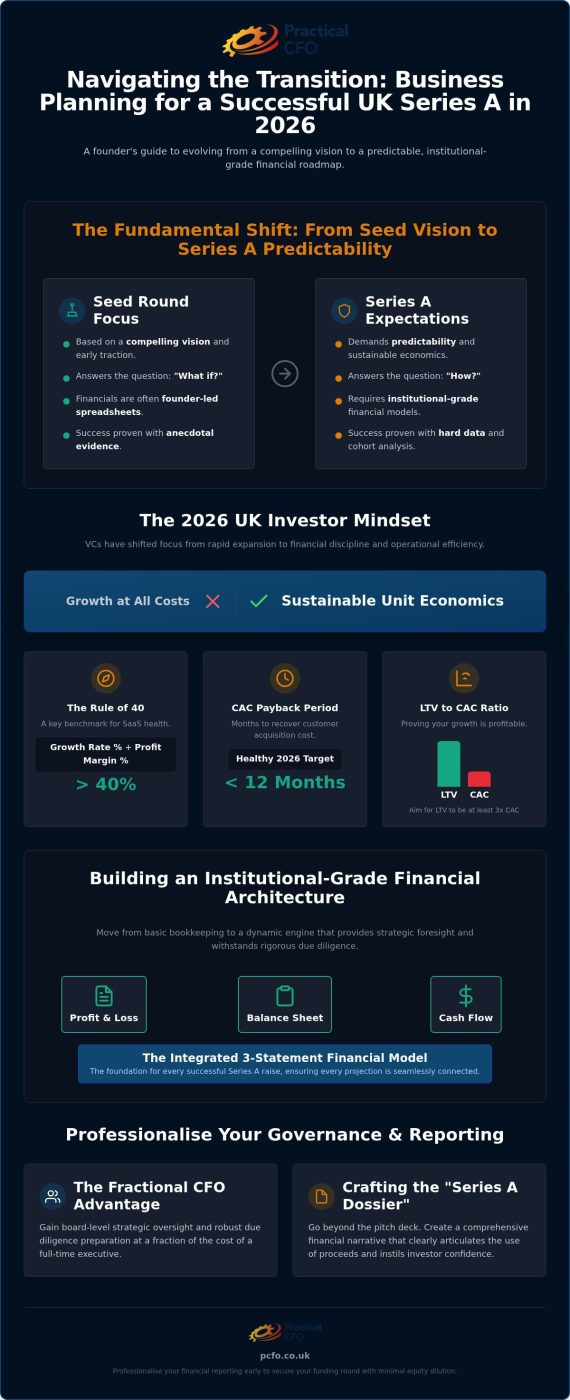
Transitioning from Seed to Series A funding represents a fundamental shift in how your business is perceived. Whilst Seed rounds are often secured on the back of a compelling vision and early traction, Series A is the point where potential must be replaced by predictability. For founders, business planning for series A funding UK involves building a bridge between the “what if” of a startup and the “how” of a scale-up. In 2026, UK investors have moved decisively away from “growth at all costs.” They now prioritise sustainable unit economics and a clear path to profitability, requiring a level of financial rigour that few Seed-stage companies possess.
This evolution demands a professionalised narrative. Institutional venture capital firms aren’t just looking for a great product; they’re looking for a professional management team that understands their levers of growth. Moving from founder-led spreadsheets to institutional-grade management accounts is a prerequisite for success. It signals that you’ve outgrown the “accidental” accounting of the early days and are ready for the scrutiny of a multi-million-pound raise. It’s about demonstrating that your business is a reliable machine ready for capital injection.
Proving Product-Market Fit with Hard Data
Investors in 2026 expect more than anecdotal evidence of success. Your business plan must pivot from “finding what works” to “scaling what works” through rigorous cohort analysis and retention metrics. Historical data should serve as the foundation for your future growth projections. If you can’t demonstrate that your customer acquisition cost (CAC) remains stable as you scale, or that your lifetime value (LTV) is grounded in actual user behaviour, your raise will likely stall. You need to prove that every pound invested has a predictable, repeatable return.
Moving Beyond Founder-Led Financials
Relying on basic spreadsheets creates significant risk during due diligence. Inconsistent reporting or a lack of integrated financial statements can erode trust with VC partners almost instantly. Transitioning to a service-first financial structure ensures your reporting is board-ready from day one. By professionalising your finance function early, you provide the transparency and strategic foresight that institutional investors demand. This level of business planning for series A funding UK turns your financial department from a historical record-keeper into a proactive growth engine that supports rapid scaling.
The Financial Architecture of a Successful Series A Raise
Effective business planning for series A funding UK requires more than just a static document; it demands a dynamic, institutional-grade financial engine. Investors look for a robust, integrated 3-statement financial model where the Profit and Loss (P&L), Balance Sheet, and Cash Flow statement interact seamlessly. This ensures that every projected sale on the P&L is reflected in your cash position and capital structure. Establishing this foundation often starts with professional outsourced accountancy solutions, which ensure your historical data is clean enough to support complex, forward-looking forecasts.
In 2026, UK VCs are heavily weighting the “Rule of 40,” a benchmark where your combined growth rate and profit margin should exceed 40%. They also expect rigorous sensitivity analysis within your model. You must demonstrate exactly what happens to your cash reserves if customer acquisition costs rise by 20% or if market expansion takes six months longer than anticipated. Proving that you’ve considered these variables builds immediate confidence in your operational discipline.
Mastering Unit Economics: LTV, CAC, and Payback Periods
For SaaS and subscription-based UK businesses, the “Magic Number” (the ratio of new revenue to sales and marketing spend) is a vital indicator of sales efficiency. Your Customer Acquisition Cost (CAC) payback period is the ultimate health check for a Series A raise, representing the number of months required for a customer to become profitable. A healthy target for 2026 is typically under 12 months. Your plan must show a clear path to profitability, proving that your growth isn’t just a result of burning capital but is driven by efficient, scalable unit economics. If you need assistance in defining these metrics, our business growth advisory team can help refine your model.
Institutional-Grade Cash Flow Forecasting
Your runway calculation is the most scrutinised figure in your entire business plan. In the current climate, VCs expect a “Series A+” plan that provides 18 to 24 months of runway, allowing you to reach the next major milestone without immediate pressure to raise again. Managing working capital is critical during this scale-up phase. Rapid growth often traps cash in debtors or inventory; your forecast must account for these timing differences to ensure you don’t run out of liquidity whilst technically being profitable. This level of foresight prevents the “growth trap” where success outpaces your available cash.
Strategic Governance and the Role of the Fractional CFO
Raising Series A capital in the UK requires more than a strong pitch; it demands a level of financial governance that founders rarely have the time to manage alone. A fractional CFO bridges the critical gap between a visionary founder and the need for a full-time, £150,000+ executive. By providing high-level oversight on a part-time basis, they ensure your business planning for series A funding UK is backed by institutional-grade rigour. This strategic partnership offers the “calm confidence” necessary during intense investor negotiations, as you’re supported by a professional who has managed the process many times before.
Understanding the strategic role of a finance director is essential for any scaling firm. Beyond basic accounting, this leader cleans up your cap table and professionalises your financial records before they reach the scrutinising eyes of venture capital partners. This proactive approach prevents the common “deal-breakers” that often emerge during the late stages of due diligence. It’s about presenting a business that is already operating with the discipline of a much larger organisation.
Closing the “Finance Gap” Before Due Diligence
Adopting a “pre-audit” mindset is the most effective way to identify financial red flags before investors do. An organised data room is your primary tool for Series A readiness. It should include fully reconciled accounts, clear evidence of statutory compliance, and proof of tax efficiency. In 2026, ensuring your EIS or SEIS status is secure and that your R&D tax credit claims are robustly documented is vital. Investors often look for reasons to say “no” during the final stages. A clean, well-structured data room removes those obstacles and accelerates the closing process.
Board-Level Reporting and Investor Relations
A CFO transforms raw data into a strategic narrative that resonates with the board. Whilst your pitch deck sells the future vision, your business plan must provide the operational evidence to support it. The relationship between these two documents is critical; they must be perfectly aligned to maintain credibility. A CFO’s primary role during the raise is to defend the company’s valuation through data-backed conviction. By presenting clear, sophisticated reports, you demonstrate that your business is managed with the foresight required for a significant capital injection.
Crafting the Series A Dossier: Beyond the Pitch Deck
Successful business planning for series A funding UK requires moving beyond the high-level slides of a pitch deck into a granular dossier of operational truth. In 2026, sophisticated investors look for a document that addresses the specificities of the British economic landscape. This includes acknowledging the doubled EIS annual fundraising caps of £10 million for standard firms, which became effective in April 2026. Your dossier acts as the definitive guide to how you will deploy capital, manage risks, and scale your team within a competitive market where UK startups raised a record £12.7 billion in the first half of the year alone. It’s the document that survives the deep-dive scrutiny of a VC’s investment committee.
The “Team” section of your dossier must evolve from a collection of founder biographies into a strategic hiring roadmap. Investors aren’t just backing your current staff; they’re funding the experts you intend to recruit post-raise. Highlighting planned hires for key roles, such as a Head of Sales or a dedicated finance leader, demonstrates that you understand the human capital required to reach your next milestone. If you’re unsure how to structure your use of proceeds to maximise investor interest, our business planning consultant services can provide the necessary framework to professionalise your approach.
The Operational Roadmap and Use of Proceeds
Your operational roadmap must map financial milestones directly to specific operational KPIs. This isn’t just about showing where the money goes; it’s about demonstrating a clear “ROI on Funding” to justify your valuation. Capital should be precisely allocated between Sales and Marketing, Product Development, and Operations. For instance, if you’re part of the AI sector that attracted $12.6 billion in H1 2026, you must show how your spend will secure a competitive advantage amongst a crowded field of well-funded rivals. Every pound must have a documented purpose that accelerates your trajectory toward a Series B exit or profitability.
Risk Mitigation and Contingency Planning
Addressing the primary threats to your plan is a sign of leadership maturity. In 2026, this means accounting for macroeconomic factors like the Bank of England base rate, which sits at 3.75%, and potential UK-specific market volatility. Proving your business’s resilience through diversified revenue streams or defensive moats is essential for building trust. You need to show that you’ve planned for scenarios where growth slows or customer acquisition costs fluctuate. A well-constructed contingency plan doesn’t signal weakness; it signals that your business is a stable, future-proofed vehicle for institutional capital.
Partnering with PCFO for Your Series A Funding Journey
PCFO offers a specialised approach to business planning for series A funding UK, specifically tailored to the rigorous demands of institutional investors in 2026. We act as an embedded strategic partner, providing the high-level oversight required to navigate complex raises without the prohibitive cost of a full-time executive hire. This on-demand model allows founders to access board-level expertise exactly when it’s needed, ensuring your financial strategy is as robust as your product vision. To help you budget for this level of support, we’ve developed a comprehensive fractional CFO pricing UK guide that outlines the investment and ROI of professional financial leadership.
Our collaborative methodology ensures we don’t just deliver a static document. We stay by your side to help you execute the strategy we’ve built together. This involves refining your operational KPIs, preparing your data room, and ensuring your business is ready for the transition from a founder-led startup to a professionally managed scale-up. By professionalising the finance function early, we help you build the trust necessary to secure capital on favourable terms.
Tailored Business Planning Consultancy
Our business planning consultant services provide custom financial modelling that reflects the unique nuances of your business model. We offer strategic growth advisory to refine your go-to-market strategy, ensuring every growth lever is validated before you step into the boardroom. During the raise itself, we provide direct support in investor meetings. Having a seasoned finance leader present adds immediate gravitas to your pitch, providing investors with the technical reassurance and data-backed conviction they need to commit capital.
Fractional Finance Leadership for Scaling Firms
Securing your Series A funding is just the beginning of a new growth chapter. PCFO supports the critical transition from Series A to Series B and beyond by implementing the robust systems and processes required for a rapidly growing organisation. We focus on future-proofing your finance function, ensuring that your reporting remains institutional-grade as your team and customer base expand. This proactive mindset helps you avoid the common pitfalls of rapid scaling and prepares you for the long-term trajectory of your business.
Enquire about our Series A business planning services today to discover how our fractional CFO and FD services can professionalise your funding round.
Securing Your Path to Institutional Investment
Successfully raising a Series A round in 2026 requires a fundamental transition from visionary storytelling to operational predictability. You’ve seen how a robust three-statement financial model and a disciplined approach to unit economics form the bedrock of investor confidence. By professionalising your narrative and preparing a granular dossier that addresses macroeconomic risks, you position your business as a high-conviction opportunity for institutional capital. It’s about demonstrating that your firm is ready for the rigours of rapid, sustainable growth.
Expert business planning for series A funding UK isn’t just about the raise; it’s about building the systems that support long-term success. Our team of fractional CFOs provides the strategic oversight and board-level gravitas necessary to navigate due diligence with confidence. We offer national coverage across the United Kingdom, ensuring that scaling SMEs have access to top-tier financial leadership without the overhead of a full-time hire. This steady hand at the helm allows you to focus on running the business whilst we manage the financial complexities of the raise.
Contact PCFO to professionalise your Series A business plan and take the next step in your growth journey. We’re ready to help you turn your strategic roadmap into a successful funding reality.
Frequently Asked Questions
What is the difference between a Seed and a Series A business plan in the UK?
A Seed plan typically focuses on vision and early product potential, whereas a Series A plan must demonstrate operational predictability. Investors now require hard data, such as cohort analysis and retention metrics, rather than anecdotal evidence. Your plan must transition from “finding what works” to “scaling what works,” backed by a professionalised narrative and institutional-grade financial reporting that proves your business is a reliable machine for capital injection.
Do I need a full-time CFO to raise Series A funding?
You don’t necessarily require a full-time CFO, which often costs over £150,000 per year. Many successful UK firms utilise fractional CFO services to provide the same level of strategic oversight and board-level gravitas at a fraction of the cost. This approach allows you to professionalise your finance function and manage the complexities of a multi-million-pound raise without the permanent executive overhead during your scaling phase.
How much should I spend on business planning consultancy for a raise?
The investment should be viewed in the context of the total raise and the potential for equity dilution. A specialist consultant ensures your financial model is board-ready and survives the intense scrutiny of venture capital due diligence. By investing in high-quality support, you protect your valuation and increase the likelihood of a successful round, which provides a significant return on investment compared to a failed or poorly negotiated raise.
What are UK VCs looking for in a financial model in 2026?
Investors in 2026 prioritise integrated 3-statement models that interact seamlessly and demonstrate the “Rule of 40.” They expect to see rigorous sensitivity analysis showing how your cash position reacts to rising costs or slower growth. Your model must also reflect current UK regulations, including the updated EIS fundraising limits, and provide a clear 18 to 24-month runway to reach your next major milestone with confidence.
How long does the Series A business planning process typically take?
The process generally takes between three to six months to complete properly. Effective business planning for series A funding UK involves cleaning up historical records, building a dynamic financial engine, and organising a comprehensive data room. Starting early ensures your finance function is professionalised well before you begin formal investor meetings, preventing the stress of identifying financial red flags whilst you are in the middle of active negotiations.
Can a fractional CFO help with my Series A valuation?
A fractional CFO is instrumental in defending your valuation through data-backed conviction and strategic storytelling. By presenting sophisticated management accounts and clear unit economics, they reduce the perceived risk for investors. They help articulate your defensive moats and provide the financial transparency that builds trust. This professional oversight ensures you negotiate from a position of strength, often resulting in better terms and significantly lower equity dilution for the founders.
What are the most common financial mistakes in Series A due diligence?
Common pitfalls include inconsistent financial reporting, unverified LTV/CAC metrics, and a lack of integrated cash flow forecasting. Investors frequently flag “accidental” accounting or messy cap tables that haven’t been professionally managed. Identifying these red flags through a “pre-audit” mindset is essential. By professionalising your finance function before the raise, you ensure that your data room is board-ready and that your statutory compliance, such as R&D tax credits, is robustly documented.
How does EIS or SEIS status affect my Series A business plan?
Tax-efficient investment schemes are a major driver for business planning for series A funding UK. In 2026, the annual fundraising cap for standard EIS companies has doubled to £10 million, providing a significant advantage for attracting UK-based investors. Your business plan must clearly document your eligibility and ensure all compliance requirements are met. This status provides investors with 30% income tax relief, making your round considerably more attractive and competitive in the current market.