

For a growing SME, the most dangerous financial decision isn’t the one that fails; it’s the one made without a clear framework for success. You’ve likely felt the weight of responsibility when considering a significant capital expenditure, wondering if the projected returns are grounded in reality or mere optimism. It’s common to feel a sense of hesitation when faced with complex investment appraisal techniques for smes, especially when trying to balance immediate cash flow against the necessity of future expansion.
This guide provides the clarity you need to move past the jargon and make decisions with absolute confidence. You’ll master the financial frameworks required to compare different options and present a compelling business case to your board or lenders. We’ll examine how to implement a formalised process for capital allocation, ensuring your strategic investments align with long-term growth. By the end of this article, you’ll have a structured approach to improving ROI and future-proofing your business’s financial health.
Key Takeaways
- Move beyond gut instinct to avoid the common SME trap of over-trading or unforeseen cash flow crises.
- Master essential investment appraisal techniques for smes to compare project profitability and risk with absolute clarity.
- Ensure every capital investment aligns with your long-term strategic vision and eventual exit strategy.
- Implement a structured framework for data gathering to eliminate optimism bias and ground your decisions in financial reality.
- Leverage fractional CFO expertise to bring boardroom-level rigour to your business planning and capital allocation.
Beyond Gut Instinct: Why Investment Appraisal Matters for Growing SMEs
Many founders rely on intuition to guide their expansion. Whilst this instinct is vital for starting a business, it’s rarely enough to scale one sustainably. Investment appraisal is a formalised process used to evaluate the potential profitability and inherent risks of a project before committing capital. By using structured business growth advisory uk, leaders can move away from guesswork and towards data-driven certainty. This transition is essential for any business aiming to move beyond its initial success into a phase of professionalised, predictable growth.
Relying on gut feeling often leads to the “SME Trap.” This occurs when a business grows too quickly without the necessary cash reserves, leading to over-trading and potential insolvency. Without applying robust investment appraisal techniques for smes, you might find your cash flow stretched to a breaking point by a project that looked profitable on paper but failed to deliver liquid returns. Every pound allocated today must also be viewed through the lens of your eventual exit. High-impact decisions directly influence your company’s valuation and its overall attractiveness to future buyers.
The Consequences of Poor Capital Allocation
Misallocating funds carries a heavy price. The most immediate is the opportunity cost; every pound spent on a low-yield project is a pound unavailable for a high-growth alternative. In a fast-moving market, poor choices can result in “stranded assets” that become obsolete before they’ve even paid for themselves. This lack of rigour also damages your standing with external stakeholders. Lenders and investors look for a disciplined approach to capital. If you cannot demonstrate a formal appraisal process, their confidence in your leadership and their willingness to provide future funding will likely diminish.
Shifting from Accounting to Strategic Finance
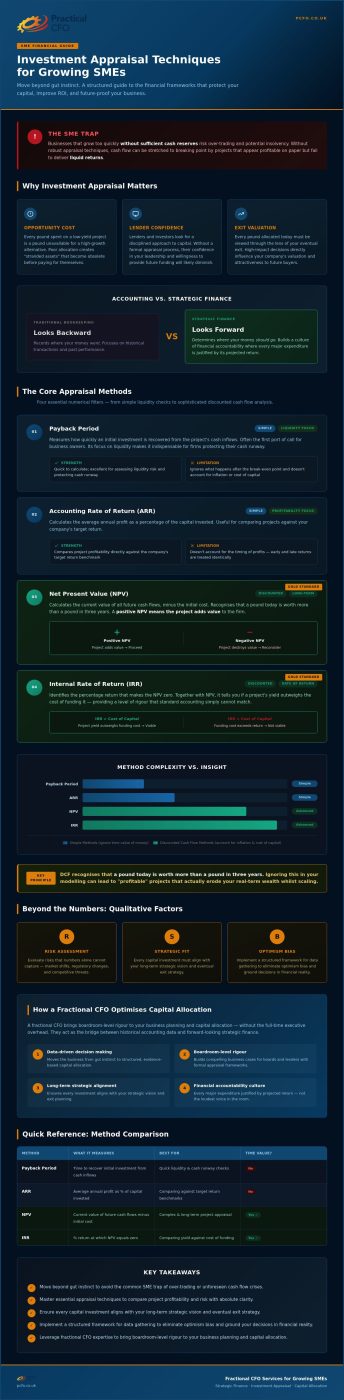
Traditional bookkeeping focuses on the past, but strategic finance looks firmly at the future. Standard accounts tell you where your money went; investment appraisal tells you where it should go. A strategic finance director acts as the bridge between these two worlds. They ensure that financial data isn’t just recorded but is used to centre strategy and future-proof the business. This shift helps build a culture of financial accountability amongst the leadership team, where every major expenditure is justified by its projected return rather than the loudest voice in the room.
The Quantitative Toolkit: Core Financial Appraisal Methods Explained
To make informed decisions, you need a robust set of numerical filters. These investment appraisal techniques for smes provide the evidence required to back your strategic vision with financial reality. Whilst numbers alone don’t tell the whole story, they provide the baseline of viability that every UK leader needs before committing significant resources.
The Payback Period is often the first port of call for business owners. It measures how quickly an initial investment is recovered from the project’s cash inflows. Whilst it ignores what happens after the break-even point, its focus on liquidity makes it indispensable for firms protecting their cash runway. Practical steps like using a Shift4 Card Machine to eliminate monthly terminal rental fees can significantly support this focus on liquidity. Accounting Rate of Return (ARR) then shifts the focus to profitability. It calculates the average annual profit as a percentage of the capital invested. It’s useful for comparing projects against your company’s target return, though it doesn’t account for the timing of those profits.
For more complex or long-term projects, Net Present Value (NPV) and Internal Rate of Return (IRR) are the gold standards. NPV calculates the current value of all future cash flows, minus the initial cost. If the result is positive, the project adds value to the firm. IRR, meanwhile, identifies the percentage return that makes the NPV zero. Together, they tell you if a project’s yield outweighs the cost of funding it, providing a level of rigour that standard accounting simply cannot match.
Simple methods like Payback are excellent for quick assessments, but they often fail to account for inflation or the cost of capital. As your business matures, incorporating Discounted Cash Flow (DCF) into your strategic business planning becomes vital. DCF recognises that a pound today is worth more than a pound in three years. Ignoring this reality in your modelling can lead to “profitable” projects that actually erode your real-term wealth whilst scaling. This methodology ensures your long-term projects remain viable even as market conditions shift.
Choosing the Right Metric for Your Project
Not every project requires the same lens. A high-growth tech investment might prioritise IRR to satisfy investor expectations for high percentage yields. Conversely, a traditional manufacturing firm buying new equipment might lean on NPV to justify a ten-year factory line upgrade. NPV is generally more reliable for absolute wealth creation, whereas IRR is better for comparing projects of different scales. Using a multi-metric approach ensures you don’t miss hidden risks or overstate potential rewards. If you’re looking to refine these calculations, a strategic growth advisor can help you tailor these frameworks to your specific business lifecycle.
Incorporating Risk and Strategic Fit: The Qualitative Dimension
A project might boast an impressive IRR, but if it diverts your best talent away from your core mission, it’s a strategic failure. Robust investment appraisal techniques for smes must extend beyond the spreadsheet to include the qualitative dimension. Every pound spent should move you closer to your ultimate goal. If you are preparing for a future sale, ensure every capital allocation decision aligns with professional exit strategy planning services. This ensures you aren’t just building a profitable project, but a more valuable, transferable asset. Evaluating management capacity is equally vital; you must honestly assess whether your current team has the bandwidth to execute the new project without breaking your existing operations.
Risk Management and Sensitivity Analysis
Identifying “known unknowns” is a critical part of the appraisal process. Sensitivity analysis allows you to stress-test your assumptions by asking “what if?”. You should model what happens if your sales volume is 20% lower than forecast, or if raw material costs rise by 15%. You don’t need complex software to do this; a simple spreadsheet model can reveal which variables have the biggest impact on your ROI. Establishing a “margin of safety” in your capital budgeting ensures that your business remains resilient even if the project underperforms. This proactive mindset prevents a single investment from jeopardising your entire cash flow.
The Intangibles: Brand, Culture, and Market Position
Some benefits are difficult to quantify but essential for long-term health. An investment in new technology might improve employee retention by reducing manual frustration, even if the direct productivity gain seems modest. Similarly, defensive investments are often necessary to protect your market share against aggressive competitors. Whilst these “intangibles” don’t always show up in an NPV calculation, they build the brand equity that attracts both talent and future buyers. Balancing these unquantifiable factors with hard data is what separates a standard accountant from a strategic financial leader. It ensures your investments support a cohesive story of growth rather than a fragmented collection of projects.
A Practical Framework for Conducting Appraisals in a Small Business
Implementing a structured roadmap transforms investment from a stressful event into a manageable business process. Step 1 begins with defining your objective with precision. Instead of a vague goal to “upgrade technology”, specify the intended outcome, such as reducing production downtime by 15%. This clarity allows you to identify all viable alternatives, including leasing, purchasing, or even outsourcing the function entirely. Step 2 requires gathering realistic data whilst consciously avoiding the optimism bias that often affects founder-led firms. It’s easy to overestimate market adoption; it’s harder to ground your forecast in conservative, achievable figures.
Step 3 involves applying the core metrics discussed previously. For many leaders, leveraging outsourced accountancy solutions ensures these calculations are performed with professional-grade accuracy. This external perspective helps neutralise internal biases. Finally, Step 4 is the presentation of the business case. Your board or lenders aren’t just looking for high numbers; they want to see that you’ve considered the risks and have a clear plan for delivering the projected ROI. Mastering these investment appraisal techniques for smes provides the boardroom-level rigour needed to secure funding and drive growth.
Data Gathering and Forecasting for SMEs
Building a reliable forecast can feel daunting when historical data is thin. In these instances, you should look to industry benchmarks and external market research to validate your assumptions. It’s equally vital to involve your department heads in this process. Your sales manager will have a more grounded view of customer demand than a spreadsheet can provide, whilst your operations lead can identify hidden costs in implementation. Deciding between an fp&a consultant vs software uk often depends on the complexity of these inputs. A consultant provides the strategic interpretation that software alone cannot offer.
The Post-Investment Audit
The appraisal process shouldn’t end once the capital is deployed. A post-investment audit involves tracking actual performance against your initial forecasted metrics. This feedback loop is essential for refining your capital allocation strategy over time. If a project fails to meet its targets, don’t view it as a total loss; use the data to understand where the assumptions fell short. This disciplined approach ensures that your next investment decision is even more informed than the last. If you need help establishing this framework, our professional Finance Director services can provide the embedded expertise your business requires.
How a Fractional CFO Optimises Capital Allocation Decisions
A standard accountant ensures your books are balanced; a strategic CFO ensures your capital is working. For many UK leaders, the gap between day-to-day bookkeeping and high-level financial leadership is where growth often stalls. A fractional CFO acts as the architect of your financial strategy, implementing sophisticated investment appraisal techniques for smes that align with your specific commercial goals. They don’t just provide the numbers; they provide the narrative that explains why an investment is the right move for your business at this specific stage of its lifecycle.
One of the most valuable roles a CFO plays is that of a neutral “challenger.” It’s natural for founders to have favourite projects or to be swayed by a sense of optimism. An embedded financial partner provides the necessary friction to test these ideas against market reality. They ensure every decision is viewed through the lens of business value and exit readiness, protecting the company from emotional or impulsive capital allocation. This level of oversight provides boardroom-level rigour without the commitment of a full-time executive hire, making it a highly efficient solution for scaling firms.
The Fractional Advantage for Scaling Firms
Accessing high-level financial modelling expertise shouldn’t require a six-figure permanent salary. By choosing a fractional model, you gain the strategic foresight of a seasoned professional at a more accessible fractional cfo pricing uk. This support is inherently scalable. As your investment complexity increases, your CFO’s involvement can grow alongside your needs. A part-time FD organises your finance function to be proactive rather than reactive, ensuring that when a growth opportunity arises, your data is already structured to support a fast, confident decision.
Securing External Funding
Banks and venture capitalists look for more than just a good idea; they look for financial discipline. Presenting a business case backed by professional investment appraisal techniques for smes immediately differentiates your firm from less sophisticated competitors. A CFO-led appraisal shows lenders that you understand your risk profile and have a clear path to repayment or ROI. This credibility is vital during due diligence, positioning your SME as a low-risk, high-potential prospect. It transforms the funding conversation from a request for support into a professional partnership based on shared financial confidence.
Securing Your Business Future Through Disciplined Investment
Mastering investment appraisal techniques for smes is the difference between speculative growth and sustainable scaling. By implementing a structured framework, you ensure that every capital expenditure strengthens your balance sheet and aligns with your long-term exit strategy. Transitioning from gut instinct to data-driven decision-making protects your cash flow whilst providing the evidence needed to win over lenders and stakeholders.
Expert Finance Director and CFO services provide the intellectual rigour required to navigate these complex financial trade-offs. Our strategic business planning and growth advisory specialists act as your embedded partners, offering composed, professional guidance when the stakes are highest. We help you balance immediate operational needs with the strategic foresight required for successful future-proofing.
Book a consultation with a PCFO strategic advisor to refine your investment strategy and ensure your next major decision is backed by boardroom-level expertise. Taking control of your capital allocation today builds the resilient, high-value business you envision for tomorrow.
Frequently Asked Questions
What is the most popular investment appraisal technique for UK SMEs?
The Payback Period remains the most popular choice amongst UK business owners due to its inherent simplicity. It focuses specifically on how quickly an initial outlay is recovered, which is vital for firms managing tight cash flow. Whilst it’s a useful entry-level tool, it doesn’t account for the total profitability of a project over its entire lifespan. For a more comprehensive view, leaders should eventually combine it with more sophisticated investment appraisal techniques for smes.
How does Net Present Value (NPV) differ from the Payback Period?
The Payback Period measures the time required to break even, whereas Net Present Value (NPV) calculates the absolute financial value a project adds to the business. NPV is generally considered more robust because it accounts for the “time value of money” by discounting future cash flows back to today’s value. Whilst Payback tells you when you’ll get your money back, NPV tells you if the investment actually increases the real-term wealth of your company.
Why should an SME bother with Internal Rate of Return (IRR)?
Internal Rate of Return (IRR) is valuable because it expresses the potential return as a single percentage yield. This makes it much easier for leaders to compare disparate projects or to check if a project’s return exceeds the interest rate on a business loan. It’s particularly useful when communicating with external investors or lenders who want to understand the relative efficiency of your capital allocation alongside other market opportunities available in the UK.
Can I use investment appraisal for small purchases, or is it only for major assets?
You should apply appraisal principles to any expenditure that impacts your long-term capital, though the level of rigour should be proportional to the risk. A small software subscription might only require a simple return-on-investment estimate. However, any purchase that significantly affects your cash runway or operational capacity deserves a formalised review. Scaling your appraisal process ensures you maintain financial discipline without creating unnecessary administrative bottlenecks for minor operational costs.
What are the common mistakes SMEs make when evaluating new projects?
Optimism bias is the most frequent error, where leaders overestimate sales and underestimate implementation costs. Other common pitfalls include ignoring the opportunity cost of what that capital could’ve achieved elsewhere and failing to conduct post-investment audits. Many SMEs also neglect the qualitative “strategic fit,” funding projects that offer good numbers but distract the team from the core mission or the eventual exit strategy goals defined by the board.
How often should a business review its investment appraisal process?
Your investment appraisal process should be reviewed at least annually to ensure it remains aligned with your current cost of capital and strategic objectives. It’s also wise to refresh your criteria whenever there is a significant shift in the economic landscape, such as a change in interest rates or market volatility. Regular reviews ensure your benchmarks for “acceptable” returns stay realistic and that your decision-making framework evolves alongside your business’s maturity.
What role does an outsourced Finance Director play in investment decisions?
An outsourced Finance Director acts as the strategic architect of your investment process, providing the neutral “challenger” role that internal teams often lack. They bring boardroom-level rigour to your financial modelling, ensuring that every project is vetted for both numerical viability and strategic alignment. By leveraging investment appraisal techniques for smes, an FD helps you build a compelling business case for lenders whilst protecting the company from high-risk or low-yield capital commitments.
Is there a specific software recommended for SME investment appraisal?
Microsoft Excel remains the industry standard for most SME investment appraisals due to its flexibility and the ease of building bespoke models. However, as your business grows in complexity, you might consider dedicated financial planning and analysis software to streamline data consolidation. The choice often depends on whether you value the strategic interpretation of an expert consultant or the automated reporting capabilities of a software-led approach for high-volume project tracking.