

What if the best way to keep investors confident after a funding round isn’t offering constant reassurance, but sharing clear, dependable information? Managing investor relations after funding can feel uncertain, especially when expectations aren’t clear, updates are inconsistent or the latest results include difficult news. A reliable communication rhythm replaces guesswork with a shared view of the business.
Investor communication matters because investors need a credible picture of financial performance, progress against plans and challenges that could affect future decisions. That doesn’t mean every update must be perfect. It means being consistent, accurate and candid about what the figures show and what you’re doing in response.
This guide explains how to build a practical post-funding update process, from agreeing a suitable reporting cadence to choosing useful financial and operational measures. It also covers how to discuss setbacks constructively, make investor conversations productive and keep reporting proportionate when finance capacity is limited. With sound management information and forward-looking financial oversight, updates can do more than report on the past: they can support better decisions and sustainable growth.
Key Takeaways
- Managing investor relations after funding starts with agreeing what investors need to know and setting a dependable communication rhythm.
- Build updates around performance, progress, risks and priorities. Use budget and forecast comparisons to give the figures useful context.
- Choose update formats and timing that keep investors informed without creating unnecessary work for your team.
- Use a clear workflow with assigned owners, review steps and follow-up so updates remain accurate and consistent.
- When reporting demands stretch your team, stronger finance leadership can improve management information and help turn investor discussions into better decisions.
Managing investor relations after funding starts with a new operating rhythm
Once a funding round closes, the conversation changes. The focus shifts from securing capital to showing how the business is progressing, how decisions connect to the plan and where conditions have shifted. Post-funding investor relations means maintaining an informed, constructive relationship with the people who have invested in the business. Their capital and perspective are part of the company’s ongoing development, not simply a completed transaction.
This relationship calls for purposeful communication, not a stream of promotional messages. Marketing aims to attract customers, and a fundraising pitch seeks new capital. Investor updates should give existing investors a grounded account of progress and the choices ahead. They sit alongside formal company reporting, rather than replacing any reporting required by law or agreed in investment documents. Those duties depend on the company’s circumstances and arrangements.
Transparency doesn’t mean promising that every target will be met. It means giving accurate context: explaining what has changed, what the business knows and what management is doing next. If a planned product launch is delayed, for example, describe the operational cause, the likely effect on the plan and the response underway. Clear context gives investors a basis for discussion without unsupported assurances. For a wider overview of the discipline, see Investor Relations Overview.
What changes once the funding round closes?
Investors become continuing stakeholders with a legitimate interest in how the company uses capital and advances its priorities. Clarify expectations early: what information will be shared, who will receive it and how questions or emerging issues will be handled. Reporting needs vary with the company’s stage, investor arrangements and funding terms, so don’t assume there is one standard approach. Agreeing a simple process can prevent mismatched expectations later.
Who owns investor communication inside the business?
The founder or CEO should remain accountable for the relationship and overall narrative. Finance leadership supports that responsibility by providing reliable figures, forecasts and explanatory context. Operational leads can contribute updates on delivery, customers or staffing, but an internal review should bring those contributions together before anything is sent. This helps prevent teams from sharing inconsistent figures or competing explanations of the same issue.
Assign one person to gather inputs, set a review point and record investor questions and agreed follow-ups. The CEO can then lead the conversation, while finance and operational colleagues validate information in their areas. You don’t need a complex investor-relations function to get started. A proportionate, repeatable process is a sound basis for managing investor relations after funding, and can develop as the business and its reporting needs grow.
Build investor updates around financial performance, progress and forward-looking context
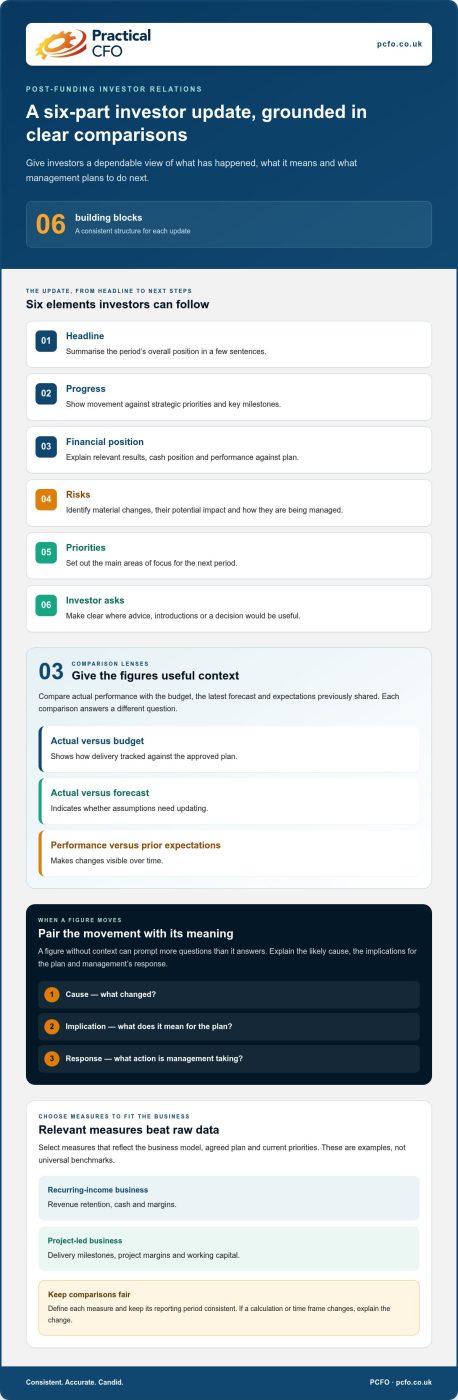
A useful investor update gives readers a clear view of what has happened, what it means and what management plans to do next. A consistent structure makes updates easier to prepare and interpret. Organise each one around six elements:
- Headline: Summarise the period’s overall position in a few sentences.
- Progress: Report movement against strategic priorities and key milestones.
- Financial position: Explain relevant results, cash position and performance against plan.
- Risks: Identify material changes, their potential impact and how they’re being managed.
- Priorities: Set out the main areas of focus for the next period.
- Investor asks: State clearly where advice, introductions or a decision would be useful.
Focus on information that supports understanding, not every available figure. Compare actual performance with the budget, the latest forecast and expectations previously shared. Each comparison answers a different question: actual versus budget shows how delivery tracked against the approved plan; actual versus forecast indicates whether assumptions need updating; and performance against prior expectations makes changes visible over time. If revenue is below forecast, explain the cause, the implications for cash or priorities, and management’s response.
Which financial and operating measures belong in an update?
Select measures that reflect the business model, agreed plan and current priorities. A company focused on recurring income might report revenue retention alongside cash and margins; a project-led business may focus on delivery milestones, project margins and working capital. These are examples, not universal benchmarks. Define each measure and keep its reporting period consistent. If a calculation or time frame changes, explain the change so investors can make a fair comparison.
Pair every material movement with a concise explanation. A figure without context can prompt more questions than it answers. Note the likely cause, what it means for the plan and what action management is taking. This keeps the update focused without hiding difficult results or burying readers in raw data.
How should leaders communicate forecasts and uncertainty?
Separate recorded results from current estimates and future assumptions. A forecast is a planning tool, not a guarantee. Explain the assumptions that matter, such as expected sales timing or planned expenditure, and describe how a different outcome could affect the outlook. If results diverge from plan, state the response and when management will reassess the position.
Before sharing an update, check the legal, contractual and investor-specific reporting requirements that apply to the company. These depend on its circumstances and arrangements. For relevant regulatory material, consult the UK Financial Conduct Authority (FCA) guidance, particularly where FCA rules may apply. General guidance does not replace checking the business’s specific obligations.
Consistent management information makes this work more manageable. If finance capacity is stretched, fractional finance leadership can help strengthen reporting and forecasting so investor updates are grounded in decision-ready information.
Choose the right investor communication cadence and format for your business
Choose a rhythm your team can maintain and investors can rely on. A growing private business doesn’t need to copy the investor portal or reporting timetable of a listed company. Agree with investors what they need, how often they need it and which channel suits each type of information. A short, regular written update may be more useful than an elaborate report that arrives inconsistently.
Each format serves a different purpose. Use these distinctions to agree a practical mix:
- Written updates: Distribute the same core information to investors and create a useful record of progress. Readers have time to review the figures, but complex issues can be harder to explore without discussion.
- Scheduled investor calls: Let leaders explain context, hear questions and discuss decisions. They’re useful for topics that need dialogue, but capture key points afterwards to avoid misunderstandings.
- Board materials: Support detailed oversight and structured discussion for directors and board participants. They can contain more depth, but may be too dense to serve as the only update for every investor.
- Shared information resource: Keeps relevant documents organised in one place and helps investors find previously shared material. It takes care to maintain and shouldn’t replace direct explanations or an opportunity to ask questions.
Written updates, investor calls or a shared portal?
Make written communication the dependable baseline, then add calls when discussion would help. A shared resource can support document access as the volume of information grows. It’s an organisational tool, not a substitute for explaining performance or responding to investors. Match the format to the purpose: a concise written note may suit routine progress, while a forecast change or strategic decision could warrant a call.
Frequency involves a trade-off. More frequent, concise updates can make changes visible sooner, but require a reliable flow of information and may leave less room for detailed analysis. Less frequent reports allow time to assemble a fuller picture, but can leave investors without context between updates. Set expectations together, then review the cadence if the business enters a period of rapid change or the process becomes burdensome. Consistency matters more than adopting a schedule the team can’t sustain.
How should investor updates handle setbacks and sensitive information?
Share setbacks plainly and promptly through the agreed channel. Explain what has happened, what it may affect, the management response and when the position will be reviewed again. Avoid selective reassurance: omitting a material challenge from a routine update can weaken confidence if the issue later becomes harder to ignore.
Before circulation, distinguish information suitable for all intended recipients from material that needs controlled handling. Investor rights, confidentiality arrangements and disclosure considerations depend on the company’s circumstances. If you’re unsure whether information can be shared, take appropriate professional advice rather than relying on informal judgement. This measured approach helps make managing investor relations after funding both candid and responsible.
Create a repeatable post-funding investor relations process in five steps
A clear workflow makes investor reporting easier to prepare, review and improve. It also helps a growing team avoid rebuilding each update from scratch. Use these five steps as a practical cycle, adapting the detail to your business and investor arrangements.
- Agree expectations. Confirm the update format, timing, recipients and process for raising questions. Record agreed requirements so the team has a clear reference point.
- Assign owners. Name the person coordinating the update and the people responsible for financial results, operating measures, risks and milestones. Make the CEO accountable for the final message.
- Prepare the information. Gather relevant management accounts, forecasts and operating information. Use existing reporting as the source instead of asking teams to create a parallel set of figures for investors.
- Review for accuracy and clarity. Check figures against source reports, confirm definitions and periods, and ensure explanations reflect the actual position. Resolve gaps before sharing the update.
- Communicate and follow up. Send the approved update through the agreed channel, record questions and commitments, and track each action to completion.
Dependable reporting inputs are central to this process. If financial information is late or difficult to reconcile, investor communications can become a separate administrative burden. Clear bookkeeping and management accounts provide a stronger base for preparing updates and forecasts. PCFO’s guide to outsourced accountancy solutions explores how reliable finance processes can support growing businesses.
Prepare information investors can understand and act on
Build the update from approved results, relevant operating measures, milestones, material risks and any decisions where investor input would help. Check the numbers against management accounts and forecasts before drafting the commentary. Use plain definitions and consistent reporting periods, then explain important movements briefly. This helps readers understand not just what changed, but why it matters to the business and its plans.
Use a simple preparation checklist: are the figures reconciled to source reports, are comparisons like-for-like, and does each key movement have a clear explanation? If assumptions have changed, make that visible rather than quietly altering the narrative.
Close the loop after every update
Keep a short action log with the investor’s question or request, the agreed response, a named internal owner and a due date. Share follow-up information consistently with the relevant investors, using the agreed channel and respecting confidentiality arrangements. Review recurring questions: they may point to missing context, an unclear measure or assumptions that need revisiting.
When finance capacity is limited, part-time or outsourced finance leadership can connect accounts, forecasts and investor reporting without duplicating work. Explore finance leadership support to strengthen the information behind your process and make managing investor relations after funding more sustainable.
Strengthen investor confidence with financial leadership that keeps reporting decision-ready
Reliable investor communication depends on the finance capability behind it. If figures arrive late, forecasts are difficult to explain or leaders spend too much time reconciling different versions of the numbers, the problem may be more than a busy reporting period. It can point to unclear ownership, processes that need improving or a need for stronger finance leadership.
There isn’t one model for every funded business. A founder-led team may manage reporting internally when its information is dependable and the workload is manageable. This keeps the process close to day-to-day decisions, but can place too much responsibility on a small leadership group. Fractional finance support adds specialist oversight without requiring a full-time finance executive. It can strengthen processes and decision support, while the business retains clear internal owners and timely input from its teams.
What finance leadership can contribute after funding
A Finance Director or CFO can help connect financial information to the decisions investors want to understand. This includes improving the quality and consistency of management accounts, testing forecast assumptions, explaining movements in performance and linking financial implications to business plans. The goal isn’t simply to produce more reporting. It’s to give leaders information they can use to make decisions and explain the reasoning behind them.
For a growing business, part-time or outsourced support offers a flexible way to add this experience as needs change. Learn more about strategic Finance Director support and how it can connect financial oversight with company priorities. Where growth plans need closer alignment with financial capacity, business growth advisory can also help leaders assess the choices ahead.
Choose the approach that matches the actual pressure points. If the numbers are accurate but updates lack ownership, clarify responsibilities first. If reports are inconsistent or forecasts don’t support decisions, strengthen the underlying finance process. If senior leaders are repeatedly pulled away from running the business to assemble information, additional finance capacity may be proportionate. These options can evolve as the company’s scale, investor expectations and reporting needs change.
Turn investor communication into a useful next step
Review your current process against three practical questions: Is information prepared consistently? Does it reach investors at the agreed time? Can leaders use it to explain performance and make informed decisions? Gaps in any of these areas are a prompt to examine management information, ownership and finance capacity, rather than simply adding more pages to an update.
PCFO provides fractional and outsourced Finance Director and CFO support for growing businesses that need stronger financial oversight and decision-ready reporting. If you’re considering how finance leadership could support your post-funding plans, discuss finance leadership support with PCFO. A clear view of your current needs can help you choose a proportionate next step in managing investor relations after funding.
Make investor communication part of your next stage of growth
As your business develops, investor communication can mature with it. Treat the process as an opportunity to sharpen how you assess progress, test assumptions and make decisions, not simply as another reporting task. A dependable approach to managing investor relations after funding can help your leadership team stay aligned as priorities and financing needs change.
If preparing clear, timely updates is stretching your team, consider whether additional financial leadership could strengthen the foundations. PCFO supports growing businesses with fractional and outsourced Finance Director and CFO services, business planning and growth advisory, and outsourced accountancy solutions.
Discuss practical finance leadership for your growing business and take a considered next step towards reporting that supports confident decisions. With the right structure in place, you can keep investors informed while giving your team more clarity to focus on growth.
Frequently Asked Questions
How often should a company update investors after funding?
Agree a frequency with investors that fits the business and its reporting capacity. A company with stable trading might choose a regular quarterly update, while a business managing a major change may agree more frequent contact for a period. Make clear what investors can expect and tell them if a planned update will be delayed. The most useful cadence is one the team can sustain and investors understand, not an arbitrary schedule copied from another company.
What should a first investor update after funding include?
A first update should establish a shared baseline for the period after the funding round. Set out current priorities, how progress will be assessed and when investors can expect future communication. Include a concise view of the financial position and key operational indicators, then clarify any assumptions that have changed since the investment plan was agreed. This gives later updates a point of comparison and helps surface different expectations before they become a source of confusion.
Should founders share bad news with investors?
Yes. Founders should communicate material setbacks honestly and without avoidable delay. Explain what is known, what remains uncertain and what the team is doing to understand or address the issue. If a major customer postpones a decision, for example, describe the potential effect on expected income and when you’ll update the outlook. Avoid presenting a worst-case scenario as certain, but don’t offer reassurance that the available information can’t support.
How is an investor update different from a board report?
An investor update is usually designed to inform investors about company progress and provide context for their involvement. A board report supports directors’ oversight and decision-making, so it may include detailed analysis, options and sensitive operational matters. The two can draw on the same underlying figures without being identical documents. Before sharing board material more widely, consider its intended audience, confidentiality and any relevant company or investment arrangements.
What metrics should a startup report to investors?
Choose measures that reflect how the business creates value and what it is trying to achieve. A subscription business could track recurring revenue, customer retention and cash; a product business might focus on sales, gross margin, inventory and delivery progress. Define each measure and use a consistent period so changes can be interpreted fairly. Don’t add a metric simply because another startup reports it. Include it only if it helps explain performance or a decision.
How can a small company manage investor relations with a lean finance team?
Keep the reporting workload proportionate by building investor information from existing bookkeeping, management accounts and forecasts. Use a short template, maintain a single source for figures and ask operational leads for updates relevant to agreed priorities. If the finance team is stretched, managing investor relations after funding may require clearer ownership or additional fractional finance leadership. The right support can help improve reporting capacity without assuming every company needs a full-time finance executive.
Can investor updates replace formal company or funding reports?
No. An informal investor update shouldn’t replace a formal report required by company law, funding documents or another applicable arrangement. Requirements vary according to the company’s circumstances and the terms agreed with investors. Keep a separate record of those obligations and their deadlines, then use investor updates for ongoing communication alongside them. If the position is unclear, obtain appropriate legal or financial advice before relying on an update to meet a formal requirement.