

Blanket cost cuts can weaken a service business without fixing the real cause of margin pressure. If revenue is growing but gross profit and cash available for growth aren’t keeping pace, learning how to improve gross margin in a service business starts with finding which work is using more time or resource than expected.
The cause may lie in pricing, scope, utilisation or delivery costs. Labour and subcontractor expenses can be difficult to trace to individual services or clients, while an overall margin can hide less profitable work. Cutting costs across the board may affect service quality and client relationships without addressing the underlying problem.
This guide explains how to diagnose margin pressure using consistent management information, identify the services, clients and delivery patterns affecting gross margin, and choose practical improvements instead of relying on blanket cuts. You’ll also learn how to build a repeatable margin review that informs business planning and growth decisions. Connecting service-level profitability with financial leadership helps you make evidence-based changes and protect capacity for sustainable growth.
Key Takeaways
- Separate gross profit from gross margin to see whether higher sales are translating into stronger delivery profitability.
- Use consistent management information to pinpoint which services, clients or projects are putting pressure on margin.
- Learn how to improve gross margin in a service business by comparing pricing, scope, utilisation and work mix before deciding where to act.
- Turn your findings into a prioritised plan, with a clear owner, baseline and measures suited to each action.
- Connect margin reviews with business planning and growth decisions so improvements can be sustained without blanket cost cuts.
What gross margin means in a service business – and why it matters
Higher sales don’t automatically mean stronger profitability. A service business can win more work yet retain less from each engagement if the extra revenue requires more delivery time, subcontractor support or other direct costs. Understanding how to improve gross margin in a service business starts with seeing what each service earns after its delivery costs.
Gross margin for a service business is the percentage of service revenue left after direct delivery costs have been deducted. Gross profit is the amount left in pounds; gross margin expresses that amount as a percentage of revenue. The Gross margin calculation helps assess how effectively revenue covers the work required to provide a service.
Gross margin isn’t the same as net profit. Net profit reflects the wider cost of running the business, including general overheads and other expenses. A service line can have a healthy gross margin but still contribute little to the bottom line if overheads are high. Gross margin is an important part of the picture, not a complete measure of business profitability.
For the measure to be useful, compare revenue and direct delivery costs on a consistent basis. If one service’s staff time is allocated to delivery but another’s is treated as overhead, their margins won’t be meaningfully comparable. Consistent management information helps distinguish a genuine performance change from a change in how costs are recorded.
How to calculate gross margin for a service
Gross margin percentage = (service revenue − direct delivery costs) ÷ service revenue × 100. Subtract the costs of delivering the service from its revenue to find gross profit. Divide that amount by service revenue and multiply by 100 to express it as a percentage.
Hypothetical example: A service generates £10,000 in revenue and has £6,000 in direct delivery costs. Its gross profit is £4,000, and its gross margin is 40%: (£10,000 − £6,000) ÷ £10,000 × 100. The £4,000 is the monetary amount; 40% is the proportion of revenue remaining after direct delivery costs.
Calculate the figure for a clearly defined service and reporting period. When comparing services, use the same cost rules and time frame for each. Otherwise, an apparent margin difference may reflect inconsistent measurement rather than a difference in delivery performance.
Which costs belong in service gross margin?
Include costs directly attributable to delivering the service. These may include the relevant share of delivery staff time, subcontractor charges and other costs incurred specifically to fulfil the work. If staff divide their time between delivery and other responsibilities, use a reasonable, consistently applied method to identify the delivery portion.
General overheads, such as central administration, are usually considered separately from direct delivery costs when analysing gross margin. Define cost categories clearly and apply them consistently across services and reporting periods. If a cost’s treatment is unclear, seek accounting advice and document the approach. This gives decision-makers a dependable basis for identifying margin pressure and choosing how to respond.
How to diagnose what is reducing gross margin in your service business
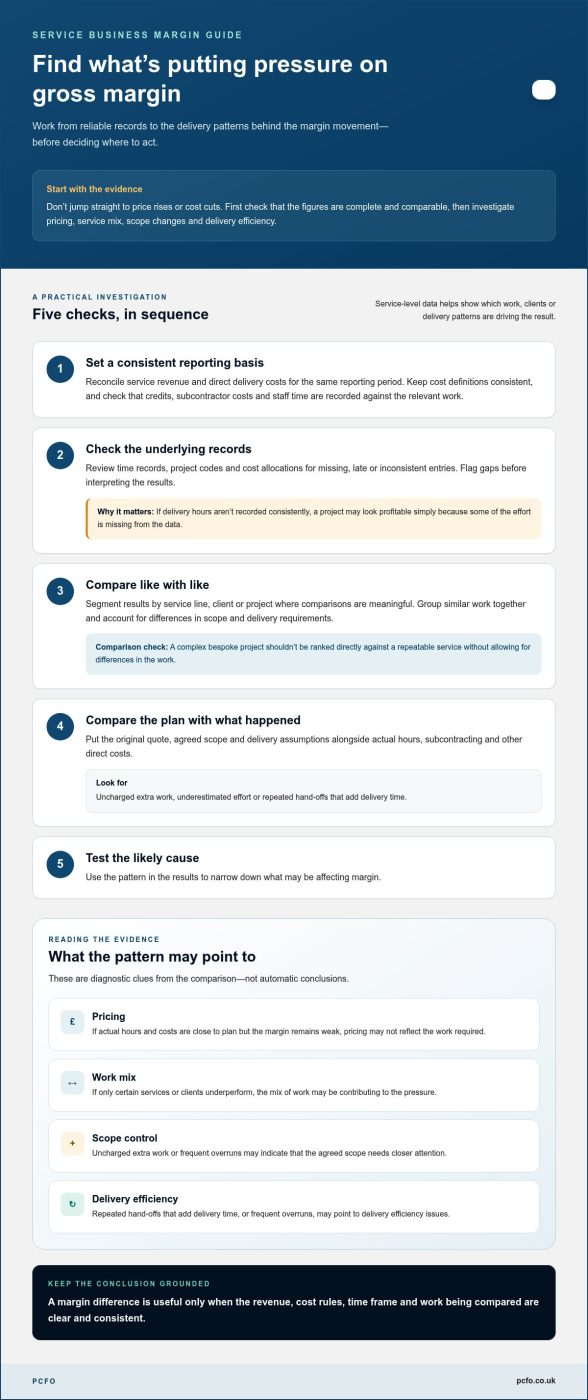
A useful diagnosis starts with reliable records and then narrows the search to the work and delivery inputs behind the margin movement. Avoid jumping straight to price rises or cost cuts. First establish whether the figures are complete and comparable, then test whether pressure comes from pricing, service mix, scope changes or delivery efficiency.
Service-level data turns a margin figure into a practical decision by showing which work, clients or delivery patterns are driving it. Use this sequence to investigate the cause before choosing an improvement.
- Set a consistent reporting basis. Reconcile service revenue and direct delivery costs for the same reporting period. Apply the same cost definitions each time, and check that credits, subcontractor costs and staff time are recorded against the relevant work.
- Check the quality of the underlying records. Review time records, project codes and cost allocations for missing, late or inconsistent entries. Flag gaps before interpreting the results. If delivery hours aren’t recorded consistently, a project may appear profitable simply because some of the effort is missing from the data.
- Segment results where comparisons are meaningful. Compare margins by service line, client or project, using groups of similar work. A complex bespoke project shouldn’t be ranked directly against a repeatable service without accounting for differences in scope and delivery requirements.
- Compare the plan with what happened. Put the original quote, agreed scope and delivery assumptions alongside actual hours, subcontracting and other direct costs. Look for uncharged extra work, underestimated effort or repeated hand-offs that add delivery time.
- Test the likely cause. If actual hours and costs are close to plan but the margin remains weak, pricing may not reflect the work required. If only certain services or clients underperform, the work mix may be the issue. Frequent overruns may point to scope control or delivery efficiency.
- Check whether the pattern repeats. Investigate recurring overruns and reliance on subcontractors, while distinguishing them from one-off work or timing effects. A cost posted after the revenue period can temporarily distort the result, so review the detail before treating one reporting period as a trend.
Build a consistent view of service revenue and delivery costs
Use agreed service categories and cost rules so each review is comparable with the last. Time records and project data can show where delivery effort goes, including work that wasn’t anticipated in the original estimate. If coding is incomplete, improve the recording process before relying on the margin analysis to guide decisions.
Find patterns by client, service and delivery team
Look for repeated differences across like-for-like work rather than drawing conclusions from a ranking of unlike projects. Check whether extra work was authorised and billed, whether particular delivery patterns use more subcontractor support, and whether a low result reflects a recurring issue or a one-off. This helps distinguish a client-specific challenge from a broader service design problem.
Once the evidence points to a likely cause, focus on the right lever rather than reacting to the headline figure. If internal reporting makes it difficult to connect delivery data with decisions, fractional finance leadership can help bring that analysis into business planning.
Which gross margin improvements should a service business prioritise?
The right improvement depends on what your diagnosis reveals. A pricing change won’t fix recurring rework, and tighter scope won’t solve a service line that consistently takes longer to deliver than its price allows. To decide how to improve gross margin in a service business, match the action to the cause, then consider its effect on clients, quality and capacity.
A considered pricing review isn’t a blanket price rise. Check whether the fee reflects the expertise, delivery time and level of service required. If the work has changed since the price was set, a revised fee may be appropriate. Explain the value and scope clearly, then monitor realised rates, client response, renewals and margin rather than assuming every client will react in the same way.
When pricing or scope changes may be the right response
Review pricing where actual delivery effort repeatedly exceeds the assumptions behind a quote, or where similar work earns different margins without a clear reason. If unplanned requests are driving overruns, set clearer boundaries and agree a change-control process so additional work can be assessed and priced. Make changes thoughtfully, then track realised rates, delivery hours, client feedback and renewals. Poorly communicated changes may affect client relationships.
When utilisation, delivery or service mix deserves attention
If pricing and scope are sound, inspect how delivery capacity is used. Scheduling gaps, avoidable rework and unnecessary hand-offs can absorb time without improving the client outcome. Standardise repeatable tasks or adjust the delivery mix where doing so maintains quality. Review low-margin services in context: they may support valuable client relationships or lead to other work. Changing or discontinuing them without considering these effects can reduce revenue or weaken retention.
Use warning signs to guide your next investigation, not as automatic instructions to cut or change work:
Warning sign: Realised rates fall below expectations. Possible action: Review pricing and delivery assumptions. Measure: Realised rate and margin by service.
Warning sign: Hours exceed the agreed scope. Possible action: Clarify boundaries and manage changes. Measure: Unbilled hours and delivery hours against plan.
Warning sign: Rework or scheduling gaps recur. Possible action: Improve hand-offs, planning or standardisation. Measure: Rework hours and productive delivery time.
Warning sign: Margins vary across services or clients. Possible action: Review the work mix before changing an offer. Measure: Comparable service-level margins and client retention.
Indiscriminate cost cutting can reduce delivery capacity, affect quality or put good client relationships at risk. Prioritise changes that address the source of pressure and protect the outcomes clients value. A finance partner can help connect these choices with wider growth plans through business growth advisory.
How to put a gross margin improvement plan into practice
A diagnosis creates value when it leads to a clear decision, an accountable owner and a way to check the result. Keep the plan focused enough to act on. Choose the highest-priority cause, record the current baseline and agree what success should look like before changing how work is priced or delivered.
A practical plan can follow this sequence:
- Describe the issue. State which service, client or delivery pattern is under pressure, using evidence from your analysis rather than a general target to “improve margin”.
- Assign an owner. Name the person responsible for putting the change into practice and coordinating with the people affected, such as the delivery team or client-facing staff.
- Record the baseline and assumptions. Capture current margin and the relevant operational measure, such as realised rates, delivery hours or rework. Note what you expect the change to affect.
- Model the likely impact. Consider the effect on gross profit, available delivery capacity and the client experience. For example, standardising part of a service may reduce avoidable effort, but the process still needs to deliver the outcome clients expect.
- Review and adapt. Compare actual results with the baseline and assumptions. If the evidence changes, investigate why and adjust the action rather than continuing with a plan that isn’t working.
Choose measures that show whether an action is working
Use a small set of clearly defined service-level indicators. Pair the financial measure with operational context: a pricing review might track realised rates alongside delivery hours, while a process change could track rework alongside gross profit. Define each measure consistently, assign responsibility for reporting it and set a review frequency that fits your reporting cycle and the speed of the decision.
Measures should answer a specific question, not simply fill a dashboard. If margin improves but client feedback worsens or delivery capacity becomes strained, the change may not be sustainable. Reviewing financial and operational results together helps reveal unintended effects early.
Make margin actions part of regular financial planning
Record the decision, owner, assumptions and expected operational effects in your planning process. At review, compare forecast with actual outcomes and investigate material differences. Perhaps the change took longer to implement, demand shifted or delivery hours didn’t fall as expected. This creates a learning loop and keeps decisions connected to current evidence.
A repeatable review also helps leaders assess whether margin actions support the business’s wider direction, rather than focusing only on short-term gains. Strategic business growth advisory can connect margin priorities with sustainable growth, while budgeting and forecasting can bring assumptions and expected results into financial planning.
For support turning margin analysis into an accountable plan, explore business planning and growth support.
How strategic finance support can sustain better service margins
Margin improvement needs more than a one-off review. It depends on reliable information, clear decisions and checks to see whether changes work as intended. If service-level reporting is unreliable, margin movements remain unexplained or operational teams lack time to investigate them, internal capacity may be limiting progress.
Fractional finance leadership can connect delivery costs with pricing decisions and business plans. A Finance Director or CFO can help owners interpret management information, assess the implications of different options and monitor agreed actions. This is strategic decision support, distinct from maintaining routine accounting records. Finance Director support can provide a framework for bringing financial insight into business decisions.
When a business may need more financial oversight
Signals include missing or inconsistent service-level data, recurring unexplained margin movement and difficulty assigning someone to investigate delivery variances. Finance leadership can help establish what the figures show, identify the assumptions behind a decision and agree how progress will be measured. The aim isn’t to change every process at once, but to make informed choices and maintain oversight as the business acts.
Good financial oversight also brings operational context into the discussion. A price adjustment, for example, may improve margin on paper but affect renewals or demand. A change to delivery processes may release capacity, yet require investment or staff training. A strategic finance partner can help weigh these trade-offs alongside the business’s priorities, without treating margin as the only measure of success.
Connect margin decisions with growth plans
Service profitability can inform where to direct capacity, which work to prioritise and whether a proposed investment fits the business’s plans. It can also show where stronger processes or clearer commercial terms may support growth without compromising client outcomes. Decisions should account for delivery quality, client relationships and the ability to sustain the service, not just its margin in isolation.
Reliable accounting information is the foundation for this analysis. Outsourced accountancy solutions can support consistent financial records, while Finance Director and CFO support can help turn those records into decisions. Together, these capabilities can give growing businesses a clearer basis for assessing how to improve gross margin in a service business and align actions with longer-term plans. They support decision-making; outcomes depend on the evidence, choices and execution.
If you’re considering how stronger financial oversight could support your margin priorities, discuss finance support with PCFO.
Make margin improvement part of your next growth decision
Choose one margin question that matters to your plans. You may need to understand whether a service can scale, whether a proposed investment is justified, or how much delivery capacity future growth will require. A focused review can give that decision a stronger financial foundation.
Learning how to improve gross margin in a service business isn’t about pursuing a percentage in isolation. It’s about understanding which work supports sustainable growth, then making deliberate choices that protect client outcomes as the business develops.
PCFO provides fractional and outsourced Finance Director and CFO support, bringing financial leadership together with business planning and growth advisory. This helps business owners connect margin insight with commercial priorities and assess the implications of their decisions.
Ready to make margin insight more useful to your plans? Discuss strategic finance support with PCFO to connect your margin priorities with business planning and growth decisions.
Frequently Asked Questions
What is a good gross margin for a service business?
There’s no single gross margin target that suits every service business. A consultancy with mostly repeatable work has a different delivery model from a specialist firm relying on extensive subcontracting. Compare margins across similar services, review how they change over time and consider what each service contributes to overheads and growth. A target is most useful when it reflects your delivery model and supports the returns your business needs.
Can a service business improve gross margin without raising prices?
Yes. You could reduce avoidable rework, improve scheduling, make better use of delivery capacity or adjust the mix of work you accept. For example, if a recurring service requires repeated manual preparation, a more consistent process may reduce delivery effort while maintaining the agreed outcome. Track client feedback and service quality alongside the financial result, so an apparent margin gain doesn’t come at the expense of retention or future work.
Should staff salaries count as direct costs when calculating service gross margin?
Include the portion of staff salary that relates to delivering the service if you’re measuring service-level gross margin. For a consultant who splits time between client work and internal management, allocate delivery time using a consistent method, such as recorded hours. Don’t treat the whole salary as a direct cost if some of the role supports general operations. Agree the approach with your accountant and apply it consistently across services.
Can a service business have a strong gross margin but still struggle with cash flow?
Yes. Gross margin measures delivery economics, not when money enters or leaves your bank account. You may complete profitable work but wait for invoices to be paid while meeting payroll or subcontractor commitments in the meantime. Deposits, payment milestones and prompt invoicing can help manage the timing gap. Also monitor debtor balances and expected cash needs: a healthy margin doesn’t guarantee that funds will be available when bills fall due.
How often should a service business review gross margin?
Review gross margin in line with your management reporting cycle, and assess individual projects when they close if the information is useful and available. Regular reviews can reveal whether a change is a one-off or part of a developing pattern. Set the frequency to match how quickly you need to make decisions: a business with changing workloads may need closer oversight than one delivering stable, repeatable services.
Does VAT affect gross margin calculations in the UK?
For margin analysis, use revenue excluding VAT, since VAT charged to customers is generally collected on behalf of HMRC rather than earned as sales income. Reclaimable VAT on purchases is generally not a delivery cost for this calculation. Irrecoverable VAT may affect costs, depending on the circumstances and accounting treatment. Keep your approach consistent, and ask your accountant how VAT should be recorded for your business.
Why can gross margin fall when a service business wins more work?
More work can reduce gross margin if the extra revenue comes from lower-margin services, discounted contracts or projects that need more effort than expected. Growth can also put pressure on delivery capacity, prompting additional subcontracting or creating scheduling inefficiencies. For example, a busy period may bring in substantial sales but require costly external support. Compare new work with existing services to see whether volume, pricing or delivery requirements have changed.