

A part-time CFO gives a growing business senior financial leadership without requiring a full-time hire. They can guide planning, reporting, cash flow and major decisions, working alongside the people who manage day-to-day finance. Knowing how to work effectively with a part-time CFO means agreeing clear priorities, sharing accurate information and keeping communication open.
As a business grows, bookkeeping alone may no longer provide the insight needed to plan confidently, report to stakeholders or prepare for fundraising. That doesn’t automatically mean you need a full-time finance leader. The right level of support depends on your goals, the decisions ahead and the work your existing team can manage.
This guide explains what a part-time CFO does, how time commitments and costs are structured, and how to set up a productive working relationship. It also covers the ways CFO support can strengthen financial reporting, prepare a business for fundraising and help turn growth plans into practical financial decisions.
Key Takeaways
- Set clear financial priorities and share accurate, timely information so your CFO can turn business goals into useful forecasts and decisions.
- Agree the work, availability and communication rhythm at the outset; the right engagement depends on your needs and the support your team already provides.
- Bring CFO support into fundraising and growth planning early, particularly when you need investor-ready reporting or a financial model to guide decisions.
- Assess candidates for relevant experience, practical modelling skills and fit with your business; FCA senior management functions also have specific disclosure considerations.
Strategic financial planning
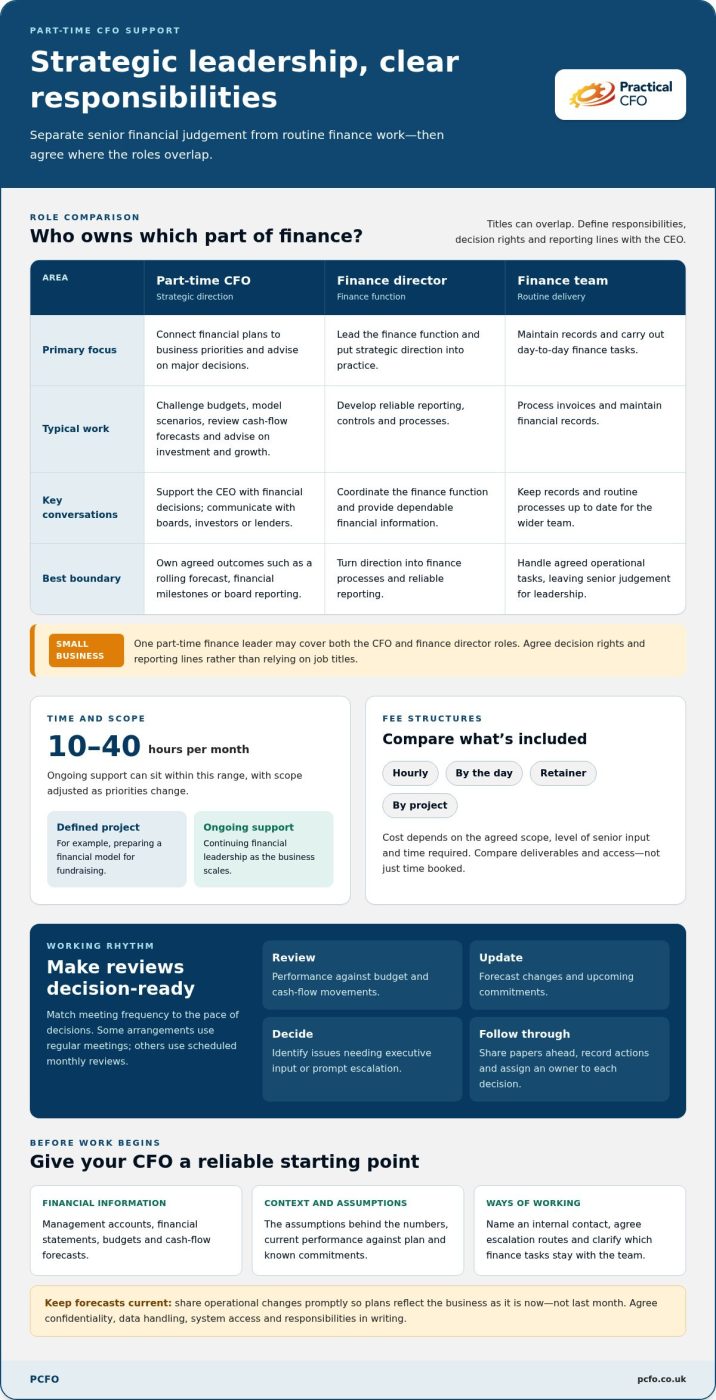
Before the start, share management accounts, financial statements, budgets, cash-flow forecasts and the assumptions behind them. Include current performance against plan and known commitments. Key risks include limited availability, unclear decision ownership and incomplete data. Set escalation routes, name an internal contact, schedule regular reviews and agree which finance tasks remain with the team.
Strategic CFO leadership
A part-time CFO provides strategic financial leadership by connecting financial plans to business priorities. They can challenge budgets, model scenarios and advise the CEO on investment, cash flow and growth decisions. Agree the outcomes they’ll own, such as a rolling forecast, financial milestones or board reporting. Share operational changes promptly so forecasts reflect the business as it is now, not last month.
CFO and finance director roles
The titles can overlap, so define responsibilities rather than relying on job names. A CFO typically focuses on strategic direction, major financial decisions and communication with boards, investors or lenders. A finance director may lead the finance function and turn that direction into reliable reporting, controls and processes. In a smaller business, one part-time leader may cover both. Agree decision rights and reporting lines with the CEO.
Balancing strategy and hands-on finance
Decide which work needs senior judgement and which tasks belong with the accounting team. For example, the CFO can review a cash-flow forecast and explain its implications, while finance staff process invoices and maintain records. This division protects time for budgeting and planning without leaving routine work ownerless. Use regular reviews to identify skills gaps, coach team members on interpreting reports and build confidence with forecasts and performance measures. Revisit the split when growth, fundraising or a change in the finance team alters the workload.
Engagement costs and time commitments
Shape the engagement around the work required, the decisions ahead and the capacity already available in your finance team. A written agreement should cover confidentiality, data handling, system access, responsibilities and how sensitive information will be shared.
Engagement examples and flexibility
A fractional CFO may join for a defined project, such as preparing a financial model for fundraising, or provide ongoing financial leadership as the business scales. Ongoing support can range from 10-40 hours per month, with the scope adjusted as priorities change. Agree the expected outputs, availability for urgent decisions and how the arrangement can be reviewed or brought to a close.
Fees may be structured hourly, by the day, on retainer or by project. The cost depends on the agreed scope, level of senior input and time required. Compare deliverables and access, not just time booked. This helps you understand what the engagement includes and whether it provides the insight and executive judgement your business needs.
Meeting frequency and financial reviews
Agree a meeting rhythm that matches the pace of decisions. Some arrangements include regular financial meetings, while others use scheduled monthly reviews. At each review, discuss performance against budget, cash-flow movements, forecast changes, upcoming commitments and decisions requiring executive input. Keep a named contact available between meetings and define which issues need prompt escalation.
Regular contact helps the CFO understand changes in trading, staffing or investment plans before they distort financial insights. Share papers ahead of each meeting, record actions and assign an owner to each decision. A short agenda keeps discussions productive and leaves time for strategy rather than routine updates.
For a growing business, part-time CFO support can be shaped around a specific project or continuing financial leadership, with the scope aligned to your priorities.
Part-time CFO support for fundraising and growth
When bookkeeping no longer supports growth decisions, senior financial leadership can connect fundraising plans with operational performance. A part-time CFO can shape the funding case, clarify how much capital supports the plan and map milestones for investors. For example, a startup preparing for a funding round can model hiring, operating costs and cash needs under different growth scenarios. That gives leaders a clearer basis for deciding when to raise.
A useful fundraising model links revenue assumptions to costs, cash flow and timing. The CFO can test how slower sales, higher hiring costs or a delayed funding round might affect the business. They can also prepare investor-ready reporting that explains performance against the plan, rather than presenting figures without context. Agree which assumptions management owns, how often they’ll be updated and who will approve changes before materials go to investors.
During a fundraise, the CFO can coordinate financial information, respond to investor questions and help the leadership team assess potential investment terms. This work requires close contact with the CEO and operational leads, who provide current information on sales, delivery and staffing. Set a clear action list for each stage, with an owner and deadline for every financial document or decision. This keeps fundraising connected to day-to-day operations.
Once funding is secured, the focus shifts to using capital effectively. A part-time CFO can compare actual results with forecasts, identify where spending diverges and advise on capital allocation. For instance, if customer demand grows faster than expected, scenario planning can show whether to prioritise recruitment, systems or market expansion. Agree measurable milestones and review them regularly, so the team can adjust plans and respond early to changes in performance.
Define the engagement around the outcome, such as preparing a fundraise, supporting expansion or completing a restructuring. Clear scope keeps CFO support focused, while regular forecasting connects senior advice to decisions the team can implement. The practical test is whether financial insight helps the business reach its next milestone without losing sight of cash, capacity or operational delivery.
How do you choose and hire a part-time CFO in the UK?
Start with the business decision you need support with, such as fundraising, expansion or stronger forecasting. Then assess candidates on relevant experience, practical financial modelling and their ability to work with your leadership team. A clear brief helps distinguish strategic CFO capability from accounting support.
Look for a track record of successful part-time engagements and experience suited to your company’s stage and sector. Ask candidates to explain how they would approach a relevant scenario, such as modelling hiring plans against cash flow. Their answer should show sound judgement, not just technical familiarity with spreadsheets.
Useful capabilities to assess include:
- Building and maintaining three-statement financial models, linking profit and loss, balance sheet and cash flow.
- More than 10 years of practical Excel experience developing financial models.
- Experience at a similarly sized company, or comparable advisory or executive work.
- The ability to explain financial findings clearly to non-financial leaders.
Match the candidate’s experience to the work ahead. Someone who has led finance in a comparable business may understand its operational pressures, while an adviser with experience in early-stage companies may suit a scaling team. Use the interview to assess how they prioritise, communicate risks and turn analysis into decisions. Agree responsibilities, reporting lines and expected outputs before work begins.
If the role involves an FCA senior management function, the firm should disclose the candidate’s directorships and partnerships held over the past 10 years, according to the Financial Conduct Authority. Treat this as a role-specific consideration during appointment planning, alongside agreeing decision authority and access to company information.
For support defining the finance leadership your business needs, discuss your CFO requirements and the decisions you want that role to support.
PCFO: Finance Director Services
PCFO helps growing businesses put experienced financial leadership behind their plans through its Finance Director Services and Chief Financial Officer Services. Turn to PCFO when you need clearer forecasts, stronger reporting or senior input on a growth decision, without making finance leadership a full-time role.
For businesses shaping their next stage, PCFO’s Business Growth Advisory and Business Planning Consultant services connect commercial priorities with practical financial plans. This support can help you assess opportunities, understand the resources required and set a clearer direction for growth. Start with the challenge you need to address, whether that’s planning, financial oversight or strategic decision-making.
To discuss financial leadership for your business, contact PCFO or visit pcfo.co.uk.
Make financial leadership part of your next decision
Growth plans are more useful when financial leadership is involved before key decisions are fixed. Understanding how to work effectively with a part time CFO starts with treating financial insight as part of business-wide decision-making, not just the finance function. This perspective can help leaders approach change with clearer priorities and a stronger view of the trade-offs.
PCFO supports businesses through Finance Director Services, Chief Financial Officer Services and Business Growth Advisory. As you consider how to work effectively with a part time CFO, identify the decisions where experienced financial input could help you move forward with greater confidence.
Explore financial leadership support with PCFO, and take a considered next step towards your growth ambitions.
Frequently Asked Questions
What Is A Part-Time CFO?
A part-time CFO provides senior financial leadership for an agreed portion of a business’s needs, rather than working full-time in-house. Often called a fractional CFO, they may work across several businesses or focus on a defined project. For example, a company might bring one in to strengthen financial oversight during expansion, then adjust the arrangement as its needs change.
Can a Part-Time CFO help improve profitability?
Yes. A part-time CFO can examine where revenue, costs and margins are changing, then help leaders decide what action to take. For example, they might compare the profitability of different products or assess whether rising operating costs are reducing margins. Measures such as gross profit and operating expenses help the team track performance and make adjustments based on results.
Can a Part-Time CFO help with fundraising or investment?
Yes. A part-time CFO can help assess funding needs, build financial models and prepare reporting for potential investors. For example, they can show how different investment levels might affect hiring, cash requirements and future plans. They can also help leaders assess investment opportunities and plan how to allocate capital. The leadership team remains central to deciding which funding options align with its objectives.
What does a part-time CFO do for a UK business?
A part-time CFO provides strategic financial oversight, helping a UK business use its figures to guide commercial decisions. Their work may include forecasting, budgeting, financial risk analysis and communication with boards or investors. They can also oversee finance operations and reporting. An accountant generally focuses on compliance, tax and statutory reporting, while a CFO concentrates on financial strategy and decisions that shape the business.
How much does a part-time CFO cost in the UK?
The cost depends on the scope of work, level of senior input, time required and whether the engagement is ongoing or project-based. PCFO tailors its services to the business’s needs. To make an initial discussion more focused, outline your priorities, existing finance capacity and expected outputs, such as fundraising support, planning or regular financial oversight.
How many hours per month should a business use a part-time CFO?
Ongoing part-time CFO engagements can range from 10-40 hours per month. The suitable commitment depends on the work required, the team’s finance capacity and whether priorities include routine oversight or a project such as fundraising. Set the hours alongside agreed outputs and meeting arrangements, then review the allocation when the project ends or the business’s needs change.