

UK tech companies are usually valued using at least two methods, producing a range rather than one definitive figure. To understand how to value a tech company for sale in the UK, compare approaches such as discounted cash flow, market multiples and asset-based valuation, then assess the company’s earnings, growth prospects and intangible assets. A valuation is a starting point for exit planning, not a guaranteed sale price.
It’s understandable to focus on revenue or a headline multiple, but buyers also assess the quality and sustainability of future cash flows. Discounted cash flow can estimate what those future cash flows are worth today, while a buyer’s strategic priorities influence which strengths matter most.
This guide explains how the main valuation methods work, where discounted cash flow fits, and how trade buyers, private equity investors and management buyouts may view a company differently. It also explores how early exit planning can help you identify opportunities, address weaknesses and build a clearer picture of the value you’re preparing to take to market.
Key Takeaways
- Build a valuation range by comparing suitable methods, and weigh future earnings alongside assets, market evidence and the strengths of your technology.
- Use discounted cash flow to examine what forecast cash flows may be worth today, with assumptions and forecast quality shaping the result.
- Consider how a trade buyer, private equity investor or management team could value your company’s growth prospects, leadership and strategic fit.
- Prepare early by strengthening financial reporting, operations and your understanding of potential buyers; PCFO’s finance and planning support can help you plan that work.
What is a business valuation?
A business valuation estimates what a company may be worth in a sale, investment or buy-out. For a UK technology business, the estimate depends on its financial performance, assets and potential buyers.
Valuation approaches
Discounted cash flow estimates value from forecast cash flows, adjusted to reflect their value today. Asset-based valuation subtracts liabilities from tangible and intangible assets, but excludes future earning potential. Comparable company analysis uses similar businesses and valuation multiples, such as EV/EBITDA. Comparing methods matters because each highlights different strengths and limitations. A range gives more context than relying on one figure.
Factors shaping tech valuations
Sector, scale and buyer type shape which evidence carries most weight. Software businesses may be assessed on recurring subscriptions, customer retention and scalability; hardware firms also depend on product assets and delivery economics. A larger company with reliable forecasts may suit cash-flow analysis, while a smaller business may be harder to compare with listed firms. Trade buyers may value strategic fit; investors may focus on growth potential. Explain what customers buy, why they value it and who the likely buyer is.
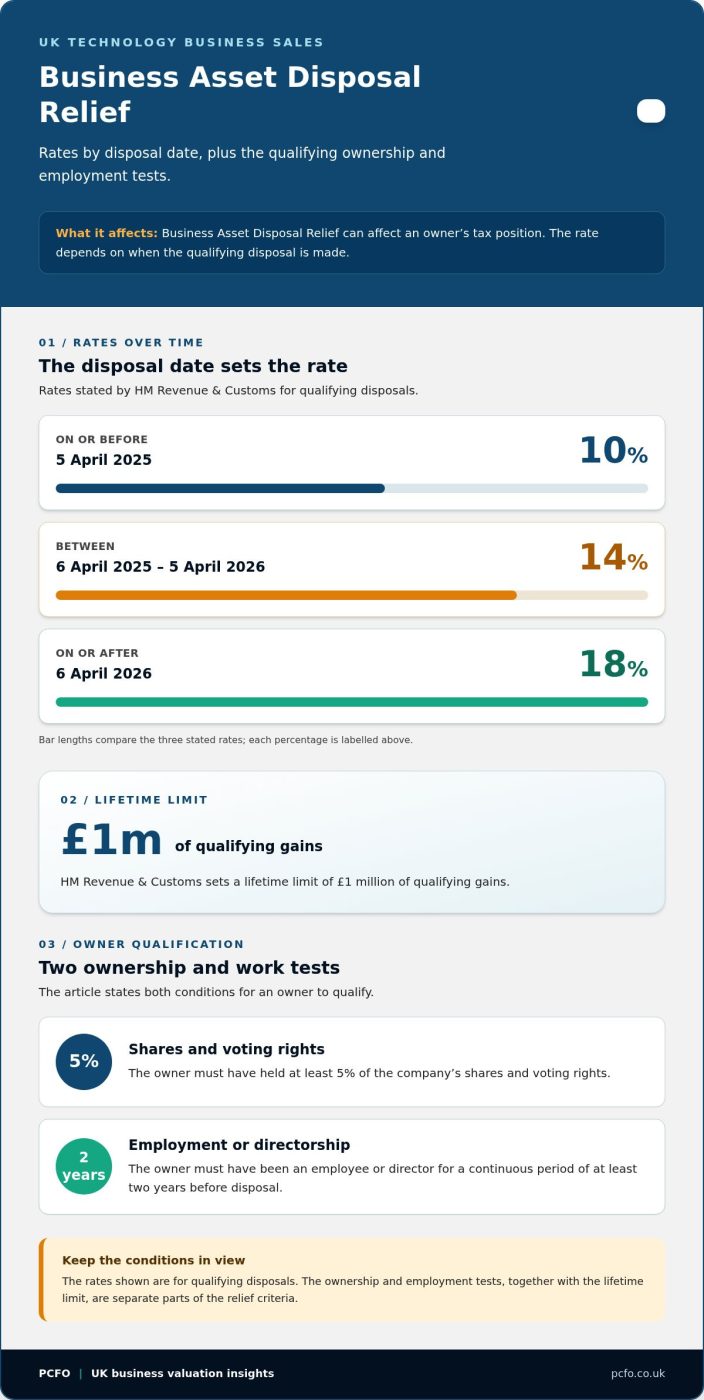
Business Asset Disposal Relief can affect an owner’s tax position. According to HM Revenue & Customs, the rate is 18% for qualifying disposals made on or after 6 April 2026, 14% for qualifying disposals made between 6 April 2025 and 5 April 2026, and 10% for qualifying disposals made on or before 5 April 2025. HM Revenue & Customs sets a lifetime limit of £1 million of qualifying gains. To qualify, an owner must have held at least 5% of the company’s shares and voting rights, according to HM Revenue & Customs. HM Revenue & Customs also states that the owner must have been an employee or director for a continuous period of at least two years before disposal.
UK business brokers and corporate finance advisers may charge fixed, time-based or completion-linked fees; engagement terms set the fee structure and payment conditions.
Valuation due diligence commonly draws on filed accounts, management accounts, forecasts, customer and revenue data, intellectual property records, contracts and share registers.
Online calculators can mislead when generic multiples or limited inputs overlook a tech company’s recurring revenue, intangible assets, forecast risks or buyer-specific fit.
Discounted cash flow
Discounted cash flow (DCF) estimates a company’s value by calculating the present value of its future cash flows. For owners considering how to value a tech company for sale in the UK, DCF connects financial forecasts with the business’s expected ability to generate cash.
Projecting future cash flows
A DCF model forecasts the cash a business expects to generate, then adjusts those future amounts to express their value today. Forecast quality matters because assumptions can shift the valuation substantially. Build projections from revenue drivers, costs, investment and working capital, rather than simply extending recent growth without examining its causes.
For a subscription software company, forecasts might reflect renewals, customer losses and expansion revenue. A hardware business may need to account for production costs, inventory and product development. Intellectual property can support future income, but the forecast should connect that asset to a credible route to sales. Separate evidence-backed assumptions from ambitions, then test how changes affect the estimate.
Assessing financial performance
Financial performance shows whether reported profits translate into cash available to the business. DCF values cash flows, not accounting profit alone. Review management accounts alongside forecasts, and explain material movements between earnings and cash, such as customer payment timing or investment in development.
Accurate projections should reflect operating history and current commitments. A business reporting rising profits may still consume cash if it funds product development or has unpaid invoices. A temporary investment period can also suppress current cash generation while supporting future growth. Show how recurring revenue, customer retention and costs shape expected cash. This evidence helps explain how to value a tech company for sale in the UK using forecasts grounded in the company’s finances.
DCF also depends on the discount rate, which reflects the risk attached to forecast cash flows. Greater uncertainty about future demand or delivery can reduce their present value. Long-term assumptions matter too: changes in expected growth or margins can alter the result. Compare scenarios and identify the evidence supporting each case.
A Finance Director can help connect financial records with forecasts and test the assumptions behind them. If you need that support, Finance Director Services can help structure the financial analysis for sale planning.
Trade buyers, private equity and management buyouts
Buyer type affects which strengths carry weight in a technology company’s valuation. Comparing likely acquisition routes helps explain why different buyers may offer different figures.
Buyer types and acquisition routes
A trade buyer acquires a company to strengthen or expand an existing business, while private equity invests for financial returns. In a management buyout, the existing leadership team acquires the company. The route matters because each buyer examines earnings, strategic fit and future growth differently. A software group may value products that complement its platform, while an investor may focus on dependable cash generation and a credible growth plan. A management team may know the operations well, but still needs a clear funding and transition plan.
Management continuity and incentives
Management continuity means the business can keep operating effectively through a change of ownership. Buyers assess this because customers, staff and suppliers need confidence that key relationships will continue. Identify which leaders own important decisions, customer accounts and product knowledge. Employee incentives can support retention when they align key people with agreed business objectives. Explain how responsibilities will transfer and how the team will stay engaged during the sale process.
Owner reliance and team strength
Owner reliance describes how much a company depends on its founder to sell, deliver or manage its technology. High reliance can make earnings appear less transferable to a buyer. A strong management team reduces this concern by showing clear accountability across finance, sales, product and operations. Buyers also look for evidence of operational and financial performance over several years. Documenting delegated decisions and repeatable processes helps demonstrate that results do not depend on one person.
Before selling, map likely buyer questions to evidence: who leads each function, how customer relationships are maintained, and which decisions still depend on the owner. This makes management continuity tangible during discussions. It also helps distinguish a company with transferable earnings from one whose performance relies heavily on its founder. A clear succession plan can support transaction deliverability and broaden the range of potential purchasers.
Exit planning and opportunity mapping
Exit planning turns a business valuation into a practical route to market. Owners typically begin seeking a valuation two to four years before a sale, while an HSBC adviser suggests starting exit preparation three to five years ahead. That lead time gives you room to strengthen performance, resolve issues and understand which buyers may show interest.
Start by mapping potential sale routes against your objectives. A trade buyer may value strategic fit, while private equity may focus on growth potential and financial performance. A management buyout may depend on leadership continuity and a credible transition plan. Identify what each route needs from the business, then compare those requirements with your current position. This creates an opportunity map, not just a list of possible purchasers.
Preparation also means making the company easier to assess. Organise financial statements, streamline operations, and ensure legal documents are current and fit for purpose. For example, reconcile management accounts with filed figures, document recurring revenue and organise key customer contracts. Internal due diligence can surface issues a buyer may later identify, giving owners time to address them before discussions progress. Clear evidence makes the business valuation more persuasive.
Use the opportunity map to identify specific value-building priorities. If revenue depends heavily on a small number of customers, assess retention and broaden the sales pipeline. If product development is difficult to explain, connect investment to customer demand and commercial outcomes. Review management responsibilities, intellectual property records and operational procedures. Each action should help a buyer understand how the company earns revenue and can continue performing after a sale.
Set review points for forecasts, business risks and buyer interest, then update the plan as trading conditions change. This keeps exit preparation connected to the company’s actual progress, rather than a fixed sale date. For structured support turning growth priorities into an exit plan, plan your business growth.
PCFO: Finance Director Services
PCFO supports owners who need to connect company performance, valuation assumptions and exit planning. Its Finance Director Services and Chief Financial Officer Services can help bring financial reporting and forecasts into a clearer strategic picture. This is particularly useful when preparing for buyer discussions or assessing how operational decisions affect future cash generation.
PCFO’s Business Growth Advisory and Business Planning Consultant services can help you evaluate growth priorities and organise them into a plan that reflects your objectives. Together, these services help clarify the financial position you’re presenting and the opportunities you want potential buyers to see.
If you’re planning a sale and want support with the financial and strategic work, book a free strategy session with PCFO to discuss your next steps.
Make your next move with a clear plan
The next step is to turn your valuation work into decisions you can act on. Decide what matters most to you as an owner: timing, the future role of the leadership team, or the type of buyer you want to engage. Those priorities can shape how you prepare the business and assess offers, not just the headline figure.
A considered approach to valuing a UK tech company for sale connects financial evidence with your intended outcome. Use your preparation to clarify which opportunities to pursue, what needs attention before a transaction, and how you’ll judge whether a proposed deal fits your objectives. This gives you a stronger basis for discussions and keeps the process focused on the future you want to build beyond the sale.
PCFO can help you bring financial and strategic considerations into your exit planning. Discuss your exit with PCFO and take a considered next step towards your plans.
Frequently Asked Questions
Which valuation method should you use?
Use the method that best reflects how the company earns and sustains value, then compare it with another approach. A profitable business with dependable forecasts may suit earnings or cash-flow analysis; a technology company with valuable intellectual property may need closer attention to intangible assets. For a young software firm, market comparisons can add context, provided the comparables genuinely match its business model and scale.
How are UK technology companies typically valued for sale?
UK technology companies are commonly assessed through earnings, cash-flow and market-based methods, with the chosen mix reflecting their maturity and revenue model. Buyers may examine enterprise value against EBITDA or recurring revenue, then adjust their view for debt, cash and transaction-specific risks. For example, a subscription business with stable renewals may attract a different analysis from a hardware company with substantial stock and production commitments.
What valuation multiples apply to UK SaaS and software companies in 2026?
There isn’t one universal SaaS or software multiple for 2026. Growing technology companies are commonly valued in a price-to-earnings multiplier range of 10-25, while 6x ARR on an enterprise value basis is an example of a technology valuation, not a guaranteed market benchmark. The relevant multiple depends on growth quality, profitability, recurring revenue, risk and comparable transactions.
How do revenue, EBITDA, ARR and growth affect a UK tech company valuation?
Revenue indicates commercial scale, while EBITDA helps show operating profitability before interest, tax, depreciation and amortisation. Annual recurring revenue (ARR) can describe contracted subscription income, but its quality depends on renewals and customer retention. Growth may support a higher valuation when it is sustainable and economically sound. Rapid expansion accompanied by weak margins or heavy cash use can lead buyers to scrutinise forecasts more closely.
How do you calculate adjusted EBITDA and normalise owner expenses?
Start with reported EBITDA, then review each proposed adjustment against invoices, payroll records and management accounts. Add back an expense only when it is genuinely non-recurring or personal, supported by evidence, and unlikely to continue after the sale. If the owner performs work the company still needs, include a realistic replacement cost rather than treating the full salary as an add-back. Buyers may challenge unsupported adjustments.
How do customer concentration, recurring revenue, churn and contract length affect valuation?
Customer concentration can increase perceived risk if a large share of revenue depends on one account. Recurring revenue and longer contracts can improve visibility, but buyers will examine renewal terms, cancellation rights and payment history. Churn reveals how consistently customers stay, while expansion among existing accounts can help demonstrate product value. A revenue schedule split by customer and contract status makes these patterns easier to assess.