

The strongest funding decision may not be a choice between debt and equity. For UK SMEs, debt financing versus equity financing comes down to whether predictable repayments fit cash flow better than sharing ownership and some influence with an investor. Debt must be repaid, usually with interest, while equity has no fixed repayments but gives investors a stake in the business.
It’s understandable to focus on the immediate funding need, but the long-term effect matters too. Debt can help you retain ownership, yet repayments continue even if trading is weaker than expected. Equity can ease cash-flow pressure and may bring expertise and contacts, but it means sharing future value and potentially decision-making.
This guide compares repayments, interest, security, guarantees, cash-flow demands and control. It also explains when combining debt and equity may offer a more balanced route, so you can assess funding against your business plans, financial resilience and ownership priorities.
Key Takeaways
- Compare the full trade-off: borrowing preserves ownership but brings repayments, while investment shares future value and may influence decisions.
- Test potential repayments against cash flow after operating costs, and account for possible security or personal guarantee requirements.
- Match the funding route to your growth plans, financial resilience and preferred level of control; a combination of debt and equity may also fit.
- PCFO’s Finance Director and Chief Financial Officer Services, Business Growth Advisory and Business Planning Consultant support can help align funding decisions with your business strategy.
Debt financing vs equity financing: what is the difference?
Debt provides funding that must be repaid, usually with interest. Equity raises capital by selling part of the business. To compare them, consider ownership, investor input, repayment obligations and the company’s stage.
Debt finance
A business loan provides a lump sum to be repaid, while the owner retains ownership. Start-ups may favour equity if they cannot afford repayments; established SMEs may find debt workable when trading history and predictable revenue support affordability. UK lenders typically assess credit history and affordability. Interest may be offset against tax, but seek professional tax advice before making business decisions.
Equity investment
Equity investors provide capital in exchange for a share of ownership and future profits, rather than fixed loan payments. A start-up with growth potential but limited repayment capacity may consider this route; an established SME may prefer debt if it can manage payments and wants to retain ownership. Alongside funding, investors can contribute industry knowledge, experience, contacts and credibility.
Investor involvement
Unlike a lender, an equity investor may have a voice in company decisions, depending on the deal. Their expertise can support growth, but expectations about returns and progress may affect the founder’s plans. Before raising funds, define the opportunity, expected return and investment timescale, then decide how much capital is needed. Equity approval typically depends on growth potential.
| Option | Repayment | Ownership | Typical assessment |
|---|---|---|---|
| Debt | Scheduled, with interest | Retained | Credit history and affordability |
| Equity | No fixed loan repayments | Shared with investors | Growth potential |
For public support, the Growth Guarantee Scheme can widen lending access for eligible SMEs. To pursue finance, first define the funding purpose and amount, then prepare forecasts and business information for lender applications or investor discussions. Choose the route that fits cash flow and the level of control you’re prepared to share.
Debt repayment, interest, security and guarantees
Debt brings repayment obligations that affect cash flow, even when trading slows. The type of funding and the loan terms shape its cost and associated risks.
Repayment obligations
Debt repayments are due regardless of business performance. A business loan often provides a lump sum with fixed, predictable payments, while asset finance can spread equipment or vehicle costs. Missed repayments can affect the business’s credit score, so include each payment in forecasts before committing. Unlike equity, debt doesn’t involve giving up ownership.
Repayment planning and cash flow
Build repayments into the funding budget alongside existing commitments and operating expenditure. Payments should come from cash flow left after current expenditure and before any dividends. Stress-test the forecast against slower growth, rising costs or lower sales. This shows whether the business can meet payments during weaker trading, not only in its expected scenario.
Interest costs
Interest adds to the amount repaid and varies with the loan terms. Compare the total repayment schedule with the capital required and the cash expected from its intended use. A longer term may reduce each payment but extend the borrowing period. Check how interest is calculated and whether payment dates align with cash receipts, rather than relying on headline rates alone.
Security and guarantees
Some business loans require collateral, putting pledged assets at risk if repayments are missed. Smaller businesses may also be asked for a personal guarantee, linking the owner personally to the debt. Debt doesn’t require business equity as collateral, but the lender’s security requirements still matter. Review the assets and guarantees involved alongside the repayment plan before accepting an offer.
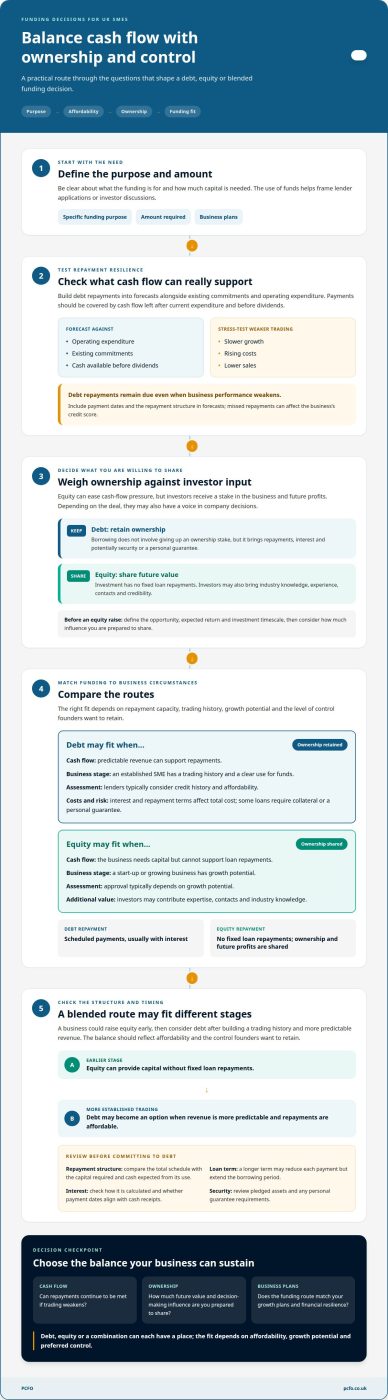
Choosing funding based on cash flow and ownership priorities
Choose funding by weighing the business’s cash flow, credit position, growth plans and desired ownership. The choice between debt and equity can also change as a company develops.
Choosing debt finance
Debt may suit an established SME with a clear use for funds and predictable revenue. Business loans can fund investment without an ownership exchange, provided cash flow can support repayments. Lenders typically assess credit history and affordability, so existing commitments matter too.
Choosing equity finance
Equity can suit a start-up or growing business that needs capital but cannot support loan repayments. It involves giving investors a share of ownership and potentially a voice in decisions. Consider whether their expertise, contacts or industry knowledge could help deliver the growth plan. Also weigh the future value being shared: an ownership stake can become costly if the business becomes highly profitable.
Combining debt and equity
A mix can match different funding needs to the business’s stage. For example, a company could raise equity early, then consider debt after building a trading history and more predictable revenue. Debt tends to cost less than equity, while an equity investment may reassure lenders about the company’s prospects and repayment capacity. The balance should reflect affordability and the amount of control founders want to retain.
Use these steps to structure the decision:
- Define the investment opportunity, expected return and timescale before setting the funding amount.
- Map forecast cash flow against existing commitments and proposed repayments.
- Decide how much ownership and decision-making influence founders are prepared to share.
- Compare a debt-only, equity-only and mixed plan against those priorities.
If a loan limit is reached or debt becomes more expensive, equity may be worth considering. A funding plan should show how the chosen structure supports growth without placing undue pressure on cash flow or ownership.
Combining debt and equity financing
UK SMEs don’t have to choose one funding route for every growth stage. A staged mix can match the amount raised to the business’s trading record, cash flow and ownership priorities.
For example, business owners may raise equity early, when revenue is less predictable and regular loan repayments would add pressure. Once the company has a trading history and more predictable revenue, it may seek debt from a lender. This sequence can preserve more ownership later, while using investor capital to support the earlier stage.
Debt tends to cost less than equity, so a suitable mix may reduce the overall cost of finance. Equity can also help a business secure borrowing by validating its prospects to a lender and supporting confidence in repayment. That does not remove the need to demonstrate affordability: forecast cash flow must still support the proposed borrowing alongside existing commitments.
Some structures blend the two more directly. Mezzanine finance works like debt, but the business may give up an equity share as payment if it defaults. Other hybrid arrangements combine borrowing with a small equity stake, giving the fund a potential return from both elements. These terms affect ownership and risk, so assess them against the capital required and the business’s ability to repay.
Use a staged assessment before agreeing a structure:
- Set out the growth opportunity, the amount required and when the funds are needed.
- Forecast cash flow under expected and weaker trading conditions.
- Estimate how much borrowing the business can service without restricting operations.
- Decide how much ownership business owners are willing to exchange for investment.
- Compare the combined structure’s repayment obligations and investor rights with the funding need.
A mix is useful when each source has a clear role, such as equity supporting early growth and borrowing funding later investment. Plan a funding strategy around your growth goals with advice that weighs capital needs, repayment capacity and ownership priorities.
PCFO
PCFO helps growing businesses connect funding decisions with their financial plans and growth objectives. If you’re weighing borrowing against giving up ownership, or considering a mix, a structured review can clarify how each route affects cash flow, repayment capacity and future plans.
Through Finance Director Services, Chief Financial Officer Services, Business Growth Advisory and business planning consultancy, PCFO can help assess funding needs, model different scenarios and align the chosen approach with your business strategy. This support is particularly useful before approaching lenders or investors, when you need a clear view of the amount required and the trade-offs involved.
Contact PCFO to discuss how your funding decision fits your business plans.
Set your funding direction with confidence
The next step is to turn your preferred funding route into a decision the business can act on. For debt financing versus equity financing for SMEs, connect the funding choice to a defined growth objective, a realistic financial plan and the ownership structure you want to build over time.
PCFO can help bring those considerations together through Finance Director Services, Chief Financial Officer Services and Business Growth Advisory. This support can be useful when you’re preparing to discuss funding, assessing how a proposed investment fits your plans, or deciding what financial oversight your next stage of growth needs.
Start a conversation about your funding priorities and the direction you want your business to take. Contact PCFO to discuss SME funding and take a considered next step towards your growth plans.
Frequently Asked Questions
Which is right for your business?
The right option supports your funding purpose without undermining cash flow or ownership priorities. For SMEs comparing debt financing and equity financing, the decision depends on factors such as funding timing and repayment capacity. A company with reliable income may consider borrowing, while a business pursuing expansion without repayment capacity may consider equity. Assess the effect on future decisions before choosing.
How to determine capital structure of an SME?
Start by identifying how much capital the business needs, what it will fund and when the investment should deliver value. Then map existing borrowing, available equity and forecast cash flow to understand repayment capacity. Model different funding combinations, including weaker trading conditions, and consider how much ownership founders wish to retain. Review the structure as the company’s revenue, commitments and growth plans change.
What are the advantages and disadvantages of equity financing?
Equity can provide capital without fixed loan repayments, which may ease pressure while a business develops. Investors can also bring relevant expertise, contacts and credibility. In exchange, founders share ownership and may give investors influence over decisions. Investors may expect a clear route to returns and progress, so weigh the value of their contribution against the future profits and control being shared.
What are the main business funding options for an SME?
Common options include business loans, asset finance, invoice finance, equity investment and working capital finance. Each suits a different need: invoice finance may help when unpaid invoices tie up cash, while asset finance can spread the cost of equipment or vehicles. SMEs can also consider refinancing existing debt or combining funding sources. Match the option to the purpose, timing and cash-flow profile.
What is a good debt-to-equity ratio for a small business?
A suggested guideline for a small business is between one pound of debt per pound of equity and two pounds of debt per pound of equity. It’s a reference point, not a universal target. The appropriate balance depends on trading stability, current commitments, access to capital and the business’s ability to service borrowing. Review the ratio alongside cash-flow forecasts and growth plans.
What is the difference between debt financing and equity financing for UK SMEs?
For UK SMEs, the distinction between debt financing and equity financing is whether funds are borrowed or raised by sharing ownership. Debt is repaid under agreed terms, usually with interest, while equity gives investors a stake. Debt can preserve ownership but adds repayment commitments. Equity avoids fixed loan repayments but shares future value and may involve investor input. Businesses can combine both sources to meet different funding needs.