

Cutting costs can create new pressure if invoices go out late or cash-flow gaps catch you by surprise. The most practical cost optimisation strategies for SMEs combine careful spending decisions with disciplined cash management: outsource suitable non-core work, renegotiate supplier terms, forecast cash flow and invoice promptly.
It’s natural to look first for expenses to remove, but reducing overheads works best when it doesn’t undermine the work that keeps your business operating and growing. This guide explains how to review recurring costs, assess outsourcing, negotiate with suppliers and improve invoicing routines. You’ll also see how cash-flow forecasting helps you plan for upcoming commitments and make cost decisions with greater confidence.
Key Takeaways
- Assess which non-core activities could be outsourced, while protecting the work that supports your business’s growth.
- Prepare for supplier discussions by reviewing your current needs, contract terms and opportunities to consolidate purchases.
- Review recurring expenses and processes to spot unused subscriptions, duplicated work and avoidable administrative steps.
- Use cash-flow forecasts and prompt, consistent invoicing to anticipate payment gaps and plan for upcoming commitments.
1. Outsourcing non-core activities
Start by separating work that directly supports sales, service delivery or product quality from supporting tasks. Bookkeeping, IT support and routine administration may be suitable for outsourcing when demand fluctuates or specialist systems are needed. For businesses seeking external financial expertise, providers such as First Call Service Solutions can deliver operational support without the overhead of hiring full-time staff. Compare the outsourced scope with the internal time it replaces, including management and training. The aim is to reduce fixed overheads without creating delays or weakening accountability.
Use zero-based budgeting to assess each activity instead of carrying last year’s spending forward. For every task, identify its business purpose, required service level and most cost-effective workable delivery model. Automation may handle repeatable steps, while a specialist provider manages exceptions. Cross-training employees can also make workloads more flexible by ensuring essential tasks have cover when demand shifts. Keep core knowledge in-house when it supports customer relationships or operational decisions.
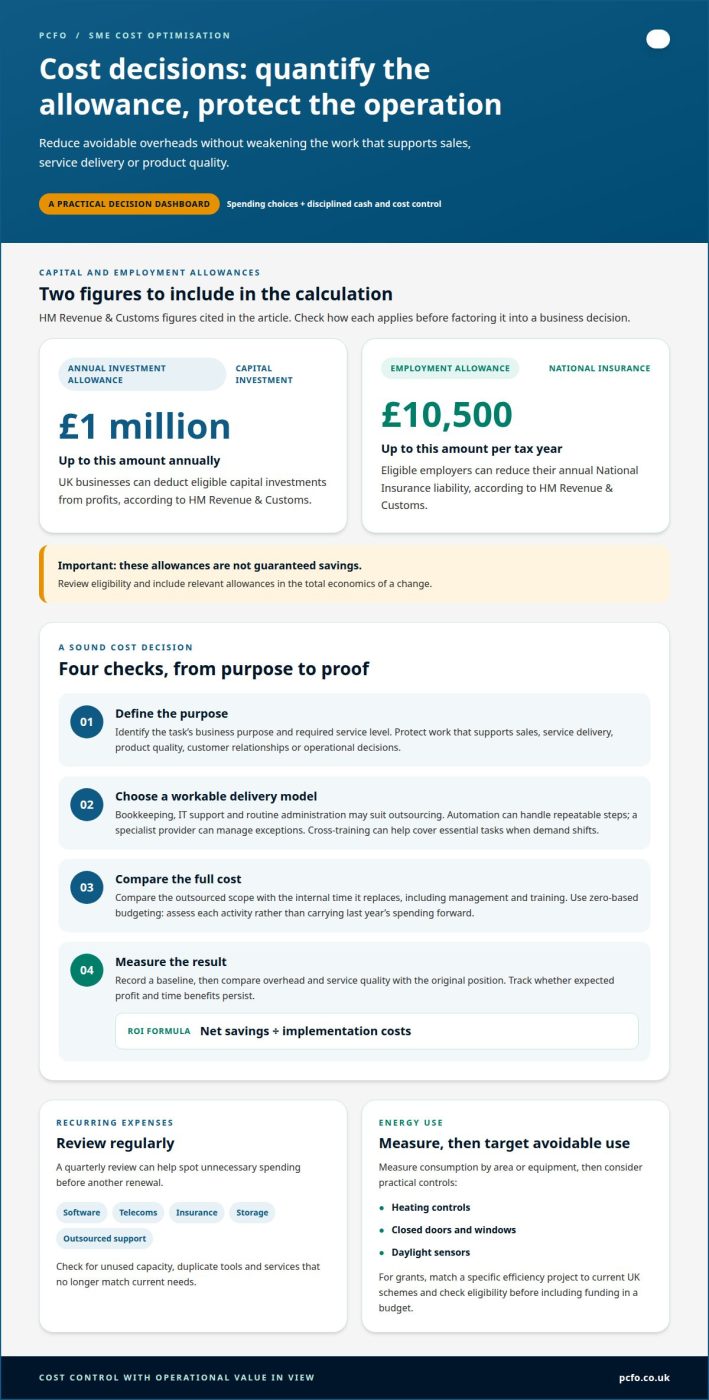
For capital purchases linked to an outsourcing decision, the Annual Investment Allowance can affect the calculation: according to HM Revenue & Customs, UK businesses can deduct up to £1 million annually in capital investments from profits. According to HM Revenue & Customs, eligible employers can reduce their annual National Insurance liability by up to £10,500 per tax year. Include relevant allowances when assessing the total economics of implementing a change, rather than treating them as guaranteed savings.
To reduce energy bills, measure consumption by area or equipment, then tackle avoidable use through heating controls, closed doors and windows, and daylight sensors. For grants, match a specific efficiency project to current UK business energy-support schemes and assess their eligibility criteria before including funding in a budget. Measure each initiative against a recorded baseline: compare the resulting overhead and service quality with the original position. Calculate return on investment by dividing net savings by implementation costs, then track whether the expected profit and time benefits persist. This makes outsourcing decisions comparable with other cost-saving options.
2. Renegotiating supplier contracts
Map supplier spending across operations, then identify overlapping contracts, unused services and renewal dates. Compare each agreement’s scope with actual use. For example, a business paying for separate support packages across teams could consider whether one consolidated contract meets its needs. Gather invoices, service records and contract terms before opening negotiations. This gives you evidence to discuss value, rather than focusing only on a lower price.
Approach suppliers with a clear proposal. Ask about revised service levels, flexible payment terms, volume pricing or a different package. Explain what your business can commit to, such as predictable orders or a longer relationship, and request terms that reflect that commitment. Weigh quality and reliability alongside savings: a cheaper input that delays delivery can disrupt employees, operations and clients. Record agreed changes in writing and check their effect on renewal, cancellation and support arrangements.
Bulk purchasing can strengthen your negotiating position when demand is stable, but weigh the purchase against storage, cash-flow and waste risks. A cooperative purchasing group can combine demand from several businesses, giving smaller firms access to terms they might not secure alone. Before committing, confirm that the shared specification meets your requirements and that delivery schedules suit your operations.
- Software: remove duplicate licences or negotiate a package based on active users, including remote employees.
- Marketing: review deliverables and reporting, then align the supplier’s scope with current campaign priorities.
- Materials: compare agreed quality and delivery terms before changing order volumes or suppliers.
Keep a simple record of the original terms, proposed changes and expected operational effect. Review supplier performance after implementation, using delivery, quality and service measures alongside spend. If contract decisions need to fit a wider growth plan, business planning support can help connect purchasing priorities with financial objectives.
Cutting unnecessary expenses and streamlining processes
Run a financial review across operating expenses, product margins and recurring commitments. Start with ledger categories, then match each expense to a current business function. Check software renewals, telecoms packages, insurance, storage and outsourced support for unused capacity or duplicated tools. A quarterly review gives owners a regular point to remove unnecessary spending before another renewal.
For software, telecoms and cloud subscriptions, compare invoices with active users, call patterns and actual resource use. Remove redundant licences, consolidate overlapping services and negotiate packages around current requirements. Cloud reviews should identify idle resources and consider auto-scaling or a FinOps approach, which connects cloud use with financial oversight. Keep essential security and support functions in scope when evaluating cheaper alternatives.
UK SMEs can assess tax reliefs and allowances alongside grants when planning eligible investment or efficiency projects. The Annual Investment Allowance and Employment Allowance are relevant examples. Review the eligibility criteria and how each applies to your business. For grants, look for current UK programmes that match the project and assess their application conditions before including potential funding in a forecast.
Premises savings may come from matching space to how the team works. Review occupancy, lease terms and unused rooms; options include downsizing, negotiating terms, using flexible office and event options from providers such as E11 SPACE, or subletting surplus space. For business rates, review the property’s current bill and assess whether an applicable relief fits the business and premises. Include lease commitments and transition costs in your decision.
Cost cutting also carries risks. Removing a control or support function can increase errors, weaken service quality or create contractual and employment issues. Assess the operational effect before changing a process, and retain the functions needed to serve clients reliably.
- Process: remove duplicated approvals and automate routine invoicing or payroll steps.
- Measure: compare spending, output and service quality before and after each change.
4. Cash-flow forecasting and invoicing discipline
A cash-flow forecast shows when money is expected to enter and leave the business. Cash flow is a challenge for 46% of SMEs, so monitor timing as well as profit. Record expected customer receipts, supplier payments, payroll, tax obligations and debt repayments. Compare the forecast with actual transactions, then update assumptions when a client changes an order or pays late.
Use your forecast to identify pressure points before committing to discretionary spending. For example, if customer payments are due after a supplier bill, consider whether you can align payment dates or phase spending. Set out expected, delayed and reduced-receipt scenarios. This helps you judge whether a purchase supports operations and remains affordable under less favourable conditions.
Disciplined invoicing improves the quality of those forecasts. Agree clear payment terms before work begins, issue an accurate invoice as soon as the agreed milestone is reached, and record its due date. Assign responsibility for monitoring outstanding invoices. Follow up promptly on overdue amounts, resolve queries quickly and record promised payment dates. A consistent process makes incoming cash easier to plan around.
- Forecast: record expected receipts and payments, including tax and debt commitments.
- Monitor: compare actual cash movements with the forecast and investigate differences.
- Invoice: issue promptly, state payment terms clearly and track overdue balances.
Clear visibility also supports better purchasing decisions. If a discount for early payment is offered, compare its value with the cash you would retain and the effective cost of using it. Don’t treat forecast income as available cash until payment arrives. These habits connect cost decisions to the funds available to meet commitments and pursue growth.
For a more structured approach to cash planning and financial decisions, strengthen your cash-flow planning.
PCFO
PCFO helps growing businesses connect cost decisions with financial planning and sustainable growth. When outsourcing, supplier changes or cash-flow pressures are difficult to assess together, PCFO’s Finance Director Services and Chief Financial Officer Services provide financial oversight. Business Growth Advisory and Business Planning Consultant services help owners weigh overhead decisions against operational priorities and future plans.
This support is useful when cost reviews need to become a coherent plan rather than a series of disconnected cuts. PCFO helps businesses understand how spending, cash flow and objectives interact, giving owners a clearer view of the implications of their decisions.
Contact PCFO to discuss how financial guidance could support your business’s cost priorities.
Build cost decisions into your next business plan
Make cost control an ongoing management discipline, not a one-off response to pressure. The most effective cost optimisation strategies for SMEs support the business’s changing priorities while preserving its capacity to serve clients and pursue growth. Set a clear objective for each decision, assign responsibility for monitoring its effect, and revisit your assumptions when trading conditions or operational needs shift.
A useful next step is to identify decisions that need a broader financial view. PCFO’s Finance Director Services, Chief Financial Officer Services and Business Growth Advisory help owners connect cost priorities with business direction. This support can be valuable when separate spending decisions are difficult to weigh against the company’s overall plans.
Contact PCFO to discuss your costs and consider the right next step for your business. A measured approach can help you move forward with greater clarity and confidence.
Frequently Asked Questions
Considering Cutting Costs in 2025?
Yes, review any 2025 cost plan against your business’s current priorities and trading conditions. Cost optimisation strategies for SMEs should distinguish efficiency gains from cuts that reduce capacity or customer service. For example, if a lower-cost process increases rework, include that effect in your review. Use the findings to set practical priorities for the next planning period, rather than carrying forward decisions that no longer fit.
What are the most effective cost optimisation strategies for UK SMEs?
Effective cost optimisation strategies for SMEs prioritise changes by financial impact, operational effect and ease of reversal. Rank proposed actions against those criteria, then start with changes that preserve the customer experience and core delivery. Assign an owner to each action and track a relevant measure, such as error rates or fulfilment delays. This helps distinguish lasting efficiency gains from cuts that shift costs elsewhere.
How can UK SMEs reduce staffing costs without redundancies?
Reduce avoidable staffing expenditure by planning workloads around demand and reviewing overtime, temporary cover and unfilled vacancies. A skills matrix can show where cross-training would give teams more flexibility, while clearer scheduling can limit idle time or last-minute cover. Discuss proposed changes with affected employees and assess the effect on service, workload and morale. The aim is to use existing capacity more effectively, not simply transfer pressure onto staff.
How can SMEs improve procurement and negotiate better supplier prices?
Prepare a negotiation brief setting out purchase history, required specifications, delivery expectations and the value of the relationship. Ask suppliers to price the full package, including delivery, support and any price-review terms, rather than comparing headline prices alone. For instance, a lower unit price may not suit your business if it requires larger orders or less reliable delivery. Document agreed terms and review them against actual performance.
What are the costs and benefits of outsourcing versus hiring in-house for SMEs?
Compare outsourcing and recruitment based on the work required, demand consistency, management time and the importance of retaining knowledge internally. Outsourcing can provide access to specialist capability without creating a permanent role, while an employee may offer continuity and closer day-to-day oversight. Include onboarding, supervision, systems and handover requirements in the comparison. The best fit depends on whether the need is ongoing, variable or tied to a defined project.
How can SMEs improve cash flow and lower borrowing and payment-processing costs?
Improve cash visibility by matching expected receipts to planned commitments and reviewing overdue customer balances by age and amount. For larger projects, consider whether deposits or milestone billing suit the contract, reducing the gap between delivery and payment. To assess borrowing or payment-processing costs, compare the full terms, fees and settlement timing across available options. Faster reconciliation can also help identify charges or payment delays that need attention.