

A sole-source supplier may limit your leverage on price, but it does not remove every point you can negotiate. Negotiating better terms with suppliers means looking beyond unit cost to payment timing, delivery schedules, service levels, contract length and performance commitments. Start with clear priorities and evidence, then explore what each side can offer.
It’s reasonable to feel cautious when a supplier has few alternatives, or when changing provider could disrupt your operations. The aim isn’t to push for a concession at any cost. It’s to reach terms that support cash flow, protect service quality and make the relationship sustainable.
This guide explains how to prepare, shape a proposal and exchange concessions thoughtfully. It also covers building supplier relationships and approaching powerful or sole-source suppliers, so you can assess your options with greater clarity.
Key Takeaways
- Set clear ideal, acceptable and walk-away outcomes before discussions begin, and support your position with relevant evidence.
- Look beyond unit price: payment timing, delivery, service levels and contract length can all create value.
- Use balanced concessions and regular, transparent communication to strengthen long-term supplier relationships.
- With a sole-source supplier, focus on the terms you can influence and prepare a credible plan for the negotiation.
What are the key elements of successful supplier negotiation?
Negotiating better terms with suppliers starts with comparable evidence, clear priorities and written records. Treat each discussion as a package, balancing cost against the agreement’s value and risks.
-
Compare Supplier Quotes with Market Data
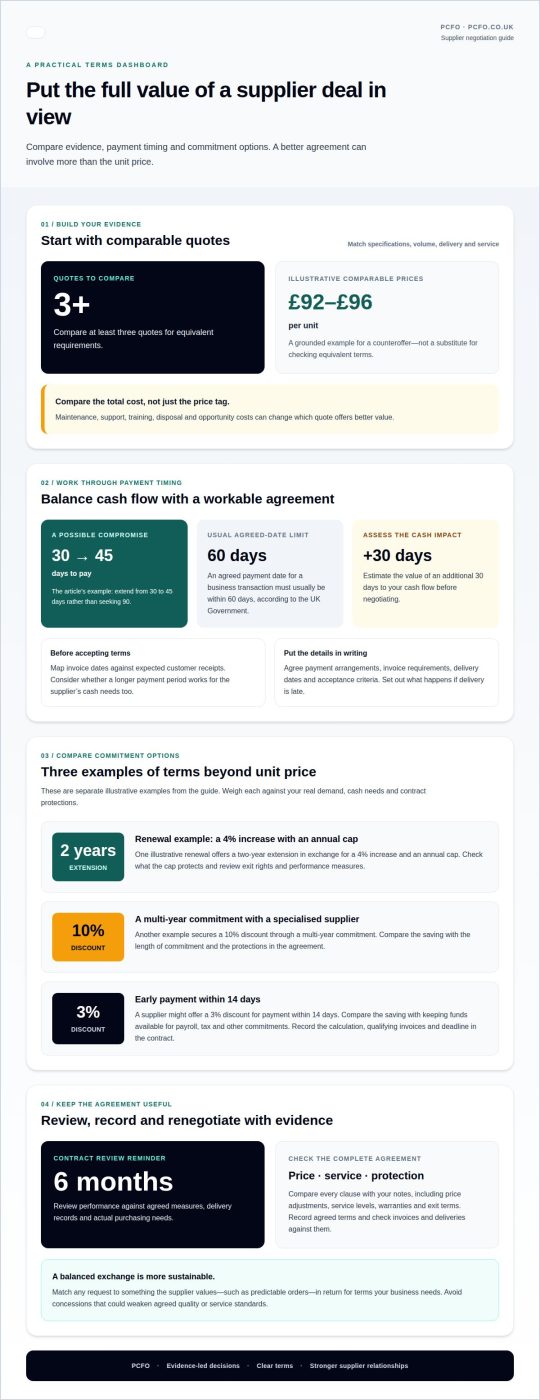
Compare at least three quotes for equivalent specifications, order volumes, delivery schedules and service levels. An evidence-based example uses comparable prices ranging from £92 to £96 per unit, giving a clearer position than an unsupported offer. Check total cost of ownership too: maintenance, support, training, disposal and opportunity costs can change which quote offers better value.
-
Set Payment, Delivery and Value-Added Terms
Agree payment arrangements, delivery dates and acceptance criteria before placing an order, particularly with a new supplier. According to UK Government, an agreed payment date for a business transaction must usually be within 60 days. Set out invoice requirements and what happens if delivery is late. You can also negotiate service levels, warranty cover or support as value-added terms.
-
Negotiate Prices and Payment Periods
To succeed at negotiating better terms with suppliers, use comparable quotes to support a counteroffer and ask about the starting price and available discounts. Exchange concessions rather than making demands: for example, discuss whether a larger order or predictable schedule could support a lower unit price. Estimate the value of an additional 30 days to your cash flow, then consider compromise, such as extending payment from 30 days to 45 days instead of seeking 90.
-
Assess Cash Flow and Negotiation Risks
Map invoice dates against expected customer receipts before accepting payment terms. A longer payment period may preserve working capital, but it might not suit the supplier’s cash needs. Pushing too hard on price or timing can strain service quality, delivery reliability or the relationship. Record agreed terms in writing, then check invoices and deliveries against that record.
Volume, contract length and early-payment discounts
- Match order volume to realistic demand. Use expected purchasing needs to decide whether a larger commitment could secure better pricing or other favourable terms. A supplier may discount consolidated orders, but excess stock ties up cash and creates storage or obsolescence risks. Set objectives first, then compare the discount with the full cost of buying and holding more.
- Trade contract length for defined protections. A longer agreement can support lower pricing, but should include safeguards against unexpected increases. One illustrative renewal offers a two-year extension in exchange for a 4% increase and an annual cap. Another example secures a 10% discount from a specialised supplier through a multi-year commitment. Check exit rights and performance measures before agreeing.
- Assess early-payment discounts against cash needs. For example, a supplier might offer a 3% discount for payment within 14 days. Compare the saving with the value of keeping funds available for payroll, tax and other commitments. Agree the discount calculation, qualifying invoices and payment deadline in the contract, rather than relying on an informal offer.
- Debrief promptly and review the final agreement. After negotiations, record what worked, which concessions were made and whether you achieved each objective. Compare every clause with your notes before signing, including price adjustments, service levels, warranties and exit terms. Involve a contract lawyer early if the agreement includes complex liability, intellectual property or regulatory clauses.
- Schedule reviews and renegotiate when circumstances change. Set a reminder to review the contract every six months, then assess performance against agreed measures, delivery records and actual purchasing needs. If demand, costs or service requirements shift, use that evidence to discuss revised terms. Record changes in writing and share them with the supplier to keep the agreement current.
Building supplier relationships
Build the relationship through regular communication, clear expectations and practical cooperation. For example, involve the supplier early when planning a change to demand or delivery.
-
Build Rapport with Suppliers
Schedule regular meetings to discuss expectations, upcoming needs and feedback, rather than getting in touch only when a problem arises. Share notes afterwards so both sides have a record of decisions and responsibilities. Understanding the supplier’s constraints can help you raise concerns constructively. If a delivery issue affects production, explain the operational impact and agree how both teams will track progress and share updates.
-
Seek a Mutually Beneficial Deal
Identify what each side values before proposing a concession. A supplier may prioritise predictable orders, while your business may need flexibility around delivery or cash flow. Offer a balanced exchange, such as clearer demand forecasts in return for more adaptable delivery schedules. Discuss the impact on service and liability as well as price. Avoid requesting concessions that could undermine the supplier’s ability to meet agreed quality or service standards.
-
Develop Collaborative Supplier Relationships
Involve strategic suppliers early in planning so their industry insight can inform decisions before requirements are fixed. For example, discuss an upcoming product change together and identify possible supply constraints, alternatives or timing adjustments. Agree shared objectives and review progress against practical measures, such as delivery reliability or response times. Keep communication open as circumstances change, and record responsibilities clearly. This makes it easier to solve problems jointly instead of treating each issue as a new dispute.
Negotiating with powerful or sole-source suppliers
A sole-source supplier limits your alternatives, but price is not the only negotiable term. Prepare around operational priorities and evidence, then focus on changes both parties can sustain.
- Prepare a realistic alternative. Identify other supply routes, substitute specifications or ways to reduce dependency, even if switching is not practical now. This is your BATNA, or Best Alternative to a Negotiated Agreement: your backup plan if discussions fail. A credible alternative helps you define your walk-away point without making threats you cannot carry out.
- Build an evidence-based position. Gather relevant benchmarks, usage patterns and performance records before the meeting. If a renewal proposes a 9% increase, compare it with a relevant index and explain why a 4% increase is more supportable. Tie your proposal to documented costs or service outcomes, rather than treating a lower figure as self-evidently fair.
- Start renewal discussions early. For a sole-source software agreement, begin preparing six months before renewal. This gives your team time to assess usage, identify unwanted features and model the effect of different terms. Ask the supplier early to explain its opening price and available discounts, then use that information to shape a considered response.
- Negotiate beyond the headline price. If the supplier will not lower its price, discuss payment timing, service levels, contract length or performance commitments. Presenting two or three options can reveal what matters most to the supplier. For example, offer a longer commitment only in exchange for a cap on annual increases or clear service measures.
- Keep the conversation controlled and documented. Set objectives before the meeting, and record agreed terms as discussions progress. If you feel pressured, ask for a break rather than accepting unclear wording. Before signing, compare the final agreement with your notes, especially on liability, renewal and exit clauses.
Plan your supplier negotiation with a clearer view of commercial priorities and financial trade-offs.
PCFO
PCFO helps business owners connect supplier decisions with cash flow, financial planning and growth priorities. If negotiations involve significant commitments or a sole-source supplier, Finance Director Services can support commercial decision-making and help assess the financial implications. For wider strategic planning, Business Growth Advisory can help align supplier arrangements with your business’s direction.
Turn to PCFO when supplier terms need to be considered alongside budgets, forecasts or growth plans. The focus is on helping you assess trade-offs and make informed decisions, rather than treating a lower price as the only measure of value.
Contact PCFO to discuss how its financial and business planning support could help with your supplier decisions.
Make supplier decisions part of your forward plan
Make each negotiation a stronger basis for future commercial decisions. A disciplined approach to negotiating better terms with suppliers helps you assess commitments alongside plans for investment, growth and working capital. Make supplier choices part of routine financial planning, rather than treating each renewal as an isolated discussion.
Bring forecast changes and supplier commitments into the same management discussion. This gives decision-makers a clearer view of which agreements still support the business’s direction and where terms may need attention. PCFO’s Chief Financial Officer Services can provide financial leadership when supplier decisions form part of wider planning and growth priorities.
Discuss your business’s needs with PCFO and take a considered next step towards more confident commercial decisions.
Frequently Asked Questions
What is the 70-30 rule in procurement negotiation?
The 70-30 rule suggests spending 70% of negotiation time on preparation and research, and 30% on the discussion itself. Use preparation to define objectives, understand the supplier’s position and consider alternatives. Then use the meeting to test assumptions, exchange proposals and record decisions. It’s a planning guideline, not a fixed formula for every supplier or agreement.
How can businesses prepare for effective negotiations with suppliers?
Set an ideal outcome, an acceptable outcome and a clear walk-away point for each priority. Gather comparable quotes, purchasing forecasts and supplier performance records to support your position. Decide who can approve changes, agree an agenda with the supplier and choose how to record decisions. For example, bring a proposed contract clause alongside your commercial request.
How does supplier market power affect negotiation strategies?
A supplier with few substitutes may have greater influence over price, timing or conditions, so identify which terms remain negotiable. Assess the cost and operational impact of switching, reducing reliance or adapting specifications. If the supplier has strong leverage, focus proposals on measurable value, such as clearer demand forecasts or phased requirements, rather than making an ultimatum your business cannot sustain.
Should procurement always aim for the lowest price?
No. Procurement should seek the strongest overall value, not simply the lowest quoted price. A cheaper offer may carry higher maintenance, support, training or disposal costs, or cause more disruption through unreliable delivery. Compare the full lifecycle cost and the supplier’s ability to meet operational needs. For example, a slightly higher quote may be preferable if it includes dependable support.
What are common mistakes to avoid in supplier negotiations?
Common mistakes include entering discussions without defined priorities, making unsupported demands and agreeing to terms without recording them. Avoid focusing solely on headline price or treating every supplier conversation as a one-off contest. For example, an aggressive discount request can damage cooperation if it ignores the supplier’s delivery constraints. If you feel pressured, pause, clarify the wording and document each agreed change before proceeding.
What supplier contract terms can be negotiated besides price?
Negotiable terms can include payment schedules, order quantities, delivery windows, service levels, warranties, support, contract duration and exit provisions. The right mix depends on your operational and financial priorities. For example, a business facing uncertain demand could seek flexible order quantities, while one relying on specialist equipment may prioritise response times and maintenance responsibilities. Record agreed measures clearly so both parties can assess performance.