

The cheapest finance support can become costly if it only records what has already happened. For a startup, affordable financial expertise for startups means matching the support to the decisions ahead, not rushing into a full-time senior hire or choosing a provider on price alone. If cash is difficult to forecast and different services seem to overlap, it can be hard to know where to start.
You don’t necessarily need an in-house Finance Director to improve financial visibility. You may need practical accounting for day-to-day records, strategic advice for planning growth, or a flexible combination that can change as your business develops. The first step is to understand what each provider does and what your startup needs now.
This guide compares routine accounting with strategic finance support, looks at flexible options such as outsourced accountancy and part-time finance leadership, and sets out questions to ask before engaging an adviser. Use it to assess scope, fit and value, and choose support without committing to more than your startup needs.
Key Takeaways
- Affordable financial expertise for startups starts with matching support to the decisions your business needs to make, rather than defaulting to the cheapest option.
- Separate routine bookkeeping and reporting from forecasting, planning and strategic financial leadership to identify gaps in your finance support.
- Compare accountants, outsourced support, fractional finance leaders and full-time hires by scope, flexibility and fit for your current stage.
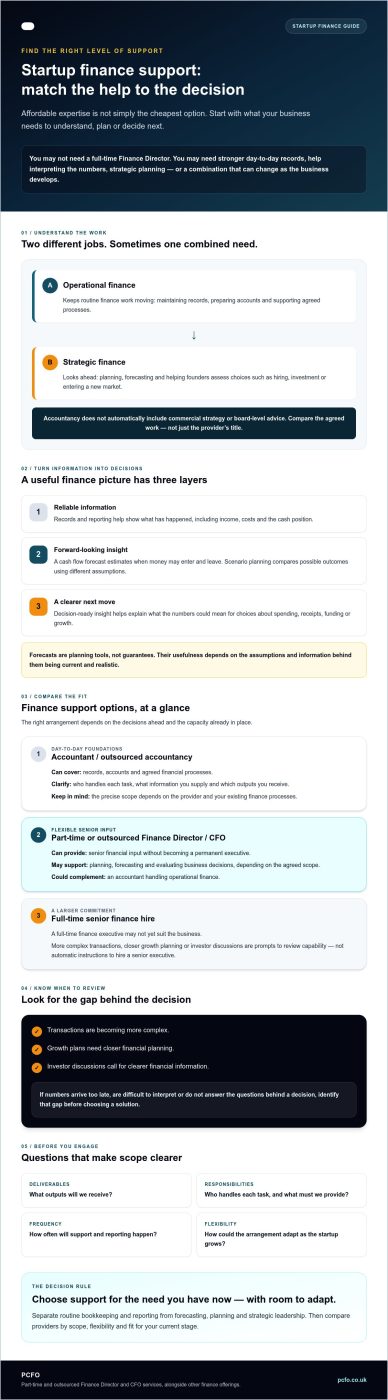
- Before engaging a provider, clarify deliverables, responsibilities, frequency of support and how the arrangement could adapt as your startup grows.
- Explore how PCFO’s part-time and outsourced Finance Director and CFO services, alongside its other finance offerings, may fit your needs.
Why affordable financial expertise matters as a startup grows
As a startup grows, its finances can become harder to manage just as the stakes of each decision rise. A founder may need clearer cash projections, better insight into performance or a plan for the next stage, while a full-time finance executive may not yet suit the business. That gap doesn’t automatically mean you need a CFO. You may need more reliable financial information, help interpreting it, or both.
Financial expertise helps turn accurate information into a clearer view of what is happening and which options are available. The foundations of entrepreneurial finance include funding, financial planning and valuation. For a founder, this can be as immediate as checking whether expected customer receipts are likely to arrive in time to cover upcoming costs.
What financial expertise can help a startup understand
A cash flow forecast estimates when money may enter and leave the business. It can flag potential pressure on cash early, giving founders time to review spending, receipts or funding options. It is a planning tool, not a guarantee. Its usefulness depends on the assumptions and information behind it, so check that these are current and realistic.
Management accounts give an internal view of performance, such as income, costs and cash position, to support regular decisions. They can provide context that historic statutory reporting may not show on its own. Scenario planning compares possible outcomes. For example, a founder can assess how a proposed hire, investment or growth plan could affect cash and costs under different assumptions.
When does a startup’s finance requirement change?
Review your finance capability when transactions become more complex, growth plans need closer planning, or investor discussions call for clearer financial information. These are prompts to assess what is missing, not instructions to hire a senior executive. Depending on the decisions ahead and the capacity already in place, a startup might need more consistent reporting, help with planning or strategic finance leadership.
Financial data records what has happened; decision-ready insight helps explain what it could mean for your next move. If the numbers arrive too late, are difficult to interpret or don’t answer the questions behind a decision, identify that gap before choosing a solution. The right level of affordable financial expertise for startups should address the need at hand and remain proportionate to the business. Better financial control does not necessarily require a full-time CFO.
What startup finance support includes, from accounts to strategic advice
Finance support covers different kinds of work, and similar service labels don’t always mean the same thing. Routine accounting helps keep records and reporting in order. Strategic finance support helps founders use financial information to plan and assess choices. A startup may need one, the other or a combination, so compare the actual scope rather than relying on a provider’s title.
Operational finance and outsourced accountancy
Operational support may involve maintaining records, preparing accounts and helping with agreed financial processes. The precise scope depends on the provider and how the startup already manages its finances. Check who is responsible for each task, what information you need to supply and which outputs you will receive. Accountancy work does not automatically include commercial strategy or board-level advice.
If you’re reviewing support for day-to-day finance, PCFO’s guide to outsourced accountancy solutions provides a relevant starting point. If funding is part of your plans, the House of Commons Library’s briefing on UK government support for startups offers broader background on public support for small businesses.
Strategic finance leadership for a startup
Strategic finance leadership looks ahead. Depending on the agreed scope, it may include planning, forecasting and helping founders evaluate decisions such as hiring, investment or entering a new market. Its purpose is to connect financial information to the choices facing the business, rather than simply produce reports.
A part-time or outsourced Finance Director or CFO can provide senior financial input without becoming a permanent executive. This may complement an existing accountant: one supports operational finance, while the other helps with financial planning and decision-making. The right arrangement depends on your priorities and what is already covered internally.
Before agreeing an engagement, clarify responsibilities, expected outputs, frequency of support and how the adviser will work with your existing finance provider. This makes it easier to check whether the support fills a real gap or duplicates work. For an overview of flexible senior support, you can explore PCFO’s finance leadership approach.
Startup finance support compared: accountant, fractional CFO or full-time hire?
The right option depends on the gap you need to fill. An accountant may keep records and reporting on track. Outsourced finance support can cover agreed operational responsibilities. A fractional finance leader adds senior input without a permanent hire, while a full-time executive works in-house with greater day-to-day continuity. These models can overlap, so compare the written scope, not just the title.
| Support option | Primary purpose and likely fit | Flexibility | Questions to confirm |
|---|---|---|---|
| Accountant | Routine accounts, reporting and agreed compliance work. May suit a startup that needs dependable financial administration. | Varies by provider and engagement. | Which records, reports and processes are included? Is planning or commercial advice included? |
| Outsourced finance support | Agreed operational finance responsibilities, potentially working alongside an existing accountant or internal team. | Can be arranged externally; exact frequency and scope need confirming. | Who handles each task? What information and outputs are expected? |
| Fractional finance leadership | Senior financial perspective for planning and decisions, where the business needs leadership input but not necessarily a full-time role. | Part-time or outsourced arrangements may offer flexibility, subject to agreement. | What decisions will the adviser support, and how often will you work together? |
| Full-time finance executive | In-house leadership and ongoing involvement where workload, complexity and management needs justify a dedicated role. | Greater day-to-day continuity, with an ongoing employment commitment. | Does the expected workload require a permanent executive, and what responsibilities will sit with the role? |
Accountant or strategic finance adviser: what is the difference?
Accountancy support commonly focuses on records, accounts and reporting. A strategic adviser looks ahead, helping the business consider forecasts, plans and the financial implications of decisions. The boundaries can overlap, so ask providers to set out deliverables and responsibilities in writing. For more context, read about the strategic role of a Finance Director. For a separate discussion of cost considerations, see fractional CFO pricing and investment considerations.
Fractional support or a full-time finance executive?
Fractional support can provide access to senior input without employing a permanent executive. An in-house leader offers closer day-to-day continuity and may suit a business with sustained finance leadership needs. Neither model is automatically right for a particular turnover, funding stage or headcount. Consider workload, complexity, internal capacity and the level of leadership required. Affordable financial expertise for startups means choosing support that fits those needs, then reviewing the arrangement as they change.
How to assess affordability and choose the right startup finance support
Affordable financial expertise for startups isn’t simply the option with the lowest headline fee. Flexible support isn’t automatically cheaper either. Assess what the engagement covers, how often you’ll use it, which decisions it will inform and what your team can manage internally. A clear scope helps you compare value without paying for unnecessary process or leaving important responsibilities unclear.
Use this selection process to make the decision more manageable:
- Define your needs. List the finance tasks and decisions you need help with, from recurring reporting to growth planning.
- Set the scope. Decide what should be handled externally and what will remain with the founder, accountant or internal team.
- Compare providers. Request written proposals that set out deliverables, exclusions, responsibilities and engagement frequency.
- Test the fit. Discuss how the provider will communicate financial information and support the decisions that matter to your startup.
- Review the arrangement. Agree when to revisit the scope as priorities, workload or business complexity change.
Questions to ask before engaging a finance adviser
Ask which decisions and recurring finance processes the engagement is intended to support. Confirm who prepares the information, who checks or interprets it, and how recommendations will be communicated. Ask how the scope could change if your priorities develop, such as moving from routine reporting to more structured growth planning. Clear answers help both sides understand what the relationship is designed to achieve.
How to compare proposals without relying on headline fees
Compare like with like. One proposal may include regular reporting while another focuses on advice, so check what is excluded and which tasks remain with you. Consider whether the proposed meetings and reports will inform real decisions or add work without improving visibility. Assess the engagement by its scope, frequency, decision value and fit with your team’s capacity, not just the provider’s title.
If growth planning is a priority, review PCFO’s business growth advisory approach as you assess the support you need. To discuss how PCFO’s finance services may fit your requirements, explore your options with PCFO.
How PCFO can provide flexible financial expertise for growing startups
PCFO offers part-time and outsourced Finance Director and Chief Financial Officer services for growing UK businesses. This gives a startup the option to explore senior finance support without assuming that a permanent executive hire is the right next step. The appropriate scope depends on the decisions ahead, the finance processes already in place and the capacity within the business.
PCFO’s service areas also include business planning, business growth advisory, exit strategy support and outsourced accountancy solutions. These address different needs, and not every service will be relevant to every startup. A founder seeking strategic input on planning, for example, may have a different requirement from one looking to review day-to-day accountancy support. Clarify your needs before discussing which services, if any, are a suitable fit.
What to discuss in an initial conversation
Prepare a concise picture of your business stage, current finance processes and the decisions you expect to make. You might discuss how confident you are in your forecasts, where reporting feels incomplete, or whether growth planning or investor preparation is a priority. Being specific helps keep the conversation focused on your needs rather than on a service label.
Ask which responsibilities would sit with the adviser and which would remain with you or your existing providers. Confirm the proposed scope, how information and recommendations would be shared, and how you would review whether the arrangement is meeting its purpose. These details help set clear expectations before you proceed.
Choose support that can adapt with the business
A startup’s finance requirements can change as its operations become more complex or its priorities shift. Review the arrangement when that happens. The right model depends on the expertise required, your internal capacity and the responsibilities agreed with the provider. Affordable financial expertise for startups is about finding a proportionate fit, not selecting a service simply because it sounds flexible.
If you’re considering whether PCFO’s services align with your current priorities, discuss your startup’s finance needs with PCFO. A clear conversation about requirements and scope can help you decide on a considered next step without assuming in advance what the right solution should be.
Choose finance support that fits your next stage
The right finance support should address the decisions and responsibilities your startup faces now, while leaving room to review the arrangement as the business develops. Routine accountancy and strategic financial leadership serve different purposes, and they can complement one another. Compare providers by their agreed scope, responsibilities and relevance to your priorities, rather than relying on titles or headline fees alone.
That’s the practical approach to affordable financial expertise for startups: choose the level of support that fits your current needs and capacity, then reassess when those needs change. PCFO offers part-time and outsourced Finance Director and CFO services, alongside business planning, growth advisory and outsourced accountancy solutions. The right combination depends on your circumstances and the scope agreed.
If you’d like to explore whether these services fit your startup’s priorities, discuss your startup’s finance needs with PCFO. A clear conversation can help you identify a sensible next step and plan with greater clarity as your business grows.
Frequently Asked Questions
What is the most affordable way for a startup to access financial expertise?
The most affordable option is the one that covers your actual finance gap without duplicating work already handled internally or by an accountant. List the decisions and recurring tasks you need support with, then compare providers’ written scopes and responsibilities. You may need operational accountancy, strategic advice or a combination. The aim is to secure enough expertise to make informed decisions, not simply choose the lowest-priced offer.
Does a startup need a CFO or just an accountant?
A startup may need an accountant, a CFO or both, depending on its requirements. Accountancy support can help with financial records, accounts and reporting, while a CFO typically provides senior financial leadership and strategic input. Responsibilities can overlap between providers, so check exactly what each service includes. If your main gap is interpreting financial information or planning for decisions ahead, consider whether strategic advice would complement your existing accounting support.
Can a startup use a part-time or outsourced Finance Director?
Yes. A startup can access Finance Director support on a part-time or outsourced basis rather than employing a permanent executive. PCFO provides Finance Director and Chief Financial Officer services in these formats for growing businesses. Agree the responsibilities and engagement arrangements with the provider, including how the adviser will work alongside your existing accountant or internal team. This lets you consider senior finance input in line with your current needs.
When should a startup seek strategic financial support?
Consider strategic support when the decisions ahead outgrow the financial insight you currently have. Signs may include difficulty assessing forecast assumptions, planning a hiring or investment decision, preparing for growth, or responding to investor discussions. These are reasons to review your finance capability, not automatic instructions to hire a CFO. First identify the specific decision or information gap, then assess whether your current provider or a separate adviser can address it.
How much does startup financial expertise cost?
Costs vary according to the provider, the work involved, the frequency of support and the complexity of your startup’s needs. Ask for a tailored proposal that sets out the scope, deliverables, exclusions and any responsibilities that remain with you. Compare proposals on a like-for-like basis rather than relying on job titles or headline fees. PCFO’s fees aren’t specified here, so contact the provider to discuss your requirements and proposed scope.
What should I ask before choosing a startup finance adviser?
Ask which decisions and recurring finance processes the adviser will support, what deliverables are included, and what work remains with you or your accountant. Clarify who prepares and reviews financial information, how recommendations will be communicated, and how often you’ll meet or receive updates. Also ask how the scope can change as your business develops, and when you’ll review whether the arrangement is meeting its purpose.