

The cheapest model to build can become the most expensive one to rely on. If you’re weighing diy financial modelling vs professional services, the right choice isn’t simply about who can create a spreadsheet. It’s about whether the model is dependable enough for the decision in front of you.
Building a model in-house can offer control and suit routine planning, particularly when assumptions are straightforward and your team has the time and finance expertise to maintain it. But a model used to guide a major investment, funding decision or growth plan may need more scrutiny. Consider whether your internal checks are enough and whether external input would be proportionate to the decision.
This article compares the trade-offs, risks and decision points to help you choose an approach that matches your model’s purpose and the consequences of getting it wrong. It covers when DIY is practical, when specialist financial leadership may add value, and what to prepare before seeking professional input. The aim is a proportionate choice, not complexity for its own sake.
Key Takeaways
- Assess your team’s finance expertise, available time and data quality before deciding whether an internal model is dependable enough.
- As assumptions, scenarios and departments become more interconnected, check whether your process can keep the model clear and adaptable.
- The diy financial modelling vs professional services decision involves more than spreadsheet ownership. Weigh internal control against external challenge, structure and capacity.
- Separate model creation from review, ongoing maintenance and interpretation. Clarify which support you need before engaging a specialist.
- Prepare the decision you need to make, your key assumptions and any existing model so a finance leader can understand where guidance may add value.
DIY financial modelling vs professional services: what is the real choice?
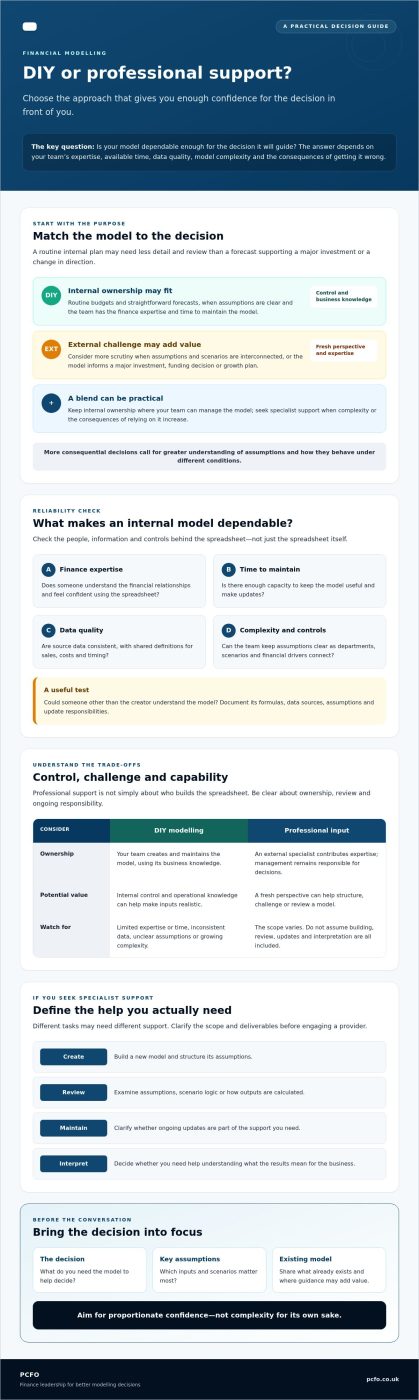
DIY modelling means your team creates and maintains the model, drawing on its knowledge of the business and financial information. Professional support brings in an external specialist to contribute expertise. The distinction isn’t simply about who opens the spreadsheet. It’s about who can build and challenge it, who is responsible for keeping it useful, and how much confidence the decision requires.
The purpose sets the standard. A simple budget for internal planning may need less detail and review than a forecast informing a major investment or a change in direction. The more consequential the decision, the more important it is to understand the assumptions behind the outputs and test how they behave under different conditions. The aim is proportionate confidence, not complexity for its own sake.
What counts as a business financial model?
A financial model links assumptions about operational activity to likely financial outcomes. For example, a growth plan might connect expected sales volumes, staffing and costs to revenue and cash flow. A cash flow forecast or budget can also explore what may happen if sales are slower than planned or costs change. Financial modelling uses these relationships to support planning and decision-making.
A model differs from historical bookkeeping or statutory accounts, which record and report financial activity rather than primarily exploring possible future outcomes. Past figures can inform assumptions, but the model’s value is in helping the business consider what might happen next.
What do professional modelling services add?
An external specialist may help structure a model, examine whether its assumptions reflect the business, test scenario logic or review how outputs are calculated. The exact scope varies. Before engaging a provider, clarify whether you need a new model, a review of an existing one, ongoing updates or help interpreting the results. Don’t assume all of these are included in one engagement.
External input can bring challenge and a fresh perspective, but it doesn’t transfer management’s responsibility for decisions. Leaders still need to judge whether assumptions are realistic and whether the outputs fit the business’s plans.
For many SMEs, a blend is practical: retain internal ownership where the team has the expertise and time to maintain the model, and seek support when complexity or the consequences of relying on it increase. That’s the central decision in diy financial modelling vs professional services. Finance leadership can help connect assumptions to business plans, but confirm the provider’s modelling scope and deliverables before proceeding.
What determines whether DIY financial modelling is reliable enough?
A model is only as dependable as the people, information and controls behind it. Before relying on an internal forecast, check whether someone in the business understands the financial relationships, can use the spreadsheet confidently and has time to maintain it. Check the quality and consistency of the source data too. If operational teams use different definitions for sales, costs or timing, even a well-built spreadsheet can produce misleading outputs.
Complexity matters. A straightforward forecast with a small number of visible assumptions may be manageable internally. Risk rises as assumptions link across departments, scenarios multiply or the model includes financial drivers your team doesn’t regularly work with. Ask what would happen if an assumption were wrong. An error in a routine planning exercise may be easy to correct; an unreliable output used to support a major commitment could have wider consequences.
Which models can a capable team manage internally?
Routine budgets and straightforward forecasts are often suitable for internal ownership when assumptions are clear and the people closest to the activity can explain them. Operational knowledge can make inputs more realistic and help teams take responsibility for updates. The model should also be understandable to someone other than its creator.
Document the formulas, data sources, assumptions and update responsibilities. Understanding how the income statement, balance sheet and cash flow relate is useful; Harvard Business Publishing’s guide to the fundamentals of financial statements provides relevant background.
Where can DIY models become fragile?
Look more closely when a model has interdependent assumptions, several scenarios or unfamiliar financial drivers. Manual data entry can introduce inconsistencies, while a hidden formula error may go unnoticed if no one checks the outputs. Multiple saved copies create another risk: decision-makers may be working from different versions.
Set out four controls before using the model:
- Owner: who maintains the model?
- Reviewer: who checks assumptions, formulas and outputs?
- Update frequency: when is it refreshed, and what events trigger an earlier update?
- Version control: where is the current approved file stored, and how are changes recorded?
Independent checking is prudent before consequential decisions depend on the results. The diy financial modelling vs professional services choice may be about targeted review or strategic guidance, rather than handing over all ownership. If internal confidence or capacity is limited, consider whether Finance Director support could help connect assumptions to your business plans. Confirm the scope of any modelling input before engaging.
DIY vs professional financial modelling: compare control, risk and capability
DIY and professional approaches have different strengths. Internal ownership keeps operational knowledge and updates close to the business. External input can add challenge, structure and capacity, particularly when decisions are complex or consequential. Neither approach guarantees accuracy. Reliable outputs depend on sound data, clear assumptions and appropriate review.
| Consideration | Internal ownership | Professional input |
|---|---|---|
| Control | Direct access to the model and its inputs; updates can reflect internal changes. | Management retains decision authority, with an external specialist contributing expertise. |
| Capability | Draws on the team’s financial and spreadsheet skills, plus operational knowledge. | May add experience with model structure, assumptions and scenario analysis. |
| Capacity | Depends on staff having time to build, maintain and explain the model. | Can provide additional capacity, subject to the agreed scope and availability. |
| Oversight | Review may be limited if the same person builds and checks the model. | An external perspective can challenge inputs and highlight questions to investigate. |
| Adaptability | Changes can be made internally, provided documentation and controls are maintained. | Support can help shape changes, though ongoing input should be agreed in advance. |
Where does DIY modelling have the advantage?
Internal teams often understand the operational detail behind the numbers: what drives sales, when costs arise and which assumptions need revisiting. That knowledge can make a model more relevant and help the people responsible for results stay engaged with it. DIY works best when the team has suitable skills and time, and keeps the model documented. Without meaningful review, a formula issue or an optimistic assumption can remain unchallenged.
When can professional input be valuable?
Consider specialist input for high-stakes planning, significant business change, complex scenarios or limited internal finance capacity. A professional may help clarify the model’s logic, test assumptions and interpret what different outcomes could mean for a decision. The strategic role of a Finance Director can include connecting financial insight with business direction. Confirm the provider’s specific modelling deliverables before assuming they are included.
A hybrid approach can be proportionate: your team owns operational inputs and routine updates, while an experienced adviser provides independent challenge at key decision points. In diy financial modelling vs professional services, the right balance depends on your capability, the model’s purpose and the consequences of relying on its outputs.
How to build, review or outsource your financial model
Choose support by starting with the decision, not the spreadsheet. The right approach for a routine budget may not suit a model informing a major investment or business change. In the wider FP&A consultant vs software discussion, the key distinction is between tools that help organise planning and the expertise needed to shape or interpret it.
Work through these steps before deciding whether to build internally, bring in external input or combine the two:
- Define the decision. Be clear about what you need to decide, who will use the model and when. This sets the timeframe and level of detail required.
- Assess complexity. Identify the key assumptions, scenarios and business areas involved. Consider whether your existing data can support the analysis.
- Test internal capability. Decide whether your team has the finance knowledge, spreadsheet skills and capacity to create and maintain the model reliably.
- Choose the support needed. Separate model creation from independent review, ongoing maintenance and interpretation. You may need one of these or a combination.
Make responsibilities clear from the outset. Agree who owns the model, what information the provider can access, which assumptions need to be documented, what outputs are expected and how review will work. Confirm the deliverables in scope rather than assuming a provider will build, check, update and explain every aspect.
What should you clarify before commissioning support?
Prepare a concise brief covering the business decision, intended users, relevant timeframe and level of detail. Gather the financial and operational information available, such as historical results, current plans and key business drivers. Note gaps, data limitations and assumptions instead of trying to make the information look complete. Ask the provider to confirm responsibilities, deliverables, review arrangements and what your team must supply or maintain.
How can a hybrid approach work in practice?
A hybrid model keeps operational context with the people closest to it, while an independent specialist challenges material assumptions and the logic connecting them to outputs. Agree who can change the model, how updates are recorded, where the current version is held and when it will be reviewed. This can preserve internal ownership while adding external perspective where confidence or capacity is limited.
The choice in diy financial modelling vs professional services needn’t be all or nothing. If you’re considering how finance leadership could fit your planning needs, discuss your Finance Director support requirements with PCFO. Confirm any model-related scope and deliverables before agreeing an engagement.
How PCFO’s finance leadership could support better modelling decisions
Financial modelling is most useful when it informs a clear business decision. If your team has a model but lacks confidence in its assumptions, or important choices are outgrowing the financial insight available internally, strategic finance leadership may help connect planning with business priorities. PCFO provides part-time and outsourced Finance Director and CFO support, alongside business planning and growth advisory for UK businesses.
This doesn’t mean assuming that a modelling task is automatically included. Confirm the scope of any model-building, review or maintenance work directly. Support may instead focus on the wider decision: whether assumptions align with your plans, what the outputs mean for the business, and where further analysis may be needed.
When might a growing business need finance leadership?
You may need additional finance leadership when reporting no longer gives you enough insight to weigh growth options, or when internal finance capacity is stretched. A Finance Director or CFO perspective can help link operational plans and financial assumptions, so leaders can assess choices in context. The appropriate involvement depends on your needs, from business planning guidance to broader financial leadership.
What should happen in an initial discussion?
Set out the decision you’re facing, the model or forecasts you currently use, and the skills and capacity available internally. Explain what information informs your assumptions and where you have concerns. Then clarify whether the need is business planning advice, Finance Director or CFO support, or outsourced accountancy solutions. Ask specifically whether model creation, review or maintenance is within the proposed scope.
A useful next step is to discuss the context and establish whether the support available fits the gap you’ve identified. The choice between diy financial modelling vs professional services can be proportionate: keep practical ownership in-house where it works, and explore finance leadership when you need added perspective or capacity. Discuss your business’s finance needs with PCFO and clarify the appropriate next step for your circumstances.
Choose the level of support your decisions require
The right approach to diy financial modelling vs professional services depends on the decision, the model’s complexity and your team’s ability to keep it reliable. Internal modelling can work well when assumptions are clear, data is accessible and someone has the time and skills to maintain it. As the stakes or complexity rise, independent challenge can help test assumptions and bring more structure to planning.
You don’t have to choose between complete independence and handing everything over. Your team can retain ownership of operational inputs while drawing on external finance leadership for perspective. Be clear about the support you need, whether that’s business planning advice, financial leadership or a specific modelling deliverable, and confirm the scope before proceeding.
PCFO provides part-time and outsourced Finance Director and CFO support, along with business planning and growth advisory for UK businesses. If you’d like to explore whether this support fits your current needs, discuss your finance needs with PCFO. A considered next step can help you make decisions with greater clarity and confidence.
Frequently Asked Questions
Is DIY financial modelling suitable for a small business?
Yes, DIY financial modelling can suit a small business if the model is straightforward and someone has the skills and time to maintain it. A routine budget or cash flow forecast with clear assumptions may be manageable internally. Document the data sources, formulas and update responsibilities, and arrange a review if the outputs will inform a consequential decision. The business should understand both what the model shows and what it leaves out.
When should a business use professional financial modelling services?
Consider professional input when a decision carries significant consequences, the model links many assumptions or departments, or your team lacks the time or finance expertise to build and check it. Support could involve creating a model, reviewing an existing one or interpreting scenarios, but these are distinct deliverables. Clarify the provider’s scope before engaging them, including who supplies data, who owns updates and what review is included.
Can I build a financial model in Excel myself?
Yes. Excel can be suitable for a model if you can represent the relevant business drivers clearly and check the calculations. Start with the decision the model needs to inform, then link assumptions such as sales volumes, staffing and costs to financial outcomes. Keep formulas understandable, record data sources and assumptions, and control versions. If the model becomes complex or supports a high-stakes decision, arrange an independent check before relying on its outputs.
What is the difference between a financial model and a forecast?
A financial model is a structure that links assumptions to financial outcomes and allows you to explore different scenarios. A forecast is an estimate of future financial performance, often based on a selected set of assumptions. A forecast can therefore be produced using a financial model, but a model may also compare several possible outcomes. Both rely on relevant data and assumptions, and neither should be treated as a certainty about future results.
How do I know if my financial model is reliable?
Check that the data is current, assumptions are documented and formulas behave as intended. Confirm that key outputs connect logically to operational drivers, and test how results change when important assumptions vary. Make sure there is a named owner, a clear update process and one approved version. For an important decision, ask someone suitably experienced who wasn’t responsible for building the model to review its logic and limitations.
Can a Finance Director help review a business financial model?
A Finance Director may be able to bring strategic financial oversight, challenge assumptions and connect model outputs with business plans. Whether they can directly build, review or maintain a particular model depends on the agreed engagement and its scope. PCFO provides part-time and outsourced Finance Director and CFO support, as well as business planning consultancy. Ask specifically what model-related input and deliverables are included before proceeding.
Should we outsource financial modelling or keep it in-house?
Choose based on your team’s capability, available time, model complexity and the consequences of relying on its outputs. Keeping routine updates in-house can preserve operational knowledge and ownership. External expertise may be useful for complex planning, an independent review or when internal finance capacity is limited. A hybrid approach can combine internal ownership of business inputs with agreed external challenge. The choice in diy financial modelling vs professional services needn’t be all or nothing.