

Scaling your turnover to record heights means very little if your net profit remains stagnant or begins to erode under the weight of rising overheads. Many UK SME owners find themselves in this exact position. It’s often the case that a major scale-up leads to increased complexity rather than increased wealth. You’ve likely experienced the frustration of watching healthy revenue figures disappear into the costs of inflation, which sat at 2.6% in June 2026, and higher interest rates. Understanding how to assess long term business profitability is the critical shift required to move from reactive management to strategic leadership.
It’s understandable to feel anxious when your P&L doesn’t reflect the hard work you’re putting into the business. This guide provides the strategic framework used by CFOs to evaluate sustainable profit margins and future-proof your growth. You’ll discover how to measure the quality of your profit. This allows you to make investment decisions with clarity and improve your valuation for an eventual exit. We will examine the core metrics that define long-term health and the practical steps you can take to protect your bottom line whilst ensuring your company remains attractive to future investors.
Key Takeaways
- Distinguish between a single profitable year and a sustainable business model by evaluating consistent surplus after all capital costs.
- Learn how to assess long term business profitability by mastering the “Holy Trinity” of margins and ensuring each sale contributes to overheads.
- Identify the “Growth Trap” where rapid expansion absorbs vital cash reserves and learn to manage working capital cycles effectively.
- Stress-test your financial resilience through sensitivity analysis and scenario planning to prepare for best and worst-case economic shifts.
- Recognise how fractional CFO services bridge the gap between basic bookkeeping and the strategic oversight required for a successful business exit.
What is Long-Term Business Profitability? (Beyond the P&L)
Long-term profitability is the consistent ability of a company to generate a surplus after all capital costs, including the cost of debt and equity, have been met. It’s a common misconception amongst SME owners that a single successful year on the Profit and Loss (P&L) statement indicates a healthy future. In reality, a profitable year doesn’t necessarily equate to a profitable business model. True sustainability is found in the pursuit of Profitable Growth, where expansion doesn’t compromise the underlying health of the balance sheet.
To understand how to assess long term business profitability, you must distinguish between transactional profit and high-quality earnings. Transactional profit is often the result of one-off projects or temporary market conditions. High-quality earnings, conversely, are recurring, predictable, and driven by a loyal customer base. CFOs often refer to this as the “Quality of Earnings.” This metric helps leaders strip away accounting noise to see if the core operations are genuinely generating value or simply benefiting from short-term windfalls.
The Difference Between Profit and Cash Flow
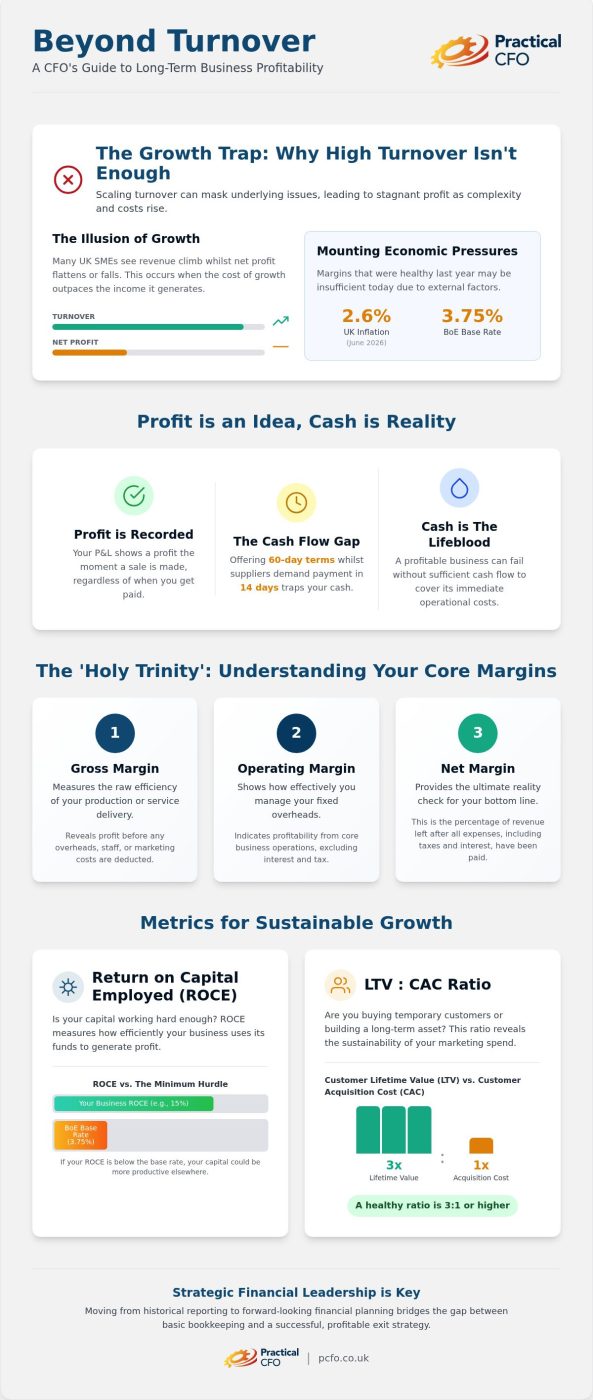
Profit is an accounting concept, but cash flow is a physical reality. Many UK SMEs fail despite showing a profit because their cash is trapped in long credit terms or excessive inventory. If you offer 60-day terms whilst your suppliers demand payment in 14 days, your growth will eventually outpace your liquidity. This timing gap can be fatal during a scale-up. Cash flow is the lifeblood whilst profit is the goal.
Why Historical Data is Only Half the Story
Traditional accountancy often relies on a “rear-view mirror” approach, focusing on what happened last quarter. Whilst historical data is useful, it doesn’t account for shifting market dynamics or rising costs. With UK inflation sitting at 2.6% in June 2026 and the Bank of England base rate at 3.75%, margins that worked last year may be insufficient today. Strategic financial leadership requires moving beyond historical reporting toward forward-looking business financial planning. This proactive mindset ensures you aren’t just measuring past success but are actively how to assess long term business profitability in the context of future economic pressures.
Key Metrics for Assessing Sustainable Growth
Relying on a single turnover figure to judge success is a risk few UK SMEs can afford. High turnover often masks underlying inefficiencies that only become apparent when cash reserves dwindle. To understand how to assess long term business profitability, you must evaluate the “Holy Trinity” of margins. Gross margin shows the raw efficiency of your service delivery or production. Operating margin reveals how effectively you manage your fixed overheads. For many retail and service businesses, reducing these overheads starts with reviewing transaction costs; performing a card terminal comparison UK can help identify more efficient payment solutions that support healthier margins. Finally, net margin accounts for tax and interest, providing the ultimate reality check for your bottom line.
Beyond these margins, Return on Capital Employed (ROCE) is the truest measure of investment efficiency. It tells you how effectively your business uses its available capital to generate profit. If your ROCE is lower than the current 3.75% Bank of England base rate, your capital might be more productive elsewhere. Similarly, the ratio of Customer Lifetime Value (LTV) to Customer Acquisition Cost (CAC) must be monitored. A healthy ratio, typically 3:1 or higher, suggests your marketing spend is building a sustainable asset rather than just buying temporary revenue.
Identifying profit leaks requires a granular look at direct costs. Small inefficiencies in procurement or delivery can compound into significant losses over time. Implementing strategic overhead reduction ensures that as revenue grows, your margins remain protected. Benchmarking these figures against UK industry averages provides a baseline for what good looks like in your sector. This comparison helps you decide whether to adjust pricing or streamline operations to stay competitive.
Unit Economics: The Building Blocks of Profit
Scaling a business with poor unit economics only accelerates the path to failure. You must calculate the contribution margin for every product or service you sell. This is the amount left after variable costs to cover fixed overheads. A business growth advisory uk specialist can help you identify which products are truly scalable. Developing robust financial models allows you to project how these economics change as you expand. If you’re looking for clarity on these metrics, our strategic financial partners can provide the direction you need to ensure every sale contributes to your long-term viability.
The Impact of Working Capital on Long-Term Viability
Working capital is often where profit goes to hide. Whilst your P&L might show a healthy surplus, that value is frequently trapped in unpaid invoices or unsold stock. If your debtor days, the time customers take to pay, exceed your creditor days, the time you have to pay suppliers, you’re essentially financing your customers’ businesses with your own profit. This is a fundamental element of how to assess long term business profitability; a business that cannot unlock its cash is a business that cannot reinvest in its future.
The “Growth Trap” is a particular risk for scaling UK SMEs. Rapid expansion requires upfront investment in stock, staff, and marketing. If your working capital cycle is inefficient, the more you sell, the more cash you need just to stay afloat. This can lead to a profitability crisis where a company is technically successful but functionally insolvent. Utilising outsourced accountancy solutions provides the granular visibility needed to spot these imbalances before they threaten your viability.
Managing the Cash Conversion Cycle
Shortening the time between spending cash and receiving it from customers is vital for protecting your net margins. High inventory turnover ensures capital isn’t sitting idle in a warehouse. You should use cash flow forecasting to stress-test your profitability against potential delays in payments. Key financial performance measures like the current ratio and the quick ratio offer a snapshot of your liquidity, but the trend of your cash conversion cycle over time tells the real story of your operational health.
Capital Allocation and Reinvestment
Long-term viability depends on disciplined capital allocation. You must decide whether drawing dividends or reinvesting for future profit serves the business lifecycle best. It’s essential to ensure your Return on Capital Employed (ROCE) stays higher than your cost of capital, especially with the Bank of England base rate at 3.75%. Strategic budgeting for R&D and market expansion should be viewed as an investment in future margins rather than a simple expense. This foresight is a core part of how to assess long term business profitability and ensures you remain competitive in a shifting market, where opting for Fleetsauce for vehicle leasing can preserve capital for higher-return activities.
Static financial reports only provide a snapshot of past performance. To truly understand how to assess long term business profitability, you must shift your focus toward dynamic stress-testing. This involves identifying the critical variables that dictate your success. Often, a mere 20% of your operational variables drive 80% of your total profit. By isolating these factors, you can determine which levers to pull when market conditions shift. Sensitivity analysis allows you to model these changes with precision, ensuring your strategy remains robust regardless of external volatility.
Scenario planning complements this by preparing your business for “Best Case,” “Worst Case,” and “Most Likely” outcomes. This isn’t about predicting the future; it’s about building organizational resilience. Coupling this with a clear break-even analysis helps you identify the exact tipping point where a dip in volume or a rise in costs could turn growth into a liability. These insights are vital for anyone considering exit strategy planning services, as they demonstrate to potential buyers that your profit isn’t accidental but engineered.
Sensitivity Analysis for UK SMEs
Consider the impact if your primary supplier costs rose by 10% tomorrow. Without a clear understanding of your price elasticity, you won’t know if you can pass that cost to customers without losing significant volume. Many SMEs find that their most profitable products are actually the most sensitive to cost fluctuations. Identifying these thresholds helps you avoid the “tipping point” where expansion begins to erode your net margins. This level of foresight ensures that your growth remains sustainable even amongst rising overheads.
Preparing for a Strategic Exit
Potential buyers look far beyond your current P&L. They assess the “quality” of your earnings and the sustainability of your margins. A common barrier to a high valuation is “owner-dependent” profit, where the business’s success is tied too closely to the founder’s personal involvement. To maximise your multiple, you must normalise your EBITDA. This process involves stripping out one-off expenses and personal costs to show the true, repeatable earning power of the organisation. If you’re ready to stress-test your business for a future sale, our strategic financial advisors can help you build a more resilient and valuable company.
How a Fractional CFO Orchestrates Long-Term Profit
Scaling a business requires a fundamental shift from recording history to shaping the future. Whilst many UK SMEs rely on a year-end accountant for compliance, true growth requires a different level of financial leadership. A fractional CFO provides the framework for how to assess long term business profitability by looking beyond the immediate cash position. This strategic oversight ensures that every decision, from hiring to capital expenditure, aligns with the company’s long-term trajectory. By integrating board-level insight at a fraction of the cost of a full-time hire, you gain a steady hand to navigate economic volatility.
The relationship between a CEO and their financial lead is the engine of a successful organisation. A fractional CFO doesn’t just present data; they translate it into actionable intelligence. This partnership allows the CEO to focus on vision and market expansion, confident that the underlying unit economics are robust. Integrating finance director expertise into your monthly management cycle transforms your financial department from a cost centre into a strategic asset.
Moving from Accountant to Strategic Partner
Your year-end accountant is essential for tax compliance, but they are rarely equipped for proactive growth advisory. Their focus is historical. In contrast, a CFO is forward-looking, identifying potential profit leaks before they impact the P&L. By establishing a “rhythm of business” through rigorous management reporting, they ensure that the leadership team is never surprised by a cash shortfall. This proactive approach is vital in a climate where UK inflation and interest rates can quickly erode margins if left unmonitored.
Investing in Expertise: The ROI of a Fractional FD
Investing in a part-time CFO often pays for itself through immediate margin improvements. For example, one UK-based service firm recently identified that a high-volume contract was actually loss-making once the true cost of senior staff time was allocated. By following their FD’s advice to renegotiate terms and pivot toward higher-margin work, the company secured its long-term viability. This level of insight is central to how to assess long term business profitability and build a company that is attractive to future investors. If you are ready to move beyond basic bookkeeping and secure your organisation’s financial future, you can Enquire about our Finance Director services today.
Building a Resilient Financial Legacy
Securing long-term viability requires moving beyond the surface-level metrics of your Profit and Loss statement. You’ve seen that true health is found in high-quality earnings, efficient working capital management, and the ability to stress-test your margins against economic shifts. Understanding how to assess long term business profitability is not a one-off exercise; it’s a continuous strategic discipline that prepares your organisation for sustainable scaling and an eventual high-value exit.
At PCFO, we provide the board-level financial leadership your business needs without the burden of a full-time executive salary. Our team specialises in fractional CFO expertise for scaling SMEs, offering dedicated growth advisory and exit strategy support. We act as your authoritative strategic partner, identifying hidden profit leaks and future-proofing your operations against market volatility.
Take the first step toward a more certain financial future today. Book a Strategic Consultation with a PCFO Finance Director to ensure your business is built to last. With the right oversight, your growth can be both ambitious and secure.
Frequently Asked Questions
What is the difference between profitability and profit?
Profit is the absolute amount of money left after all expenses are paid, whereas profitability is a relative measure used to determine the scope of a company’s profit in relation to its size. Whilst profit tells you how much you made last year, profitability indicates how efficiently your business generates that wealth. It’s a critical distinction for understanding how to assess long term business profitability because a large profit doesn’t always mean a healthy, efficient model.
What is a good net profit margin for a UK SME?
A good net profit margin varies significantly by sector. Service-based businesses often achieve different results compared to those in manufacturing or retail due to varying overhead structures. It’s essential to benchmark your performance against your specific industry standards to ensure your growth is sustainable. Focusing on your specific margins allows you to maintain competitiveness within the UK economic climate, ensuring that your business generates enough surplus to reinvest in future expansion.
How often should I conduct a profitability analysis?
You should review your core margins monthly as part of your management reporting cycle, but a deep strategic profitability analysis is best conducted quarterly. This frequency allows you to spot profit leaks early and adjust your pricing or operations before they impact your annual results. Regular reviews provide the foresight needed to navigate shifting market conditions, ensuring that your strategic decisions are always backed by the most current financial data.
Can a business be profitable but have no cash?
A business can certainly be profitable on paper whilst having no cash in the bank. This usually occurs because profit is recorded when an invoice is raised, but cash only arrives when the client pays. If your capital is trapped in unpaid invoices or high inventory levels, you may face a liquidity crisis. Managing your cash conversion cycle is just as important as generating profit to ensure your business remains functionally solvent.
How does inflation affect long-term profitability assessment?
Inflation erodes the real value of your profit margins by increasing the cost of raw materials, wages, and overheads. With UK inflation recorded at 2.6% in June 2026, failing to adjust your pricing accordingly can lead to margin creep. When learning how to assess long term business profitability, you must factor in these rising costs to ensure your business remains resilient over several years, protecting your purchasing power and ensuring long-term sustainability.
What is the most important metric for business growth?
Whilst many focus on turnover, Return on Capital Employed (ROCE) is often the most vital metric for sustainable growth. It measures how efficiently your business uses its capital to generate profit. If your ROCE is consistently higher than your cost of borrowing, you have a scalable model. Pairing this with a healthy Customer Lifetime Value to Acquisition Cost ratio ensures that your expansion is building long-term value rather than just temporary revenue.
How do I improve my business valuation before an exit?
Improving your valuation requires demonstrating that your profits are sustainable and independent of the founder’s daily involvement. You should focus on normalising your EBITDA by removing one-off expenses and personal costs to show the true earning power of the organisation. Increasing the proportion of recurring revenue and documenting clear, repeatable processes also makes the business more attractive to buyers. A predictable profit stream typically commands a higher multiple during an exit negotiation.
What role does a fractional CFO play in profit improvement?
A fractional CFO acts as a strategic architect, moving beyond basic bookkeeping to identify hidden profit leaks and operational inefficiencies. They provide board-level financial leadership that helps the CEO make informed, data-driven decisions about pricing, investment, and cost control. By implementing robust management reporting and scenario planning, a fractional CFO ensures the business is future-proofed. This professional oversight often pays for itself through significantly improved margins and a more robust business valuation.