

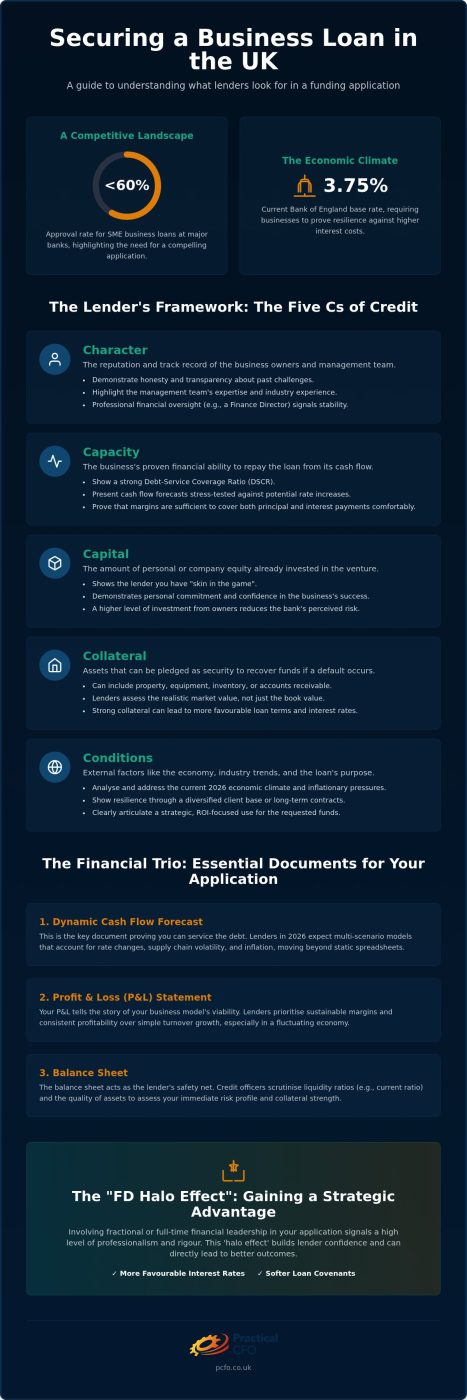
With approval rates for SME business loans at major banks currently sitting below 60%, the difference between a successful funding round and a flat rejection often comes down to the quality of your financial narrative. It’s natural to feel a sense of trepidation when facing complex bank terminology or wondering how to value your collateral whilst the Bank of England base rate sits at 3.75%. You aren’t alone if you find yourself asking what do uk banks look for in a business loan application whilst trying to secure the capital needed for your next phase of growth.
We understand that the gap between a business owner’s vision and a lender’s spreadsheet can feel vast. This article provides a clear roadmap to bridge that divide by preparing a rigorous funding pack that speaks the bank’s language. You’ll discover how to lower interest rates through better risk presentation and gain the confidence required to lead high-level discussions with your relationship manager. We’ll examine the specific strategic criteria lenders use in 2026, from advanced cash flow forecasting to the fundamental ‘Five Cs of Credit’, ensuring your application is both robust and persuasive.
Key Takeaways
- Master the “Five Cs of Credit” framework to align your funding request with the specific risk-assessment filters used by modern UK lenders.
- Identify exactly what do uk banks look for in a business loan application, focusing on sustainable margins and a robust asset base rather than simple turnover growth.
- Learn how to articulate a strategic narrative that highlights your management team’s expertise and your company’s unique market position to build lender confidence.
- Follow a structured preparation guide to create a professional funding pack, including a high-impact executive summary and a detailed, ROI-focused use of funds.
- Understand the “FD Halo Effect” and how fractional financial leadership can help you negotiate more favourable interest rates and softer loan covenants.
The Five Cs of Credit: The Framework UK Banks Use to Assess Risk
UK lenders don’t just review spreadsheets; they evaluate the narrative behind your numbers. When asking what do uk banks look for in a business loan application, you’re essentially asking how they measure risk. The “Five Cs” framework remains the standard methodology for this assessment. It provides a structured way for lenders to determine the creditworthiness of a business before they commit capital.
The framework consists of five core pillars:
- Character: The track record and reputation of the business owners and management team.
- Capacity: The business’s legal and financial ability to repay the debt, often measured through cash flow.
- Capital: The amount of personal or company equity already invested in the venture.
- Collateral: Assets that can be pledged as security to recover funds if a default occurs.
- Conditions: External factors such as the 2026 economic climate, interest rates, and industry-specific trends.
Character and Credibility: The Human Element
Capacity and Conditions: The External Reality
Capacity is primarily about repayment ability. Banks typically use the Debt-Service Coverage Ratio (DSCR) to ensure your cash flow can comfortably cover both interest and principal payments. With the Bank of England base rate currently at 3.75%, lenders are stress-testing applications against even higher potential rates. They need to see that your margins aren’t so thin that a 1% rate rise would lead to a default.
Conditions focus on the broader 2026 market. Lenders are currently scrutinising how businesses handle inflationary pressures and shifting consumer behaviour. You must demonstrate that your company is resilient. Highlighting a diversified client base or a long-term supply contract can help mitigate the bank’s concerns about external volatility. When you present a clear strategy for navigating these conditions, you reduce the perceived risk of your application.
The Financial Trio: Essential Documents for Your Application
Securing funding requires a cohesive narrative told through three primary financial statements. While the UK government’s business loan guide outlines the basic paperwork required, a strategic application goes much deeper. It reconciles historical performance with future projections to prove reliability. When considering what do uk banks look for in a business loan application, understand that they prioritise sustainable margins over rapid, loss-making growth. Your Profit and Loss (P&L) statement must demonstrate that your business model remains profitable even as external costs fluctuate.
Mastering the Cash Flow Forecast
A static spreadsheet is no longer sufficient for high-value borrowing. In 2026, lenders expect dynamic models that account for the prevailing 3.75% base rate and inflationary pressures. Using professional cash flow forecasting services allows you to build multi-scenario models. These should specifically factor in supply chain lead times and potential price volatility in your cash runway. A robust forecast proves you’ve considered the “what if” scenarios, which significantly reduces the bank’s perceived risk. It’s the document that demonstrates you can actually service the debt you’re requesting.
The Balance Sheet as a Safety Net
Your balance sheet provides the ultimate safety net for the lender. Credit officers look closely at liquidity ratios, particularly the current ratio, to assess your immediate risk profile. They distinguish between the book value of your assets and their actual market value in a liquidation scenario. You must identify and explain any “hidden” liabilities, such as deferred tax or specific lease obligations, before the bank finds them. A clean, strong balance sheet proves your company has the substance to weather economic shifts. It shows you have “skin in the game” through a solid equity position.
Aligning these three documents requires intellectual rigour and a deep understanding of how credit committees operate. If you’re unsure how your current figures might be perceived, our Business Growth Advisory team can help you refine your financial pack to meet the highest institutional standards.
Assessing the Management Team and Strategic Narrative
Banks lend to people, not just spreadsheets. A robust business plan is only as credible as the individuals executing it. When determining what do uk banks look for in a business loan application, the credit committee seeks evidence that the leadership team possesses the intellectual rigour to navigate a shifting economy. They want to see that you’ve moved beyond simple operations and are thinking strategically about the long-term trajectory of your firm.
The Strength of the Management Team
Experience is a non-negotiable asset in the eyes of a lender. Lenders look for a proven track record within your specific sector amongst your key personnel. If your core team lacks specific financial expertise, it’s often viewed as a significant risk factor that could lead to rejection. This is where a fractional FD or a business growth advisory uk partner becomes invaluable. They fill the financial leadership void, signalling to the bank that your fiscal management is in expert hands. Succession planning is another critical factor. Banks need to know that the business isn’t entirely dependent on one individual, especially for long-term lending commitments.
Market Position and Competitive Moat
Your strategic narrative must clearly define your competitive advantage. Banks want to know why your favourite customer segments choose you over competitors. Are you protected by a “moat”, which is a unique value proposition that’s difficult for others to replicate? You should demonstrate a sophisticated understanding of your industry’s 2026 lifecycle. This involves acknowledging external threats whilst showing how your specific market position provides resilience against downturns.
Every financial assumption needs a “Plan B”. If your revenue growth is 20% lower than forecasted, you must show how you’ll still meet your repayment obligations. Presenting these contingencies proactively demonstrates a level of maturity that lenders appreciate. You can verify your readiness by reviewing a business loan eligibility checklist to ensure your strategic case aligns with current institutional expectations. This transparency reduces the lender’s perceived risk and positions you as a reliable partner.
Preparing the Funding Pack: A Step-by-Step Preparation Guide
Whilst a bank’s online portal might suggest a simple process of uploading documents, the reality of securing significant funding is far more strategic. You should adopt a “Credit Memo” approach. This means drafting your pack to answer a credit officer’s likely questions before they’ve even had the chance to ask them. By pre-empting concerns about risk or liquidity, you demonstrate the high-level financial control that lenders find reassuring. When asking what do uk banks look for in a business loan application, the answer is often a proactive mindset that minimises uncertainty.
The Executive Summary and Use of Funds
Your executive summary is the most critical two pages in your entire pack. It must sell the deal by linking the loan request to specific growth milestones rather than vague operational needs. Avoid general terms like “working capital”. If you’re requesting £250,000, specify exactly how that capital will be deployed. For instance, allocating £150,000 to new production machinery and £100,000 to a specific marketing programme provides a clear ROI path. This level of detail allows the bank to see how the investment will directly increase your repayment capacity. Reviewing your strategic business planning uk ensures that these requests align with your long-term corporate objectives.
The Importance of Clean Data
Data integrity is the foundation of bank trust. Discrepancies between your management accounts and your filed Companies House records are a major red flag that can derail an application instantly. When asking what do uk banks look for in a business loan application, the answer always includes consistency. Your management accounts must be up to date, error-free, and reconciled to the penny. Utilising professional outsourced accountancy solutions ensures that your data remains beyond reproach. It prevents the awkward conversations that arise when a credit officer spots a technical inconsistency you’ve missed.
If you’re preparing for a significant funding round, our Finance Director Services can provide the intellectual rigour needed to build a world-class funding pack that stands up to institutional scrutiny.
How Fractional Finance Leadership Increases Your Success Rate
The “FD Halo Effect” is a well-recognised phenomenon in commercial lending. When you introduce a Finance Director into your leadership structure, you immediately signal to the bank that your company prioritises financial discipline. Lenders are more likely to approve applications when they know a seasoned expert is overseeing the cash flow and strategic direction. When asking what do uk banks look for in a business loan application, the presence of professional financial leadership is often the deciding factor that moves a file from “pending” to “approved”. It demonstrates that you’ve moved beyond a transactional mindset and into a strategic partnership with your lender.
Bridging the Communication Gap
An FD acts as a vital bridge between your vision and the bank’s requirements. They translate your growth plans into the specific metrics relationship managers need to see, such as Debt-Service Coverage Ratio (DSCR), EBITDA, and Loan-to-Value (LTV). This technical fluency builds immediate credibility. Your FD becomes the primary point of contact, handling complex queries with a level of intellectual rigour that a non-financial CEO might struggle to match. They also provide professional coaching for the “Banker Interview”, ensuring you present a composed and authoritative front when meeting with the credit committee.
Beyond approval, an FD provides a significant return on investment by negotiating more favourable terms. They understand how to present risk in a way that can lower interest rates and soften restrictive covenants. Understanding fractional cfo pricing uk is essential here; the cost of the service is often offset by the interest savings and improved capital flexibility secured through professional negotiation.
Post-Funding Management and Reporting
Success doesn’t end with the drawdown of funds. You must manage the relationship proactively to avoid “technical defaults” caused by breached covenants. Your FD ensures that regular management information (MI) is delivered on time, keeping the bank supportive of your future ambitions. This ongoing compliance answers the question of what do uk banks look for in a business loan application over the long term: reliability and transparency. This level of oversight is critical if you plan for future funding rounds or an eventual exit strategy. By maintaining a transparent dialogue, you future-proof your business against shifting market conditions.
Securing Your Company’s Financial Future
Navigating the 2026 lending landscape requires more than just a healthy turnover; it demands a sophisticated alignment of financial data and strategic narrative. By mastering the “Five Cs of Credit” and presenting a meticulous funding pack, you transform your application from a simple request into a compelling investment case. Understanding exactly what do uk banks look for in a business loan application allows you to pre-empt credit committee concerns and negotiate from a position of strength.
Professional cash flow modelling and the strategic oversight of a Finance Director are the most effective tools for reducing perceived risk. These elements don’t just increase approval rates; they unlock more favourable interest rates and flexible covenants that support long-term scalability. If you’re ready to scale, you can secure your business funding with expert FD support from PCFO. Our team provides strategic Finance Director oversight and comprehensive business planning consultancy, backed by a proven track record in SME growth advisory. With the right expertise at the helm of your financial strategy, your path to sustainable capital is clear.
Frequently Asked Questions
Do I need a business plan for a UK bank loan in 2026?
Yes, a detailed business plan is a mandatory requirement for most UK lenders in 2026. Banks use this document to assess your strategic foresight and repayment ability. A professional plan should include three-year financial forecasts, a clear market analysis, and a detailed breakdown of how the funds will be utilised. This is a core part of what do uk banks look for in a business loan application to ensure the venture is viable and sustainable.
What is the minimum credit score for a business loan?
There is no universal minimum credit score, but high-street banks typically require a “Good” or “Excellent” rating. Lenders scrutinise both your personal credit history and your company’s credit report to assess risk. If your score is below the average for your sector, you may face higher interest rates or be required to provide additional security. It’s essential to manage credit proactively before submitting your funding pack to ensure the best possible terms.
How much can I borrow based on my business turnover?
Lenders typically offer between 10% and 25% of your annual turnover, though this depends heavily on your sector and profit margins. Whilst turnover provides a baseline, banks prioritise your Debt-Service Coverage Ratio (DSCR) to ensure you can afford the monthly repayments. For example, a business with £1 million turnover but narrow margins may borrow less than a higher-margin firm with £500,000 turnover. Your cash flow stability is the primary factor in determining your limit.
What is a personal guarantee and should I sign one?
A personal guarantee is a legal agreement making a director personally liable for the debt if the business defaults. Lenders often require these for unsecured loans or when a business lacks a long trading history. Before signing, you should seek independent legal advice and consider the risk to your personal assets. It’s often possible to negotiate the scope of the guarantee or limit it to a specific percentage of the total loan amount to manage your exposure.
How long does the bank loan application process take?
The timeline for a business loan application typically ranges from two weeks to three months. Simple, unsecured loans from challenger banks don’t take long to process, but complex funding rounds involving high-street lenders require more time for due diligence. Preparing a comprehensive funding pack in advance can significantly accelerate the process. Your relationship manager will need time to review your management accounts, credit history, and strategic narrative before reaching a final credit decision.
What are the most common reasons for business loan rejection?
Poor cash flow and inadequate financial documentation are the most frequent reasons for loan rejection. With approval rates currently below 60%, many applications fail because the business cannot prove its ability to service the debt under current market conditions. Other common factors include weak credit scores, a lack of collateral, or a vague strategic narrative. Understanding what do uk banks look for in a business loan application is critical to avoiding these common pitfalls and securing approval.
Can I get a business loan without collateral?
You can secure a business loan without collateral through “unsecured” lending options, though these often carry higher interest rates. Lenders mitigate their risk on unsecured loans by requiring personal guarantees from the directors. Alternatives like the Growth Guarantee Scheme (GGS) also provide a 70% government guarantee to lenders, which can help businesses without significant assets access funding. However, secured loans generally offer more favourable terms and lower APRs for established UK companies.
How does a fractional FD help with the application?
A fractional Finance Director acts as a strategic bridge between your company and the bank’s credit committee. They ensure your management accounts are beyond reproach and that your cash flow forecasts are robust enough to withstand institutional stress testing. By providing high-level financial leadership, an FD builds lender confidence and helps you negotiate better interest rates. This professional oversight signals to the bank that your business is managed with the intellectual rigour required for significant borrowing.