

What if the numbers reaching your desk helped you decide what to do next, not just explain what has already happened? Bookkeeping and routine reporting are essential, but they may not provide the forward-looking insight you need to assess a growth plan, manage cash flow or weigh a major investment. That’s where the benefits of outsourced CFO support come into focus: senior financial judgement, brought into the business flexibly when it can make a difference. If your finance support keeps the records in order but leaves strategic questions unanswered, an outsourced CFO can connect financial information with the decisions ahead.
You’ll learn how an outsourced CFO can improve financial visibility, strengthen planning and support sustainable growth without requiring a full-time senior appointment. We’ll also look at how the role can work alongside your existing team, build an understanding of your business and turn financial reporting into practical guidance. From forecasting and performance insight to longer-term business planning, this article explains what strategic finance leadership can contribute and how it can help you make better-informed decisions.
Key Takeaways
- Learn how outsourced CFO leadership differs from routine finance processing, and when growing businesses may need strategic direction.
- See how financial information can support clearer choices, with forecasting used as a planning tool rather than a promise.
- Explore the benefits of outsourced CFO support, including flexible access to senior expertise, and the importance of business context and communication.
- Use a practical sequence to assess decision-making gaps, priorities and where financial leadership could add value.
- Discover how PCFO’s outsourced CFO and Finance Director services connect financial insight with business growth and planning.
Benefits of an outsourced CFO: why growing businesses seek strategic finance support
Growth brings more complex decisions, from hiring and investment to entering a new market or preparing for a transition. But needing stronger financial direction doesn’t always mean creating another full-time role. An outsourced CFO provides senior financial leadership on a flexible basis, helping business owners connect financial insight with business priorities. This differs from routine bookkeeping or accountancy processing, which records and reports transactions but may not interpret their strategic implications.
The benefits of outsourced CFO support can include clearer decisions, stronger forward planning, better financial visibility and added leadership capacity. The value depends on the business’s priorities, the reliability and timeliness of its financial information, and how well the CFO works with owners and the existing team. For a general overview of the role, see What is a Virtual CFO?
When financial reporting needs to inform decisions
Historical figures show what has happened. Strategic interpretation helps leaders consider what those figures could mean for the choices ahead. Management accounts can provide a regular view of performance, margins and cash position. A CFO can investigate the reasons behind a change, such as whether sales growth is accompanied by healthy margins or rising costs are putting pressure on cash.
This turns reporting from a record of past activity into a basis for discussion. Before committing to additional staff, for example, leaders can review current performance, expected costs and the likely effect on cash flow. The figures won’t remove uncertainty, but they can make assumptions visible and support a more considered decision.
Why flexible senior finance leadership can suit a changing business
A company’s need for strategic input can change as it grows, restructures or prepares for a transition. It may need closer financial oversight during expansion, then a different focus as operations stabilise or exit planning begins. Flexible CFO support can align senior input with current priorities without assuming the business needs a permanent, full-time appointment.
The role can also bring financial leadership into conversations across the business, linking operational insight with planning and longer-term goals. This is closely related to the strategic role of a Finance Director, who helps translate business objectives into financial plans and meaningful oversight.
To make that support useful, agree what the business needs the CFO to help achieve. Consider:
- Which upcoming decisions need stronger financial analysis?
- Where do existing reports leave uncertainty about performance or cash flow?
- What information can the team provide, and how consistently?
- How will the CFO collaborate with owners and colleagues?
Clear answers focus the relationship on practical priorities rather than analysis for its own sake. An outsourced CFO can strengthen financial leadership, but the value comes from applying insight to important decisions and keeping the work grounded in the business’s circumstances.
How an outsourced CFO turns financial information into better decisions
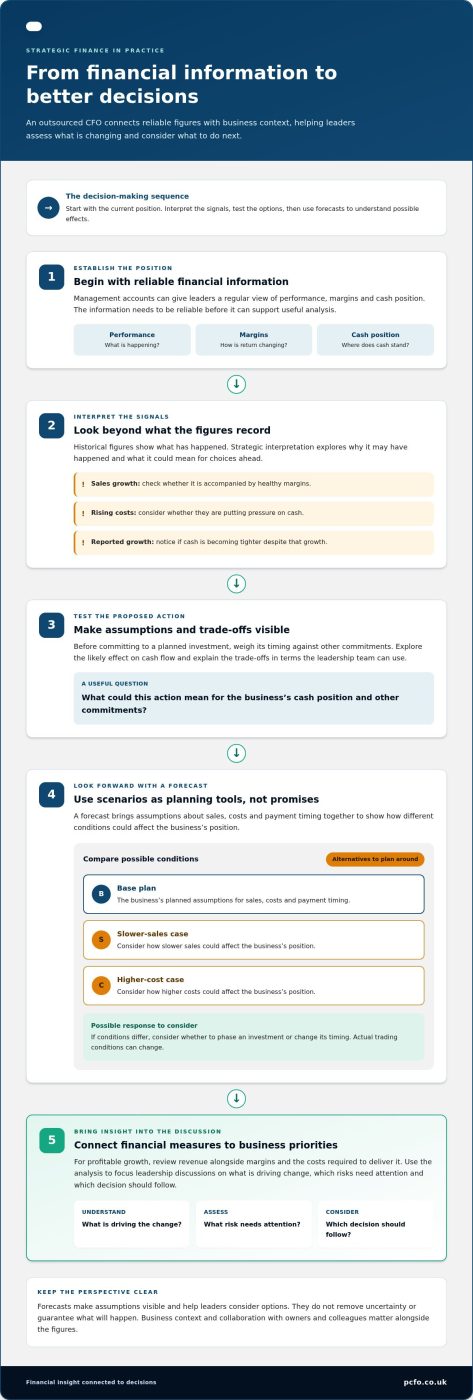
Financial information is more useful when it helps answer a specific question. An outsourced CFO can establish the current position, interpret what is changing, assess the options and explain the implications to the people responsible for acting. This connects reporting with management discussions, instead of leaving figures to be reviewed in isolation.
The process starts with reliable information. From there, the CFO can identify signals that need attention, such as a shift in margins, costs rising faster than sales or cash becoming tighter despite reported growth. The next step is to test what those signals mean for a proposed action. For example, the timing of a planned investment can be weighed against other commitments, with the trade-offs explained in terms the leadership team can use. Business context matters as much as the figures, so this work is collaborative.
Forecasting and cash flow visibility
A useful forecast is a forward-looking decision tool, not a guarantee of what will happen. It brings assumptions about sales, costs and payment timing together to show how different conditions could affect the business’s position. Cash flow visibility helps leaders consider when money may come in, when obligations are due and what options remain before they commit resources.
Scenario planning adds perspective. A business might compare its base plan with a slower-sales case or a higher-cost case, then consider whether to phase an investment or change its timing. These are alternatives to plan around, not predictions. Actual trading conditions can change.
Strategic planning, performance and governance
Financial measures are most useful when they connect to business priorities. If the priority is profitable growth, leaders can review revenue alongside margins and the costs required to deliver it. Reporting can then prompt focused questions: what is driving the change, what risk needs attention and which decision should follow? This analysis supports management judgement without removing uncertainty.
An outsourced CFO can bring financial insight into planning and leadership discussions. For a broader view of the role’s strategic contribution, see The Strategic Contributions of an Outsourced CFO.
A useful decision cycle can include:
- Establish the position: review current financial information and identify gaps that affect the decision.
- Interpret the signals: distinguish temporary movements from patterns that may need a response.
- Compare the choices: test assumptions and consider likely implications for cash, performance and priorities.
- Communicate the outcome: make the options, uncertainties and next steps clear to decision-makers.
The benefits of outsourced CFO support depend on insight being timely, understandable and connected to action. If your business needs to bring forecasts, performance and planning into sharper focus, explore PCFO’s outsourced CFO support.
Is an outsourced CFO too distant? Addressing trust, control and value
An external CFO can contribute effectively only if they understand the business behind the figures. They need context about your goals, pressures, financial records and decision-making processes, as well as working relationships with the people who know day-to-day operations. Without that foundation, advice may be technically sound but poorly matched to the circumstances.
This is a practical consideration, not a reason to dismiss the model. The benefits of outsourced CFO support can include flexible access to senior expertise and an independent perspective, but the relationship takes time to establish. Onboarding, clear communication and access to useful information all require effort. The arrangement won’t suit every business or automatically deliver better value. Its usefulness depends on whether it addresses a real need and works well with the team.
How an external CFO gets to know the business
Good onboarding gives an outsourced CFO a working understanding of the business’s objectives, financial records, current processes and key decision-makers. Regular conversations with owners and finance colleagues help clarify how the business operates, what has changed and which issues need attention. That shared context makes it easier to connect financial analysis with operational reality.
Accurate, timely information is the foundation of useful financial advice. If records arrive late or key assumptions aren’t explained, analysis may be incomplete or decisions delayed. Agree what information is needed, who provides it and how often, to create a dependable working rhythm.
Working alongside an existing finance team
Strategic financial leadership can complement, rather than replace, existing accounting and operational responsibilities. An internal finance colleague might manage regular records and reporting, while an outsourced CFO uses that information to support planning, evaluate options and inform leadership discussions. The division depends on the business’s structure and priorities.
Set expectations early. Agree who prepares information, who reviews it, which decisions need CFO input and how recommendations are shared. A regular meeting schedule and clear routes for raising urgent questions can reduce duplicated work and uncertainty about ownership. If the business also uses outsourced accountancy solutions, distinguish routine finance-function responsibilities from strategic leadership, then define how the two areas work together.
Trust also depends on control. The CFO can present analysis, challenge assumptions and explain potential consequences, but business leaders retain responsibility for decisions. The CFO’s role is to inform judgement, not take accountability away from directors or owners. A useful working relationship makes both the advice and its limits clear.
Before starting, consider whether the business can provide the necessary context, make relevant people available and act on agreed priorities. If so, flexible expertise and an outside perspective may be valuable. If not, improving information flow and agreeing responsibilities may need to come first. This keeps expectations realistic and the relationship focused on decisions that matter.
How to assess whether outsourced CFO benefits match your business
The benefits of outsourced CFO support are most relevant when there’s a clear gap between the financial insight your business has and the decisions it needs to make. A single cash flow concern or growth opportunity doesn’t automatically mean you need an outsourced CFO. Look for recurring questions, changing priorities and decisions that would benefit from stronger financial analysis.
Use this sequence to assess the fit:
- Identify the decision gap. Pinpoint a specific decision that feels difficult to make with the information or expertise currently available.
- Define your priorities. Clarify whether you need support with growth planning, investment choices, forward visibility or preparing for a business transition.
- Review your information. Gather current financial reports and note where data is late, incomplete or difficult to interpret.
- Agree what usefulness means. Set practical measures, such as clearer options for a key decision or more consistent financial input to planning discussions.
These steps help distinguish a strategic finance need from an issue better addressed by improving existing processes. They also give an external CFO a defined starting point rather than an open-ended brief.
Signals that senior financial input may be useful
Consider whether leaders repeatedly lack visibility over cash, struggle to compare investment options or can’t see the financial implications of growth plans. A need for more structured planning or preparation for an exit may also prompt a review. These are signals to examine, not proof that outsourced support is the right answer. Consider how often they arise, how urgent they are and how they affect decisions.
Setting up a productive working relationship
Before work begins, agree objectives, provide access to relevant financial information and name internal contacts who can explain the business context. Set reporting priorities, identify which decision forums need financial input and establish a practical communication rhythm. Clear responsibilities help the CFO work alongside the existing team without confusion about who owns each task.
Prepare a concise briefing to focus the first discussions. Include current financial information, the business’s objectives, key questions for the coming period and an outline of existing finance-team responsibilities. This gives the CFO a clearer view of what the business is trying to achieve and where support may be most useful.
Review progress against the goals you agreed, not against a promised financial result. For example, assess whether leaders have clearer analysis for planned decisions, whether reporting priorities are being met and whether recommendations are relevant to business objectives. If priorities change, revisit the scope and measures together.
If you’re weighing up whether senior finance input fits your current priorities, explore PCFO’s finance leadership support as a potential route to clearer planning and decision-making.
How PCFO’s outsourced CFO support can help put the benefits into practice
Putting the benefits of outsourced CFO support into practice starts with your business priorities. PCFO provides part-time and outsourced CFO and Finance Director services for growing UK businesses, bringing strategic financial leadership that can work alongside existing teams. The focus is on connecting financial information with the decisions ahead, whether the priority is growth, stronger planning or preparing for a future transition.
This support works best as a collaborative relationship, grounded in the company’s objectives, available financial information and the responsibilities already held by owners and colleagues. The scope can be shaped around the needs being addressed rather than assuming every business requires the same arrangement.
Connecting financial leadership with business priorities
Financial visibility becomes more useful when it informs business plans and management decisions. An outsourced CFO can help leaders consider how a growth plan relates to performance, cash flow and operational priorities. PCFO’s business growth advisory and business planning consultancy complement this financial leadership, bringing financial insight into discussions about direction and practical next steps.
For businesses exploring how to scale, business growth advisory can connect ambitions with the planning required to pursue them.
Support for growth and future transitions
Priorities can change as a business develops. A company focused on expansion may need financial input to assess plans and understand their implications, whilst one preparing for a future transition may need to consider its longer-term position. PCFO also provides exit strategy support to help businesses plan for a potential transition, without promising a particular sale outcome.
The right focus depends on the business’s circumstances. Leaders can identify the decisions requiring attention, the information available and how senior financial input should work alongside existing accountancy and operational responsibilities. Clear priorities help keep the support relevant as plans evolve.
Before taking the next step, outline the financial leadership you need, the business objectives behind it and the questions you want to resolve. This gives PCFO a useful starting point for a focused discussion about how part-time or outsourced CFO support could fit. The aim is a working relationship that connects financial insight with your wider business priorities.
Discuss your outsourced CFO support needs with PCFO.
Give your next business decision a stronger financial foundation
Consider the benefits of outsourced CFO support when an important decision is approaching and you want a clearer view of its financial implications. Start by identifying the question you need to answer and the information or perspective that would help you move forward. That gives a conversation about senior finance leadership a practical focus.
PCFO works with growing businesses through part-time and outsourced CFO and Finance Director services, with related support in business planning, growth advisory and exit strategy planning. The aim is to align financial leadership with your priorities and the stage your business is navigating, without assuming every organisation needs the same approach.
You don’t need to have every detail resolved before exploring what support could look like. A clear outline of your objectives, current challenges and upcoming decisions is a useful place to begin. Discuss the financial leadership your business needs with PCFO, and take a considered step towards your next decision with greater confidence.
Frequently Asked Questions
What are the main benefits of an outsourced CFO for a small business?
The main benefits include access to senior financial judgement, stronger planning and clearer insight without appointing a full-time CFO. For a small business, this can help owners assess choices such as taking on a large customer, investing in equipment or changing pricing. The benefits of outsourced CFO support depend on the business’s needs and the quality of information available, so start with the decisions where additional financial expertise could help.
Can an outsourced CFO work with my existing finance team?
Yes. An outsourced CFO can work alongside an existing bookkeeper, accountant or finance team, with responsibilities agreed to suit the business. An internal colleague might prepare regular reporting, for example, while the CFO helps leaders interpret it and assess a proposed investment. Clarifying who prepares, reviews and acts on financial information helps avoid duplicated work and allows each person to contribute effectively.
Is an outsourced CFO suitable for a business that is still growing?
Yes. Growing businesses can benefit when decisions are becoming more complex but a full-time senior finance role isn’t yet needed. A founder preparing to expand a team, enter a new market or pursue a larger contract may need a clearer view of the financial implications. Growth alone doesn’t determine suitability. Consider whether strategic financial input would address a recurring need and support decisions the business is already facing.
How does an outsourced CFO support business growth planning?
An outsourced CFO can help translate growth ambitions into financial questions that leaders can examine. A plan to increase capacity, for example, can be assessed against expected costs, sales assumptions and the timing of cash needs. This helps owners compare options and identify which assumptions to monitor as the plan progresses. The analysis informs decisions, but it can’t guarantee that a particular growth target will be achieved.
What information does an outsourced CFO need to understand a business?
An outsourced CFO usually needs relevant financial records and reporting, along with context about how the business operates. Helpful information may include budgets, cash flow, sales patterns, major costs, existing commitments and plans for the coming period. It’s also useful to explain how revenue is generated, what affects delivery and who makes key decisions. Sharing the questions that concern you helps focus the review on practical priorities.
Can an outsourced CFO help prepare a business for sale?
Yes. An outsourced CFO can support preparation by helping owners examine financial information, understand performance drivers and plan for a potential transition. This may help identify areas that need attention before a sale process begins and support clearer financial planning. Preparation doesn’t guarantee a buyer, sale price or timescale. PCFO provides exit strategy support for businesses considering a future transition, alongside financial leadership and planning.
How often does an outsourced CFO work with a business?
There isn’t one frequency that suits every business. The level of input can be shaped around priorities, upcoming decisions and the support already available internally. A business approaching a significant investment may need closer involvement during that planning period, whilst another may need input around periodic reviews and key milestones. Agreeing the scope and communication rhythm helps ensure the arrangement remains useful as circumstances change.
What is the difference between an outsourced CFO and an accountant?
An accountant commonly supports financial record-keeping, reporting and accounting processes, whilst an outsourced CFO focuses on senior financial leadership and strategic decisions. The roles can overlap and complement one another. Accounting information may show what a project has cost; a CFO can help assess what that means for future plans or resource choices. The precise division of work depends on the business’s existing finance arrangements and needs.